





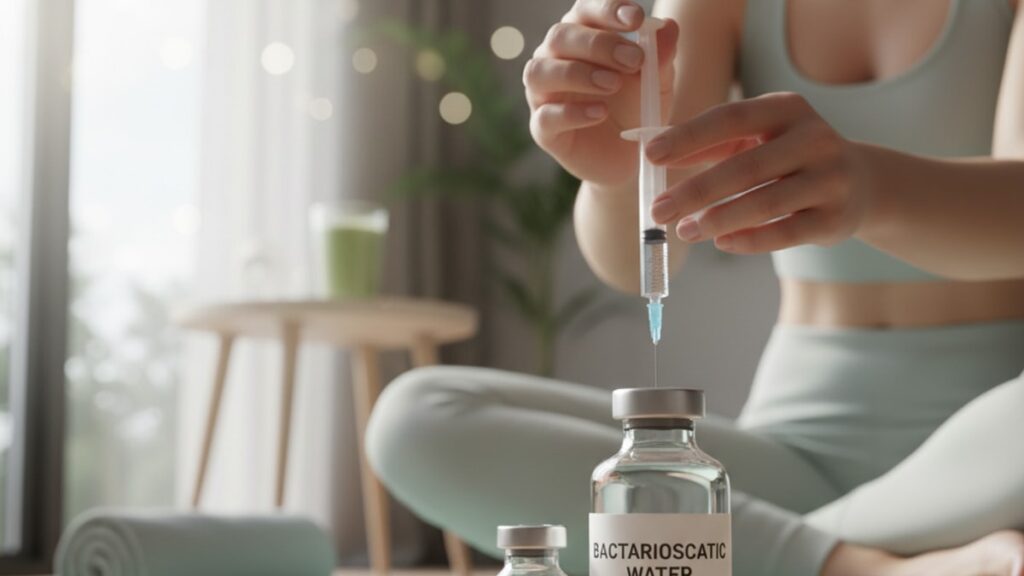
In the world of advanced biological research, precision isn't just a goal; it's the entire foundation. Every variable matters. Every measurement must be impeccable. When you're working with potent, research-grade peptides like retatrutide, the initial step of reconstitution—transforming that stable, lyophilized powder into a usable liquid solution—is arguably one of the most critical moments in your entire experimental workflow. Get it wrong, and the consequences can cascade, jeopardizing hours of work, valuable materials, and the integrity of your data. It's a scenario our team has seen far too often.
So, let’s talk about one of the most common questions we get from labs across the country: how much bac water for 12 mg retatrutide? It’s not a trivial question. The answer dictates the final concentration of your solution, which in turn dictates the accuracy of your dosing for every single subsequent experiment. This isn’t a place for guesswork. It demands a clear understanding of the math and the process. We’re here to walk you through it, step by step, to ensure your research starts on solid, reliable ground.
First Things First: Understanding Your Materials
Before we even touch a syringe, it's crucial to understand what we're working with. You have two primary components: the lyophilized retatrutide and the bacteriostatic water. They might seem simple, but their properties are what make this process so specific.
Retatrutide, like many advanced peptides, is synthesized and then lyophilized (or freeze-dried) for a very important reason: stability. In its powdered form, it’s incredibly stable and can be stored for long periods without degradation. The moment you introduce a liquid, you start the clock on its viability. This is why it's shipped as a powder. You, the researcher, are in control of when it becomes active. And at Real Peptides, we ensure that the 12 mg in that vial is exactly 12 mg, thanks to our rigorous small-batch synthesis process. That initial accuracy is the bedrock of everything that follows.
Then there's the diluent: Bacteriostatic Water, or "bac water." Why this specific liquid? Bac water is sterile water that contains 0.9% benzyl alcohol. That tiny addition makes a world of difference. The benzyl alcohol acts as a preservative, inhibiting bacterial growth within the vial after you’ve reconstituted it. This is a non-negotiable element for multi-use vials because every time you puncture the rubber stopper, you introduce a minuscule risk of contamination. Using simple sterile water doesn't offer that protection, dramatically shortening the usable life of your peptide and introducing a formidable risk to your research. We can't stress this enough—using the correct diluent is paramount.
The Math: It's Simpler Than You Think
Now for the core of the question. Calculating the amount of bac water you need is all about deciding on your desired final concentration. There isn't a single "correct" amount of water; it all depends on how concentrated you want your final solution to be. A more diluted solution might be easier for measuring very small doses, while a more concentrated one can be useful for other protocols. It's your choice, driven by your experimental needs.
Here’s the simple formula that governs it all:
Total Volume of Bac Water (in mL) = Total Amount of Peptide (in mg) / Desired Concentration (in mg/mL)
Let’s make this real with your 12 mg vial of retatrutide.
Scenario 1: Creating a 2 mg/mL Concentration
This is a common concentration that many labs find convenient. It's potent but still easy to measure for various applications.
- Your Total Peptide = 12 mg
- Your Desired Concentration = 2 mg/mL
Plugging it into the formula:
Volume of Bac Water = 12 mg / 2 mg/mL = 6 mL
So, to get a solution where every milliliter (mL) contains 2 milligrams (mg) of retatrutide, you would need to add 6 mL of bacteriostatic water to your 12 mg vial. Simple, right?
Scenario 2: Creating a 1 mg/mL Concentration
What if you need a more diluted solution for finer dose control? Let's aim for 1 mg of retatrutide per milliliter of solution. This can be incredibly helpful when your protocol demands high levels of granularity.
- Your Total Peptide = 12 mg
- Your Desired Concentration = 1 mg/mL
Let's do the math again:
Volume of Bac Water = 12 mg / 1 mg/mL = 12 mL
In this case, you would need to add 12 mL of bac water. Every 1 mL you draw from this vial will now contain exactly 1 mg of the peptide.
Scenario 3: A Higher Concentration—4 mg/mL
Perhaps your research calls for a more concentrated stock. Let’s calculate for a 4 mg/mL solution.
- Your Total Peptide = 12 mg
- Your Desired Concentration = 4 mg/mL
Volume of Bac Water = 12 mg / 4 mg/mL = 3 mL
To achieve this higher concentration, you’d add just 3 mL of bac water. The resulting solution is more potent per unit of volume.
Our team has found that thinking about your end-use first is the best way to decide. Ask yourself: What dose will I be using most often? How can I make the measurement of that dose as simple and repeatable as possible? Answering that question will point you directly to your ideal concentration. Honestly, though, planning this step saves so much headache later.
Visualizing Dosage: The Syringe Factor
Understanding the concentration is one thing, but translating that to a dose in a syringe is where it becomes practical. Most research applications use a U-100 insulin syringe, which has 100 individual tick marks (units) that add up to 1 mL.
Let’s go back to our 2 mg/mL solution (created with 6 mL of bac water).
- Total Volume = 6 mL = 600 units on multiple syringes
- Total Peptide = 12 mg
To find out how much peptide is in each unit on the syringe, you divide the total peptide by the total units:
12 mg / 600 units = 0.02 mg per unit.
That means for every single tick mark on the syringe, you are measuring 0.02 mg (or 20 micrograms, mcg) of retatrutide. If your protocol called for a 0.5 mg dose, you would draw up 25 units (0.5 mg / 0.02 mg/unit). This clear, direct relationship between units and dosage is why getting the initial reconstitution right is so critical.
Why Retatrutide is The Most Effective FAT LOSS Peptide
This video provides valuable insights into how much bac water for 12 mg retatrutide, covering key concepts and practical tips that complement the information in this guide. The visual demonstration helps clarify complex topics and gives you a real-world perspective on implementation.
Reconstitution Concentrations: A Comparison
To make this even clearer, our team put together a quick-reference table. This shows how different volumes of bac water affect the final concentration and the dose per unit on a standard U-100 syringe when starting with a 12 mg vial.
| Bac Water Added | Final Concentration | Volume per 1mg Dose | Dose per Syringe Unit (mcg) |
|---|---|---|---|
| 2 mL | 6 mg/mL | 0.167 mL (16.7 units) | 60 mcg |
| 3 mL | 4 mg/mL | 0.25 mL (25 units) | 40 mcg |
| 4 mL | 3 mg/mL | 0.33 mL (33.3 units) | 30 mcg |
| 6 mL | 2 mg/mL | 0.5 mL (50 units) | 20 mcg |
| 12 mL | 1 mg/mL | 1.0 mL (100 units) | 10 mcg |
This table (which we recommend lab teams print out) is a powerful tool for planning. It visually demonstrates the trade-offs. Adding less water gives you a more concentrated solution where small volumes pack a bigger punch, but it can make measuring tiny doses trickier. Adding more water dilutes it, making it easier to measure small doses with precision but requiring larger injection volumes.
The Reconstitution Process Itself: Technique Matters
Knowing the numbers is only half the battle. The physical act of reconstitution requires a delicate touch. Peptides are complex, fragile molecules. Mishandling them can physically break them apart (a process called denaturation), rendering them completely useless for your research.
Here's the process our own biochemists follow:
-
Preparation is Key: Gather your materials: the vial of 12 mg retatrutide, your vial of bacteriostatic water, a fresh alcohol swab, and the correct size syringe for measuring the bac water (a 3mL or 5mL syringe often works well for these volumes).
-
Sanitize: Wipe the rubber stoppers of both vials with an alcohol swab. Let them air dry. Don't blow on them. We're maintaining a sterile environment.
-
Draw the Diluent: Pull back the plunger on your syringe to the volume of bac water you calculated (e.g., 6 mL for a 2 mg/mL solution). Insert the needle into the bac water vial and inject the air. This equalizes the pressure and makes it much easier to draw the liquid out. Then, draw your calculated volume of bac water.
-
The Gentle Introduction: Now for the most critical step. Insert the needle into the retatrutide vial. Angle it so the stream of bac water runs down the inside glass wall of the vial. Do not—we repeat, do not—squirt the water directly onto the lyophilized powder. This forceful stream can damage the peptide structure. The goal is a gentle introduction.
-
Swirl, Don't Shake: Once all the bac water is in the vial, remove the syringe. Now, gently swirl the vial in a circular motion. You can also roll it between your palms. It might take a few minutes for the powder to dissolve completely. Be patient. Shaking the vial is one of the most common and catastrophic mistakes we see. It creates foam and the shearing force can destroy the delicate peptide chains. You want a clear solution with no visible powder particulates.
That's it. You've successfully reconstituted your peptide. Now, it's ready for use in your research, and you can be confident in its concentration and viability.
Common Pitfalls and How to Sidestep Them
Over the years, our team has helped countless researchers troubleshoot their experiments. And—let's be honest—many issues trace back to this initial reconstitution step. Here are the most frequent missteps we've encountered:
- The Wrong Diluent: Using sterile water instead of bac water for a multi-use vial. This is a huge risk for contamination after the first use. Or, even worse, using tap water or other non-sterile liquids. This will invalidate any research results instantly.
- The "Eyeball" Method: Simply guessing the amount of water to add. This is a recipe for disaster. Your final concentration will be a mystery, making any data you collect unreliable and unrepeatable—the two cardinal sins of scientific research.
- Aggressive Handling: Shaking the vial vigorously. As we mentioned, this is a peptide killer. These are not robust chemicals; they are intricate biological molecules that demand careful handling.
- Calculation Errors: A simple misplaced decimal can throw off your concentration by a factor of ten. Always double-check your math. Or better yet, have a colleague check it for you. It takes five seconds and can save you weeks of failed experiments.
- Improper Storage: Once reconstituted, peptides need to be stored correctly. For retatrutide, this means refrigeration. Leaving it at room temperature for extended periods will cause it to degrade rapidly.
Avoiding these pitfalls isn't complicated. It just requires diligence and a respect for the materials you're working with. It's about building good lab habits that become second nature.
The Foundation of Great Research
Ultimately, the quest for accurate reconstitution isn't just about a single vial of retatrutide. It's about the integrity of your entire research endeavor. You can have the most brilliant experimental design and the most advanced analytical equipment, but if the compound you're studying is at an unknown concentration or has been damaged during preparation, your results are built on sand.
This is why we're so relentless about quality at Real Peptides. We know that the work you do depends on the purity, stability, and accurate quantification of our products. When you start with a vial containing precisely 12 mg of pure, correctly sequenced retatrutide, you've eliminated a massive variable from your work. You can proceed with confidence, knowing that your starting material is a known, reliable constant.
Your precision in the lab deserves a foundation of equal precision from your supplier. That's the partnership we strive for. When you're ready to ensure your research is built on the highest quality peptides available, we're here. Get Started Today.
And we don't just stop at providing the materials. We believe in empowering the research community. That's why we create resources like this guide and post visual walkthroughs of key lab techniques on our YouTube channel. For more insights and updates from the front lines of peptide research, be sure to connect with us on our Facebook page. We're constantly sharing information to help labs like yours achieve breakthrough results.
Frequently Asked Questions
Can I use sterile water instead of bacteriostatic water for retatrutide?
▼
You can, but only if you plan to use the entire vial in a single session. Bacteriostatic water contains a preservative to inhibit bacterial growth for multi-use, which sterile water lacks. We strongly recommend bac water for any vial you’ll access more than once.
What happens if I accidentally shake the retatrutide vial after adding water?
▼
Shaking can denature the peptide, meaning the complex protein structure can be damaged or destroyed. This can render the peptide inactive and useless for research. Always gently swirl or roll the vial to mix.
How should I store retatrutide after it’s been reconstituted?
▼
Once reconstituted, the vial must be stored in a refrigerator, typically between 2°C and 8°C (36°F and 46°F). This slows degradation and maintains its potency for the recommended period.
How long is reconstituted retatrutide viable?
▼
When reconstituted with bacteriostatic water and stored properly in a refrigerator, retatrutide is typically stable for up to 4 weeks. Always check the specific guidelines for the peptide you are using.
Does the temperature of the bac water matter during reconstitution?
▼
Room temperature bacteriostatic water is perfectly fine for reconstitution. Using extremely hot or cold water is not recommended as temperature shocks could potentially affect the peptide’s delicate structure.
Why can’t I just add 1 mL of bac water to every vial?
▼
You could, but that would give you a very specific, high concentration (12 mg/mL in this case). The amount of bac water you add is what determines the final concentration, which should be chosen based on your specific research protocol and dosing needs.
What size syringe is best for reconstituting a 12 mg vial?
▼
For drawing the bacteriostatic water, a 3 mL, 5 mL, or even a 10 mL syringe is ideal, depending on your target volume. For administering doses from the reconstituted vial, a U-100 insulin syringe is standard for precise measurements.
My reconstituted solution looks cloudy. Is it safe to use?
▼
No. A properly reconstituted peptide solution should be perfectly clear. Cloudiness can indicate that the peptide has not fully dissolved, has been damaged (denatured), or is contaminated. We advise against using any solution that is not clear.
Is it possible to add too much bac water?
▼
While you can’t chemically damage the peptide by adding too much water, you will create a very diluted solution. This could make it difficult to administer an effective dose without using an impractically large volume of liquid.
Can I pre-fill syringes with doses for the week?
▼
Our team generally advises against this. The stability of peptides is best maintained in the sterile glass vial. Pre-filling syringes can increase the risk of contamination and potential interaction with the plastic over time.
How do I know the 12 mg listed on the vial is accurate?
▼
This comes down to supplier quality. At Real Peptides, we utilize small-batch synthesis and rigorous quality control, including HPLC and Mass Spec analysis, to guarantee that the amount listed on the vial is precisely what it contains.











