





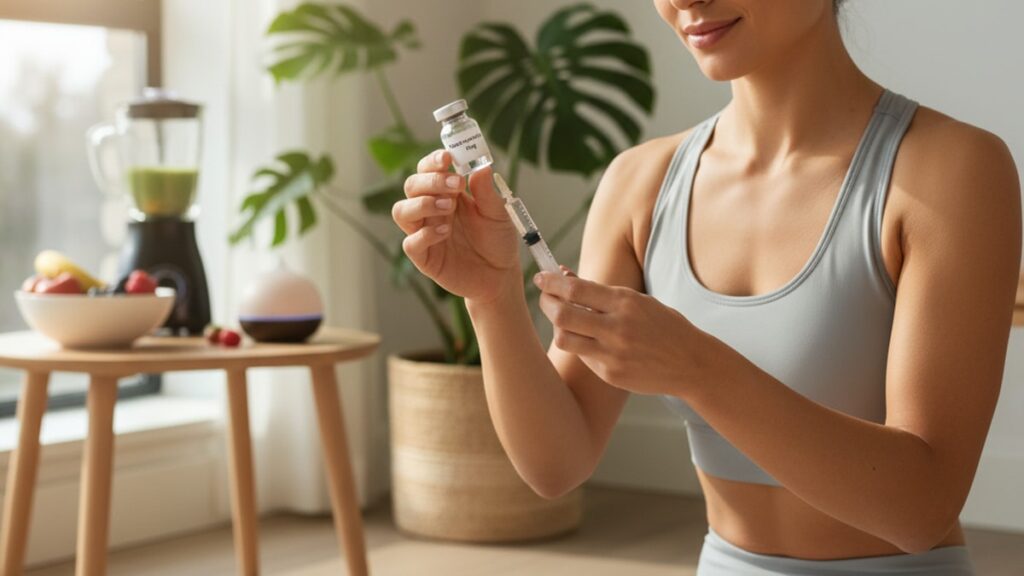
One of the most frequent questions our team gets from researchers, both seasoned and new, revolves around a seemingly simple—yet absolutely critical—step in their lab work: reconstitution. Specifically, we hear this one a lot: how much bac water for 5mg retatrutide? It's a foundational question, and getting it right is the difference between valid, reproducible data and a wasted batch of high-purity peptide. It’s the kind of detail that can make or break a study.
Let’s be honest—when you've invested in a premium, research-grade peptide like retatrutide, the last thing you want is to compromise its integrity with a calculation error. We get it. Here at Real Peptides, our entire operation is built on an obsession with precision, from our small-batch synthesis process right down to the final lyophilized product. That precision doesn't stop when the vial leaves our facility; it extends to your lab bench. So, we're going to walk you through not just the 'how,' but the 'why,' ensuring you have the confidence to handle this crucial step flawlessly every single time.
First Things First: Why Precision is Non-Negotiable
Before we even touch a syringe, it's vital to understand what you're working with. Lyophilized peptides, like the retatrutide in that small glass vial, are in a freeze-dried powder form. This state is fantastic for stability and long-term storage. It’s robust. But for use in any research application, it needs to be brought back into a liquid solution. This process is called reconstitution, and it is a moment of profound vulnerability for the peptide's complex molecular structure.
This isn't like mixing a simple saline solution. You're dealing with delicate chains of amino acids. An incorrect dilution volume, the wrong type of liquid, or even an aggressive mixing technique can shear these chains apart, rendering the peptide completely inert. All your careful planning, your entire experimental setup, could be invalidated right at this initial stage. We can't stress this enough—this step demands an almost surgical level of precision. Every variable matters, from the purity of the peptide itself (which is our promise to you) to the accuracy of your measurements.
Our experience shows that labs achieving the most consistent results are the ones that treat reconstitution with the same reverence as data analysis. It’s not a preliminary chore; it’s the bedrock of the entire experiment. Getting the concentration right ensures that the dosage you administer in your protocol is exactly what you intend it to be. A 10% error in dilution can lead to a 10% error in your results, and in the world of high-stakes research, that’s an unacceptable margin.
Understanding the Core Components: Retatrutide and BAC Water
To master the process, you have to know your tools. It’s simple, really. You have two primary components: the peptide and the diluent.
Retatrutide (5mg Vial): This is your active compound. In its lyophilized state, it's a small, often unassuming disc or powder at the bottom of the vial. The '5mg' on the label represents the total mass of the active peptide inside. When you buy from a reputable source like Real Peptides, you can trust that this number is accurate, a result of meticulous synthesis and quality control. This accuracy is the starting point for all your calculations. If your starting mass is a mystery number, your final concentration will be, too.
Bacteriostatic Water (BAC Water): This is not just any water. It's sterile water that contains a secret ingredient: 0.9% benzyl alcohol. This small addition makes a world of difference. The benzyl alcohol acts as a preservative, a bacteriostatic agent that inhibits the growth of contaminants that might be introduced into the vial during repeated use. This is absolutely critical for multi-use vials. Using simple sterile water would mean the solution is only safe for a single draw before the risk of bacterial contamination skyrockets. BAC water extends the life and safety of your reconstituted peptide solution significantly—usually up to 28 days when stored correctly.
Think of it this way: the retatrutide is the high-performance engine, and the BAC water is the specialized fuel and coolant that keeps it running safely and effectively over time.
The Math Behind the Mix: How to Calculate Your Dilution
Alright, let's get down to the numbers. The core principle here is creating a solution with a known concentration, typically expressed in milligrams per milliliter (mg/mL) or micrograms per milliliter (mcg/mL). The formula is beautifully simple:
Total Amount of Peptide (mg) / Total Volume of BAC Water (mL) = Concentration (mg/mL)
With a 5mg vial of retatrutide, you control the final concentration by choosing how much BAC water to add. There isn't one 'correct' amount of water; the right amount is dictated entirely by your research protocol and the desired concentration you need for accurate dosing.
Let’s run through a few common scenarios:
-
Scenario 1: Adding 1 mL of BAC Water
- Calculation: 5mg retatrutide / 1 mL BAC water
- Resulting Concentration: 5 mg/mL
- This is a highly concentrated solution. It's useful if your protocol requires very small, potent doses. Since 1mg = 1000mcg, this solution also contains 5000 mcg/mL.
-
Scenario 2: Adding 2 mL of BAC Water
- Calculation: 5mg retatrutide / 2 mL BAC water
- Resulting Concentration: 2.5 mg/mL
- This is a very common dilution. It's less concentrated, which makes it easier to measure out slightly larger, more manageable volumes for dosing. This solution contains 2500 mcg/mL.
-
Scenario 3: Adding 2.5 mL of BAC Water
- Calculation: 5mg retatrutide / 2.5 mL BAC water
- Resulting Concentration: 2 mg/mL
- Another excellent option that simplifies the math for certain dosing schedules. This solution contains 2000 mcg/mL.
Here’s a quick-reference table our team put together to visualize these options.
| Volume of BAC Water Added | Total Peptide in Vial | Resulting Concentration (mg/mL) | Resulting Concentration (mcg/mL) | Notes |
|---|---|---|---|---|
| 1.0 mL | 5 mg | 5.0 mg/mL | 5000 mcg/mL | High concentration, good for small doses. |
| 1.5 mL | 5 mg | 3.33 mg/mL | 3330 mcg/mL | A less common but viable intermediate concentration. |
| 2.0 mL | 5 mg | 2.5 mg/mL | 2500 mcg/mL | Very common, balances concentration and measurability. |
| 2.5 mL | 5 mg | 2.0 mg/mL | 2000 mcg/mL | Easy-to-calculate concentration for dosing. |
| 5.0 mL | 5 mg | 1.0 mg/mL | 1000 mcg/mL | Lower concentration, requires larger draw volumes. |
Choosing the right dilution is a strategic decision. A more concentrated solution (like 5mg/mL) means you'll draw a smaller volume for a given dose, but any tiny error in your measurement will be magnified. A more dilute solution (like 1mg/mL) is more forgiving on measurement accuracy but requires drawing a larger volume, which might not be practical for your research model. Our team generally recommends the 2mL or 2.5mL dilution for most standard applications as it strikes a perfect balance.
Why Retatrutide is The Most Effective FAT LOSS Peptide
This video provides valuable insights into how much bac water for 5mg retatrutide, covering key concepts and practical tips that complement the information in this guide. The visual demonstration helps clarify complex topics and gives you a real-world perspective on implementation.
A Step-by-Step Guide to Reconstitution
Knowing the math is one thing; executing it flawlessly is another. Here is the exact, step-by-step process our lab technicians follow. We recommend you adopt it as your standard operating procedure.
-
Preparation is Everything: Gather your supplies. You'll need your vial of 5mg retatrutide, a vial of bacteriostatic water, several alcohol prep pads, and a sterile syringe (typically a 3mL syringe for drawing the water and an insulin syringe for later dosing). Ensure you're working on a clean, disinfected surface.
-
Sanitize the Vials: Pop the protective plastic caps off both the retatrutide vial and the BAC water vial. Vigorously wipe the rubber stoppers on top of both with an alcohol pad and allow them to air dry for a few seconds. Do not skip this. Ever.
-
Draw the BAC Water: Take your 3mL syringe and draw air into it equal to the volume of BAC water you plan to inject (e.g., pull the plunger to the 2mL mark). Insert the needle through the rubber stopper of the BAC water vial and inject the air. This pressurizes the vial and makes it much easier to draw the liquid out smoothly. Now, invert the vial and draw your calculated volume of BAC water.
-
The Slow Injection: This is the most delicate part of the entire process. Insert the needle of the BAC water-filled syringe into the vial of lyophilized retatrutide. Here’s the key—do not inject the water directly onto the peptide powder. This can damage the molecule. Instead, angle the needle so the stream of water runs down the inside wall of the glass vial. Depress the plunger slowly and gently. Let the water trickle down and pool with the powder.
-
The Gentle Swirl: Once all the BAC water is in the vial, remove the syringe. Now, gently swirl the vial between your fingers or roll it between your palms. NEVER, EVER SHAKE THE VIAL. We will repeat this. Do not shake it. Shaking creates froth and, more importantly, the mechanical force can shear the peptide bonds. The powder should dissolve completely within a minute or two of gentle swirling.
-
Final Inspection: Hold the vial up to a light source. The final solution should be perfectly clear, with no floating particles or cloudiness. If it's cloudy or has floaters, the peptide may be degraded, and you should not use it. This is exceedingly rare with high-purity products like ours but is a critical final check.
Common Pitfalls and How Our Team Avoids Them
We've consulted with enough labs over the years to see where things can go wrong. Honestly, it's almost always one of these few simple, avoidable mistakes.
The Catastrophic Shake: We mentioned it above, but it bears repeating. We've seen researchers, often in a hurry, give the vial a vigorous shake like they're mixing a protein drink. This is the fastest way to destroy your peptide. The molecular structure is fragile. The gentle swirl is non-negotiable.
Using the Wrong Water: Someone in the lab grabs sterile water instead of BAC water. While the peptide will dissolve, the solution is now a ticking clock for bacterial growth. If it's a multi-use vial, it's compromised after the first puncture. Our team labels everything meticulously to prevent these mix-ups.
Measurement Mayhem: Using the wrong tool for the job. Trying to measure 0.1mL in a 5mL syringe is a recipe for inaccuracy. Use an appropriately sized syringe for the volume you are handling. For drawing reconstitution water, a 3mL syringe is fine. For dosing, a U-100 insulin syringe marked in units (where 10 units = 0.1mL) is the gold standard for precision. We've found that this simple tool change dramatically improves dose-to-dose consistency.
Ignoring Storage Protocols: Reconstituting the peptide perfectly and then leaving it on the lab bench at room temperature is like building a race car and filling it with sugar. It completely undermines all the careful work you just did. Which brings us to our next point.
Proper Storage: Protecting Your Reconstituted Peptide
Once reconstituted, your retatrutide solution is no longer shelf-stable at room temperature. Its new home is the refrigerator.
- Temperature: The vial must be stored at refrigerated temperatures, typically between 2°C and 8°C (36°F and 46°F). The door of the fridge is often the worst place due to temperature fluctuations; the main body of the fridge is best.
- Light Protection: Peptides can be sensitive to light. Keeping the vial in its original box or a small, dark container within the fridge provides an extra layer of protection against degradation.
- Duration: Thanks to the bacteriostatic agent in the BAC water, the reconstituted solution is generally viable for up to 28 days. It's crucial to label your vial with the date of reconstitution so you can track its age. Our team's policy is simple: when in doubt, start fresh.
- Freezing: We generally advise against freezing reconstituted peptides unless you are following a very specific, validated protocol for single-use aliquots. The freeze-thaw cycle can be very damaging to the peptide structure, and for a multi-use vial, it’s simply not a viable option.
The Real Peptides Commitment: Purity from Start to Finish
All of this discussion about meticulous reconstitution technique hinges on one foundational assumption: that the 5mg of lyophilized powder in your vial is, in fact, 5mg of pure, active retatrutide. This is where the source of your peptides becomes the most important variable in your entire research project.
At Real Peptides, we're not just distributors; we are deeply involved in the science. Our commitment to small-batch synthesis and rigorous third-party testing ensures that what's on the label is what's in the vial. There are no fillers, no degraded byproducts, just the pure, unadulterated peptide you need for your work. This means your calculations for how much bac water for 5mg retatrutide will be accurate because the starting number—5mg—is a figure you can trust implicitly. You can explore our full range of high-purity research compounds on our website. We believe that reliable research starts with reliable materials. It’s that simple.
Mastering the art of reconstitution is a fundamental lab skill. It's about more than just adding water to a powder; it's about respecting the science, ensuring precision, and laying the groundwork for data that you can stand behind. It’s the first step in a long process, and getting it right sets the tone for everything that follows.
For more visual guides on lab techniques and peptide science, we highly recommend checking out channels like MorelliFit on YouTube, which often provides great practical demonstrations. And, of course, for the latest product information and research insights from our team, be sure to connect with us on Facebook. We're always sharing what we've learned. If you're ready to build your next study on a foundation of unmatched purity and precision, we invite you to explore our offerings and Get Started Today.
Frequently Asked Questions
Can I use sterile water instead of BAC water for retatrutide?
▼
While sterile water will dissolve the peptide, it lacks the preservative (benzyl alcohol) found in BAC water. This means your solution is only suitable for a single use, as the risk of bacterial contamination increases dramatically after the first puncture of the vial stopper.
What happens if I accidentally shake the retatrutide vial?
▼
Shaking the vial can cause mechanical stress that damages the delicate peptide chains, a process known as shearing. This can render the retatrutide inactive and compromise your research results. Always gently swirl or roll the vial to dissolve the powder.
How long does reconstituted retatrutide last in the fridge?
▼
When reconstituted with bacteriostatic water and stored properly in a refrigerator (2°C to 8°C), the solution is typically stable and safe to use for up to 28 days. We recommend labeling the vial with the reconstitution date.
My reconstituted retatrutide solution looks cloudy. Is it safe to use?
▼
No, you should not use it. A properly reconstituted solution should be perfectly clear. Cloudiness or visible particles can indicate that the peptide has degraded, become contaminated, or did not dissolve properly. It’s best to discard the vial.
What is the best concentration to mix my 5mg retatrutide to?
▼
There is no single ‘best’ concentration; it depends on your specific research protocol. However, a common and practical choice is to add 2mL of BAC water to create a 2.5 mg/mL solution, as it balances potency with ease of measurement.
Why do I need to inject the BAC water down the side of the vial?
▼
Injecting the water slowly down the interior side of the glass vial prevents the force of the stream from directly hitting and potentially damaging the lyophilized peptide powder. It’s a gentle technique to ensure the peptide’s structural integrity is maintained during reconstitution.
Can I pre-load syringes with reconstituted retatrutide for later use?
▼
Our team generally advises against this practice. Storing peptides in plastic syringes for extended periods can lead to adsorption of the peptide to the plastic, reducing the effective dose. It’s always best to draw each dose from the glass vial immediately before use.
What kind of syringe should I use for reconstitution and dosing?
▼
For reconstitution, a 3mL or 5mL syringe is suitable for accurately measuring the BAC water. For dosing, we strongly recommend using a U-100 insulin syringe, as its fine gradations allow for highly precise measurement of small volumes.
Does it matter if I use a 1mL or 2mL dilution if my final dose is the same?
▼
Yes, it can. A more concentrated solution (e.g., from a 1mL dilution) requires drawing a very small volume, where tiny measurement errors are magnified. A more dilute solution (from 2mL) allows for a larger, more manageable draw volume, which can increase accuracy.
Should I store my reconstituted peptide in the freezer?
▼
We generally do not recommend freezing a multi-use vial of reconstituted peptide. The freeze-thaw process can degrade the peptide structure. Refrigeration at 2°C to 8°C is the standard, recommended storage method.
How do I know if the peptide powder has gone bad before reconstitution?
▼
High-quality lyophilized peptide should appear as a solid, white, caked powder or disc. If it looks gummy, discolored, or has a melted appearance, it may have been exposed to heat or moisture and should not be used.











