





In the world of peptide research, precision isn't just a goal; it's the entire foundation. Every variable, from temperature to timing, can influence your outcomes. And when you're working with a sophisticated compound like cagrilintide, that demand for precision gets amplified tenfold. We've seen brilliant research derailed by one seemingly minor misstep during the reconstitution phase. It's a frustrating, expensive, and entirely avoidable problem.
That’s why our team at Real Peptides put this protocol together. We don't just supply high-purity, research-grade peptides synthesized right here in the United States; we feel a professional responsibility to ensure our clients have the procedural knowledge to match the quality of the compounds they're using. Getting the mix right is the critical bridge between a pure, lyophilized peptide and valid, reproducible data. Let’s walk through exactly how to do it correctly.
Understanding Cagrilintide: Why Precision Matters
Before we even touch a vial, it’s crucial to understand what we're working with. Cagrilintide isn't just another peptide. It's a long-acting amylin analogue, a sophisticated molecule designed to mimic the effects of the natural hormone amylin. Its primary area of research revolves around metabolic health, specifically its potential role in glucose control and weight management. It's a formidable tool in the lab, but its complex structure—a delicate chain of amino acids—is also its vulnerability.
This isn't a compound you can treat casually. The lyophilized (freeze-dried) powder you receive is stable, but the moment you introduce a liquid, you initiate a chemical transformation that requires unflinching attention to detail. Aggressive handling, the wrong diluent, or improper temperatures can fracture or denature these delicate peptide bonds. When that happens, the compound is no longer cagrilintide. It’s a vial of compromised, ineffective, and scientifically useless material. All the effort that went into its synthesis and purification is lost in an instant.
Our experience shows that the most common point of failure in peptide research isn't the quality of the peptide itself (assuming you're sourcing from a reputable lab like ours) but in the reconstitution. It's a catastrophic error. You're not just wasting the product; you're invalidating every single data point generated from that vial. This is why learning how to mix cagrilintide isn't a suggestion—it's a non-negotiable requirement for serious research.
Assembling Your Reconstitution Toolkit
You wouldn't build a high-performance engine with a rusty wrench, and you shouldn't prepare a high-purity peptide with subpar equipment. Setting up a clean, organized workspace with the right tools is the first step toward a successful mix. It's simple, but it's foundational.
Here's what our lab team recommends having on hand before you begin:
- Your Vial of Lyophilized Cagrilintide: This is the star of the show. We recommend letting it come to room temperature for about 15-20 minutes before you start. This simple step helps prevent condensation from forming inside the vial when you introduce the room-temperature diluent.
- Bacteriostatic Water: This is the industry standard for reconstituting most peptides for research, including cagrilintide. It's sterile water that contains 0.9% benzyl alcohol, which acts as a preservative. This is critical—it inhibits bacterial growth, allowing you to store the reconstituted peptide and draw multiple doses over time without contamination. Don't substitute this.
- Sterile Syringes (Two Types): You'll need at least two. One larger syringe (typically 3ml or 5ml) is for accurately measuring and transferring the bacteriostatic water into the peptide vial. A second, smaller syringe (like a U-100 insulin syringe) is for drawing precise doses of the final solution for your research application. Always use a new, sterile syringe for every single transfer and every single dose.
- Alcohol Prep Pads: Sterility is paramount. You'll need these to sanitize the rubber stoppers on both your peptide vial and your bacteriostatic water vial. This isn't optional. It's a critical, non-negotiable element of aseptic technique.
A clean, dedicated workspace is implied here. Don't do this on your cluttered desk. Wipe down your surface, wash your hands, and approach the process with the focus it deserves.
The Step-by-Step Protocol: How to Mix Cagrilintide
Alright, your station is prepped, and your tools are ready. Now we get to the core procedure. Follow these steps meticulously. We've refined this process over years of lab work, and it's designed to protect the integrity of the peptide at every stage.
Step 1: Preparation and Sanitization
First things first. Pop the plastic protective caps off both the cagrilintide vial and the bacteriostatic water vial. You'll see a rubber stopper underneath. Take a fresh alcohol prep pad and vigorously wipe the surface of each stopper. Let them air dry for a few seconds. This simple action removes any surface contaminants and is your first line of defense against bacterial contamination.
Step 2: Calculating Your Diluent Volume
This is where a little bit of math comes in, but don't worry, it's straightforward. You need to decide on your final concentration. A common and easy-to-manage concentration for research is 1mg per 1mL.
Let’s use a common example: a 5mg vial of cagrilintide.
- Goal: Create a solution where every 1mL of liquid contains 1mg of cagrilintide.
- Calculation: If you have 5mg of powder, you'll need 5mL of bacteriostatic water to achieve that 1mg/mL concentration.
If you wanted a higher concentration, say 2mg/mL, you would use half the amount of water (2.5mL for a 5mg vial). For most research applications, our team finds that 1mg/mL provides a great balance of potency and dosing accuracy. It makes the math for drawing individual doses much, much easier later on.
Step 3: Introducing the Bacteriostatic Water
This is the most delicate part of the process. We can't stress this enough—how you add the water matters immensely.
- Take your larger mixing syringe and draw up the calculated amount of bacteriostatic water (in our example, 5mL). Be precise. Expel any air bubbles by flicking the syringe and gently pushing the plunger until a tiny bead of liquid appears at the needle tip.
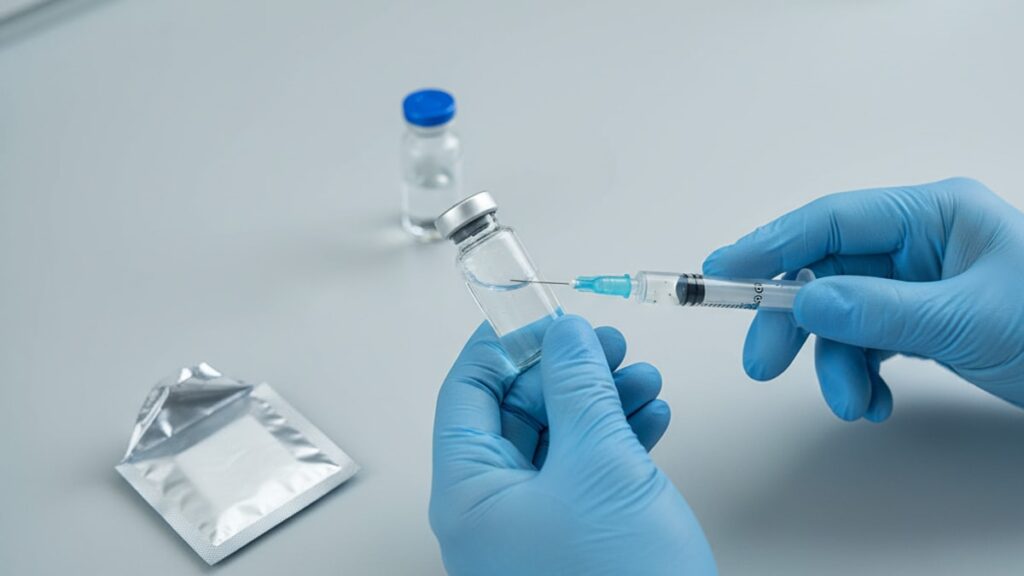
- Now, take your vial of cagrilintide. Insert the needle of the syringe through the center of the rubber stopper. Here's the key technique: Angle the needle so that it's touching the inside wall of the glass vial.
- Slowly—and we mean slowly—depress the plunger. Allow the water to run down the side of the glass. Do NOT spray the water directly onto the lyophilized powder cake. This forceful stream can damage the peptide molecules. You want the water to gently pool and dissolve the powder, not blast it apart.
The vial is pressurized, so you may need to let some air in or out to equalize it. Some researchers find it helpful to first inject the same volume of air into the bacteriostatic water vial before drawing the liquid, which makes it easier to pull the plunger back.
Step 4: The Gentle Mix
Once all the water has been added, remove the syringe. Now, you need to ensure the powder is fully dissolved. The temptation is to shake it. Do not shake the vial. Shaking creates shear stress and foaming, which is catastrophic for the peptide's structural integrity. It will denature the compound.
Instead, gently swirl the vial in a circular motion. You can also roll it between your palms. Be patient. It might take a few minutes for all the powder to dissolve completely. The goal is a gentle, persuasive action, not a violent one.
Step 5: Final Inspection
Once you believe it's fully mixed, hold the vial up to a light source. The final solution should be perfectly clear. Crystal clear. If you see any cloudiness, floating particles, or sediment, something has gone wrong. It could be a sign of contamination or that the peptide has not dissolved properly. An improperly mixed or compromised solution should never be used for research. It's better to discard it and start over than to proceed with questionable material. When you source from a quality supplier like Real Peptides, you can be confident that any cloudiness is a result of the reconstitution process, not the product itself.
I Stacked Retatrutide and MOTS-c for 60 Days and THIS Happened!
This video provides valuable insights into how to mix cagrilintide, covering key concepts and practical tips that complement the information in this guide. The visual demonstration helps clarify complex topics and gives you a real-world perspective on implementation.
Dosing and Administration: From Vial to Syringe
Now that you have a perfectly reconstituted vial of cagrilintide, the next step is drawing an accurate dose for your research protocol. This also requires a careful hand.
Let's continue with our example of a 1mg/mL solution. If your research protocol calls for a 250mcg (or 0.25mg) dose, you would need to draw 0.25mL of the solution.
Here's how we recommend doing it:
- Take a new, sterile insulin syringe. These are marked in units or mL, making precise measurements easier. A U-100 syringe has 100 markings per mL, so 0.25mL would be 25 units on the syringe.
- Wipe the vial's rubber stopper again with a fresh alcohol pad.
- Pull back the syringe plunger to the mark for your desired dose (e.g., 25 units). This draws air into the syringe.
- Invert the vial and insert the needle. Inject the air from the syringe into the vial. This equalizes the pressure and makes it much easier to draw the liquid out without a struggle.
- Slowly pull back the plunger, drawing slightly more than your target dose into the syringe.
- Keeping the needle in the vial, tap the syringe to get any air bubbles to rise to the top. Then, slowly depress the plunger to push the air and the excess liquid back into the vial until the top of the plunger perfectly aligns with your target dose mark.
This method ensures an accurate, air-free dose every time. The most common administration route for research is subcutaneous injection, which allows for steady absorption. And—this is critical—always use a fresh syringe for every single administration. Reusing needles is a direct path to contamination and infection.
Storage Protocols: Protecting Your Investment
Your job isn't done once the peptide is mixed. Proper storage is just as important for maintaining its potency and stability over time.
- Before Reconstitution: The lyophilized powder is relatively stable. It should be stored in a cool, dark place. A refrigerator is ideal, but a cool drawer away from light and heat is also acceptable for short periods. Avoid temperature extremes.
- After Reconstitution: This is where the rules become rigid. The reconstituted, liquid cagrilintide must be stored in the refrigerator at a temperature between 2°C and 8°C (36°F and 46°F). Do not freeze it. Freezing and thawing cycles can degrade the peptide structure.
Properly stored, a reconstituted vial of cagrilintide mixed with bacteriostatic water should remain stable and potent for several weeks (typically up to 4 weeks). Our team strongly recommends labeling the vial with the date of reconstitution and the final concentration (e.g., "Cagrilintide, 1mg/mL, Mixed on 10/26/23"). This removes all guesswork. It's a simple habit that prevents costly mistakes.
Common Pitfalls and How to Avoid Them
We've consulted with countless researchers, and we've seen a few common—and avoidable—mistakes pop up time and again. Let's be honest—knowing what not to do is just as important as knowing what to do.
- Using the Wrong Diluent: Never use tap water, distilled water, or sterile water (without the bacteriostatic agent) if you plan to use the vial for more than a single dose. These lack a preservative, and bacteria will begin to grow almost immediately. Stick to bacteriostatic water.
- Aggressive Shaking: We mentioned it before, but it bears repeating. Shaking will destroy your peptide. Gentle swirling is the only acceptable method.
- Inaccurate Measurements: Eyeballing the amount of water or the final dose is a recipe for disaster. Use properly calibrated syringes and double-check your math. Reproducible research demands reproducible measurements.
- Poor Sterile Technique: Forgetting to wipe the stoppers, reusing syringes, or touching the needle to a non-sterile surface can introduce bacteria that will not only contaminate your vial but could also pose a significant risk in your research model. Be meticulous.
- Improper Storage: Leaving the reconstituted vial out on the lab bench for hours or putting it in the freezer will drastically shorten its effective lifespan. Refrigerate it immediately after use.
Avoiding these simple traps is half the battle. It's the diligence and adherence to protocol that separate successful research from failed experiments. For those who are visual learners, our team often points to resources like the MorelliFit YouTube channel, which has excellent visual guides on general lab techniques that can be incredibly helpful in seeing these processes in action.
Comparison Table: Diluents for Peptide Reconstitution
To make it perfectly clear, here's a breakdown of the common diluents and why the choice matters so much.
| Diluent Type | Primary Use Case | Preservative | Post-Mix Shelf Life (Refrigerated) | Our Team's Recommendation |
|---|---|---|---|---|
| Bacteriostatic Water | Multi-use vials, standard research applications. | 0.9% Benzyl Alcohol | Several weeks (up to 4+) | The gold standard. Use this for cagrilintide and most peptides. |
| Sterile Water | Single-use applications only. | None | < 24 hours | Avoid unless you plan to use the entire vial immediately. |
| Acetic Acid Solution | For peptides that have solubility issues in water. | None (typically) | Varies, often short | Not necessary for cagrilintide. Only use if specified by manufacturer. |
Why Purity is the Foundation of Your Research
We could talk about mixing technique all day, but it all becomes a moot point if the peptide you start with is subpar. You can have the most impeccable lab technique in the world, but you can't reconstitute purity into a poorly synthesized product. The entire process—from mixing to data analysis—rests on the quality of the raw material.
This is why at Real Peptides, we're relentless about our process. We specialize in small-batch synthesis in our U.S.-based facilities. This allows for an incredible level of quality control, ensuring the amino-acid sequencing is exact and that purity levels are consistently high. You're not getting a mass-produced compound that's been sitting on a shelf for months; you're getting a research tool crafted for precision.
When you know your starting material is pure, you can have confidence that your reconstituted solution is, too. It removes a massive variable from your research, allowing you to trust your results. If you're ready to see the difference that quality makes, you can explore our offerings and Get Started Today.
Perfecting your mixing technique is a skill, and like any skill, it gets easier with practice. But it's a skill that pays enormous dividends in the form of reliable, consistent, and trustworthy research data. It honors the investment you've made in your work and in the high-quality compounds that drive it forward. Treat every vial with the respect it deserves, and your research will be better for it.
We're always sharing more insights and lab tips with the research community. Be sure to follow our work and connect with us on Facebook for the latest updates and discussions. We believe in empowering researchers not just with better peptides, but with better knowledge.
Frequently Asked Questions
Can I use sterile water instead of bacteriostatic water to mix cagrilintide?
▼
We strongly advise against it for multi-use vials. Sterile water has no preservative, so bacteria can grow quickly after the first puncture. Only use it if you intend to draw the entire contents of the vial for immediate, single-use application.
What happens if I accidentally shake the vial?
▼
Shaking can cause mechanical stress that denatures the delicate peptide bonds, essentially breaking the molecule and rendering it inactive. If you’ve shaken a vial vigorously, its integrity is compromised, and we recommend discarding it to ensure data validity.
How long does reconstituted cagrilintide last in the fridge?
▼
When mixed with bacteriostatic water and stored properly in the refrigerator (2°C-8°C), reconstituted cagrilintide is typically stable for up to four weeks. Always label your vial with the date of mixing to keep track.
My mixed solution looks cloudy. What should I do?
▼
A properly mixed solution should be perfectly clear. Cloudiness or visible particles indicate a problem—either contamination or improper reconstitution. For the sake of your research integrity, you should not use it and should discard the vial.
Why can’t I just use tap water to mix my peptides?
▼
Absolutely not. Tap water is non-sterile and contains minerals, impurities, and microorganisms that will contaminate and degrade the peptide. It will completely invalidate your research and can be dangerous.
What is a good starting concentration to aim for?
▼
Our team finds that a concentration of 1mg/mL is excellent for most research applications. It’s potent enough while making the math for calculating smaller doses (measured in mcg) very straightforward.
How can I tell if my reconstituted peptide has degraded?
▼
Visual signs like cloudiness are a clear indicator. However, degradation can also occur without any visible change. The best way to prevent it is by adhering strictly to storage protocols—proper refrigeration and using it within the recommended timeframe.
Is it okay to pre-load syringes with doses for the week?
▼
We generally do not recommend this. The plastic in syringes is not designed for long-term storage of these compounds, and there’s a higher risk of contamination and potential loss of potency. It’s always best to draw a fresh dose before each administration.
Does the temperature of the bacteriostatic water matter when mixing?
▼
Yes, using room-temperature bacteriostatic water is ideal. Adding very cold liquid to a room-temperature vial (or vice-versa) can create unnecessary thermal stress on the peptide. Letting both components reach equilibrium is a small but important step.
What’s the best type of syringe to use for dosing?
▼
For accurate dosing, U-100 insulin syringes are the best choice. They are marked in small, precise increments (units), which makes measuring doses in micrograms (mcg) much easier and more repeatable than with larger syringes.
Is it okay to freeze reconstituted cagrilintide to make it last longer?
▼
No, we do not recommend freezing reconstituted cagrilintide. The freeze-thaw cycle can damage the complex peptide structure, leading to a loss of potency. Refrigeration is the correct storage method.
How do I properly dispose of used syringes and vials?
▼
Used syringes and needles should be disposed of in a designated sharps container to prevent accidental injury. Check your local regulations for proper sharps disposal procedures. Empty glass vials can typically be discarded with regular lab glass waste.











