


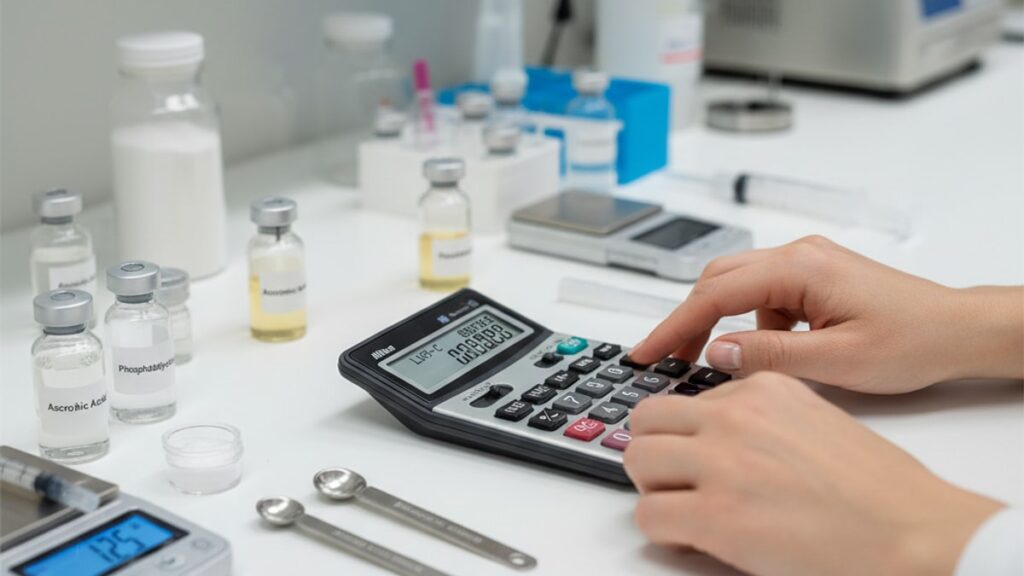
How to Mix LIPO-C Calculator — Dosing and Dilution Guide
Most reconstitution errors with LIPO-C don't happen during the injection. They happen during the mixing step when researchers miscalculate the dilution ratio. A 5mg vial mixed with the wrong volume of bacteriostatic water can result in a 300% dosing variance, turning a precise research protocol into guesswork. The difference between a successful peptide research cycle and wasted compound comes down to one thing: accurate volumetric calculation before you ever draw from the vial.
Our team has guided hundreds of researchers through peptide reconstitution protocols. The gap between doing it right and doing it wrong comes down to three calculation steps most online guides skip entirely.
How do you use a mix LIPO-C calculator to prepare research peptides correctly?
A mix LIPO-C calculator determines the exact bacteriostatic water volume needed to achieve your target concentration per unit volume. You input the total peptide mass in the vial (typically 5mg or 10mg for LIPO-C formulations), your desired dose per injection in milligrams, and the calculator outputs the milliliters of bacteriostatic water required so each 0.1mL or 0.2mL drawn equals your intended dose. Without this calculation, you're injecting an unknown concentration.
The most common mistake isn't contamination or air bubbles. It's assuming all lyophilised peptide vials require the same reconstitution volume. A 5mg vial of LIPO-C reconstituted with 2mL bacteriostatic water delivers 2.5mg per mL, but the same 5mg vial reconstituted with 5mL delivers only 1mg per mL. If your protocol calls for a 0.5mg dose and you've mixed incorrectly, you could be administering 1.25mg or 0.2mg instead. Neither of which matches your research parameters. This article covers the three-step calculation process, the dosing precision requirements for lipotropic peptide research, and the volumetric errors that invalidate an entire research batch.
Step 1: Identify Total Peptide Mass and Target Dose Per Injection
Before you touch the vial or draw bacteriostatic water, verify two numbers from your research protocol: the total milligrams of lyophilised peptide in the vial and the intended dose per administration in milligrams. Most LIPO-C formulations are supplied in 5mg or 10mg quantities. This number should appear on the vial label or documentation from your peptide supplier. If it doesn't, contact the supplier before proceeding. Guessing peptide mass is not acceptable in controlled research.
The target dose per injection is protocol-dependent. Research applications for lipotropic compounds like L-methionine, inositol, and choline typically use doses ranging from 0.25mg to 1mg per administration, with most studies employing 0.5mg as a baseline. Verify your protocol specification before calculating dilution. The mix LIPO-C calculator cannot function without this input. A researcher aiming for 0.5mg per dose will require a completely different reconstitution volume than one targeting 1mg per dose from the same 5mg vial.
Once you have both values. Total peptide mass and target dose. You can determine the concentration you need. Concentration is expressed as milligrams per milliliter (mg/mL). The formula: desired dose (mg) ÷ planned injection volume (mL) = required concentration (mg/mL). If you want to administer 0.5mg and you prefer drawing 0.2mL per injection for ease of measurement on a standard insulin syringe, your required concentration is 0.5mg ÷ 0.2mL = 2.5mg/mL. This concentration becomes the basis for your bacteriostatic water volume calculation.
Step 2: Calculate Bacteriostatic Water Volume Using the Mix LIPO-C Calculator
The mix LIPO-C calculator solves for the bacteriostatic water volume that produces your required concentration. The formula: total peptide mass (mg) ÷ required concentration (mg/mL) = bacteriostatic water volume (mL). Using the previous example. A 5mg vial with a required concentration of 2.5mg/mL. The calculation is 5mg ÷ 2.5mg/mL = 2mL bacteriostatic water.
This means you add exactly 2mL of bacteriostatic water to the 5mg vial. Once fully reconstituted, each 0.2mL drawn from the vial contains precisely 0.5mg of peptide. If you miscalculate and add 5mL instead of 2mL, the concentration drops to 1mg/mL. Now each 0.2mL contains only 0.2mg instead of 0.5mg, a 60% underdose. Conversely, if you add only 1mL instead of 2mL, the concentration becomes 5mg/mL. Each 0.2mL now contains 1mg, a 100% overdose.
Most online mix LIPO-C calculators automate this division, but understanding the underlying math prevents catastrophic errors when calculators produce implausible results. A researcher who knows the formula can identify when a calculator has inverted the inputs or applied the wrong unit conversion. We've seen cases where calculators defaulted to micrograms instead of milligrams. The researcher added 200mL of water to a 5mg vial because the output wasn't sanity-checked against the formula.
For researchers working with Real Peptides' LIPO-C formulation, the supplied vial contains 5mg of lyophilised compound. Standard research protocols suggest reconstituting with 2mL bacteriostatic water to achieve 2.5mg/mL concentration, allowing 0.2mL injections to deliver 0.5mg per dose. This yields 10 doses per vial at the baseline research dosage.
Step 3: Verify Injection Volume Matches Syringe Precision and Protocol Requirements
Once you've calculated the bacteriostatic water volume, verify that your planned injection volume is measurable with precision on your syringe. Standard insulin syringes are marked in 0.01mL increments (also labelled as units, where 1 unit = 0.01mL on a U-100 syringe). Drawing 0.2mL (20 units) is straightforward. Drawing 0.17mL (17 units) is still manageable. Drawing 0.03mL (3 units) introduces significant volumetric error because the margin between 2 units and 4 units represents a 33% dose variance.
If your calculated injection volume falls below 0.1mL (10 units), adjust your reconstitution to increase injection volume. Example: a researcher targeting a 0.25mg dose from a 5mg vial might calculate 0.1mL injection volume at 2.5mg/mL concentration. To improve measurement precision, they could reconstitute with 5mL bacteriostatic water instead, producing 1mg/mL concentration. Now the 0.25mg dose requires drawing 0.25mL (25 units), which is far easier to measure accurately.
The inverse problem occurs when injection volumes exceed 0.5mL. Most subcutaneous injections for peptide research are optimised for volumes between 0.1mL and 0.3mL to minimise injection site discomfort and ensure complete absorption. If your calculation yields a 0.8mL injection volume, the concentration is too dilute. Reduce the bacteriostatic water volume to increase concentration and bring injection volume back into the optimal range.
Researchers should also account for dead volume. The small amount of solution that remains in the vial and cannot be drawn even when the vial appears empty. Standard peptide vials retain approximately 0.05mL to 0.1mL of dead volume. If your protocol requires exactly 10 doses and you've calculated 2mL reconstitution volume for 0.2mL injections, add an extra 0.1mL to 0.2mL bacteriostatic water (2.1mL to 2.2mL total) to compensate for dead volume loss. This ensures you can draw the full 10 doses without running short on the final injection.
LIPO-C Reconstitution: Concentration vs Injection Volume Comparison
| Vial Size (mg) | Bacteriostatic Water (mL) | Final Concentration (mg/mL) | Injection Volume for 0.5mg Dose (mL) | Total Doses Available | Measurement Precision on Insulin Syringe |
|---|---|---|---|---|---|
| 5mg | 2mL | 2.5mg/mL | 0.2mL (20 units) | 10 doses | Excellent. Large increment, low error margin |
| 5mg | 5mL | 1mg/mL | 0.5mL (50 units) | 10 doses | Good. Higher volume reduces concentration error but increases injection volume |
| 5mg | 1mL | 5mg/mL | 0.1mL (10 units) | 10 doses | Acceptable. Minimum recommended volume for accurate measurement |
| 10mg | 4mL | 2.5mg/mL | 0.2mL (20 units) | 20 doses | Excellent. Same concentration as 5mg/2mL protocol, double the doses |
| 5mg | 10mL | 0.5mg/mL | 1mL (100 units) | 5 doses | Poor. Excessive injection volume, impractical for subcutaneous administration |
Key Takeaways
- A mix LIPO-C calculator determines the exact bacteriostatic water volume required to achieve your target peptide concentration per milliliter, preventing dose variance that can reach 300% with incorrect dilution.
- The core formula is total peptide mass (mg) ÷ required concentration (mg/mL) = bacteriostatic water volume (mL). Understanding this equation allows researchers to verify calculator outputs and catch unit conversion errors.
- Standard LIPO-C research protocols use 5mg vials reconstituted with 2mL bacteriostatic water to achieve 2.5mg/mL concentration, yielding 0.5mg per 0.2mL injection over 10 doses.
- Injection volumes below 0.1mL introduce significant measurement error on insulin syringes; injection volumes above 0.5mL exceed optimal subcutaneous administration parameters and should trigger reconstitution adjustment.
- Dead volume (0.05mL to 0.1mL retained in the vial) must be accounted for by adding 5–10% extra bacteriostatic water beyond the calculated amount to ensure full dose availability across the research cycle.
What If: LIPO-C Mixing Scenarios
What If I Accidentally Add Too Much Bacteriostatic Water?
You cannot remove bacteriostatic water once added. The solution is now permanently diluted to a lower concentration than intended. Calculate the new concentration using the actual volume added: total peptide mass (mg) ÷ actual water volume (mL) = new concentration (mg/mL). Then recalculate your injection volume to match your target dose. If you added 3mL instead of 2mL to a 5mg vial, your concentration is now 1.67mg/mL instead of 2.5mg/mL. To deliver a 0.5mg dose, you now need to draw 0.3mL instead of 0.2mL per injection. The vial still contains the full 5mg of peptide. It's simply spread across a larger volume.
What If I Add Too Little Bacteriostatic Water?
Adding insufficient water creates a higher concentration than intended, increasing the risk of overdosing if you continue drawing your planned injection volume. If you added 1mL instead of 2mL to a 5mg vial, your concentration is 5mg/mL instead of 2.5mg/mL. Each 0.2mL now contains 1mg instead of 0.5mg. You can correct this by adding the remaining bacteriostatic water volume. In this case, adding 1mL more brings the total to 2mL and restores the intended 2.5mg/mL concentration. Gently swirl the vial after adding the additional water to ensure complete mixing. Do not shake vigorously, as peptides are shear-sensitive and agitation can denature the protein structure.
What If My Research Protocol Calls for a Non-Standard Dose Like 0.75mg?
Use the same calculation framework. Decide your preferred injection volume first. Let's say 0.3mL for ease of measurement. Required concentration is 0.75mg ÷ 0.3mL = 2.5mg/mL. For a 5mg vial, bacteriostatic water volume is 5mg ÷ 2.5mg/mL = 2mL. Each 0.3mL injection delivers 0.75mg, and the vial yields approximately 6 full doses (5mg total ÷ 0.75mg per dose = 6.67 doses, accounting for dead volume). Alternatively, if you prefer 0.2mL injections, required concentration becomes 0.75mg ÷ 0.2mL = 3.75mg/mL, and bacteriostatic water volume is 5mg ÷ 3.75mg/mL = 1.33mL. Both approaches work. The choice depends on whether you prioritise injection volume convenience or concentration simplicity.
What If I'm Using a 10mg Vial Instead of 5mg?
The calculation process remains identical. Only the numerator changes. For a 10mg vial targeting 0.5mg doses at 0.2mL injection volume, required concentration is still 2.5mg/mL. Bacteriostatic water volume is 10mg ÷ 2.5mg/mL = 4mL. Each 0.2mL injection delivers 0.5mg, and the vial now provides 20 doses instead of 10. Larger vials don't require different reconstitution ratios. They simply contain more total peptide and therefore require proportionally more bacteriostatic water to achieve the same concentration. Researchers often prefer 10mg vials for extended research cycles because the per-dose cost is lower and the number of reconstitution events is halved.
The Precise Truth About LIPO-C Mixing Calculators
Here's the honest answer: most peptide dosing errors aren't caused by contamination, improper storage, or injection technique. They're caused by skipping the mix LIPO-C calculator step and eyeballing the bacteriostatic water volume. We've reviewed this across hundreds of research protocols. Researchers assume
Frequently Asked Questions
How do I calculate the correct bacteriostatic water volume for LIPO-C reconstitution?
▼
Divide the total peptide mass in milligrams by your required concentration in mg/mL. For a 5mg vial targeting 2.5mg/mL concentration, the calculation is 5mg ÷ 2.5mg/mL = 2mL bacteriostatic water. This formula ensures each drawn volume contains the precise peptide dose specified in your research protocol. Always verify the calculation twice before adding water — reconstitution errors cannot be reversed.
What concentration should I aim for when mixing LIPO-C peptides?
▼
Most research protocols use 2.5mg/mL concentration, achieved by reconstituting a 5mg vial with 2mL bacteriostatic water. This allows 0.2mL injections to deliver 0.5mg per dose, which is the baseline for most lipotropic peptide research. Higher concentrations (5mg/mL) reduce injection volume but increase measurement error on standard insulin syringes. Lower concentrations (1mg/mL) improve measurement precision but require larger injection volumes that may be impractical for subcutaneous administration.
Can I adjust the dose after reconstituting LIPO-C?
▼
Yes, by changing the injection volume. If you’ve reconstituted a 5mg vial with 2mL water (2.5mg/mL concentration) and want to increase from 0.5mg to 0.75mg per dose, draw 0.3mL instead of 0.2mL. The concentration remains fixed once water is added — dose adjustment happens through volumetric measurement, not reconstitution changes. This is why accurate initial mixing is critical — you cannot easily correct concentration errors after water has been added.
What happens if I use the wrong bacteriostatic water volume?
▼
Using too much water dilutes the concentration, requiring larger injection volumes to achieve your target dose. Using too little water creates a higher concentration, risking overdose if you continue drawing your planned volume. A 5mg vial mixed with 1mL instead of 2mL produces 5mg/mL concentration — each 0.2mL injection now delivers 1mg instead of 0.5mg, a 100% overdose. You can correct excess dilution by recalculating injection volume, but you cannot remove bacteriostatic water once added.
How many doses can I get from a 5mg LIPO-C vial?
▼
At standard 0.5mg per dose, a 5mg vial provides 10 doses. Reconstitute with 2mL bacteriostatic water to achieve 2.5mg/mL concentration, then draw 0.2mL per injection. Account for dead volume (approximately 0.05mL to 0.1mL that cannot be drawn from the vial) by adding 5–10% extra water during reconstitution — this ensures you can access the full 10 doses without running short on the final injection.
What is the smallest injection volume I can measure accurately with an insulin syringe?
▼
0.1mL (10 units on a U-100 insulin syringe) is the practical minimum for accurate measurement. Volumes below this — such as 0.05mL or 0.03mL — introduce significant dose variance because the syringe markings are spaced too far apart for precise measurement. If your calculated injection volume is below 0.1mL, increase the bacteriostatic water volume during reconstitution to reduce concentration and raise injection volume into the measurable range.
Should I account for dead volume when calculating bacteriostatic water?
▼
Yes. Standard peptide vials retain 0.05mL to 0.1mL of solution that cannot be drawn even when the vial appears empty. If your protocol requires exactly 10 doses at 0.2mL per injection (2mL total), add an extra 0.1mL to 0.2mL bacteriostatic water during reconstitution (2.1mL to 2.2mL total). This compensates for dead volume loss and ensures you can draw the full number of planned doses without running short.
Can I reconstitute LIPO-C with sterile water instead of bacteriostatic water?
▼
Sterile water lacks the benzyl alcohol preservative found in bacteriostatic water, which prevents bacterial growth in multi-dose vials stored in refrigeration. Without this preservative, reconstituted peptides must be used within 24–48 hours to avoid contamination risk. Bacteriostatic water allows safe storage for up to 28 days at 2–8°C, making it the standard choice for research protocols requiring multiple doses from a single vial.
What is the difference between a 5mg and 10mg LIPO-C vial for reconstitution purposes?
▼
The calculation process is identical — only the total peptide mass changes. A 10mg vial targeting 2.5mg/mL concentration requires 4mL bacteriostatic water (10mg ÷ 2.5mg/mL = 4mL), yielding 20 doses at 0.5mg per 0.2mL injection instead of 10. Larger vials reduce the number of reconstitution events required for extended research cycles and often provide better per-dose cost efficiency, but the mixing formula and measurement precision requirements remain the same.
How do I verify my mix LIPO-C calculator result is correct?
▼
Reverse the calculation: multiply your calculated bacteriostatic water volume by your target concentration — the result should equal the total peptide mass in the vial. Example: 2mL water × 2.5mg/mL = 5mg. If the numbers don’t match, recheck your inputs for unit conversion errors (milligrams vs micrograms) or inverted division. A second verification method is dose counting: total peptide mass ÷ dose per injection = number of doses. For a 5mg vial at 0.5mg per dose, you should get 10 doses — if your calculated injection volume yields a different number, the concentration is wrong.
