


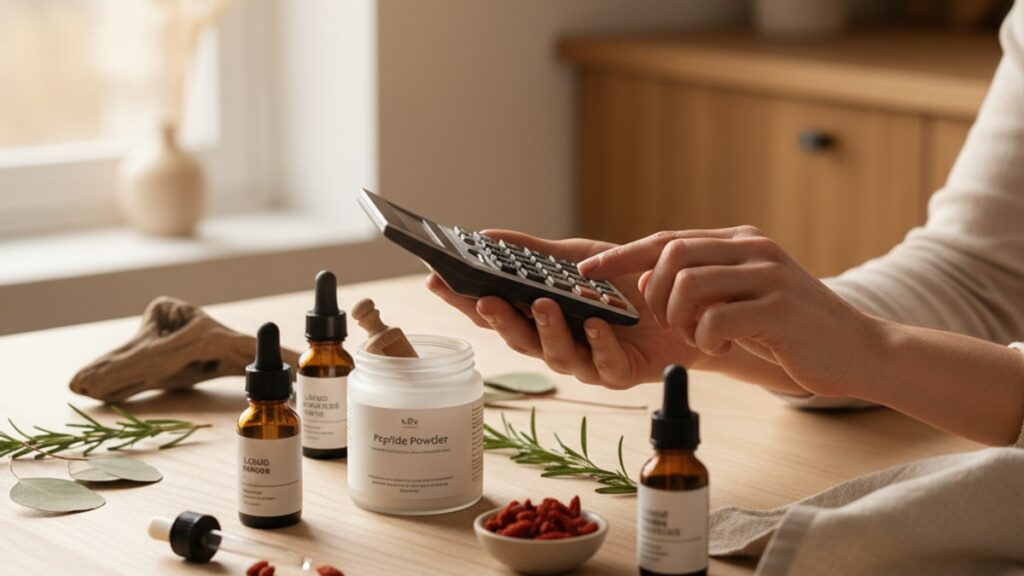
How Many mcg in 1mg Peptide? Quick Math Explained
A researcher reconstitutes a 5mg vial of Thymalin with 2mL bacteriostatic water. Then draws 0.1mL assuming they're administering 250mcg. They're actually injecting 250mcg only if the concentration math is correct. Get the mg-to-mcg conversion wrong at any stage and the entire protocol collapses. This isn't abstract theory. It's the single conversion factor that determines whether your research dose matches your protocol.
We've guided hundreds of researchers through peptide reconstitution protocols. The gap between doing it right and doing it catastrophically wrong comes down to understanding one immutable relationship: 1 milligram equals 1,000 micrograms. That's it. No rounding. No approximations. No context-dependent variation.
How many mcg are in 1mg of peptide?
1 milligram (mg) equals exactly 1,000 micrograms (mcg). This relationship is constant regardless of peptide type, molecular weight, or formulation. To convert any peptide dose from mg to mcg, multiply by 1,000. A 2.5mg vial contains 2,500mcg total peptide. A 0.25mg dose equals 250mcg. This conversion is the foundation of every reconstitution calculation, syringe measurement, and protocol design in peptide research.
The Featured Snippet gave you the conversion factor. Here's what it didn't tell you: the mcg-to-mg relationship is where most reconstitution errors originate. Not because the math is hard, but because researchers conflate concentration with total mass. A 5mg vial reconstituted in 1mL gives you 5,000mcg/mL concentration, not 5mcg/mL. That three-order-of-magnitude mistake happens more often than published protocols admit. This article covers the exact math behind peptide reconstitution, how to calculate per-injection doses from vial concentration, and the syringe measurement errors that negate even perfect arithmetic.
The Milligram-to-Microgram Conversion Rule
The metric system defines the relationship precisely: 1 milligram equals 1,000 micrograms. Milli- means one-thousandth (10⁻³), and micro- means one-millionth (10⁻⁶). So 1mg is 1,000 times larger than 1mcg. To convert mg to mcg, multiply by 1,000. To convert mcg to mg, divide by 1,000. There are no exceptions, no peptide-specific adjustments, and no molecular-weight dependencies. The conversion holds whether you're working with MK 677, Cerebrolysin, or any lyophilised peptide.
Peptide vials are labelled in milligrams because that's the standard unit for bulk powder mass. Dosing protocols often specify micrograms because therapeutic or research doses sit in the 100–500mcg range. Writing '0.25mg' is less intuitive than '250mcg' when measuring with insulin syringes graduated in 0.01mL increments. The unit shift doesn't change the underlying quantity. A 5mg vial of Dihexa contains 5,000mcg total peptide. If your protocol calls for 250mcg per injection, that vial provides exactly 20 doses. Assuming zero waste, perfect reconstitution, and accurate syringe measurement.
Here's the part most guides skip: the mg-to-mcg conversion is only the first step. The actionable number you need is concentration. Mcg per mL of reconstituted solution. That requires a second calculation: total mcg divided by reconstitution volume in mL. A 10mg vial reconstituted in 2mL bacteriostatic water yields 10,000mcg ÷ 2mL = 5,000mcg/mL. If you need 300mcg per dose, you draw 0.06mL. Miss the concentration step and you're calculating dose volume from vial mass. Which tells you nothing.
How Reconstitution Volume Changes Concentration
Reconstitution volume determines concentration, not total peptide content. A 5mg vial contains 5,000mcg whether you add 1mL, 2mL, or 5mL of bacteriostatic water. The mass doesn't change, but the concentration does. Reconstitute 5mg in 1mL and you get 5,000mcg/mL. Reconstitute the same 5mg in 2mL and you get 2,500mcg/mL. Same peptide, same total dose potential, half the concentration. The volume you inject to achieve a target dose scales inversely with concentration.
Our team has found that concentration mismatches cause more protocol failures than any other variable. A researcher calculates dose volume based on one reconstitution volume, then inadvertently uses a vial reconstituted at a different ratio. The result: a 2× overdose or underdose that isn't discovered until comparing results across batches. Real Peptides recommends standardising reconstitution volumes across all vials of the same peptide. If you reconstitute one 5mg vial in 2mL, reconstitute every subsequent 5mg vial in 2mL. Consistency eliminates arithmetic errors at the measurement stage.
Concentration also affects peptide stability after reconstitution. Higher concentrations (10,000mcg/mL or above) generally maintain potency longer than dilute solutions (1,000mcg/mL or below) because there's less opportunity for degradation at the air-liquid interface per unit peptide. But higher concentrations require smaller injection volumes. Sometimes as little as 0.02–0.05mL. Which increases measurement error with standard 1mL insulin syringes. The optimal reconstitution volume balances stability against measurement precision. For most research peptides in the 5–10mg range, reconstituting in 2–3mL hits that balance: concentrations stay above 2,000mcg/mL, and per-dose volumes remain above 0.1mL.
Calculating Per-Dose Volume from Vial Concentration
Once you know vial concentration in mcg/mL, calculating per-dose injection volume is straightforward: desired dose in mcg divided by concentration in mcg/mL equals volume in mL. If your protocol specifies 250mcg and your vial concentration is 2,500mcg/mL, you draw 250 ÷ 2,500 = 0.1mL. If the same protocol runs on a vial reconstituted to 5,000mcg/mL, the dose volume drops to 250 ÷ 5,000 = 0.05mL. The peptide dose stays constant. Only the volume changes.
Syringe graduation limits measurement accuracy. Standard 1mL insulin syringes are marked in 0.01mL increments (sometimes labelled as 'units' on U-100 syringes, where 1 unit = 0.01mL). That means the smallest measurable volume is 0.01mL, and realistic measurement accuracy sits around ±0.005mL due to meniscus reading and plunger friction. If your calculated dose volume is 0.03mL, you're working at the edge of syringe precision. A 0.005mL error represents a 16% dose variance. Reconstituting to yield dose volumes above 0.1mL reduces proportional measurement error.
Here's the practical workflow we've tested across hundreds of vials: (1) Determine your target per-dose amount in mcg. (2) Choose a reconstitution volume that yields a per-dose injection volume between 0.1–0.3mL. This range balances measurement precision with practical syringe capacity. (3) Calculate required concentration: target dose in mcg divided by desired volume in mL. (4) Calculate reconstitution volume: total vial content in mcg divided by required concentration. For a 5mg (5,000mcg) vial targeting 250mcg doses at 0.2mL per injection, required concentration is 250 ÷ 0.2 = 1,250mcg/mL. Reconstitution volume is 5,000 ÷ 1,250 = 4mL.
How Many mcg in 1mg Peptide: Concentration Calculation Comparison
| Vial Size (mg) | Reconstitution Volume (mL) | Resulting Concentration (mcg/mL) | Volume for 250mcg Dose (mL) | Measurement Precision |
|---|---|---|---|---|
| 5mg | 1mL | 5,000 mcg/mL | 0.05mL | Low. Near syringe minimum graduation |
| 5mg | 2mL | 2,500 mcg/mL | 0.1mL | Moderate. 10 graduation marks, ±5% error |
| 5mg | 4mL | 1,250 mcg/mL | 0.2mL | High. 20 graduation marks, ±2.5% error |
| 10mg | 2mL | 5,000 mcg/mL | 0.05mL | Low. Difficult to measure accurately |
| 10mg | 4mL | 2,500 mcg/mL | 0.1mL | Moderate. Adequate for most protocols |
Key Takeaways
- 1 milligram equals exactly 1,000 micrograms. Multiply any mg value by 1,000 to convert to mcg, with no peptide-specific adjustments or molecular-weight dependencies.
- Concentration in mcg/mL is calculated as total vial content in mcg divided by reconstitution volume in mL. A 5mg vial in 2mL yields 2,500mcg/mL, not 5mcg/mL.
- Per-dose injection volume equals target dose in mcg divided by vial concentration in mcg/mL. If you need 250mcg from a 2,500mcg/mL solution, draw exactly 0.1mL.
- Reconstitution volume determines measurement precision: higher volumes yield lower concentrations and larger per-dose volumes, reducing proportional syringe measurement error.
- Standard 1mL insulin syringes have 0.01mL graduation. Target per-dose volumes above 0.1mL to keep measurement error below ±5%.
- Standardise reconstitution volumes across all vials of the same peptide to eliminate protocol inconsistencies and dosing errors between batches.
What If: Quick Math Peptide Dosing Scenarios
What If I Accidentally Reconstitute a 5mg Vial with 1mL Instead of 2mL?
Your concentration doubled. You now have 5,000mcg/mL instead of the intended 2,500mcg/mL. If your protocol called for 0.2mL to deliver 500mcg at the lower concentration, drawing 0.2mL from the higher-concentration vial delivers 1,000mcg. A 2× overdose. Recalculate immediately: divide your target dose by the new concentration to find the correct volume. For 500mcg at 5,000mcg/mL, draw 0.1mL. Do not attempt to dilute the vial post-reconstitution unless you can calculate the precise additional volume needed and verify homogeneous mixing.
What If My Syringe Is Graduated in Units Instead of mL?
Most insulin syringes marked in 'units' follow the U-100 standard, where 100 units equals 1mL. Meaning 1 unit equals 0.01mL. To convert your calculated dose volume in mL to syringe units, multiply by 100. A 0.15mL dose equals 15 units. A 0.08mL dose equals 8 units. Verify your syringe is U-100 by checking the barrel label. U-40 and U-50 syringes exist but use different unit-to-mL ratios and will cause dosing errors if assumed to be U-100.
What If I Need a Dose Smaller Than 0.05mL?
Reconstitute the same vial mass in a larger volume to reduce concentration. If a 5mg vial reconstituted in 2mL (2,500mcg/mL) requires a 0.04mL injection for 100mcg, reconstitute in 5mL instead (1,000mcg/mL). Now the same 100mcg dose requires 0.1mL, which sits comfortably within standard syringe precision. Alternatively, use a 0.3mL or 0.5mL insulin syringe with finer graduations, though these are less common and require sourcing from specialised suppliers.
What If the Vial Label Says '5mg ±10%' — How Do I Calculate Dose?
Pharmaceutical-grade peptides from Real Peptides include purity and mass variance specifications. A '5mg ±10%' label means actual peptide content ranges from 4.5mg to 5.5mg. For conservative dosing, calculate as if the vial contains the lower bound (4.5mg = 4,500mcg). If you reconstitute in 2mL assuming 5,000mcg and the vial actually contains 4,500mcg, your calculated 250mcg dose is actually 225mcg. A 10% underdose, which is safer than a 10% overdose from assuming the upper bound.
The Unforgiving Truth About Peptide Dosing Math
Here's the honest answer: the mg-to-mcg conversion is the easiest part of peptide dosing, yet it's where most failures originate. Not because researchers can't multiply by 1,000, but because they conflate mass with concentration and skip the intermediate calculation. A vial labelled '10mg' doesn't tell you how many mcg you're injecting. It tells you how many mcg exist in total. The number that matters. Concentration in mcg/mL. Requires you to know reconstitution volume and complete the division step before you ever touch a syringe. We've reviewed protocols where researchers calculated dose volume directly from vial mass, bypassing concentration entirely, and wondered why results didn't replicate across batches. The arithmetic isn't optional.
Peptide potency degrades the moment you add bacteriostatic water. Even under ideal refrigeration at 2–8°C, reconstituted peptides lose 1–3% potency per week due to oxidation, aggregation, and hydrolysis. A vial calculated to contain 5,000mcg on day zero contains closer to 4,850mcg by week two and 4,700mcg by week four. If your protocol spans multiple weeks, dose drift is unavoidable unless you account for it. Some researchers compensate by slight dose escalation over time; others reconstitute smaller volumes per vial and discard after two weeks rather than stretching to the 28-day bacteriostatic limit. Neither approach is wrong. But pretending reconstituted peptides maintain full potency indefinitely is.
Calculating dose volume from concentration assumes homogeneous distribution of peptide throughout the reconstituted solution. Lyophilised peptides don't always dissolve instantly or completely. Gentle swirling. Never shaking. Is required to ensure full solubilisation without denaturing the protein structure through shear force. If you draw from a vial before the powder fully dissolves, concentration in that aliquot may be lower than calculated. Verify complete dissolution visually before the first draw. The solution should be perfectly clear with no visible particulates, cloudiness, or sediment. If it's not, let it sit at room temperature for 10–15 minutes and swirl again. Forcing dissolution by vigorous shaking introduces air bubbles that denature peptides at the liquid-air interface.
Our team has refined peptide protocols across products like SLU PP 332, Survodutide, Mazdutide, and CJC1295 Ipamorelin. The single most impactful change: standardising reconstitution volumes and pre-calculating per-dose syringe graduations before opening any vial. Write the target volume directly on the vial label in permanent marker. '0.15mL = 300mcg'. So there's no room for miscalculation at injection time.
If the quick math conversion seems too simple to warrant an entire article, you're not wrong. The arithmetic is trivial. But trivial arithmetic applied incorrectly at scale produces systematic dosing errors that researchers don't catch until they compare results across studies. One vial reconstituted at 5,000mcg/mL and another at 2,500mcg/mL look identical in the syringe. The only difference is the invisible number you used three steps earlier when you added bacteriostatic water. Miss that, and every injection afterward is wrong in a direction you won't detect.
Frequently Asked Questions
How many micrograms are in 1 milligram of peptide?
▼
1 milligram (mg) equals exactly 1,000 micrograms (mcg) for all peptides, regardless of molecular weight or formulation. To convert any peptide dose from mg to mcg, multiply by 1,000. A 2.5mg vial contains 2,500mcg total peptide. This conversion is constant and does not vary by peptide type or purity level.
How do I calculate peptide concentration after reconstitution?
▼
Divide total vial content in mcg by reconstitution volume in mL. A 5mg vial (5,000mcg) reconstituted in 2mL bacteriostatic water yields 5,000 ÷ 2 = 2,500mcg/mL. If reconstituted in 4mL, the same vial yields 1,250mcg/mL. Concentration determines how much volume you draw per dose — not the vial mass itself.
What injection volume do I need for a 250mcg peptide dose?
▼
Divide your target dose in mcg by vial concentration in mcg/mL. If concentration is 2,500mcg/mL, then 250mcg requires 250 ÷ 2,500 = 0.1mL. If concentration is 5,000mcg/mL, the same 250mcg dose requires only 0.05mL. The dose stays the same — only the volume changes based on how much bacteriostatic water was added during reconstitution.
Can I use the same syringe measurement for different peptide vials?
▼
Only if both vials were reconstituted to the exact same concentration. A 0.1mL injection delivers 250mcg from a 2,500mcg/mL solution but delivers 500mcg from a 5,000mcg/mL solution. Always recalculate dose volume when switching to a new vial unless you’ve standardised reconstitution volumes across all vials of the same peptide.
What happens if I reconstitute with the wrong volume of bacteriostatic water?
▼
Your concentration changes, which changes the per-dose injection volume required. If you intended 2mL but added 1mL, concentration doubles — drawing the original calculated volume delivers twice the intended dose. Recalculate immediately using the actual volume added. Do not attempt to correct by adding more water post-reconstitution unless you can ensure complete mixing.
How does syringe graduation affect peptide dosing accuracy?
▼
Standard 1mL insulin syringes are marked in 0.01mL increments, making 0.01mL the smallest measurable volume. Realistic accuracy is ±0.005mL due to meniscus reading and plunger friction. If your calculated dose is 0.03mL, a 0.005mL error represents a 16% dose variance. Reconstitute to yield per-dose volumes above 0.1mL to reduce proportional measurement error.
Why do some peptide protocols specify doses in mcg instead of mg?
▼
Research and therapeutic peptide doses typically range from 100–500mcg per injection — writing ‘0.25mg’ is less intuitive than ‘250mcg’ when measuring with insulin syringes graduated in 0.01mL increments. The mcg unit also matches the precision required for dose adjustments, where changes of 50–100mcg are common but would appear as 0.05–0.1mg in milligram notation.
Does peptide molecular weight affect the mg-to-mcg conversion?
▼
No. The mg-to-mcg conversion is a unit transformation, not a molecular calculation. 1mg equals 1,000mcg whether you’re working with a small peptide like Cartalax or a larger compound like Hexarelin. Molecular weight affects bioavailability and receptor binding, not the arithmetic of dose preparation.
How long does reconstituted peptide maintain accurate concentration?
▼
Reconstituted peptides stored at 2–8°C typically maintain 97–99% potency for the first two weeks, dropping to 94–97% by week four due to oxidation and hydrolysis. Concentration calculated at reconstitution remains accurate as a mass-per-volume figure, but effective dose decreases slightly over time. Some protocols compensate by slight dose escalation after two weeks or by reconstituting smaller volumes and discarding sooner.
What’s the difference between vial mass and vial concentration?
▼
Vial mass (in mg) is the total amount of peptide powder in the vial before reconstitution. Concentration (in mcg/mL) is how much peptide exists per unit volume after adding bacteriostatic water. A 10mg vial contains 10,000mcg total, but concentration depends entirely on reconstitution volume — 10,000mcg in 2mL equals 5,000mcg/mL. You inject based on concentration, not total mass.
Can I reconstitute peptides with sterile water instead of bacteriostatic water?
▼
Sterile water lacks the antimicrobial preservative (typically 0.9% benzyl alcohol) that bacteriostatic water contains, reducing the safe storage window from 28 days to 24–48 hours after reconstitution. If using sterile water, prepare only what you’ll use within two days and discard the remainder. For multi-dose vials intended to last weeks, bacteriostatic water is the standard and safer choice.
How do I verify my peptide vial contains the labelled mass?
▼
Without lab-grade analytical equipment (HPLC, mass spectrometry), you cannot verify peptide mass at home. Reputable suppliers like Real Peptides provide Certificates of Analysis (CoA) with third-party purity and mass verification for each batch. Always source from suppliers who publish CoAs and manufacture under cGMP standards — visual inspection cannot detect underfilled vials or low-purity product.
