


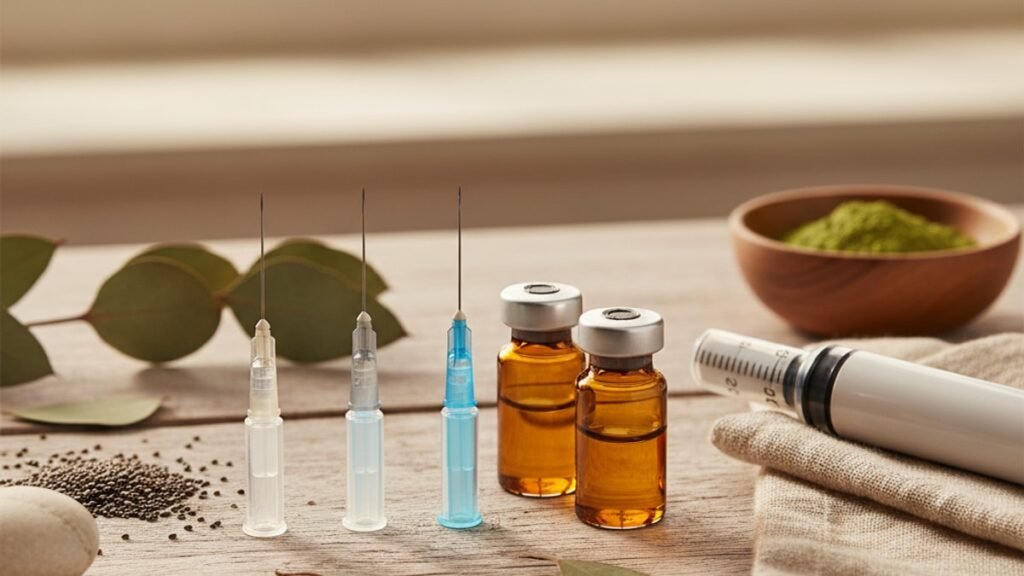
Needle Gauge Peptides: 27G vs 29G vs 31G Comparison
Most peptide users obsess over reconstitution sterility. Then use the wrong needle gauge and compromise accuracy, comfort, or both. The difference between 27G, 29G, and 31G isn't just about pain tolerance; it's about injection speed, hand stability requirements, and how much room for error you have when drawing from a vial. A 27G needle draws peptide solution in 3–4 seconds but requires precise angle control to avoid tissue trauma. A 31G needle takes 12–15 seconds to draw the same volume but delivers subcutaneous injections with minimal sensation and virtually no bleeding. Assuming your hands are steady enough to insert it without bending the needle.
We've guided researchers through peptide administration protocols for years. The gap between 'doing it right' and 'doing it wrong' comes down to matching needle gauge to injection volume, viscosity, and user experience level. Three variables most guides ignore entirely.
What's the best needle gauge for peptide injections?
29G needles deliver the optimal balance for most peptide applications: fast enough to draw reconstituted solutions in 6–8 seconds, narrow enough to minimise subcutaneous tissue disruption, and forgiving enough that minor hand tremor won't bend the needle during insertion. 27G needles work for larger volumes (≥0.5mL) or oil-based carriers but increase injection site soreness. 31G needles offer maximum comfort but require steady hands and patience. Drawing 0.3mL can take 12–15 seconds, and any insertion angle error bends the tip.
The Featured Snippet gives you the practical answer. Here's what it doesn't tell you: needle gauge affects more than comfort. It determines draw time (which impacts sterility exposure), injection pressure (which affects peptide dispersion in subcutaneous tissue), and error tolerance (how much your hand can shake before the needle bends or you miss the injection site). Peptide solutions reconstituted with bacteriostatic water have viscosity similar to saline. Meaning gauge selection is about technique and volume, not solution thickness. This article covers the biomechanical differences between 27G, 29G, and 31G needles, the scenarios where each excels, and the preparation mistakes that negate needle selection entirely.
Why Needle Gauge Matters More Than Most Peptide Protocols Acknowledge
Needle gauge is measured inversely. Higher numbers mean narrower diameter. A 27G needle has an outer diameter of 0.41mm; 29G measures 0.34mm; 31G measures 0.26mm. That 0.15mm difference between 27G and 31G translates to roughly 60% reduction in cross-sectional area, which directly affects fluid dynamics during both draw and injection. When you pull back a syringe plunger to draw peptide solution through a 31G needle, the narrow bore creates significantly higher resistance than a 27G needle drawing the same volume. This is why draw time scales non-linearly with gauge.
The practical implication: a 27G needle draws 0.3mL of reconstituted semaglutide in approximately 3–4 seconds, while a 31G needle requires 12–15 seconds for the same volume. That extended draw time increases the window during which the vial septum remains punctured and exposed to ambient air. A sterility consideration that matters more in multi-dose vials used over weeks. Additionally, the injection pressure required to expel solution through a narrower needle is higher, which can cause localised tissue resistance and micro-trauma if the injection is too rapid. Researchers using Thymalin or other immune-modulating peptides where injection site inflammation could confound results should prioritise slower, controlled delivery. Which naturally favours 29G or 31G over 27G.
The Overlooked Variable: Hand Stability and Needle Flexibility
Needle gauge selection isn't just a comfort decision. It's a biomechanical constraint. Narrower needles bend more easily under lateral force. A 31G needle inserted at a 45-degree angle into subcutaneous tissue will bend if your hand wavers more than 2–3mm during insertion, particularly in individuals with low subcutaneous fat where the needle encounters denser fascia sooner. A 27G needle tolerates 5–6mm of lateral movement before bending becomes an issue. This matters because most peptide injections target the subcutaneous layer 4–6mm below the skin surface. Shallow enough that insertion angle errors are common, especially in leaner individuals or those self-administering without mirrors.
For researchers working with compounds like MK 677, where consistent dosing over months is critical, needle bending mid-injection isn't just inconvenient. It risks incomplete dose delivery or contamination if the needle must be withdrawn and replaced. Our experience shows that users new to subcutaneous injection should start with 29G needles: they're forgiving enough to tolerate minor technique errors but narrow enough to minimise discomfort. Advanced users comfortable with slower draw times and precise insertion can graduate to 31G for maximum comfort, while those prioritising speed and drawing larger volumes (0.5mL+) benefit from 27G despite the slightly increased post-injection soreness.
Injection Speed, Peptide Dispersion, and Subcutaneous Pooling
The rate at which peptide solution is delivered into subcutaneous tissue affects how it disperses and absorbs. Rapid injection through a 27G needle. Completing a 0.3mL dose in under 2 seconds. Creates a localised bolus that pools in one area before diffusing. Slower injection through a 31G needle. The same 0.3mL delivered over 6–8 seconds. Allows the solution to disperse during administration, reducing the likelihood of a visible subcutaneous 'bubble' post-injection. This is why 31G needles are preferred for peptides where injection site reactions (localised redness, firmness, or delayed absorption) are more common, such as GLP-1 agonists or growth hormone secretagogues.
Here's the mechanism: subcutaneous tissue has limited capacity to immediately absorb injected fluid. When solution is delivered faster than local capillary uptake can handle, it pools temporarily and creates pressure against surrounding tissue. Which the body interprets as mild inflammation. Studies on insulin injection techniques (which share the same subcutaneous delivery method) show that slower injection rates reduce post-injection site induration by 30–40%. For researchers using Cerebrolysin or other neurotrophic peptides where consistent absorption kinetics matter, controlling injection speed with appropriate needle gauge is as important as dose accuracy itself.
Needle Gauge Peptides 27G 29G 31G Comparison: Complete Analysis
This table compares the three most common needle gauges for peptide administration across the factors that actually affect protocol success. Not just comfort.
| Gauge | Outer Diameter | Draw Time (0.3mL) | Injection Speed | Hand Stability Required | Tissue Trauma Risk | Best Use Case | Our Assessment |
|---|---|---|---|---|---|---|---|
| 27G | 0.41mm | 3–4 seconds | Fast (1–2 sec) | Low. Tolerates 5–6mm lateral movement | Moderate. Wider bore creates more tissue disruption | Volumes ≥0.5mL, oil-based carriers, users prioritising speed over comfort | Best for experienced users drawing larger doses or working with viscous solutions. Acceptable discomfort trade-off for efficiency. |
| 29G | 0.34mm | 6–8 seconds | Moderate (3–4 sec) | Moderate. Tolerates 3–4mm lateral movement | Low. Narrow enough to minimise trauma while maintaining control | General peptide use, first-time users, daily injection protocols | The universal choice. Balances draw speed, injection control, and comfort without requiring advanced technique. |
| 31G | 0.26mm | 12–15 seconds | Slow (6–8 sec) | High. Bends with >2–3mm lateral movement | Very Low. Minimal tissue disruption and virtually no bleeding | Low-volume peptides (<0.3mL), users prioritising comfort, facial or delicate tissue injections | Maximum comfort but demands patience and steady hands. Best for experienced users who've mastered insertion angle and can tolerate slower workflows. |
Key Takeaways
- 27G needles have an outer diameter of 0.41mm and draw 0.3mL of peptide solution in 3–4 seconds. Fastest option but creates more tissue trauma and post-injection soreness.
- 29G needles (0.34mm diameter) balance draw speed (6–8 seconds for 0.3mL), injection control, and comfort. The optimal starting point for most peptide administration protocols.
- 31G needles (0.26mm diameter) take 12–15 seconds to draw 0.3mL but deliver injections with minimal sensation and virtually no bleeding. Best for experienced users with steady hands.
- Narrower needles bend more easily: 31G needles tolerate only 2–3mm of lateral hand movement during insertion before bending, compared to 5–6mm for 27G needles.
- Injection speed affects peptide dispersion: rapid delivery through wider needles can cause subcutaneous pooling and delayed absorption, while slower delivery through narrower needles allows better tissue distribution.
What If: Needle Gauge Peptides Scenarios
What If I'm Drawing From a Multi-Dose Vial Used Over Weeks?
Use 29G or 31G needles to minimise septum damage. Each needle puncture through a vial septum creates microscopic channels that compromise the seal. Wider needles (27G) create larger channels that allow air exchange and increase contamination risk over time. Multi-dose vials containing bacteriostatic water remain stable for 28 days when stored at 2–8°C, but only if the septum maintains integrity. If you're drawing daily doses from the same vial for three weeks, the cumulative septum trauma from a 27G needle can compromise sterility by week two. Switch to 29G or accept the slower draw time of 31G to extend vial usability.
What If My Hands Shake Slightly During Injection?
Start with 29G needles. They're forgiving enough to tolerate minor tremor without bending. Hand tremor amplitude typically ranges from 1–4mm in individuals without neurological conditions, which falls within the tolerance range of 29G needles (3–4mm lateral movement before bending). If you're using peptides like Dihexa where precise cognitive research protocols demand consistent dosing, a bent needle mid-injection isn't just inconvenient. It compromises dose accuracy. Avoid 31G needles until your technique is rock-solid.
What If I Need to Inject Larger Volumes (≥0.5mL)?
Use 27G needles. The draw time and injection pressure required for 0.5mL+ through 29G or 31G becomes impractical. Drawing 0.7mL through a 31G needle takes 25–30 seconds, and the injection pressure required to expel that volume risks tissue damage or incomplete delivery if the needle shifts during the prolonged injection. For compounds like SLU PP 332 or other research peptides where dosing exceeds 0.5mL per administration, 27G needles are the only practical choice despite slightly increased discomfort.
The Blunt Truth About Needle Gauge Selection
Here's the honest answer: most peptide users choose needle gauge based on what they read in a forum thread, not what their actual injection volume, hand stability, or peptide viscosity demands. The 'comfort first' advice you see everywhere. Always use 31G, it's painless. Ignores the fact that 31G needles are objectively harder to use correctly. They bend if your insertion angle is off by more than 10 degrees, they take three times longer to draw solution (which matters for sterility), and they require injection pressure that can cause tissue resistance if you're not familiar with proper technique. The result: users who jump straight to 31G without mastering 29G first end up with bent needles, incomplete doses, and injection site issues they blame on the peptide rather than their equipment choice.
The 29G needle exists because it's the engineering compromise that works for 80% of users, 80% of the time. It's not the most comfortable option. 31G is. It's not the fastest option. 27G is. It's the option that tolerates technique errors without punishing you for them. If you're new to peptide administration, start with 29G. If you're experienced and prioritising comfort over speed, graduate to 31G. If you're drawing ≥0.5mL or working with oil-based carriers, accept that 27G is your only practical choice. Stop optimising for a variable. Comfort. That matters less than consistent, accurate dosing.
Needle gauge matters, but it's downstream of reconstitution accuracy, storage discipline, and injection technique. Get those right first. The difference between 29G and 31G is marginal compared to the difference between proper and improper vial handling. For research-grade peptides where purity and consistency are non-negotiable, starting with high-quality compounds from verified suppliers matters more than needle selection. You can learn the perfect gauge for your protocol only if the peptide itself is dosed correctly and stored properly from the start.
The choice between 27G, 29G, and 31G needles isn't about comfort alone. It's about matching needle biomechanics to your injection volume, hand stability, and experience level. A 29G needle is the starting point for most users because it balances speed, control, and forgiveness. If your hands are steady and you value comfort above all else, 31G works. But only if you're willing to slow down and perfect your insertion angle. If you're drawing larger volumes or prioritising efficiency, 27G delivers despite slightly more tissue disruption. The wrong needle doesn't ruin a peptide protocol. But the right needle makes consistent, accurate administration significantly easier.
Frequently Asked Questions
What is the best needle gauge for daily peptide injections?
▼
29G needles are optimal for daily peptide protocols because they balance draw speed (6–8 seconds for 0.3mL), injection control, and comfort without requiring advanced technique. Daily injections mean frequent vial punctures — 29G needles create smaller septum damage than 27G, extending multi-dose vial sterility, while being more forgiving than 31G needles that bend easily with minor hand tremor. For peptides like semaglutide or tirzepatide administered weekly, 31G offers maximum comfort if you have steady hands; for daily compounds like growth hormone secretagogues, 29G prevents technique fatigue over months of consistent use.
Can I use a 31G needle for all peptide types?
▼
No — 31G needles are impractical for volumes exceeding 0.4mL or peptides reconstituted in oil-based carriers. The narrow bore (0.26mm diameter) creates high resistance during draw and injection: pulling 0.5mL through a 31G needle takes 20–25 seconds, and the injection pressure required can cause tissue resistance or incomplete delivery. Use 31G only for low-volume, water-based peptide solutions where comfort is the priority and you have the hand stability to insert the needle without bending it. For larger doses or viscous solutions, 27G or 29G needles are necessary.
Why does my 31G needle bend during injection?
▼
31G needles bend when lateral hand movement exceeds 2–3mm during insertion, or when the needle encounters dense fascia at an improper angle — both are common in leaner individuals with less subcutaneous fat. The 0.26mm diameter creates a flexible needle that tolerates minimal force before deforming. To prevent bending: pinch subcutaneous tissue to create a softer insertion target, insert at a consistent 45-degree angle, and stabilise your hand against your body or a flat surface during the full insertion motion. If bending persists, switch to 29G needles — the slightly wider diameter (0.34mm) tolerates 3–4mm of hand movement without compromising.
How does needle gauge affect peptide absorption rates?
▼
Needle gauge indirectly affects absorption by controlling injection speed and subcutaneous dispersion. Rapid injection through a 27G needle delivers peptide solution faster than local capillary uptake can absorb, causing temporary pooling and delayed absorption — studies on subcutaneous insulin show this increases site induration by 30–40%. Slower injection through 31G needles allows the solution to disperse during delivery, reducing pooling and promoting faster absorption. The peptide molecule itself absorbs at the same rate regardless of needle gauge — what changes is how evenly the solution distributes in subcutaneous tissue immediately post-injection.
What needle gauge should I use for oil-based peptide carriers?
▼
Use 27G needles for oil-based carriers — the viscosity of oil solutions creates exponentially higher resistance through narrower needles. Drawing 0.3mL of an oil-based peptide through a 29G needle can take 15–20 seconds; through a 31G needle, it becomes nearly impractical at 30+ seconds. The wider bore of a 27G needle (0.41mm diameter) reduces draw time to 5–7 seconds and lowers the injection pressure required to expel viscous solutions. Oil-based carriers are rare in peptide research but common in testosterone or certain nootropic formulations — if your peptide uses an oil vehicle, 27G is non-negotiable.
Does needle gauge affect injection site pain more than needle length?
▼
Yes — gauge (diameter) has significantly more impact on pain than length within the standard subcutaneous range. A 31G needle (0.26mm diameter) creates 60% less tissue disruption than a 27G needle (0.41mm diameter), even if both are the same length. Subcutaneous injections target tissue 4–6mm below the skin, so needle length differences of 1–2mm are negligible for pain — the width of the puncture wound determines sensation. Shorter needles reduce the risk of intramuscular injection in lean individuals but do not meaningfully affect discomfort compared to gauge selection.
Can I reuse a peptide needle if I only used it once?
▼
No — single-use needles should never be reused, even for the same peptide and same individual. A single insertion dulls the needle tip at a microscopic level, creating a blunter puncture on the second use that increases tissue trauma, pain, and infection risk. Additionally, peptide residue left in the needle bore after the first injection can degrade between uses, even if refrigerated, compromising dose accuracy. Sterility cannot be maintained outside a clinical autoclave — any reuse introduces contamination risk that bacteriostatic water cannot neutralise. Needles cost pennies per unit; reusing them to save money risks protocol integrity.
What is the difference between needle gauge and needle length for peptides?
▼
Gauge measures needle diameter (27G = 0.41mm, 29G = 0.34mm, 31G = 0.26mm), while length measures how deep the needle penetrates (common subcutaneous lengths are 12.7mm or 0.5 inches). Gauge affects draw time, injection pressure, comfort, and tissue trauma — narrower needles are slower but more comfortable. Length affects whether the injection reaches subcutaneous tissue (correct) or deeper muscle tissue (incorrect for most peptides). For subcutaneous peptide delivery, use 12.7mm length needles with 29G or 31G gauge for most applications; shorter needles (8mm) are acceptable for individuals with higher body fat, while longer needles (16mm) risk intramuscular delivery in lean individuals.
How do I know if I’m using the wrong needle gauge for my peptide protocol?
▼
Signs of incorrect gauge selection include: excessive draw time (>15 seconds for 0.3mL suggests the needle is too narrow for your volume), frequent needle bending during insertion (31G is too delicate for your hand stability), post-injection bleeding or bruising at most sites (27G may be too wide for your subcutaneous tissue density), or visible subcutaneous pooling that takes >10 minutes to absorb (injection speed through a wide needle is too fast). If any of these occur consistently across multiple injections, adjust gauge: move from 31G to 29G if bending is common, from 27G to 29G if tissue trauma is excessive, or from 29G to 27G if draw time is impractically slow for your dosing volume.
Should I use different needle gauges for drawing vs injecting peptides?
▼
Not for standard peptide protocols — using separate needles for draw and injection adds unnecessary steps, increases contamination risk from additional needle handling, and provides negligible benefit for water-based peptide solutions. The practice originated in medical settings using multi-dose vials with thick rubber stoppers that rapidly dull needles, but modern peptide vials with thinner septa do not dull 29G or 31G needles after a single puncture. The exception: if you are drawing from a vial with a damaged or thick septum that visibly dulls the needle tip during draw, use a 25G needle to draw and switch to 29G or 31G for injection — but this is a workaround for poor vial quality, not standard practice.
