



There’s a sprawling, often confusing world of research compounds out there, and it’s getting more complex by the day. We’ve seen it firsthand. Researchers, both new and experienced, are constantly navigating a landscape filled with misinformation. One of the most persistent questions our team encounters revolves around a powerful growth hormone secretagogue: is Hexarelin a steroid? It’s a fair question, especially when you look at some of the downstream effects. But the answer is critical for the integrity of any study.
Let’s be absolutely clear from the start. No, Hexarelin is not a steroid. Not even close. Confusing the two is like confusing a key for the engine it starts—they are related in function but fundamentally different in nature. In this definitive breakdown, we're going to dissect the biochemistry, explore the mechanisms, and lay out the unflinching facts. As a company dedicated to providing the highest-purity peptides for laboratory research, we believe that clarity is non-negotiable. Precision in understanding is just as important as precision in synthesis.
The Short Answer (And Why It Gets Complicated)
As we said: Hexarelin is not a steroid. It’s a peptide.
Simple, right? Yet, the confusion persists. This happens because both categories of compounds can, through wildly different biological pathways, lead to some similar observable outcomes, like an increase in lean muscle mass and improved recovery. It’s this overlap in effect—not mechanism—that fuels the misconception. Our experience shows that when researchers focus only on the end result, they risk mischaracterizing the very tools they're working with. That’s a catastrophic error in a field that demands precision. The real story, the one that matters for valid research, lies in how these molecules work. And they could not be more different.
So, What Exactly Is Hexarelin?
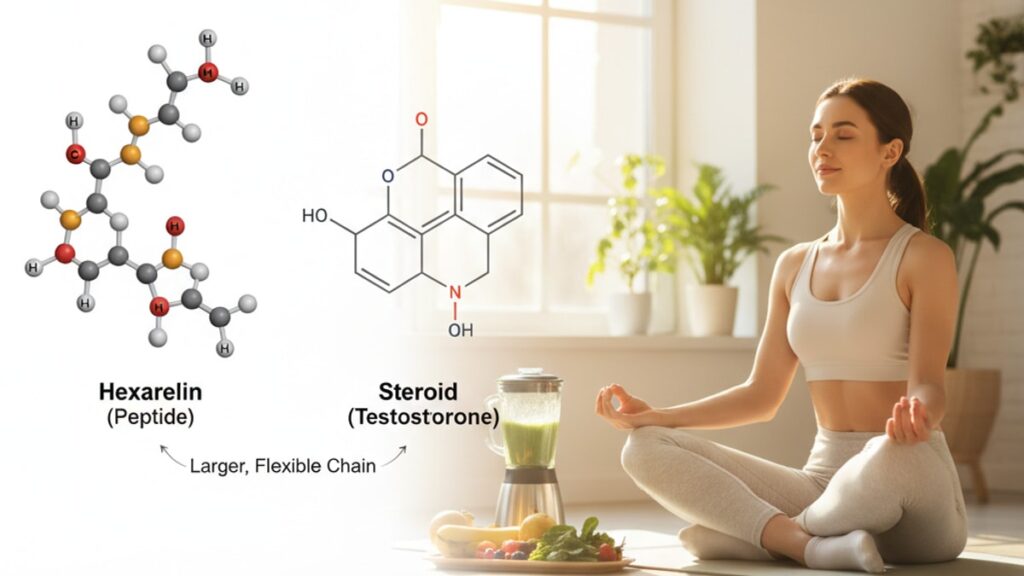
Hexarelin is a synthetic peptide, specifically a hexapeptide, meaning it's a chain built from six amino acids. Its primary identity in the world of biochemistry is that of a Growth Hormone Secretagogue (GHS). Think of it as a highly specific signaling molecule. Its job isn't to be a hormone but to tell your body to release one of its own.
Here’s how it works on a cellular level: Hexarelin binds to and activates a specific receptor called the growth hormone secretagogue receptor 1a, or GHSR-1a. This receptor is most famously located in the pituitary gland, the body's master control center for many hormones. When Hexarelin activates this receptor, it triggers a potent, pulsatile release of endogenous growth hormone (GH). It’s essentially knocking on the pituitary’s door and saying, “Time to release the GH.”
This mechanism makes it one of the most powerful GHS peptides currently studied. It’s structurally similar to other well-known compounds like GHRP-6 and GHRP-2, but its efficacy in stimulating GH release is considered substantially greater. The key takeaway here is that Hexarelin promotes the secretion of the body's own growth hormone. It’s an indirect action, a biological request rather than a hormonal replacement.
Now, Let's Define Anabolic Steroids
Anabolic-Androgenic Steroids (AAS) are an entirely different class of compounds. They are synthetic derivatives of testosterone, the primary male sex hormone. Where Hexarelin is a signaling peptide, a steroid is a direct-acting hormonal agent. It doesn't ask the body to do anything; it forces a specific action.
Anabolic steroids work by diffusing across a cell’s membrane and binding directly to androgen receptors (AR) located within the cytoplasm of that cell. Once this steroid-receptor complex is formed, it travels into the cell's nucleus and binds to DNA. This action directly initiates a cascade of events leading to increased protein synthesis—the fundamental process behind muscle tissue repair and growth. They are, in essence, a brute-force method for triggering anabolism.
This direct binding to androgen receptors is the hallmark of a steroid. It’s also the source of their androgenic effects, which are the masculinizing characteristics associated with testosterone (e.g., body hair growth, deepening voice). The mechanism is direct, powerful, and system-wide, impacting every cell in the body that has an androgen receptor. This is a far cry from the targeted signaling action of a peptide like Hexarelin.
The Core Differences: A Side-by-Side Breakdown
To truly appreciate the distinction, it helps to see the characteristics laid out side-by-side. Our team often uses this framework to help researchers grasp the fundamental separation between these two classes of molecules. The differences aren't just subtle—they are chasms in biochemical philosophy.
| Feature | Hexarelin (Peptide GHS) | Anabolic Steroids (AAS) |
|---|---|---|
| Chemical Structure | Chain of 6 amino acids (a peptide) | Synthetic derivative of testosterone (a lipid) |
| Primary Mechanism | Binds to GHSR-1a to stimulate pituitary GH release | Binds directly to androgen receptors to initiate protein synthesis |
| Hormonal Source | Endogenous (stimulates the body's own GH production) | Exogenous (introduces a synthetic hormone into the body) |
| Target Receptors | Growth Hormone Secretagogue Receptor (GHSR) | Androgen Receptor (AR) |
| Key Biological Action | Secretagogue (promotes secretion) | Agonist (directly activates a receptor) |
| Regulatory Pathway | Utilizes the ghrelin signaling pathway | Directly manipulates the endocrine system's hormonal balance |
| Feedback Loop | Can cause pituitary desensitization over time | Suppresses the HPTA, shutting down natural testosterone production |
Looking at this table, the distinction becomes crystal clear. Hexarelin works with the body’s existing hormonal systems, prompting them into action. Steroids override these systems, replacing natural signals with a powerful, synthetic one. This is the single most important difference a researcher must understand. It dictates everything from the compound's potential applications to its side effect profile.
Why the Widespread Confusion?
So, if they're so different, why does the question “is hexarelin a steroid” even exist? As we touched on earlier, it comes down to a handful of overlapping, surface-level effects that can be observed in research settings. Both can contribute to:
- Increased Muscle Mass: Hexarelin accomplishes this indirectly via elevated GH and subsequent IGF-1 levels, which promote cellular growth and repair. Steroids do this directly by binding to androgen receptors in muscle tissue and forcing protein synthesis.
- Fat Loss: Elevated GH levels can boost metabolism and encourage lipolysis (the breakdown of fats). Similarly, the powerful anabolic environment created by steroids often results in a leaner body composition.
- Enhanced Recovery: Both GH/IGF-1 and testosterone play critical roles in tissue repair. By elevating levels of these hormones (through very different means), both classes of compounds can be observed to reduce recovery time in study subjects.
An untrained eye might see these similar outcomes and incorrectly group the compounds together. But this is a classic case of correlation not equaling causation—or in this case, similar results not equaling a similar mechanism. It's a nuance that we can't stress enough. For any research to be considered valid, it must be predicated on a correct understanding of the molecule's classification and mechanism of action. Sourcing pure, accurately identified compounds is the first step. That’s why at Real Peptides, our entire process, from small-batch synthesis to third-party testing, is designed to guarantee that what's on the label is what's in the vial. Period.
The Research Landscape: Beyond Muscle Growth
The scientific inquiry into Hexarelin extends far beyond just anabolism. In fact, some of its most compelling research is in completely different areas, further distancing it from the typical steroid profile. A significant body of research has focused on the cardioprotective effects of Hexarelin. Studies have investigated its potential to mitigate damage to heart tissue, improve cardiac function after ischemic events, and interact with different cardiac receptors (like CD36).
This paints a picture of a nuanced signaling molecule with diverse physiological roles. It's not a blunt instrument for muscle growth; it's a specific key for a very particular lock (the GHSR), which happens to have implications for metabolism, recovery, and cardiovascular health. This is a stark contrast to anabolic steroids, whose research is overwhelmingly focused on treating conditions like hypogonadism and muscle-wasting diseases, or their use (and abuse) in athletic performance.
For researchers exploring these novel pathways, the purity of the peptide is everything. Contaminants or incorrectly synthesized sequences could completely invalidate findings, especially in sensitive models of cardiac function. This is why our commitment to verifiable purity across our entire catalog, from metabolic peptides like Tirzepatide to neuroregenerative agents like Cerebrolysin, is so foundational to our mission. If you're studying the subtle effects of a molecule, you need to be certain you're only studying that molecule.
Side Effect Profiles: A Tale of Two Different Worlds
Nothing highlights the difference between Hexarelin and steroids more starkly than their potential side effect profiles. The risks associated with each are a direct reflection of their mechanisms.
Potential Side Effects Associated with Hexarelin Research:
- Increased Cortisol and Prolactin: Hexarelin is known to cause a temporary, dose-dependent rise in these stress and lactation hormones. This is a significant consideration in any research protocol.
- Water Retention: The spike in GH can lead to some degree of water retention, particularly in the initial phases of administration.
- Pituitary Desensitization: This is a crucial point. Continuous, non-pulsatile administration of a powerful GHS like Hexarelin can cause the GHSR receptors to become less responsive over time. The pituitary essentially starts to ignore the signal. This is why research protocols often involve cyclical or pulsed administration to maintain receptor sensitivity.
- Numbness or Tingling: Some reports note transient paresthesia (tingling) in the extremities, a known side effect of sharp increases in growth hormone.
Potential Side Effects Associated with Anabolic Steroid Research:
- HPTA Suppression/Shutdown: This is the big one. Introducing exogenous testosterone signals the Hypothalamic-Pituitary-Testicular Axis (HPTA) to stop its own production. This suppression can be profound and may require a lengthy recovery period.
- Hepatotoxicity: Many oral anabolic steroids are chemically modified to survive first-pass metabolism in the liver, which places significant strain on the organ and can lead to liver damage.
- Cardiovascular Strain: Steroids can negatively impact cholesterol levels (lowering HDL, raising LDL), increase blood pressure, and contribute to ventricular hypertrophy, all of which increase cardiovascular risk.
- Androgenic Effects: These include male pattern baldness, acne, oily skin, and virilization (development of male characteristics) in female subjects.
- Estrogenic Effects: Excess testosterone can be converted to estrogen via the aromatase enzyme, leading to side effects like gynecomastia (development of breast tissue) and severe water retention.
The difference is night and day. Hexarelin's side effects stem from over-stimulating a natural process. Steroids' side effects stem from hijacking and overriding natural processes. Understanding this distinction is absolutely paramount.
The Broader Peptide Universe
It's important to place Hexarelin in its proper context. It’s just one fascinating compound in the vast and rapidly expanding universe of research peptides. This field offers an incredible degree of specificity that older classes of compounds simply can't match. We have peptides being studied for targeted fat loss, like AOD9604, and others for their potential to accelerate wound healing, like the renowned BPC-157 Peptide. There are even complex combinations, like our Wolverine Peptide Stack, designed for multifaceted recovery research.
Each of these molecules, from Tesamorelin to Ipamorelin, operates with a unique mechanism, targeting specific receptors to achieve a precise biological outcome. This is the future of biochemical research: moving away from blunt instruments and toward highly refined tools. For those who want to see these concepts explained more visually, our team often breaks down the mechanisms of different peptides on our YouTube channel, which can be a great resource for grasping these complex topics.
Ultimately, the journey into peptide research is a commitment to understanding nuance. It’s about recognizing that Hexarelin is not a steroid, but rather a sophisticated tool for investigating the intricate GH axis. If your research demands this level of precision and the highest standard of purity, we invite you to explore our full collection of research peptides and see the difference that quality makes. When your results depend on it, there's no room for compromise. Now that you have the facts, you can move forward with clarity. If you're ready to equip your lab with the best, you can Get Started Today.
So, while the initial question might be simple, the answer reveals a deep and important truth about modern biochemistry. Hexarelin is a peptide secretagogue, a world away from the direct hormonal force of an anabolic steroid. Knowing the difference isn't just academic—it's the foundation of good science.
Frequently Asked Questions
Is Hexarelin a steroid?
▼
No, absolutely not. Hexarelin is a synthetic peptide, specifically a growth hormone secretagogue. It works by stimulating the pituitary gland to release its own growth hormone, whereas steroids are synthetic derivatives of testosterone that directly bind to androgen receptors.
What is the main difference between Hexarelin and an anabolic steroid?
▼
The primary difference is their mechanism of action. Hexarelin is an indirect-acting secretagogue that promotes endogenous hormone release. Anabolic steroids are direct-acting exogenous hormones that override the body’s natural systems to force protein synthesis.
Does Hexarelin suppress natural testosterone production?
▼
No, Hexarelin does not affect the Hypothalamic-Pituitary-Testicular Axis (HPTA) and therefore does not suppress the body’s natural production of testosterone. This is a key characteristic that distinguishes it from anabolic steroids.
Why do people confuse Hexarelin with steroids?
▼
The confusion arises because both can lead to similar outcomes, such as increased muscle mass and fat loss. However, they achieve these results through completely different biological pathways. People often group them by effect rather than by their fundamental biochemical nature.
Is Hexarelin considered a SARM?
▼
No, Hexarelin is not a Selective Androgen Receptor Modulator (SARM). SARMs work by selectively binding to androgen receptors, similar to steroids but with more tissue-specificity. Hexarelin does not interact with androgen receptors at all; it targets the ghrelin/GHS receptor.
What are the main potential side effects of Hexarelin in research?
▼
The most noted potential side effects are a temporary increase in cortisol and prolactin levels, some water retention, and the possibility of pituitary desensitization with continuous use. These are vastly different from the severe side effects associated with steroids.
Is Hexarelin’s chemical structure similar to testosterone?
▼
Not in the slightest. Hexarelin is a peptide, which is a chain of amino acids. Testosterone and its derivatives (steroids) are lipids with a specific four-ring carbon structure. Their molecular makeup is entirely different.
Can Hexarelin be used for hormone replacement therapy (HRT)?
▼
Hexarelin is a research compound and not approved for therapeutic use. Its mechanism stimulates GH, not testosterone, so it wouldn’t be a candidate for testosterone replacement therapy. Research into GH-axis stimulation is ongoing for various conditions.
How does Hexarelin compare to other GHRPs like GHRP-6?
▼
Hexarelin is considered one of the most potent growth hormone-releasing peptides (GHRPs). While it shares a similar mechanism with GHRP-6 and GHRP-2, it typically elicits a stronger GH pulse per microgram. However, it also tends to cause a more significant rise in cortisol and prolactin.
Do you need Post Cycle Therapy (PCT) after researching Hexarelin?
▼
No, Post Cycle Therapy (PCT) is a protocol used to help restore natural testosterone production after it has been suppressed by anabolic steroids. Since Hexarelin does not suppress the HPTA, a PCT is not necessary.
Is Hexarelin legal to purchase for research?
▼
Yes, Hexarelin is legal to purchase and possess for laboratory and research purposes only. It is not approved by the FDA for human consumption. At Real Peptides, we supply high-purity [Hexarelin](https://www.realpeptides.co/products/hexarelin/) strictly for in-vitro research applications.
