


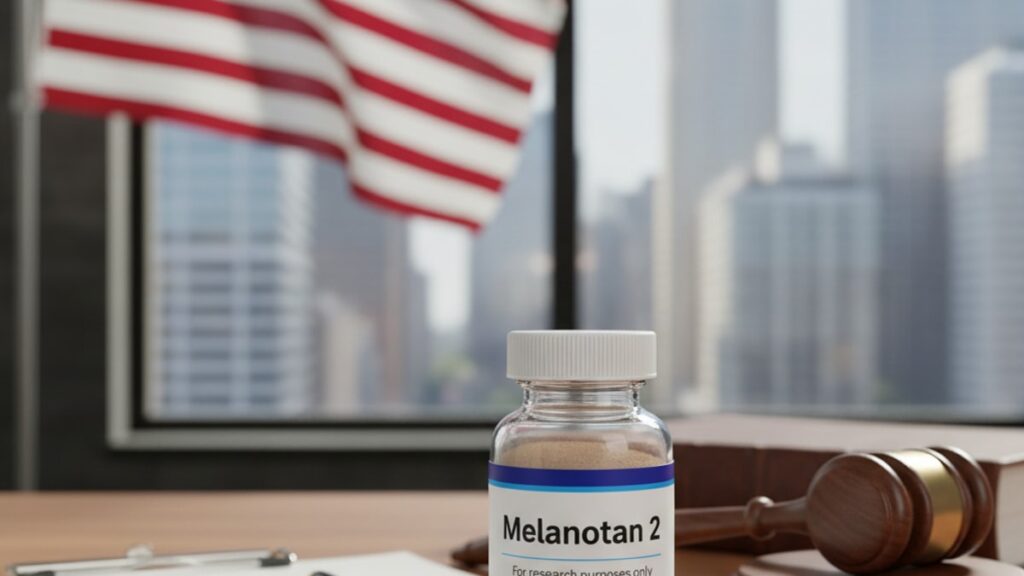
Let's get straight to it. The question of whether Melanotan 2 is legal in the US isn't a simple yes or no. It's a sprawling, nuanced issue tangled in a web of FDA regulations, state laws, and the critical, often misunderstood, world of research chemicals. Our team fields questions about this constantly, and we see a ton of conflicting, and frankly, dangerous information floating around online. It’s confusing, and when it comes to compounds you might introduce into a lab setting—or that others might consider for personal use—confusion is the last thing you need.
Our goal here isn't to give you a vague, fence-sitting answer. As a company dedicated to providing high-purity, research-grade peptides, we believe in clarity and uncompromising standards. We're here to cut through the noise and give you an unflinching look at the legal and regulatory landscape surrounding Melanotan 2 (MT2). This is about understanding the rules, the risks, and the reasons behind them, so you can make informed decisions grounded in fact, not forum speculation.
So, What Exactly is Melanotan 2?
Before we dive into the legal maze, it's crucial to understand what we're talking about. Melanotan 2 is a synthetic peptide, a lab-created analog of a naturally occurring hormone called alpha-melanocyte-stimulating hormone (α-MSH). In the body, α-MSH plays a central role in stimulating melanogenesis—the process that produces melanin, the pigment responsible for skin color. More melanin means darker skin. Simple, right?
Well, mostly. The synthetic version, MT2, was originally developed at the University of Arizona in the 1980s with a noble goal: to find a way to prevent skin cancer by inducing a protective tan without exposure to harmful UV radiation. It was designed to be a more potent and stable version of the natural hormone. Its sibling, Melanotan 1, is a more direct, linear analog of α-MSH, while Melanotan 2 has a slightly different structure that allows it to bind to a broader range of melanocortin receptors. This broader action is key; it's why MT2 is associated with effects beyond just tanning, including increased libido, appetite suppression, and other metabolic changes. This multifaceted impact is what makes it a fascinating compound for researchers but also a source of significant concern for regulators.
The Core Question: Is Melanotan 2 Legal in the US?
Here’s the bottom line, and we can't stress this enough: The U.S. Food and Drug Administration (FDA) has not approved Melanotan 2 for human use. It cannot be legally manufactured, marketed, or sold as a drug, a cosmetic, a supplement, or for any form of human consumption.
That's the hard line.
Any website or vendor selling MT2 with claims about tanning, sexual enhancement, or weight loss is breaking the law. The FDA has issued numerous warning letters over the years to companies making such claims, and they've been very clear about their position. From their perspective, it's an unapproved new drug with unproven safety and efficacy. End of story.
But wait. If that's the case, why can you find it for sale online? This is where the labyrinth of chemical regulations begins. The legality of Melanotan 2 hinges entirely on its intended use. It can be legally synthesized, sold, and purchased in the United States under one, and only one, condition: it must be intended for in-vitro research and laboratory experimentation only.
This is the so-called "research chemical loophole." It's not really a loophole but rather a separate regulatory category. Companies like ours, Real Peptides, operate squarely within this framework. We synthesize high-purity peptides, including MT2, for scientists, universities, and research institutions conducting legitimate studies. Every vial we ship is clearly labeled "For Research Purposes Only" and "Not for Human Consumption." This isn't just fine print; it's the legal and ethical foundation of our business. The moment the intended use shifts from laboratory research to personal use, the legal status changes dramatically—and dangerously.
Think of it like this: a lab can legally purchase pure ethanol for experiments. But if the lab technician starts selling it as a beverage, they've crossed a serious legal line. The substance is the same; the intent is everything.
Why Hasn't the FDA Approved It?
It's a fair question. If it was developed decades ago, why is it still languishing in regulatory purgatory? The reasons are multifaceted and center almost exclusively on safety.
First, there has never been a comprehensive, large-scale clinical trial for Melanotan 2 that meets the FDA's rigorous standards. The existing data comes from small-scale studies, anecdotal reports, and animal models. That's simply not enough evidence for an agency tasked with protecting public health to grant approval. Without robust data, the full spectrum of its effects and long-term risks remains largely unknown.
Second, the known side effects are significant. Users frequently report a range of acute reactions, including:
- Nausea and Vomiting: This is one of the most common and immediate side effects, often occurring shortly after administration.
- Facial Flushing: A sudden reddening and feeling of warmth in the face and neck.
- Loss of Appetite: While some researchers study this for its potential therapeutic effects, it's a significant side effect for general use.
- Spontaneous Erections (in males): This effect led to the development of a separate, FDA-approved drug, Bremelanotide (PT-141), for female sexual dysfunction. But as an unsolicited side effect of MT2, it's a concern.
- Increased Blood Pressure: Some studies and reports have linked MT2 use to temporary spikes in blood pressure.
Beyond these immediate effects, the most formidable concern is its potential link to melanoma, the most serious type of skin cancer. Since MT2 works by stimulating melanocytes (the melanin-producing cells), there's a theoretical risk that it could also promote the growth of existing, undiagnosed melanoma or cause changes in moles. While a direct causal link hasn't been definitively proven in large-scale human trials (because they haven't happened), the biological plausibility is strong enough to give regulators serious pause. It's a risk the FDA is simply unwilling to take without overwhelming evidence of safety, which does not exist.
Understanding the "Not for Human Consumption" Label
That little label is everything. For a legitimate research chemical supplier, it's a declaration of legal and ethical boundaries. For a buyer, it should be a clear and unambiguous warning. When you see "For Research Purposes Only," it means the product has not been manufactured to pharmaceutical-grade standards for human safety. It hasn't been tested for sterility, stability in the human body, or long-term health effects.
Our team has seen firsthand what happens when this line is blurred. The internet is filled with unregulated sellers who slap on this label as a thin veil of legitimacy while winking at the buyer through their marketing. This is where the danger escalates exponentially. These sources often operate without any quality control. What are you actually getting?
It could be the right compound but at the wrong dose. It could be contaminated with bacterial endotoxins from a non-sterile manufacturing process. It could contain residual solvents from sloppy synthesis. Worst of all, it might not even be Melanotan 2. We've heard horror stories. This is why our commitment at Real Peptides to small-batch synthesis and third-party purity testing isn't just a marketing point; it's a critical, non-negotiable element of our operation. Researchers need to know that the Tirzepatide or Semax they are studying is exactly what it claims to be, down to the amino acid sequence. The same standard must apply to every compound in our catalog.
Buying a substance intended for human use from a source that explicitly states it's not for human use is a catastrophic gamble. You're putting your trust in an entity that is, by its very business model, operating in a legal and ethical gray zone. There's no oversight, no accountability, and no recourse if something goes wrong.
Melanotan 2 vs. Approved Alternatives: A Clear Comparison
To put the legal and safety differences in stark relief, it’s helpful to compare MT2 to a compound that successfully navigated the FDA approval process. Bremelanotide (sold as Vyleesi) is a perfect example, as it's a direct descendant of Melanotan 2 research.
| Feature | Melanotan 2 (MT2) | Bremelanotide (Vyleesi / PT-141) |
|---|---|---|
| Legal Status (US) | Unapproved by FDA. Legal for research only. | FDA-approved prescription drug. |
| Primary Indication | None (Investigational for tanning/libido). | Treatment of hypoactive sexual desire disorder (HSDD) in premenopausal women. |
| Mechanism | Binds to multiple melanocortin receptors (MC1R, MC3R, MC4R, MC5R). | More selective, primarily targeting MC3R and MC4R, with less effect on MC1R. |
| Known Side Effects | Nausea, flushing, tanning, blood pressure changes, potential melanoma risk. | Nausea, flushing, headache, injection site reactions. Tanning effect is minimal. |
| Regulation & QC | Unregulated market. Purity and safety vary wildly. | Manufactured under strict cGMP standards. Consistent dosage and purity. |
| Availability | Sold by research chemical suppliers. | Requires a prescription from a licensed healthcare provider. |
This table makes the distinction crystal clear. One is a regulated pharmaceutical with a specific, approved use and a known safety profile. The other is an unregulated chemical with unknown long-term risks, confined to laboratory settings for a reason. Our research-grade PT-141 Bremelanotide is available for scientists studying these mechanisms, but it exists in a completely different legal universe from its FDA-approved counterpart.
The Risks of Buying from Unverified Sources
Let's be blunt. The gray market for peptides is a minefield. When you venture outside of established, reputable suppliers, you are taking a significant, sometimes dramatic, risk. We've built our entire business at Real Peptides on the principle of verifiable quality because we know what the alternative looks like.
Unverified sellers often source their raw materials from the cheapest possible overseas manufacturers with zero oversight. There's no quality control, no batch testing, and no guarantee of purity or even identity. A certificate of analysis can be easily forged. What does this mean for a researcher? It means your experiment is invalid before it even begins. If you're studying the effects of TB-500 on cellular migration, but your vial is only 70% pure, your data is useless. It’s a waste of time, grants, and resources.
For an individual considering personal use, the stakes are infinitely higher. An impure product could lead to a severe allergic reaction, infection from bacterial contamination, or unknown toxic effects from chemical byproducts. It's a game of Russian roulette. Our experience shows that consistency and purity are paramount. That’s why we focus on small-batch synthesis, allowing for meticulous quality control at every step. It’s more expensive and time-consuming, but it's the only way to guarantee that what's on the label is what's in the vial. Whether it's a complex peptide like our Wolverine Peptide Stack or a foundational compound like BPC-157, the standard has to be absolute.
The Future of Melanocortin Receptor Agonists in Research
Despite the legal issues surrounding its unsanctioned use, Melanotan 2 and other melanocortin receptor agonists remain subjects of intense scientific interest. The very properties that make MT2 risky for casual use make it a powerful tool for researchers. Scientists are exploring its potential to influence:
- Metabolism and Appetite: The MC4 receptor is a key regulator of energy homeostasis. Compounds that target it are being investigated as potential treatments for obesity and metabolic syndrome.
- Sexual Function: The research that led to Bremelanotide continues, with scientists exploring how these pathways influence sexual arousal and function in both men and women.
- Neuroinflammation and Brain Injury: Some studies suggest that melanocortin agonists may have neuroprotective and anti-inflammatory effects, opening doors for research into conditions like stroke and traumatic brain injury.
- Autoimmune Conditions: By modulating inflammatory pathways, these peptides could be investigated for their role in managing certain autoimmune disorders.
This is the legitimate frontier of peptide science. It's where progress is made carefully, methodically, and safely in controlled laboratory environments. For a more visual breakdown of some of these complex scientific mechanisms, our team often recommends video resources; you can explore our YouTube channel for content that delves into the science behind various research compounds.
Providing pure, reliable molecules to the researchers doing this vital work is our mission. It’s about enabling discovery, not encouraging reckless personal experimentation. When you're ready to conduct serious research, we're here to help you Get Started Today with materials you can trust.
The story of Melanotan 2 is a powerful case study in the divide between scientific potential and public safety. It’s a compound with fascinating biological activity that has been co-opted by an unregulated market for cosmetic and lifestyle purposes. The answer to "is it legal?" is, therefore, a firm "it depends." For a researcher in a lab coat, obtaining it for an experiment is legal. For an individual buying it for a pre-beach tan, its possession and use exist in a perilous legal gray area, and its purchase from a non-reputable source is an invitation for disaster.
Ultimately, the law is built around intent and safety. Until Melanotan 2 can be proven safe and effective for a specific medical use through the FDA's rigorous approval process, it will remain firmly in the realm of research. Understanding this distinction isn't just about following the law—it's about respecting the scientific process and prioritizing health and safety above all else.
Frequently Asked Questions
Is it illegal to buy Melanotan 2 online in the US?
▼
It is legal to purchase Melanotan 2 online in the US only if it’s intended for legitimate laboratory and research purposes. Buying it for personal use, such as tanning or libido enhancement, is not its legal purpose and falls into a significant legal gray area.
Can a doctor prescribe Melanotan 2 in the USA?
▼
No. Since Melanotan 2 is not an FDA-approved drug, a doctor cannot legally prescribe it for any medical or cosmetic purpose in the United States. Any prescription for it would be invalid.
What is the main difference between Melanotan 1 and Melanotan 2?
▼
Melanotan 1 is a linear peptide that primarily targets the MC1R receptor to stimulate melanin production. Melanotan 2 has a cyclic structure that allows it to bind to a broader range of melanocortin receptors, causing additional effects like increased libido and appetite suppression.
Is Melanotan 2 a steroid?
▼
No, Melanotan 2 is not a steroid. It is a synthetic peptide, which is a short chain of amino acids. Its mechanism of action is completely different from anabolic steroids, as it works by stimulating hormone receptors related to pigmentation.
Are there any FDA-approved tanning injections?
▼
No, the FDA has not approved any injectable drugs for the purpose of skin tanning. The only approved product derived from this research is Bremelanotide (Vyleesi), which is approved for female sexual dysfunction, not tanning.
Why do companies sell MT2 if it’s not for human use?
▼
Reputable companies like Real Peptides sell Melanotan 2 strictly for in-vitro research and laboratory experimentation. This is a legal and distinct market that supplies scientists and institutions studying its properties in a controlled, non-human setting.
What are the legal risks of being caught using Melanotan 2?
▼
While possession for personal use isn’t typically a high-priority crime, it exists in a legal gray area. The primary legal risk falls on those who sell and market it for human consumption. However, users could face issues if state laws are stricter or if they are found to be distributing it.
Are tanning nasal sprays with Melanotan 2 legal?
▼
No. Any product, whether an injection or a nasal spray, that contains Melanotan 2 and is marketed for human use (like tanning) is considered an unapproved drug by the FDA and is illegal to sell in the US.
Is Melanotan 2 legal in other countries like the UK or Australia?
▼
The legality varies, but many countries have similar restrictions. In Australia and the UK, for example, it is illegal to sell and supply Melanotan 2 for cosmetic purposes, and authorities have issued strong warnings against its use.
How can I verify the purity of a research peptide?
▼
Always purchase from a reputable supplier that provides recent, third-party lab testing results, like a Certificate of Analysis (COA), for each batch. At Real Peptides, we believe in this transparency as a cornerstone of providing reliable research materials.
What does ‘for research purposes only’ actually mean?
▼
This label signifies that the product is a chemical intended for laboratory experiments, such as in-vitro (in glass, like a petri dish) or animal studies. It means the substance is not sterile, purified, or tested for safety in humans.
Does Real Peptides test its Melanotan 2 for purity?
▼
Absolutely. Every batch of every peptide we synthesize, including our [Melanotan 2](https://www.realpeptides.co/products/melanotan-2-mt2-10mg/), undergoes rigorous testing to confirm its identity, purity, and quality. We provide these results to ensure researchers have complete confidence in their materials.
