





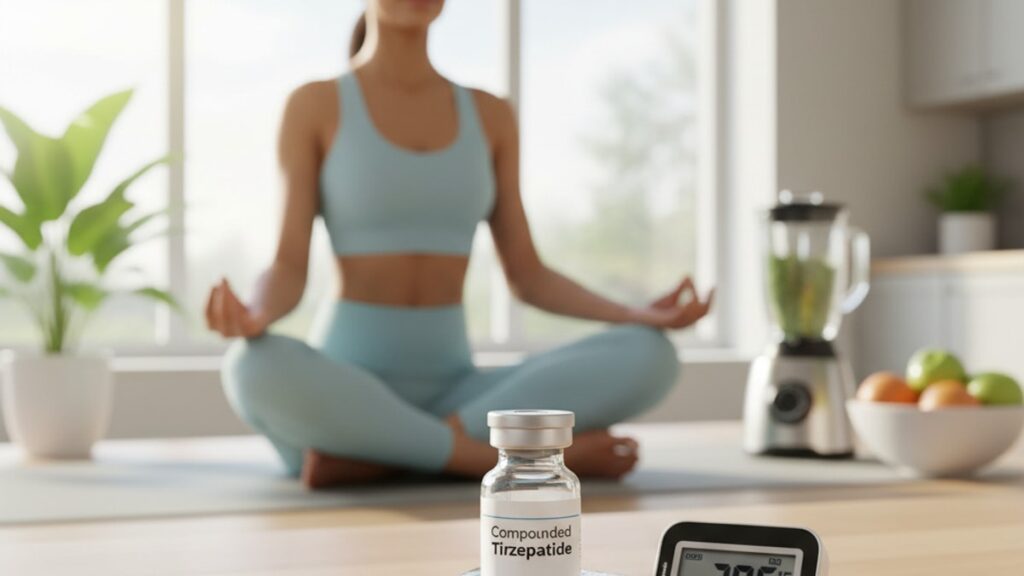
It’s a question our team hears all the time, often whispered with a hint of panic. You’re traveling, the power goes out, or maybe you just forgot to put it back after your research application. Suddenly, you’re staring at the vial on the counter and wondering, “Is it ruined?” The question of how long can compounded tirzepatide be out of the fridge isn't just about convenience; it’s about protecting the integrity of a sophisticated research compound. And let’s be honest, it’s about safeguarding your investment and ensuring the reliability of your data.
Here at Real Peptides, we live and breathe peptide science. Our entire process, from meticulous small-batch synthesis to rigorous quality control, is designed to deliver peptides of the highest purity and stability, like our research-grade Tirzepatide. But even the most impeccably crafted peptide is, at its core, a delicate chain of amino acids. Understanding how environmental factors affect that chain is not just good practice—it's a critical, non-negotiable element of responsible research. So, let’s get into the real-world science behind tirzepatide's stability and give you the clear, authoritative answers you need.
First, Why Is Compounded Tirzepatide Different?
This is the absolute first thing to understand. When you see storage guidelines for a major brand-name drug, those recommendations are based on millions of dollars in stability studies conducted by the manufacturer. They’ve tested the final, approved product in its specific vial, with its specific preservatives, under a sprawling range of conditions. That data is proprietary and applies only to their finished product.
Compounded tirzepatide is different. It's prepared by a compounding pharmacy for specific research needs. This means the formulation might vary. The concentration could be different, and crucially, the preservatives—or lack thereof—can significantly change the stability profile. Our experience shows that while the core tirzepatide molecule is the same, you're now dealing with a unique preparation. This is why you can't simply apply the manufacturer's storage guidelines to a compounded version. You're in a different ballpark.
Because of this, the general consensus in the research community leans toward a more conservative approach. We can't stress this enough: when in doubt, err on the side of caution. The integrity of your research depends on the viability of the compounds you use. At Real Peptides, we ensure the lyophilized (freeze-dried) powder you receive is in its most stable state. The clock really starts ticking once you reconstitute it with Bacteriostatic Water.
The Science of Peptide Degradation: What’s Happening in That Vial?
To really grasp the time limits, you need to understand why refrigeration is so important. Peptides aren't like simple chemical compounds. They are biological molecules, and they are susceptible to a few key enemies.
1. Temperature (The Obvious Culprit): Heat is kinetic energy. When you introduce heat to a vial of tirzepatide, you're essentially making the molecules vibrate and move faster. This increased energy can be enough to break the fragile peptide bonds that hold the amino acid chain together in its specific, functional shape. Think of it like a delicate ice sculpture. In a freezer, it's stable. On a warm counter, it begins to lose its structure and, eventually, melts into a puddle. For a peptide, this “melting” means it loses its biological activity. The higher the temperature, the faster this degradation occurs. It's an exponential process.
2. Microbial Contamination: This is a huge factor, especially for reconstituted peptides. The moment you introduce liquid—even sterile bacteriostatic water—you've created a potential environment for bacteria or fungi to grow. Refrigeration dramatically slows down the reproductive cycle of most common microbes. At room temperature, however, a single stray bacterium can multiply into a colony surprisingly fast, contaminating your entire vial and rendering it useless and unsafe for any application. This is why proper sterile technique during reconstitution is just as important as storage.
3. Agitation and Light: While temperature is the primary concern, other factors play a role. Vigorous shaking or agitation can physically shear the peptide chains, a process called mechanical degradation. This is why we always recommend gently rolling the vial to mix, not shaking it like a cocktail. Furthermore, exposure to UV light can also provide the energy needed to break down peptide bonds over time. It's a less aggressive process than heat, but it's cumulative. Storing the vial in its box or in a dark part of the fridge helps mitigate this.
So, when your vial is sitting on the counter, it’s fighting a multi-front battle against heat, potential microbes, and light. Keeping it refrigerated is its primary defense system.
So, How Long Is Too Long?
Here’s the practical, no-nonsense answer you’re looking for, based on established biochemical principles and extensive experience within the research community. We need to break this down into two scenarios: the lyophilized (powder) form and the reconstituted (liquid) form.
Lyophilized (Freeze-Dried) Powder:
This is the most stable state for any peptide. Before reconstitution, a vial of lyophilized tirzepatide is quite resilient. It can typically withstand being at room temperature for several days, even up to a week, without significant degradation. This is why shipping them without cold packs is standard practice for high-quality suppliers like us. The lack of water prevents microbial growth and slows chemical breakdown. However, for long-term storage, you should absolutely keep it in the freezer to maximize its shelf life, which can be years in this state.
Reconstituted (Liquid) Tirzepatide:
This is where things get critical. Once you've added bacteriostatic water, the peptide is far more fragile.
-
The General Rule: The widely accepted standard in the research community is that reconstituted tirzepatide should not be left at room temperature (around 68-77°F or 20-25°C) for more than 8 hours. Some might stretch this to 12 hours, but our team recommends the 8-hour window as a safer limit to ensure minimal potency loss.
-
The Absolute Maximum: Is there a hard cutoff where it becomes completely inert? It’s a gradient of degradation, not an on/off switch. However, after 24 hours at room temperature, you can assume significant degradation has occurred. The potency will be compromised, and the risk of microbial growth increases dramatically, even with bacteriostatic water. We would strongly advise against using a vial that has been left out for this long in any serious research application. The results would simply be unreliable.
Think of it this way: every hour it spends out of the fridge, a small percentage of its effectiveness is potentially lost. The first few hours are likely negligible. But as the hours stack up, the loss accelerates. It's a game of diminishing returns you don't want to play with sensitive research compounds.
A Quick Comparison of Storage Scenarios
Let's visualize how these factors impact the peptide's integrity. This is a simplified model, but it illustrates the core principles our team uses when advising researchers.
| Scenario | Temperature | Risk of Degradation | Risk of Contamination | Our Recommendation |
|---|---|---|---|---|
| Reconstituted, In Fridge | 36-46°F (2-8°C) | Very Low | Very Low | Ideal Storage. Use within the timeframe specified by the compounding pharmacy (typically 30-60 days). |
| Reconstituted, Room Temp < 8hr | ~72°F (22°C) | Low to Moderate | Low | Acceptable for temporary situations. Return to the fridge as soon as possible. Potency should be largely intact. |
| Reconstituted, Room Temp > 24hr | ~72°F (22°C) | High | Moderate to High | Not Recommended. Assume significant potency loss and potential contamination. Discard for reliable research. |
| Left in a Hot Car > 2hr | 100°F+ (38°C+) | Very High | High | Catastrophic. The peptide is almost certainly compromised. Do not use. Discard immediately. |
| Lyophilized Powder, Room Temp | ~72°F (22°C) | Very Low | Negligible | Safe for shipping/short term. For long-term storage (months/years), transfer to a freezer. |
This table really puts it into perspective. The difference between a few hours and a full day is not trivial—it's the difference between a viable compound and a questionable one.
Real-World Scenarios: Travel, Power Outages, and Mistakes
Knowing the science is one thing. Applying it when life happens is another. Let's walk through some common situations.
Scenario 1: Air Travel
You have a flight and need to bring your reconstituted tirzepatide. What do you do? Panic is not the answer. Preparation is.
- The Solution: Invest in a small, high-quality medical travel cooler. These are insulated cases that often come with reusable ice packs. A good one can easily keep the vial at the correct refrigerated temperature for 12-24 hours, more than enough for most travel days.
- TSA/Security: Keep the peptide in its original labeled vial. While regulations can vary, it's generally fine to travel with research compounds for personal use, but keeping them clearly labeled and separate can smooth the process. Never put it in checked luggage. The temperature fluctuations and potential for lost baggage are far too high a risk. Always carry it on.
Scenario 2: The Power Goes Out
The power is out for an unknown amount of time. Your fridge is slowly warming up.
- The Solution: First, don't open the fridge door. A closed refrigerator can maintain its cool temperature for about 4-6 hours. If the outage is short, you're likely fine. If it's projected to last longer, it's time for a backup plan. Have a small cooler and some ice packs on hand. You can transfer the vial to the cooler to ride out the outage. If you don't have a cooler, a simple insulated lunch bag with a frozen gel pack can work in a pinch.
Scenario 3: You Just Forgot
You did your work, got distracted, and realized the vial has been sitting on your desk for 5 hours. Deep breaths.
- The Solution: Based on our 8-hour rule of thumb, you are likely okay. The degradation in that timeframe should be minimal. Immediately place it back in the fridge. Don't put it in the freezer to 'quick cool' it—freezing and thawing a reconstituted peptide can also damage it. Just put it back in the main body of the fridge and continue your protocol as normal. To prevent this, our team suggests creating a habit: make putting the vial away the very last step of your process, a non-negotiable final check before you walk away.
Ultimately, the goal is to minimize the total cumulative time the vial spends at room temperature over its lifespan. A few hours here and there might be unavoidable, but consistently leaving it out will undoubtedly shorten its effective life and impact your results.
The Real Peptides Commitment to Quality
This entire discussion about stability underscores why starting with the highest quality peptide is so important. A peptide that begins with 99%+ purity, like those across our full range of research compounds, has a much better starting point. It's free from contaminants and byproducts of synthesis that could accelerate degradation. Our small-batch synthesis process ensures that every vial we ship meets this exacting standard.
When you're asking how long can compounded tirzepatide be out of the fridge, you're really asking about preserving the tool you're using for your research. The quality of that tool is paramount. It’s why we’ve dedicated our entire business to providing researchers with compounds they can trust, from popular peptides like BPC 157 and CJC1295 Ipamorelin to more specialized molecules. If you're ready to see the difference that impeccable purity makes in your research, it's easy to Get Started Today.
The bottom line is this: treat your reconstituted peptides with the same care you would treat a carton of milk. You wouldn't leave milk on the counter all day and expect it to be fine. While a peptide won't spoil in the same way, the principle of temperature-dependent stability is identical. Protect your compounds, and you'll protect the integrity of your hard work.
FAQs
Frequently Asked Questions
Can I pre-fill syringes with tirzepatide for the week?
▼
We generally advise against this. Pre-filling syringes increases the surface area exposed to potential contaminants and the plastic of the syringe itself. It’s always best practice to draw from the sterile vial just before application for maximum purity and potency.
What does degraded tirzepatide look like?
▼
Often, there are no visual cues. The liquid may remain clear. Sometimes it might become cloudy, which is a definite sign of contamination or degradation and means you should discard it immediately. The lack of visual change is why adhering to storage guidelines is so critical.
Is it better to store reconstituted tirzepatide in the fridge door or the back?
▼
Store it in the main body of the refrigerator, preferably towards the back. The temperature in the fridge door fluctuates the most due to it being opened frequently. The back of the fridge provides a more stable, consistently cold environment.
Does freezing a reconstituted vial of tirzepatide extend its life?
▼
No, we don’t recommend this. The process of freezing and thawing can cause the peptide molecules to expand and contract, which can damage their structure. Lyophilized (powder) peptides should be frozen for long-term storage, but once reconstituted, they should only be refrigerated.
How long is the lyophilized (powder) form of tirzepatide stable at room temperature?
▼
The freeze-dried powder is quite stable. It can easily handle several days, even up to a week or more, at room temperature during shipping without significant degradation. For long-term storage of months or years, however, it must be kept in a freezer.
I left my vial out for 10 hours. Is it completely useless?
▼
It’s not ideal, as it’s beyond our recommended 8-hour window. While not completely useless, you should assume some level of degradation and potency loss has occurred. For critical research, it would be best to start with a fresh vial to ensure data accuracy.
What is the ideal temperature for refrigerating compounded tirzepatide?
▼
The ideal temperature is standard medical refrigeration, which is between 36°F and 46°F (2°C to 8°C). This temperature is cold enough to slow molecular and microbial activity without risking freezing.
Does light really damage tirzepatide?
▼
Yes, prolonged exposure to UV light can degrade peptides over time. While it’s less of an immediate threat than heat, it’s a contributing factor. We recommend keeping the vial in its original box or a dark container within the fridge to protect it.
Why can’t I just shake the vial to mix it?
▼
Vigorous shaking creates mechanical stress that can physically break the delicate peptide chains, rendering them inactive. Always reconstitute by gently rolling the vial between your hands until the powder is fully dissolved.
Can I use a different kind of water to reconstitute tirzepatide?
▼
You should only use bacteriostatic water, which contains a small amount of benzyl alcohol as a preservative. Using sterile water means there is no agent to prevent bacterial growth, drastically shortening the vial’s safe-use lifespan.
If my vial arrives warm from shipping, is it damaged?
▼
No, this is perfectly fine for lyophilized (powder) peptides. They are shipped in this stable state and can handle ambient temperatures for the duration of transit without any issue. You should, however, place it in the freezer upon arrival for long-term storage.











