





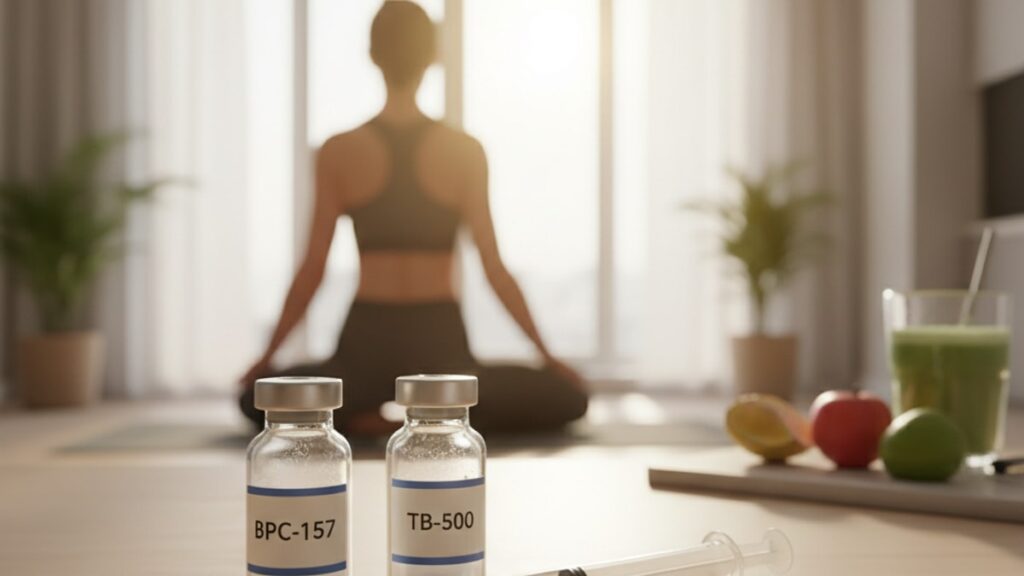
When it comes to advanced peptide research, precision isn't just a goal; it's the entire foundation. We've seen a huge surge in inquiries about combining specific peptides for synergistic studies, and the BPC 157 and TB 500 combination is consistently at the top of that list. Researchers are exploring their combined potential, and that exploration demands an impeccable understanding of the preparation process. It’s not just about mixing two substances; it's about preserving the integrity of complex amino acid chains to ensure your study's data is valid and reproducible.
Our team at Real Peptides has spent years perfecting synthesis and handling protocols, not just for our own quality control but to support the scientific community we serve. We believe that providing exceptional, high-purity peptides is only half the job. The other half is sharing the expertise needed to handle them correctly. This isn't about giving advice for use—we're here to provide a clear, professional, lab-grade protocol for reconstituting and mixing these two powerful research compounds. Let's get this right.
Why Researchers Combine BPC 157 and TB 500
Before we dive into the mechanics of mixing, it helps to understand the scientific rationale driving researchers to study these two peptides together. They operate on fascinatingly different, yet complementary, pathways. Think of it this way: BPC 157 Peptide is often studied for its localized effects. It's a stable gastric pentadecapeptide that has shown a remarkable ability in preclinical studies to promote healing and regeneration at specific sites of injury. It's the targeted specialist.
On the other hand, TB 500, or Thymosin Beta-4, is the systemic operator. It's a naturally occurring peptide found in virtually all human and animal cells. Its primary role is to upregulate proteins like actin, which is critical for cell migration, proliferation, and differentiation. In research, this translates to a broad, body-wide potential for tissue repair, inflammation modulation, and angiogenesis (the formation of new blood vessels). It works everywhere.
The hypothesis for combining them is straightforward yet profound: you get the targeted, potent action of BPC 157 at a specific research site, supported by the systemic, foundational healing environment fostered by TB 500. It’s a compelling one-two punch that has captured the attention of researchers globally. But to study this potential synergy effectively, the preparation has to be flawless. Any misstep in the mixing process can degrade the peptides, alter their concentrations, and ultimately render an entire experiment's data useless. We can't stress this enough: the work you do in the lab before administration is just as critical as the study itself.
Sourcing Your Materials: The Non-Negotiable First Step
Let’s be brutally honest. If you start with low-purity or improperly synthesized peptides, nothing else you do matters. Your calculations can be perfect, your technique impeccable, but your results will be compromised from the start. This is the single biggest point of failure we see in research efforts outside of major institutional labs.
Peptides like BPC 157 and TB 500 are delivered in a lyophilized state—a fancy term for freeze-dried. This process removes water, making the delicate amino acid structures stable for shipping and storage. When you receive them, they should be a solid, white puck or powder at the bottom of a sealed vial. At Real Peptides, every batch undergoes rigorous third-party testing to confirm its purity, sequence, and concentration because we know that researchers depend on that guarantee. It's the bedrock of reliable science.
Here’s what you absolutely need before you even think about mixing:
- High-Purity Peptides: Your vials of BPC 157 Peptide and TB 500. Ensure they come with certificates of analysis (COAs) confirming their purity.
- Bacteriostatic Water: This is sterile water mixed with 0.9% benzyl alcohol, which acts as a preservative. This is a critical, non-negotiable element. Using sterile water or, worse, tap water will lead to bacterial growth and rapid degradation of your peptides. We supply high-quality Bacteriostatic Water specifically for this purpose.
- Insulin Syringes: You'll need at least two. One for reconstituting the peptides and another for measuring and administering the research dose. Look for syringes calibrated in international units (IU) or milliliters (mL) for easy, accurate measurements.
- Alcohol Prep Pads: For sterilizing the vial stoppers and the injection site in your research model. Hygiene is paramount to prevent contamination.
Sourcing from a reputable U.S.-based supplier who is transparent about their manufacturing and testing processes isn't just a good idea; it's essential for the validity of your work. Once you have these high-quality components, you're ready to proceed.
Let's Talk Reconstitution: The Core Process
Reconstitution is the process of adding a liquid (your bacteriostatic water) to the lyophilized peptide powder, bringing it back into a stable, injectable solution. This is a delicate procedure. These peptides are complex molecules, not simple chemical compounds. Shaking them vigorously can shear the amino acid chains, destroying the very thing you're trying to study.
Step 1: Preparation and Sterilization
Before you start, lay out all your materials on a clean, sterile surface. Wash your hands thoroughly. Use an alcohol prep pad to wipe the rubber stopper on your BPC 157 vial, your TB 500 vial, and your bacteriostatic water vial. Let them air dry. Don't blow on them. This simple step prevents contamination that could compromise your entire batch.
Step 2: Drawing the Bacteriostatic Water
Take an insulin syringe and pull back the plunger to the volume you intend to draw. For example, if you're adding 1 mL of water, pull the plunger back to the 1 mL mark. This equalizes the pressure and makes drawing the liquid easier. Insert the needle through the rubber stopper of the bacteriostatic water vial and inject the air. Then, turn the vial upside down and slowly draw your desired amount of water into the syringe. Let’s stick with 1 mL for this example as it simplifies the math later on.
Step 3: Reconstituting the Peptide
This is where technique truly matters. Take your syringe with the bacteriostatic water and insert the needle through the rubber stopper of your peptide vial (let's start with BPC 157). Now, this is important: aim the needle tip at the side of the glass vial, not directly onto the lyophilized powder. You want the water to run gently down the side of the vial. Slowly and carefully depress the plunger, allowing the water to trickle in and pool around the powder.
Do not shake the vial. Ever.
Once the water is in, remove the syringe. You'll notice the powder begins to dissolve on its own. To help it along, you can gently roll the vial between your fingers or palms. The motion should be slow and deliberate. Within a minute or two, you should have a completely clear solution. If there are any particles or cloudiness, the peptide may be compromised. With the high-purity peptides we produce, you'll always get a crystal-clear solution.
Repeat this exact same process for your second vial (the TB 500), using a fresh, sterile syringe to draw the bacteriostatic water.
Step-by-Step: How to Mix BPC 157 and TB 500 for a Single Application
Now we get to the heart of the matter. You have two separate vials, each containing a perfectly reconstituted peptide. The goal is to administer them together in a single injection for your research subject. The most common question our team gets is, "Can I just mix them both in the same vial?"
Our professional recommendation is a firm no. We strongly advise against mixing the entire contents of both vials together for storage. Why? Peptides have different stability profiles and isoelectric points. Mixing them in a single solution for an extended period could lead to degradation, precipitation, or unforeseen chemical reactions that reduce their efficacy. The only way to guarantee the stability and accurate dosing of each compound is to keep them in their separate vials until the moment of administration.
So, how do you do it correctly? You draw them into the same syringe, one after the other, right before application.
Here's the professional protocol:
-
Decide on Your Research Dose: First, you need to know the exact dose of each peptide required for your experiment. For example, let's say your protocol calls for 250 mcg of BPC 157 and 250 mcg of TB 500.
-
Draw the First Peptide: Take a new, sterile insulin syringe. Let's start with BPC 157. Following sterile procedure (wiping the stopper again), insert the needle into the BPC 157 vial. Turn the vial upside down and carefully draw your calculated dose (e.g., 250 mcg) into the syringe. Be precise. Pulling back a tiny bit of air first can help you get all the liquid out of the needle hub when you're done.
-
Draw the Second Peptide: Now, without expelling the BPC 157, you'll draw the TB 500. Wipe the stopper of the TB 500 vial. Carefully insert the same needle into the vial. Turn it upside down and slowly pull back the plunger to draw your calculated dose of TB 500 (e.g., 250 mcg). The BPC 157 solution will now be joined by the TB 500 solution in the barrel of the syringe.
-
Administer Immediately: The two peptides are now mixed in the syringe, but only for a few moments. This minimizes any potential interaction. You can now proceed with the administration to your research subject as per your experimental design.
This method ensures that each peptide remains stable and pure in its own environment until the last possible second. It also allows for incredible flexibility in dosing. If one day your protocol requires a different ratio, you haven't committed an entire vial to a fixed combination. It's the only method that meets professional laboratory standards.
Calculating Your Research Dose: A Guide to Precision
Accurate dosing is everything. A miscalculation can invalidate your results. The math is simple, but you have to be meticulous. It all comes down to the amount of peptide in the vial, the amount of bacteriostatic water you add, and the calibration of your syringe.
Let’s use a common scenario: you have a 5mg vial of BPC 157 and a 5mg vial of TB 500.
Remember: 1 milligram (mg) = 1000 micrograms (mcg).
So, each vial contains 5000 mcg of peptide.
Now, let’s consider the volume of bacteriostatic water you add. This determines the concentration of your solution. Adding more water doesn't change the amount of peptide; it just makes the solution more dilute, which can sometimes make it easier to measure smaller doses accurately.
Here’s a simple comparison table our lab team uses to illustrate this point:
| Amount of BAC Water Added | Total Peptide in Vial | Resulting Concentration | Volume for a 250mcg Dose |
|---|---|---|---|
| 1 mL (100 units on syringe) | 5000 mcg | 50 mcg per unit | 5 units |
| 2 mL (200 units on syringe) | 5000 mcg | 25 mcg per unit | 10 units |
| 2.5 mL (250 units on syringe) | 5000 mcg | 20 mcg per unit | 12.5 units |
Let's break down the math for the 1 mL example:
- You have 5000 mcg of peptide in the vial.
- You add 1 mL of water. A standard U-100 insulin syringe has 100 tick marks (units) for 1 mL.
- Calculation: 5000 mcg / 100 units = 50 mcg of peptide per unit.
- So, if your protocol requires a 250 mcg dose, you would calculate: 250 mcg / 50 mcg/unit = 5 units.
You would draw 5 units on your insulin syringe to get exactly 250 mcg.
And the math for the 2 mL example:
- You have 5000 mcg of peptide in the vial.
- You add 2 mL of water (which is 200 units on the syringe).
- Calculation: 5000 mcg / 200 units = 25 mcg of peptide per unit.
- For a 250 mcg dose: 250 mcg / 25 mcg/unit = 10 units.
See how that works? Using more water means you draw a larger volume for the same dose, which can reduce the margin of error. We recommend that researchers starting out use 2 mL of water, as measuring 10 units is often easier and more precise than measuring 5. Always double-check your math before drawing your dose. For a visual demonstration of similar lab techniques, you can often find helpful tutorials on platforms like YouTube; in fact, our own YouTube channel often explores related scientific topics.
Proper Storage: Protecting Your Research Investment
Improper storage can degrade your peptides just as quickly as poor mixing technique. You've invested in high-purity compounds; don't let them go to waste.
Before Reconstitution (Lyophilized Powder):
The freeze-dried powder is quite stable. For short-term storage (a few weeks), you can keep it in a cool, dark place like a cupboard. For long-term storage, the gold standard is a freezer. This will preserve the peptide's integrity for years.
After Reconstitution (Liquid Solution):
Once you've added bacteriostatic water, the clock starts ticking. The reconstituted solution is far less stable and MUST be stored in a refrigerator. Do not freeze it. Freezing a liquid solution can damage the peptide structures. Kept in the fridge (around 36-46°F or 2-8°C), your reconstituted BPC 157 and TB 500 will remain stable and potent for several weeks, typically up to 30 days. Always label your vials with the date of reconstitution so you can keep track.
Light is also an enemy. Peptides are sensitive to UV degradation, so always keep the vials in a dark place, like the box they came in, even inside the refrigerator. Proper storage is a simple but critical step in ensuring the consistency and reliability of your research from the first dose to the last.
Common Mistakes We've Seen (And How You Can Avoid Them)
Over the years, our team has consulted with countless researchers, and we've seen a few common, preventable errors pop up again and again. Avoiding these pitfalls is key to successful and repeatable experiments.
- Shaking the Vial: We've said it before, but it bears repeating. This is the cardinal sin of peptide handling. It's an instant way to destroy what you've paid for. Always swirl or roll gently.
- Using the Wrong Diluent: We sometimes hear about researchers using sterile water because it was all they had. While better than nothing, it lacks the bacteriostatic agent, meaning bacteria can begin to grow within 24 hours, compromising the solution. Always insist on Bacteriostatic Water.
- Pre-Mixing in One Vial: The temptation for convenience is strong, but as we discussed, this is a bad lab practice that introduces too many variables and risks degradation. Keep them separate until administration.
- Inaccurate Dosing: This often stems from a simple math error or misunderstanding the syringe markings. Always write down your calculation and have a colleague double-check it if possible. Precision is key.
- Sourcing from Unvetted Suppliers: The peptide market is, frankly, sprawling and filled with providers of questionable quality. Low prices often mean low purity, contaminants, or incorrect peptide sequences. This is catastrophic for research. Aligning with a transparent, U.S.-based company that provides third-party verification, like Real Peptides, is the only way to build your research on a solid foundation.
Handling these compounds correctly is a skill, and like any skill, it improves with practice and attention to detail. The integrity of your research depends on getting these foundational steps right every single time. It's a demanding standard, but it's the one that science requires. When you're ready to ensure your work is based on the highest quality materials available, we're here to help you Get Started Today.
Frequently Asked Questions
Can I mix BPC 157 and TB 500 in the same vial for storage?
▼
Our team strongly advises against this. Mixing peptides in a single vial for storage can lead to degradation and dosage inaccuracy due to different stability profiles. The best practice is to store them in separate vials and draw them into the same syringe just before administration.
What is the best liquid to use for reconstituting peptides?
▼
Bacteriostatic (BAC) water is the industry standard and what we exclusively recommend. It is sterile water containing 0.9% benzyl alcohol, which prevents bacterial growth and keeps the reconstituted peptide solution stable for several weeks in the refrigerator.
How long does reconstituted BPC 157 or TB 500 last?
▼
When reconstituted with bacteriostatic water and stored properly in a refrigerator (never frozen), both BPC 157 and TB 500 are typically stable for up to 30 days. Always label your vial with the date of reconstitution.
Why shouldn’t I shake the vial after adding water?
▼
Peptides are complex, fragile chains of amino acids. Shaking the vial can physically break these chains apart (a process called shearing), destroying the molecule’s structure and rendering it ineffective for research.
Do I need to use a new syringe every time?
▼
Yes, for any new reconstitution or administration, using a fresh, sterile syringe is critical. This prevents cross-contamination between vials and ensures the sterility of your research compounds, which is paramount for valid results.
How should I store the peptides before I mix them?
▼
Before reconstitution, the lyophilized (freeze-dried) powder is most stable. For long-term storage, keep it in a freezer. For short-term storage of a few weeks, a cool, dark, and dry place like a cupboard is sufficient.
What does ‘mcg’ mean in dosing?
▼
‘Mcg’ stands for microgram. It is a unit of mass where 1000 micrograms (mcg) equals 1 milligram (mg). Most peptide research protocols are dosed in micrograms due to their potency.
Is it better to use 1 mL or 2 mL of BAC water for a 5mg vial?
▼
Both are acceptable, but using 2 mL of water makes the solution more dilute. This means you will draw a larger volume for the same mcg dose, which can make accurate measurement easier and reduce the margin for error, especially for new researchers.
What if my reconstituted peptide solution looks cloudy?
▼
A correctly reconstituted, high-purity peptide should result in a completely clear solution. If your solution is cloudy or has visible particles, it may indicate poor quality, contamination, or degradation, and we would advise against using it in your research.
Can I use tap water or bottled water to mix my peptides?
▼
Absolutely not. Tap water and bottled water are not sterile and contain minerals and impurities that can contaminate and degrade the peptides. Only use bacteriostatic water from a trusted source for reconstitution.
How do I draw two different peptides into one syringe accurately?
▼
First, draw your calculated dose of the first peptide (e.g., BPC 157). Then, using the same syringe, insert the needle into the second vial (e.g., TB 500) and carefully draw the second dose. The total volume in the syringe will be the sum of the two doses.











