





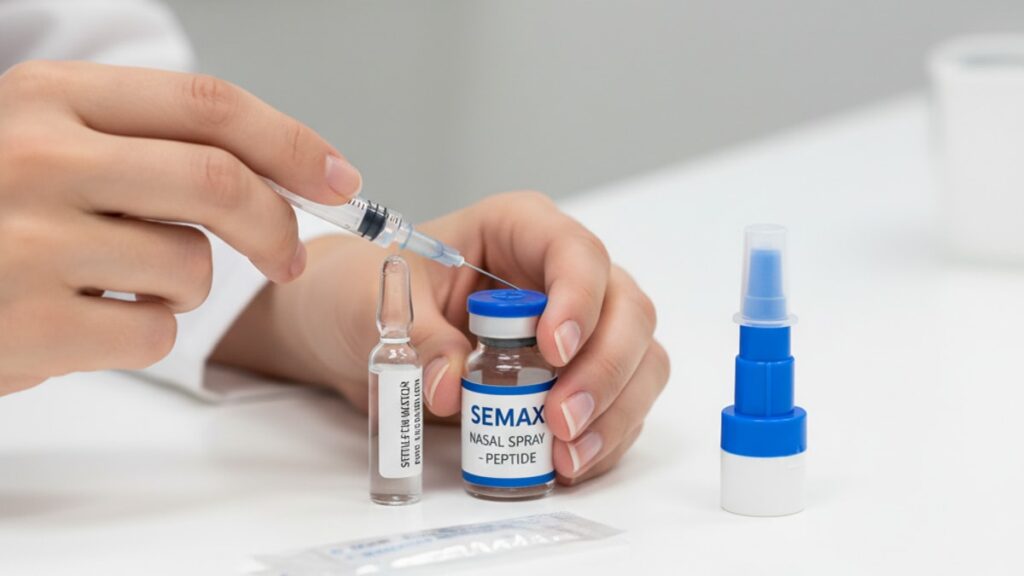
You’ve made the investment. You’ve sourced high-purity, research-grade peptides, and you're ready to begin your work. But there's a critical, often underestimated step that stands between that lyophilized powder in the vial and a valid, usable solution: reconstitution. For compounds administered nasally, like Semax, this process is even more nuanced. Get it wrong, and you don't just risk inaccurate dosing—you risk degrading the very peptide you've invested in, rendering your research unreliable before it even begins.
Our team has consulted with countless researchers over the years, and we've seen firsthand how improper handling can undermine the most well-designed studies. It’s a frustrating and costly mistake. That’s why we’re not just a supplier of premium peptides like our Semax Amidate Peptide; we see ourselves as your partner in research. We believe that providing the highest quality compounds is only half the battle. The other half is empowering you with the knowledge to handle them correctly. This is our definitive process on how to reconstitute Semax nasal spray, refined from years of experience to ensure maximum stability and accuracy.
Why Proper Reconstitution is Non-Negotiable
Let's be direct. Peptides are delicate molecules. They are not simple chemical compounds that can be casually mixed with water and stored on a shelf. They are complex chains of amino acids, and their three-dimensional structure is what gives them their biological activity. This structure is fragile.
Lyophilization, or freeze-drying, is a process designed to preserve this delicate structure by removing water, placing the peptide in a state of suspended animation. It’s incredibly effective for long-term storage and shipping. The moment you introduce a liquid—the process of reconstitution—you reanimate the peptide, but you also expose it to a host of potential threats: pH changes, osmotic shock, microbial contamination, and physical agitation. Any of these can cause the peptide to denature, cleave, or aggregate. In simple terms, they can break it.
A broken peptide is a useless peptide. It won't produce the expected results in your study, leading to confusing data, wasted resources, and potentially incorrect conclusions. For a nootropic peptide like Semax, where the goal is often to study subtle cognitive or neurological effects, precision is everything. An under-dosed or degraded solution won't just yield no results; it could yield misleading ones. We can't stress this enough: your reconstitution technique is as critical to the outcome of your research as the initial purity of the compound itself. It’s a non-negotiable element of good laboratory practice.
Assembling Your Toolkit: What You'll Absolutely Need
Before you even think about opening your vials, you need to assemble the right equipment. Working with research peptides demands a near-surgical level of cleanliness and precision. Attempting this with subpar tools is a recipe for contamination and failure. Here’s what our team considers essential:
- Lyophilized Semax Peptide: This is the foundation. Starting with a high-purity product is paramount. At Real Peptides, our commitment to small-batch synthesis and rigorous quality control ensures you're beginning with a compound that is pure, stable, and accurately dosed, like our Semax Amidate Peptide.
- Bacteriostatic Water: This is your reconstitution liquid, or diluent. We'll dive deeper into this, but for now, know that you need sterile water that contains a bacteriostatic agent to prevent bacterial growth. Our lab-grade Bacteriostatic Water is specifically prepared for this purpose.
- Sterile Syringe with Needle: A 3ml or 5ml syringe with a 21-gauge needle is typically ideal for accurately measuring and transferring the bacteriostatic water. Ensure it's new and in a sealed, sterile package.
- Empty, Sterile Nasal Spray Bottle: The final destination for your reconstituted solution. It must be sterile and capable of delivering a consistent, metered dose per spray. Many are designed to deliver 0.1mL per actuation, which is a common standard for these applications.
- Alcohol Prep Pads: For sterilizing everything—the vial tops, your hands (or gloves), and your work surface. Don't skip this. Contamination is the silent killer of good research.
Having these items ready and laid out on a clean, disinfected surface sets the stage for a successful and sterile process. It’s about creating a controlled environment to protect the integrity of your investment.
The Diluent Debate: Bacteriostatic Water vs. The Rest
Not all water is created equal, especially in a laboratory setting. The choice of diluent is one of the most critical decisions you'll make during reconstitution. We've seen researchers try to use sterile water, or even worse, distilled or tap water, with catastrophic results. For a multi-use preparation like a nasal spray, there is only one correct choice in our professional opinion.
Here’s a quick breakdown of your options and why one stands far above the others.
| Diluent Type | Key Ingredient(s) | Primary Use Case | Shelf Life (Reconstituted) | Our Recommendation |
|---|---|---|---|---|
| Bacteriostatic Water | Sterile Water + 0.9% Benzyl Alcohol | Multi-use vials (like nasal sprays) | Excellent (Up to 28 days) | Highly Recommended |
| Sterile Water | Pure, Sterile Water (H2O) | Single-use applications only | Poor (Less than 24 hours) | Not Recommended for Nasal Sprays |
| Saline Solution | Sterile Water + 0.9% Sodium Chloride | Specific protocols requiring isotonicity | Poor (Less than 24 hours) | Not Recommended (Unless specified) |
| Tap/Distilled Water | Non-sterile H2O | NEVER for research peptides | N/A – Contaminated from start | Absolutely Prohibited |
Let’s be perfectly clear. The 0.9% benzyl alcohol in bacteriostatic water is a preservative. It actively inhibits the growth of bacteria. When you create a nasal spray, you're creating a solution that will be used multiple times over days or weeks. Every time you use the spray, you risk introducing airborne or contact-based bacteria into the bottle. Without a preservative, that bottle can quickly become a petri dish, contaminating your peptide and posing a safety risk.
Sterile water is just that: sterile. But the moment you open it and use it, it's no longer sterile. It has no defense against new bacteria. That's why it's only suitable for a single-use injection where the entire vial is used at once. Using it for a nasal spray is asking for trouble. So, for the stability of your Semax and the integrity of your research, bacteriostatic water isn't just a suggestion; it's a requirement.
The Real Peptides Method: A Step-by-Step Reconstitution Process
Alright, you've got your tools, you understand the stakes, and you have the right diluent. Now it's time for the procedure itself. Follow these steps meticulously. Do not rush. Precision is your best friend here.
Step 1: Preparation and Sanitization
First, create your sterile field. Thoroughly wash your hands with soap and water. If you have nitrile gloves, now is the time to put them on. Cleanse your work surface—a countertop or lab bench—with a disinfectant. Lay out all your supplies. Take an alcohol prep pad and vigorously wipe the rubber stopper on your vial of Semax Amidate Peptide and the top of your Bacteriostatic Water vial. Let them air dry for about 30-60 seconds. This allows the alcohol to evaporate and do its job.
This isn't just for show. It's a critical step in preventing microbial contamination that could ruin your entire batch.
Step 2: Calculating Your Concentration (The Math Matters)
This is where many people get intimidated, but it's just simple math. Your goal is to create a solution where each spray delivers a specific dose. Let's walk through a common example.
- Your Vial: Let's say you have a 10mg vial of Semax.
- Your Nasal Bottle: Assume it delivers 0.1mL of liquid per spray.
- Your Target Dose: Let's say you want each spray to contain 100mcg (micrograms) of Semax.
First, convert everything to the same unit. 10mg = 10,000mcg.
Now, figure out the total volume you need. If you want 100mcg per 0.1mL spray, that means your solution needs a concentration of 1,000mcg per 1mL (since 1mL = 10 x 0.1mL).
Finally, calculate how much bacteriostatic water to add to your 10,000mcg vial to achieve this concentration:
(Total amount of peptide) / (Desired concentration) = Total volume
(10,000mcg) / (1,000mcg/mL) = 10mL
So, you will need to add 10mL of bacteriostatic water to your 10mg vial of Semax to create a solution where each 0.1mL spray delivers 100mcg. Double-check your math. Then check it again. Our experience shows that simple calculation errors are a frequent source of inconsistent research data.
Step 3: Drawing the Bacteriostatic Water
Uncap your sterile syringe. Pull the plunger back to the 10mL mark, drawing 10mL of air into the syringe. Insert the needle through the sanitized rubber stopper of the bacteriostatic water vial. Push the 10mL of air into the vial. This equalizes the pressure and makes it much easier to draw the liquid out accurately. Invert the vial and slowly pull the plunger back, drawing exactly 10mL of bacteriostatic water into the syringe. Check for any large air bubbles. If you see any, flick the syringe gently to make them rise to the top and carefully push them out.
Step 4: Introducing the Water to the Peptide
This is the most delicate part of the entire process. Take your syringe filled with bacteriostatic water and carefully insert the needle through the sanitized stopper of the Semax vial. You are NOT going to blast the water directly onto the lyophilized powder. That physical force can shear the peptide chains.
Instead, angle the needle so it's touching the inside wall of the glass vial. Slowly, gently, and deliberately push the plunger, allowing the water to trickle down the side of the glass and pool at the bottom. The powder will begin to dissolve as the water is introduced. Continue until all 10mL of water has been transferred.
Step 5: Gentle Mixing (Do NOT Shake!)
We've seen it happen, and it's catastrophic. Shaking a vial of reconstituted peptide creates foam and subjects the molecules to intense shearing forces. It's one of the fastest ways to destroy them.
Once the water is in, gently swirl the vial in a circular motion. You can also roll it between your palms. Be patient. The lyophilized powder will dissolve completely. It might take a minute or two. The final solution should be perfectly clear. If it's cloudy or has visible particles, it may indicate a problem with either the peptide's integrity or your reconstitution process.
Step 6: Transferring to the Nasal Spray Bottle
Using a new sterile syringe (or the same one if you're confident in your sterile technique), draw up the now-reconstituted Semax solution from the vial. Carefully uncap your sterile nasal spray bottle and transfer the solution into it. Secure the spray cap tightly.
Step 7: Labeling and Storage
Your final step is to label the nasal spray bottle clearly. What should be on the label? At a minimum: the name of the compound (Semax), the concentration (e.g., 100mcg/0.1mL spray), and the date of reconstitution. This is vital for safety, accuracy, and tracking shelf life.
Store the reconstituted nasal spray in the refrigerator, typically between 2°C and 8°C (36°F and 46°F). Do not freeze it. Proper storage is essential for maintaining potency over its lifespan, which, thanks to the bacteriostatic water, should be up to four weeks.
Common Mistakes We See (And How to Avoid Them)
Over the years, our team has troubleshot just about every reconstitution error imaginable. Learning from these common pitfalls can save you time, money, and the integrity of your research.
- The Aggressive Shake: We mentioned it before, but it bears repeating. Shaking is the enemy. It introduces kinetic energy that breaks fragile peptide bonds. Always swirl or roll gently.
- The Wrong Water: Using sterile water for a multi-use nasal spray or, heaven forbid, tap water, is a guarantee of contamination and degradation. Tap water contains minerals, chlorine, and microbes that will destroy the peptide. Stick to Bacteriostatic Water. It's the professional standard for a reason.
- The “Firehose” Technique: Spraying the water directly onto the peptide powder can cause damage. The gentle trickle down the side of the vial is a small detail that makes a significant difference in preserving the molecule's structure.
- Skipping the Cleaning: A casual approach to sanitization is a huge risk. Bacteria are everywhere. Wiping down your surfaces and vial stoppers with alcohol is a non-negotiable step to ensure a sterile final product.
- Improper Storage: Leaving your reconstituted solution at room temperature is a surefire way to accelerate its degradation. Peptides are sensitive to heat. Refrigeration is mandatory to preserve potency for any length of time.
Avoiding these simple mistakes elevates your practice from amateur to professional and ensures the data you collect is built on a foundation of quality and precision.
Beyond Semax: Applying These Principles to Other Peptides
While this guide focuses on how to reconstitute Semax nasal spray, the core principles of sterile technique, careful measurement, and gentle handling apply to nearly all research peptides. Whether you're working with another nootropic like Selank Amidate Peptide, a healing compound like BPC 157 Peptide, or exploring our full range of research peptides, these fundamentals remain the same.
Understanding this process builds confidence and competence in the lab. It's a foundational skill for anyone serious about peptide research. And for a more visual walkthrough of some of these lab techniques, you can always check out our YouTube channel, where we break down complex topics into easy-to-understand videos.
Our unflinching commitment at Real Peptides is to support the research community from every angle. This means providing impeccably pure compounds and also sharing the expertise needed to use them effectively. The quality we build into our products through small-batch synthesis is the starting point; your meticulous handling is what carries that quality through to your results.
Precision at every stage is what separates ambiguous data from breakthrough discoveries. It requires patience and a respect for the delicate nature of these powerful research tools. By mastering this process, you're not just mixing a solution—you're ensuring the validity and potential of your work. If you're ready to start with the highest quality materials, we're here to help you Get Started Today.
Frequently Asked Questions
How long does reconstituted Semax last in the refrigerator?
▼
When reconstituted with bacteriostatic water and stored properly in the refrigerator (2-8°C), Semax nasal spray is typically stable for up to 28 days. After this period, its potency may begin to decline.
Can I use sterile water instead of bacteriostatic water?
▼
We strongly advise against it for a multi-use nasal spray. Sterile water contains no preservative, meaning bacteria can grow once it’s opened. It’s only suitable for single-use applications where the entire vial is used immediately.
What happens if I accidentally shake the vial?
▼
Shaking can physically damage the delicate peptide chains through a process called shearing, potentially denaturing the Semax and rendering it inactive. Always mix by gently swirling or rolling the vial.
My reconstituted Semax solution looks cloudy. What should I do?
▼
A properly reconstituted Semax solution should be perfectly clear. Cloudiness can indicate bacterial contamination, improper reconstitution, or a problem with the product’s integrity. We recommend discarding any cloudy solution to ensure research accuracy.
Is it safe to freeze my reconstituted Semax?
▼
No, you should not freeze reconstituted Semax. The freeze-thaw cycle can damage the peptide’s structure and cause it to lose potency. The correct storage method is refrigeration.
How do I know what concentration to make?
▼
The ideal concentration depends entirely on your research protocol and desired dosage per spray. You must calculate the volume of bacteriostatic water needed based on the total milligrams of peptide in the vial and your target dose per actuation.
Why is it important to inject air into the bacteriostatic water vial first?
▼
Injecting a volume of air equal to the liquid you plan to withdraw equalizes the pressure inside the vial. This makes it significantly easier to draw the water into the syringe smoothly and accurately without fighting a vacuum.
Can I reconstitute Semax with saline solution?
▼
While technically possible, it’s not recommended unless your specific research protocol calls for an isotonic solution. Like sterile water, standard saline lacks a preservative, making it unsuitable for a multi-use nasal spray.
What is the powder in the vial before I add water?
▼
The powder is lyophilized, or freeze-dried, peptide. This process removes water to make the peptide stable for shipping and long-term storage at room temperature or in a freezer.
Does the brand of bacteriostatic water matter?
▼
Yes, quality matters. You should always source your [Bacteriostatic Water](https://www.realpeptides.co/products/bacteriostatic-water/) from a reputable supplier like Real Peptides to ensure it is sterile and contains the correct concentration of benzyl alcohol preservative.
Can I pre-fill multiple nasal spray bottles from one vial?
▼
Yes, as long as you maintain a sterile process throughout. Ensure each nasal spray bottle is sterile before filling and that you label each one correctly with the concentration and date of reconstitution.
What’s the best way to clean my work area?
▼
We recommend using a disinfectant spray or wipe to thoroughly clean the surface where you will be working. After that, using 70% isopropyl alcohol pads provides an excellent final step for sterilizing vial tops and tools.











