





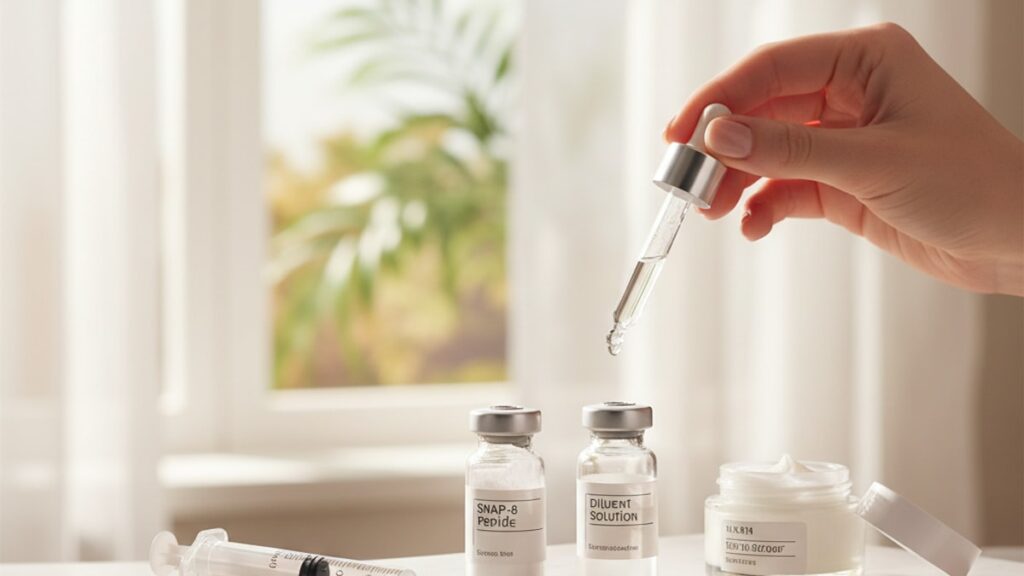
You've just received your vial of high-purity, lyophilized peptide. It’s a small puck of white powder, seemingly inert, yet holding immense potential for your research. This is a critical moment. What you do next—the process of reconstitution—is just as important as the meticulous synthesis we perform in our labs. Honestly, it's the step where brilliant research can either be set up for success or inadvertently compromised before it even begins.
Our team at Real Peptides has seen it all. We pour relentless effort into small-batch synthesis to guarantee the exact amino-acid sequencing and impeccable purity of compounds like our Snap 8 Peptide. But once that vial leaves our facility, its integrity rests on proper handling. We're not just a supplier; we're partners in your research. That’s why we’ve put together this definitive protocol on how to reconstitute SNAP-8 peptide. This isn't just a list of steps. It's a transfer of our collective experience to ensure the compound you work with is exactly as potent and stable as intended.
Why Proper Reconstitution is Non-Negotiable
Let's be frank. Lyophilization, or freeze-drying, is the gold standard for preserving the delicate structure of a peptide chain. It removes water under low pressure, rendering the molecule exceptionally stable for shipping and long-term storage. It’s a state of suspended animation. The moment you introduce a liquid, the clock starts ticking. The peptide awakens, but it's also now vulnerable to a host of environmental factors that can degrade it.
Improper reconstitution can lead to a cascade of problems. We're talking about catastrophic failures. Using the wrong solvent can cause the peptide to clump, fall out of solution, or even break down entirely. Shaking the vial vigorously, a common mistake born from impatience, can shear the delicate amino acid chains through mechanical force, rendering the peptide useless. It’s like shaking a fragile crystal sculpture. The result is a mess. Even something as seemingly small as using non-sterile water can introduce proteases—enzymes that literally chew up proteins and peptides—contaminating your entire batch.
This isn't just about wasting a vial. It's about the integrity of your data. If your peptide is only at 70% of its expected potency due to poor handling, every single data point you collect will be skewed. You'll be chasing ghosts, trying to figure out why your results aren't reproducible. It's a formidable, often moving-target objective that wastes time, resources, and grant money. Our experience shows that ninety percent of reconstitution issues trace back to a handful of simple, avoidable errors. This protocol is designed to eliminate them. It's comprehensive.
Gathering Your Essential Lab Supplies
Before you even think about touching the vial, you need to set up your workspace like a surgeon. A clean, sterile environment is paramount. We can't stress this enough. Contamination is the silent killer of good research. Here's what our team recommends you have on hand, ready to go.
- Your Lyophilized SNAP-8 Peptide: Of course, you'll need your vial from a trusted source. At Real Peptides, we ensure every vial is sealed under vacuum to protect it until the moment you're ready.
- Bacteriostatic Water: This is your reconstitution solvent of choice. We strongly recommend Bacteriostatic Water (BAC water) for most research peptides, including SNAP-8. It's sterile water that contains 0.9% benzyl alcohol, which acts as a bacteriostatic agent to prevent microbial growth after the vial has been opened. This is a critical, non-negotiable element for multi-use vials.
- Sterile Syringes: You’ll need at least two. One for drawing the BAC water and transferring it to your peptide vial, and another for drawing your precise research doses. We recommend 3ml syringes with a 21-gauge needle for reconstitution and 1ml insulin syringes (marked in IU/mL) for dosing, as they allow for meticulous accuracy.
- Alcohol Prep Pads: Use these to sterilize everything. The rubber stopper on your peptide vial, the top of the BAC water vial, and the surface you're working on. Don't skip this. Contamination can enter through the tiniest of openings.
Having these items laid out on a clean, disinfected surface before you start transforms the process from a rushed task into a methodical, scientific procedure. That's the key.
The Step-by-Step Protocol for Reconstituting SNAP-8
Alright, you've got your supplies and a clean workspace. Now, we get to the core procedure. Follow these steps precisely. There are no shortcuts to good science.
-
Preparation and Sterilization: First things first. Allow the lyophilized SNAP-8 vial to come to room temperature. This prevents condensation from forming inside the vial when you open it. While it's warming up (it only takes a few minutes), wipe down the rubber stoppers on both your SNAP-8 vial and your BAC water vial with an alcohol prep pad. Let them air dry. Do not blow on them.
-
Calculate Your Solvent Volume: This is where precision begins. You need to decide on your final concentration. A common and easy-to-manage concentration is 1mg per 0.1mL. Let's say your vial contains 10mg of SNAP-8 peptide. To achieve this concentration, you would need to add 1mL of BAC water. The math is simple: if you add 1mL of water to a 10mg vial, each 0.1mL of the solution will contain 1mg of the peptide. If you wanted a less concentrated solution, say for smaller dose requirements, you could add 2mL of water to the 10mg vial. This would give you a concentration of 0.5mg per 0.1mL.
-
Draw the Bacteriostatic Water: Take your 3ml syringe. Uncap it and pull back the plunger to the mark corresponding to the volume you calculated (e.g., 1mL). Insert the needle through the sterilized rubber stopper of the BAC water vial. Push the air from the syringe into the vial—this equalizes the pressure and makes it much easier to draw the liquid. Now, turn the vial upside down and slowly pull the plunger back, drawing your exact amount of BAC water. Check for any large air bubbles. If you see them, gently tap the syringe to make them rise to the top and carefully push the plunger to expel them.
-
Introduce the Solvent to the Peptide: This is the most delicate part of the process. Take your syringe filled with BAC water and carefully insert the needle through the center of the sterilized rubber stopper on your SNAP-8 vial. Now, this is crucial: do not inject the water directly onto the lyophilized powder. This can damage the peptide. Instead, angle the needle so that the stream of water runs slowly down the inside wall of the glass vial. Push the plunger gently and steadily until all the water has been transferred. The goal is to be as gentle as possible.
-
Dissolve the Peptide: Once the water is in, remove the syringe. You'll see the powder start to dissolve. To help it along, gently swirl the vial in a circular motion or roll it between your palms. Under no circumstances should you shake the vial. Shaking creates foam and, more importantly, can shear the peptide bonds, destroying the molecule. Patience is your friend here. Most peptides will dissolve within a few minutes. If some powder remains, let the vial sit in the refrigerator for a bit longer and then give it another gentle swirl.
-
Final Inspection: The final solution should be completely clear. If you see any cloudiness or floating particles, it could indicate a problem with solubility or potential contamination. With high-purity peptides like ours from Real Peptides, this is exceptionally rare when using the correct protocol. Once it's clear, your SNAP-8 peptide is officially reconstituted and ready for your research application.
For those who are more visual learners, our team is working on creating more video content to demonstrate these techniques. You can always check out our YouTube channel for other helpful insights from the community.
Choosing Your Reconstitution Solvent: A Critical Decision
While we almost always recommend Bacteriostatic Water for its preservative qualities, it's important for researchers to understand the options. The solvent you choose has a direct impact on the shelf-life and stability of your reconstituted peptide. We've put together a simple comparison to clarify the differences.
| Solvent Type | Key Ingredient(s) | Primary Use Case | Shelf-Life of Reconstituted Peptide | Our Professional Observation |
|---|---|---|---|---|
| Bacteriostatic Water | Sterile Water + 0.9% Benzyl Alcohol | Multi-use vials, standard research peptides like SNAP-8 | Several weeks (refrigerated) | The Gold Standard. The benzyl alcohol is highly effective at preventing contamination over multiple withdrawals from the vial. This is our default recommendation. |
| Sterile Water | Sterile Water only | Single-use applications, immediate use | Very short (24 hours refrigerated) | Lacks a preservative, so the risk of bacterial contamination is extremely high after the first puncture. Only suitable if you plan to use the entire vial at once. |
| Acetic Acid Solution (0.6%) | Acetic Acid + Sterile Water | For highly hydrophobic or difficult-to-dissolve peptides | Variable, depends on the peptide | Not typically required for SNAP-8. This is a specialized solvent for peptides that won't dissolve in water. Using it unnecessarily can alter the pH and affect peptide stability. |
As you can see, the choice is clear for a peptide like SNAP-8 which is readily soluble in water. The preservative properties of BAC water provide a crucial safety net for your research, ensuring the solution remains sterile and potent for weeks when stored properly. It's a simple choice that protects a significant investment.
Calculating Your Dosage: Precision is Paramount
Now that you have a reconstituted solution, the next step is calculating the correct volume for your desired dose. This requires careful attention to detail. Let's break it down with a clear example.
Let’s stick with our previous scenario:
- Vial Size: 10mg of SNAP-8
- Reconstitution Volume: 1mL (100 units on an insulin syringe) of BAC water
First, determine your solution's concentration.
Concentration = Total Peptide Amount / Total Solvent Volume
- Concentration = 10mg / 1mL
- This means your solution has a concentration of 10mg per mL.
Now, let's say your research protocol calls for a dose of 500mcg (which is 0.5mg).
Volume to Draw = Desired Dose / Concentration
- Volume to Draw = 0.5mg / (10mg/mL)
- Volume to Draw = 0.05mL
So, you would need to draw 0.05mL of the solution. On a standard U-100 1mL insulin syringe, 1mL is 100 units. Therefore, 0.05mL is equal to 5 units on the syringe. It's a tiny amount, which is why using an insulin syringe is so critical for this kind of work. It allows for the nuanced, meticulous control necessary for reproducible results. Always double-check your math before drawing your dose. A simple calculation error can throw off an entire experiment.
Storage Secrets: Protecting Your Reconstituted Peptide
Reconstitution is step one. Proper storage is the long-term commitment. Once in a liquid state, peptides are much more susceptible to degradation from heat, light, and agitation. Protecting your solution is just as important as mixing it correctly.
Here's what our lab team lives by:
- Refrigerate Immediately: As soon as your peptide is reconstituted, it should be stored in a refrigerator at a temperature between 2°C and 8°C (36°F and 46°F). This is the standard for short-to-medium term storage, typically lasting several weeks.
- Avoid the Door: Don't store your vials in the refrigerator door. The temperature there fluctuates wildly every time it's opened. Place it in the main body of the fridge, preferably towards the back, where the temperature is most stable.
- Protect from Light: While most lab fridges are dark, if there's any light exposure, it's best to keep the vial in its original box or wrap it in foil. Light can degrade certain amino acid residues over time.
- Long-Term Storage (Freezing): If you don't plan on using the entire vial within a few weeks, freezing is an option. However, this comes with a huge caveat: avoid repeated freeze-thaw cycles. Each cycle can damage the peptide structure. If you need to store it long-term, our team recommends pre-loading individual doses into syringes and freezing those. That way, you only thaw what you need for each application. This approach, which we've refined over years, delivers the best possible stability for long-term projects.
Common Pitfalls and How to Sidestep Them
We've guided countless researchers through this process, and we've seen the same handful of mistakes pop up time and again. Foreseeing these pitfalls is the best way to avoid them.
- The Shaker's Mistake: We've said it before, but it bears repeating. Vigorously shaking the vial is the fastest way to destroy your peptide. It's a natural instinct when trying to mix something, but you must resist. Gentle swirling or rolling is the only way.
- The Eyeballing Error: Don't guess your water volume. Don't assume you can just "add a little." Use a proper, graduated syringe to measure your solvent precisely. Your concentration calculation—and therefore all subsequent dosing—depends entirely on this initial measurement.
- The Contamination Risk: Using an old alcohol wipe, not wiping the stoppers, or working on a dirty surface are all invitations for contamination. Treat the process with the aseptic technique it deserves. Your results depend on it.
- Using the Wrong Water: A researcher once told us they used distilled water from the grocery store. It's a catastrophic error. Only use laboratory-grade, sterile Bacteriostatic Water or, in a pinch, sterile water for injection. Anything else introduces a universe of unknown variables and contaminants.
Avoiding these simple errors is 90% of the battle. The rest is just careful execution.
Our Commitment to Purity Extends Beyond the Vial
At Real Peptides, our job doesn't end when a product ships. Our unflinching commitment to quality means we see ourselves as partners in advancing scientific discovery. That's why we obsess over small-batch synthesis and third-party testing for every single compound we offer, from cosmetic peptides like SNAP-8 to more complex research molecules found across our entire peptide collection.
We believe that providing this kind of in-depth procedural guidance is a fundamental part of that commitment. A pure, perfectly synthesized peptide is only as good as its handling in the lab. By empowering researchers with the knowledge to reconstitute, store, and dose these compounds correctly, we're helping to ensure that the data generated is as accurate and reliable as possible.
It’s a philosophy that touches every aspect of our work. We know that behind every vial is a research project, a hypothesis, and a quest for answers. We're honored to be a part of that journey. We mean this sincerely: your success is our success. That's why we're here to provide the highest quality tools and the expert knowledge to help you use them effectively. It’s time to get your project moving in the right direction. You can Get Started Today by exploring our verified-purity products.
This methodical approach to reconstitution ensures that the potential we build into each peptide at the molecular level is fully realized in your hands. It’s the bridge between our lab and yours, built on a foundation of shared precision and a relentless pursuit of valid, reproducible results.
Frequently Asked Questions
Why can’t I just use tap water or bottled water to reconstitute my SNAP-8 peptide?
▼
Absolutely not. Tap and bottled water are not sterile and contain minerals, impurities, and potentially microorganisms like bacteria. These can contaminate and degrade the peptide, rendering your research invalid. Always use sterile Bacteriostatic Water for reconstitution.
What should I do if my reconstituted SNAP-8 solution looks cloudy?
▼
A cloudy solution is rare with high-purity SNAP-8 and usually indicates a problem. It could be due to bacterial contamination or poor solubility from using the wrong solvent. We recommend discarding the vial, as its integrity is compromised.
How long will my reconstituted SNAP-8 last in the refrigerator?
▼
When reconstituted with Bacteriostatic Water and stored correctly between 2°C and 8°C, your SNAP-8 solution should remain stable for several weeks, typically 4 to 6. Avoid storing it in the fridge door where temperatures fluctuate.
I accidentally shook the vial instead of swirling it. Is the peptide ruined?
▼
It’s very likely that the peptide’s structural integrity has been compromised. Shaking can shear the delicate amino acid bonds. While it may not be completely inert, its potency and effectiveness are significantly reduced, and we would not consider it viable for accurate research.
Does the amount of BAC water I add change the peptide’s overall strength?
▼
No, the total amount of peptide in the vial remains the same. Adding more or less water only changes the concentration of the solution. Using less water will create a more concentrated solution (more mg per mL), while using more water will dilute it.
Can I pre-load syringes with SNAP-8 and store them?
▼
Yes, this is an excellent practice, especially for long-term storage. Pre-loading individual doses into insulin syringes and freezing them is the best way to avoid repeated freeze-thaw cycles on the main vial, preserving the peptide’s integrity.
What is the white powder in the vial before reconstitution?
▼
The white powder is the lyophilized, or freeze-dried, form of the SNAP-8 peptide. This process removes water, placing the peptide in a highly stable state for shipping and storage until you are ready to reconstitute it for use.
Is it normal for there to be a vacuum in the peptide vial?
▼
Yes, it’s a very good sign. At Real Peptides, we seal our vials under a slight vacuum to ensure they are airtight and protected from atmospheric contaminants during transit. You may hear a slight hiss as you puncture the stopper.
My insulin syringe is marked in ‘IU’. How does that convert to mL?
▼
For standard U-100 insulin syringes, the conversion is straightforward: 100 IU is equal to 1 mL. Therefore, 10 IU is 0.1 mL, and 1 IU is 0.01 mL. This fine graduation is what makes these syringes ideal for accurate peptide dosing.
Can I mix two different peptides in the same syringe?
▼
Our team strongly advises against this unless a specific research protocol has validated the stability of that particular combination. Mixing peptides can lead to unknown chemical reactions, degradation, or precipitation, compromising the integrity of both compounds.
What’s the difference between SNAP-8 and Argireline?
▼
Both are cosmetic peptides that target expression wrinkles, but SNAP-8 (Acetyl Octapeptide-3) is an elongated version of Argireline (Acetyl Hexapeptide-3). It’s considered a next-generation peptide in this class, designed for similar research applications.
Does the brand of Bacteriostatic Water matter?
▼
Yes, quality and sterility are paramount. Always source your [Bacteriostatic Water](https://www.realpeptides.co/products/bacteriostatic-water/) from a reputable supplier of laboratory chemicals or research products, like us, to ensure it is sterile and correctly formulated with 0.9% benzyl alcohol.











