





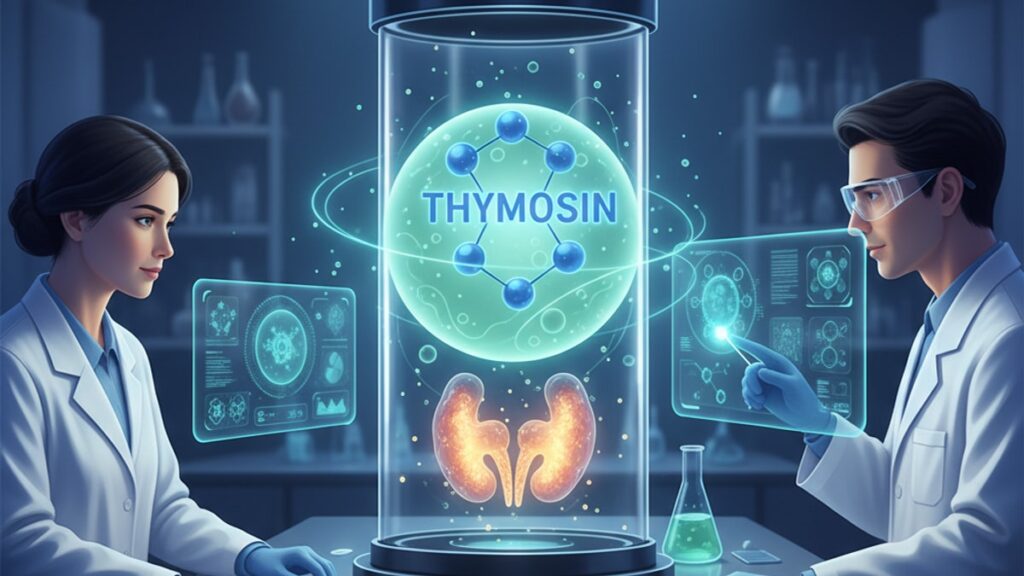
When you think about the major players in your endocrine system, a few usual suspects probably come to mind. The thyroid, the adrenals, maybe even the pituitary gland. But what about the thymus? It's an organ that, for many, remains shrouded in a bit of mystery. It's a small gland, nestled just behind your sternum and between your lungs, that plays a colossal role in your health, especially during your early years. And the key to its power lies in the hormones it produces—specifically, a family of proteins collectively known as thymosin.
Our team at Real Peptides fields questions about peptide functions all the time, and a common point of confusion is this powerful but often misunderstood hormone. So, what is the function of the hormone thymosin? The answer isn't a simple one-liner. It's a sprawling, multifaceted story about immune defense, cellular repair, and biological communication. It's about training an army of specialized cells to protect you from invaders and then dispatching a clean-up crew to repair the damage after the battle is won. Understanding thymosin is fundamental to understanding how your body maintains resilience, and for the research community, it represents a frontier of immense potential.
So, What Exactly Is Thymosin?
First things first, let's clear something up. When we talk about "thymosin," we're not talking about a single molecule. It's actually a family of several distinct polypeptide hormones secreted by the thymus gland. Think of it less like a solo artist and more like a band, where each member has a specific instrument and role, but they all work together to create the final piece of music. The two most researched and well-understood members of this family are Thymosin Alpha 1 (Tα1) and Thymosin Beta 4 (Tβ4).
The thymus gland itself is fascinating. It's most active and largest during childhood and adolescence. This is its prime time. During these years, it's working relentlessly to populate your body with a sophisticated and highly trained type of white blood cell called a T-cell (the 'T' stands for thymus-derived). After puberty, the thymus gradually begins to shrink and is slowly replaced by fat in a process called thymic involution. This doesn't mean it shuts down completely, but its output significantly declines. This natural decline is one reason why understanding the function of its hormones has become such a critical area of study.
These hormones are the chemical messengers that orchestrate the thymus's most important job: building a robust and intelligent immune system. They are the signals that turn raw, naive immune cells into battle-hardened veterans. It's a process of education and maturation that is absolutely essential for your long-term health. Without it, your body would be left defenseless against a constant barrage of pathogens.
The Immune Conductor: The Role of Thymosin Alpha 1
If the immune system is an orchestra, Thymosin Alpha 1 is the conductor. Its primary, non-negotiable role is orchestrating the maturation and differentiation of T-cells. This is the absolute core of its function. Immature immune cells, called thymocytes, migrate from the bone marrow to the thymus. Once there, they undergo a rigorous training program, and Thymosin Alpha 1 is the head drill instructor.
It's the immune system's boot camp.
Under the influence of Tα1, these thymocytes are educated to recognize the difference between "self" (your own body's cells) and "non-self" (invaders like viruses, bacteria, and fungi). This is a critical distinction. Cells that can't make this distinction are eliminated, preventing autoimmune diseases where the body mistakenly attacks itself. The cells that graduate become several types of mature T-cells:
- Helper T-cells (CD4+): These are the strategists. They don't kill invaders directly but activate and direct other immune cells to mount a defense.
- Cytotoxic T-cells (CD8+): These are the frontline soldiers. They directly identify and eliminate infected or cancerous cells.
- Regulatory T-cells (Tregs): These are the peacekeepers. They suppress the immune response once a threat has been neutralized, preventing excessive inflammation and collateral damage.
But Thymosin Alpha 1's job doesn't stop there. Our experience in the research field shows that its influence extends beyond the thymus. It also acts as an immunomodulator throughout the body, meaning it helps to balance and fine-tune immune responses. It can enhance the activity of T-cells and other immune players like Natural Killer (NK) cells, making them more effective at their jobs. This is why peptides like Thymosin Alpha 1 are such a significant point of focus in immunological research. It’s not just about turning the immune system 'on'; it's about making it smarter and more efficient.
The Cellular Repair Crew: Unpacking Thymosin Beta 4
Now, let's pivot to the other star player: Thymosin Beta 4. If Tα1 is the military general, Tβ4 is the head of the corps of engineers. Its functions are profoundly different but equally vital. While Tα1 focuses on external defense, Tβ4 is all about internal maintenance, repair, and regeneration.
What is the function of the hormone thymosin in this context? It's all about healing.
Thymosin Beta 4 is found in virtually all human cells, but it's particularly concentrated at sites of injury. Its primary mechanism of action is its ability to bind to actin, a protein that forms the structural filaments of a cell's cytoskeleton. By regulating actin polymerization, Tβ4 plays a fundamental role in cell migration, structure, and division. When an injury occurs—whether it's a cut on your skin, a strained muscle, or damage to an internal organ—Tβ4 levels in the area spike. It's an immediate call to action.
Here’s a breakdown of what our team has learned about its key regenerative functions:
- Promotes Angiogenesis: It stimulates the formation of new blood vessels from existing ones. This is absolutely crucial for healing, as a new blood supply is needed to deliver oxygen, nutrients, and immune cells to the damaged area.
- Encourages Cell Migration: It helps cells like fibroblasts and keratinocytes move to the wound site to begin rebuilding tissue and closing the gap.
- Reduces Inflammation: Tβ4 has potent anti-inflammatory effects. It helps to down-regulate pro-inflammatory cytokines, which reduces swelling, pain, and secondary damage caused by an overzealous inflammatory response.
- Minimizes Scar Tissue: By modulating collagen deposition and promoting a more organized healing process, Tβ4 can help reduce the formation of fibrotic or scar tissue.
Because of this remarkable and diverse skill set, synthetic versions like TB 500 (Thymosin Beta 4) have become indispensable tools for researchers studying everything from cardiac repair after a heart attack to accelerated recovery from musculoskeletal injuries. It represents a completely different axis of thymosin's influence—one focused on rebuilding from within.
Thymosin Alpha 1 vs. Thymosin Beta 4: A Comparison
It’s easy to get them confused, but their domains are quite distinct. Both originate from the same conceptual family of thymic peptides, but their applications and biological roles diverge significantly. For researchers, knowing which tool to use for which job is paramount. We've put together a simple table to highlight the key differences based on current scientific understanding.
| Feature | Thymosin Alpha 1 (Tα1) | Thymosin Beta 4 (Tβ4) |
|---|---|---|
| Primary Function | Immune system modulation and T-cell maturation. | Tissue repair, regeneration, and anti-inflammatory action. |
| Main Site of Action | Primarily acts on cells of the immune system (T-cells, NK cells). | Acts on a wide variety of cell types at sites of injury. |
| Key Biological Process | Orchestrates adaptive immunity and pathogen defense. | Manages actin dynamics, angiogenesis, and cell migration. |
| Main Research Focus | Immunodeficiencies, enhancing vaccine response, oncology. | Wound healing, cardiac repair, musculoskeletal injuries. |
This isn't to say their functions are completely siloed. Biology is rarely that neat. There is some crossover, and the body's systems are deeply interconnected. A well-regulated immune system (thanks to Tα1) is essential for proper wound healing, and reduced inflammation (thanks to Tβ4) supports healthy immune function. They are two sides of the same coin of systemic health and resilience.
Why Purity Is Non-Negotiable in Thymosin Research
Now, this is where it gets incredibly important for the scientific community. When you're conducting research with peptides like thymosin, the quality of your materials is everything. It's the difference between clear, reproducible data and a wasted experiment. We can't stress this enough.
The synthesis of peptides is a complex, delicate process. Creating a precise chain of amino acids in the correct sequence requires impeccable chemistry and unflinching quality control. Even a tiny impurity or a slight deviation in the sequence can render the peptide inert or, worse, cause unexpected and confounding results in a study.
This is the core philosophy behind what we do at Real Peptides. While the market is flooded with mass-produced, low-cost alternatives, we've always prioritized precision over volume. Our U.S.-based labs focus on small-batch synthesis. This approach allows our team to maintain rigorous oversight at every step, ensuring the final product has the exact amino-acid sequence and a verified level of purity that serious researchers demand. Your data can only be as good as your reagents. It’s that simple.
Whether you're investigating the immunomodulatory effects of Tα1 or the regenerative potential of a compound like BPC-157, the integrity of the molecule is the foundation of your work. We believe that providing researchers with reliable, high-purity compounds is our primary responsibility. It’s how we contribute to the next wave of discoveries. You can explore our entire catalog of research-grade compounds on our Shop All Peptides page to see that commitment in action.
The Future of Thymosin: What's on the Horizon?
The story of thymosin is far from over. In fact, we might just be getting to the most exciting chapters. As our understanding of cellular biology deepens, the potential applications for these powerful peptides continue to expand into some truly groundbreaking areas.
Researchers are actively exploring the role of Thymosin Beta 4 in neurogenesis and neuroprotection, investigating its potential to help repair neural tissue after a stroke or traumatic brain injury. Others are focused on its cardioprotective effects, hoping to find ways to limit damage and improve recovery following a heart attack. There's also a burgeoning interest in the role of thymic peptides in healthy aging. Since the thymus naturally shrinks and becomes less effective over time (that thymic involution we mentioned), researchers are asking if supporting its function could help maintain immune robustness later in life.
We're passionate about following this cutting-edge science and often discuss new studies and their implications. For a more visual breakdown of some of these complex topics, our team regularly posts updates and explanations on our YouTube channel, where we try to make this intricate science accessible.
The function of the hormone thymosin, once thought to be limited to simply making T-cells, is now understood to be a profound and systemic influence on our health. It's a master regulator of both defense and repair, a testament to the body's incredible, interconnected design.
From the high-stakes training ground of the thymus to the microscopic construction sites of a healing wound, the thymosin family of peptides are unsung heroes of our biology. They work quietly and efficiently behind the scenes, ensuring our bodies are prepared for external threats and equipped to rebuild from internal damage. For any researcher looking to explore these pathways, the journey begins with understanding these foundational principles and, crucially, with materials you can trust. If you're ready to take the next step in your own work, we're here to help you Get Started Today.
Frequently Asked Questions
What is the main function of the hormone thymosin?
▼
The primary function of the hormone thymosin is to stimulate the development and differentiation of T-lymphocytes, or T-cells. These are critical white blood cells that orchestrate the body’s adaptive immune response to pathogens and abnormal cells.
Is thymosin a single hormone?
▼
No, thymosin is not a single hormone. It’s a family of several related polypeptide hormones produced by the thymus gland, with Thymosin Alpha 1 and Thymosin Beta 4 being the most well-studied members, each having distinct biological functions.
What is the difference between Thymosin Alpha 1 and Thymosin Beta 4?
▼
Thymosin Alpha 1 primarily functions as an immune modulator, crucial for T-cell maturation and enhancing immune defense. In contrast, Thymosin Beta 4 is centrally involved in tissue repair, wound healing, angiogenesis, and reducing inflammation.
Where is thymosin produced in the body?
▼
Thymosin hormones are primarily produced in the epithelial cells of the thymus gland, a small organ located in the chest behind the sternum. The thymus is most active during childhood and adolescence.
Does thymosin production decrease with age?
▼
Yes, it does. The thymus gland naturally begins to shrink and become less active after puberty in a process called thymic involution. This leads to a significant decline in the production of thymosin and other thymic hormones.
What are T-cells, and how does thymosin affect them?
▼
T-cells are a type of white blood cell essential for immunity. Thymosin acts as a key signaling molecule within the thymus gland, ‘educating’ immature T-cells to recognize and attack specific foreign invaders while ignoring the body’s own healthy tissues.
Can thymosin help with wound healing?
▼
Specifically, Thymosin Beta 4 (Tβ4) plays a critical role in wound healing. It promotes cell migration, the formation of new blood vessels (angiogenesis), and has anti-inflammatory properties, all of which accelerate the tissue repair process.
Is thymosin a steroid?
▼
No, thymosin is not a steroid. Steroid hormones are derived from cholesterol, whereas thymosins are peptide hormones, which are short chains of amino acids. Their chemical structures and biological mechanisms are completely different.
Why is peptide purity important in thymosin research?
▼
Purity is critical because even minor impurities or incorrect amino acid sequences can drastically alter a peptide’s biological activity. For reliable and reproducible scientific results, researchers must use high-purity, accurately synthesized peptides like those we provide at Real Peptides.
What is the relationship between the thymus gland and thymosin?
▼
The thymus gland is the factory that produces thymosin. It provides the specific microenvironment where immature immune cells are exposed to thymosin hormones, which drives their maturation into functional T-cells.
Are there other important thymic peptides besides thymosin?
▼
Yes, the thymus produces other peptides like thymulin and thymopoietin. While thymosins are the most studied, these other hormones also play synergistic roles in regulating immune function and T-cell development.











