



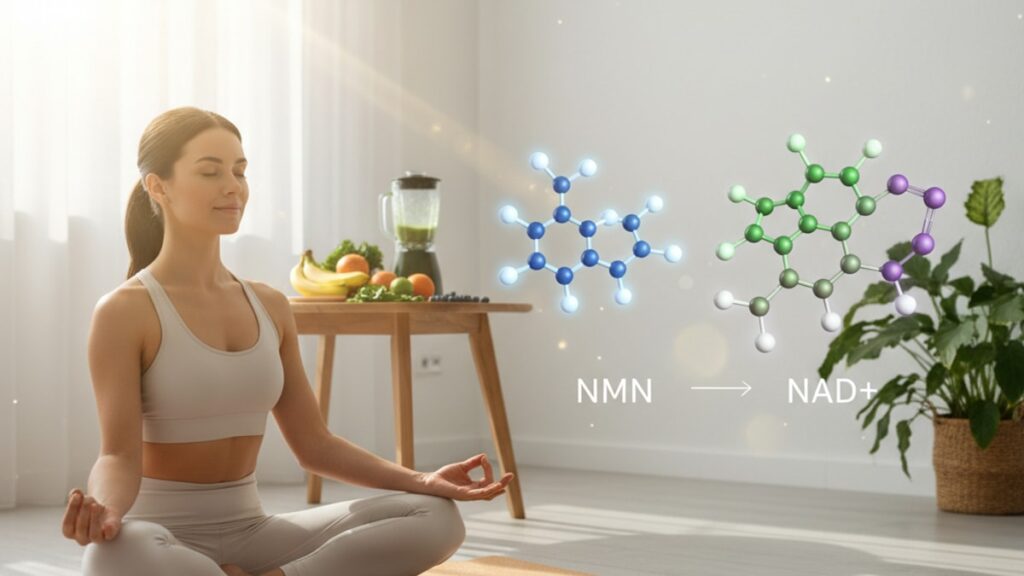
It’s one of the most frequent questions we hear from research teams and bio-innovators alike: is NMN and NAD the same? The short answer is a definitive no. But the long answer—the one that really matters for anyone serious about cellular biology, aging, and metabolic research—is far more nuanced and, frankly, much more interesting. The confusion is completely understandable. These two molecules are constantly mentioned together, often in the same breath, creating the impression that they're interchangeable. They're not.
Think of it like this: NMN is the shipment of high-grade parts arriving at a factory, while NAD+ is the high-performance engine rolling off the assembly line. You absolutely cannot have one without the other, but their roles are fundamentally distinct. One is the raw material, the potential. The other is the finished, functional tool that gets the job done. Here at Real Peptides, where precision is the bedrock of everything we do, understanding these critical distinctions is paramount. It’s the difference between a successful experiment and one that yields confusing, unreliable data. So, let’s clear up the fog and dive into what makes each of these molecules unique and why their relationship is a cornerstone of modern biological research.
Let's Settle It: What is NAD+?
Before we can even touch on NMN, we have to start with the star of the show: NAD+. The acronym stands for Nicotinamide Adenine Dinucleotide, and if there were a VIP list for molecules inside your cells, NAD+ would be at the top. It's not an exaggeration to call it one of the most critical coenzymes for life.
What’s a coenzyme? It’s a helper molecule. It doesn't initiate reactions on its own but binds to enzymes to help them do their jobs. And NAD+ is the ultimate helper, participating in more than 500 different enzymatic reactions. That’s a staggering number. Our team often describes it as the primary currency of cellular energy transfer. It’s involved in the fundamental processes that turn the food we eat into the energy our cells use to function, repair, and survive.
Its most famous role is in metabolism. NAD+ is essential for the Krebs cycle and oxidative phosphorylation—the core processes that happen inside our mitochondria to generate ATP, the cell's main energy source. It acts as an electron shuttle, accepting and donating electrons in a constant dance of redox reactions. Without sufficient NAD+, this entire energy production line grinds to a catastrophic halt. But its job description is far more sprawling than just energy production. NAD+ is also a critical signaling molecule, consumed by several key enzyme families:
- Sirtuins: Often called the “longevity genes,” these are a class of proteins that regulate cellular health, DNA repair, inflammation, and metabolic efficiency. Sirtuins are NAD+-dependent, meaning they literally cannot function without it. They use up NAD+ to carry out their protective tasks. More active sirtuins are linked to healthier aging, and more NAD+ means more sirtuin activity.
- PARPs (Poly(ADP-ribose) polymerases): These are the cell’s first responders for DNA damage. When a strand of DNA breaks, PARPs rush to the scene to signal for repair. This process is incredibly energy-intensive and consumes massive amounts of NAD+. Significant DNA damage can actually deplete a cell's NAD+ stores, creating an energy crisis.
- CD38: This is a major NAD+-consuming enzyme found on the surface of many immune cells. Its activity tends to increase with age, and it's considered one of the primary reasons NAD+ levels decline over time. It essentially chews through the available supply.
The real challenge, and the central reason we’re even having this conversation, is that NAD+ levels aren’t static. They decline steadily and significantly as we age. This decline is linked to many of the hallmarks of the aging process, from reduced energy and mitochondrial dysfunction to slower cellular repair. It’s a formidable problem, and it’s why the scientific community has become so intensely focused on finding ways to support and replenish our natural NAD+ pools.
So, Where Does NMN Fit In?
Now we get to the other half of the equation. If declining NAD+ is the problem, NMN (Nicotinamide Mononucleotide) is one of the most promising proposed solutions. Why? Because NMN is a direct precursor to NAD+.
Our bodies have elegant recycling systems called salvage pathways to create NAD+. Instead of building this complex molecule from scratch every time, cells recycle its components. NMN is a key intermediate in the most prominent of these pathways. When NMN enters a cell, it's quickly converted into NAD+ in a single enzymatic step. It’s incredibly efficient. This is why the analogy of raw materials and a finished product works so well. NMN is the near-finished component that just needs one final step on the assembly line to become the functional NAD+ engine.
But wait, you might be asking, why not just use NAD+ directly? It’s a fantastic question that gets to the heart of the issue. The NAD+ molecule is relatively large and charged, making it very difficult to cross the cell membrane. Think of it as trying to fit a fully assembled car through a regular doorway—it just doesn't work. For a long time, it was believed that NAD+ couldn't enter cells at all and had to be synthesized inside. While some recent research suggests there may be specific transporters in certain cell types, the prevailing understanding is that direct supplementation with NAD+ is inefficient for raising intracellular levels throughout the body.
This is where precursors like NMN shine. NMN is a smaller molecule. It has its own dedicated transporter (Slc12a8) that allows it to efficiently slip inside cells, where it can then be immediately converted. This makes it a powerful tool for research aimed at boosting intracellular NAD+ levels. By providing the raw material, you’re effectively stocking the cellular factory so it can ramp up production of the final product. It’s a subtle but critical distinction. You're not forcing the finished product in; you're supporting the cell's own natural ability to produce what it needs.
This approach is at the core of countless studies on aging, neurodegeneration, and metabolic disease. The hypothesis is simple: if declining NAD+ contributes to age-related dysfunction, can restoring those levels with a precursor like NMN slow or even reverse some of those processes? The data from preclinical studies has been incredibly compelling, driving an explosion of interest in this pathway.
The Core Difference: Precursor vs. Coenzyme
Let’s be blunt. Is NMN and NAD the same? Absolutely not.
One is a building block. The other is the functional machinery. Their relationship is sequential and codependent, but their identities are distinct. NMN’s primary biological role is to become NAD+. NAD+, on the other hand, has a massive portfolio of jobs it performs directly. NMN is the potential; NAD+ is the kinetic reality. Our experience shows that grasping this difference is the first step toward designing intelligent experiments.
To make it crystal clear, we've broken down the key distinctions in this table:
| Feature | Nicotinamide Mononucleotide (NMN) | Nicotinamide Adenine Dinucleotide (NAD+) |
|---|---|---|
| Role | Precursor Molecule | Active Coenzyme |
| Primary Function | To be converted into NAD+ | Facilitates redox reactions, energy metabolism, DNA repair |
| Molecular Size | Smaller (334.24 g/mol) | Larger (663.43 g/mol) |
| Cellular Entry | Can enter cells via dedicated transporters | Generally cannot cross the cell membrane directly |
| Direct Action | Limited direct enzymatic action on its own | Directly used by hundreds of enzymes (e.g., Sirtuins, PARPs) |
| Research Focus | Studied as an effective strategy to boost intracellular NAD+ levels | Studied for its direct roles in cellular processes and extracellular signaling |
This table really cuts to the chase. You use NMN when the research objective is to see the downstream effects of increased intracellular NAD+ synthesis. You might use NAD+ itself in in vitro studies where you can bypass the cell membrane or when studying its extracellular effects. They are different tools for different, though related, jobs. We can't stress this enough: choosing the right molecule for your experimental design is a critical, non-negotiable element for generating valid data.
Why is the NMN-to-NAD+ Pathway So Important for Research?
The intense focus on this pathway isn’t just academic. It has profound implications for some of the most pressing challenges in human health. The ability to modulate NAD+ levels opens up a formidable frontier for investigation.
In aging research, it's a game-changer. Scientists are exploring how maintaining youthful NAD+ levels can impact everything from muscle function and cardiovascular health to cognitive decline. The logic is compelling: by refueling the cell’s fundamental repair and energy systems, you might be able to enhance its resilience against the stressors that accumulate over a lifetime. It's not about finding a mythical fountain of youth, but about understanding the mechanisms of cellular maintenance and how they can be supported.
Metabolic research is another huge area. Conditions like obesity and type 2 diabetes are characterized by mitochondrial dysfunction and poor energy utilization. Since NAD+ is central to metabolism, researchers are investigating whether boosting its levels can improve insulin sensitivity, enhance glucose metabolism, and restore mitochondrial health. The results from animal models have been exceptionally promising, suggesting that this pathway could be a powerful target for managing metabolic disorders.
Then there's neuroscience. The brain is an incredibly energy-hungry organ, consuming about 20% of the body's total oxygen and calories despite being only 2% of its weight. This relentless energy demand makes it particularly vulnerable to declines in NAD+ and mitochondrial function. Studies are underway to determine if NMN can protect neurons from age-related damage, support cognitive function, and potentially offer a new angle for tackling neurodegenerative diseases.
The simple truth is that nearly every aspect of cellular health is touched by NAD+. That's why this isn't a niche area of science anymore. It’s foundational. And for any lab working in these fields, having access to verifiably pure compounds to study these mechanisms is essential.
The Purity Problem: Why Source Matters for Researchers
Let's be honest. The explosion of interest in NMN and NAD+ has led to a flooded market, and not all of it is good. The space is rife with products—both for research and consumer use—that suffer from catastrophic quality control issues. We've seen reports of products containing little to no active ingredient, incorrect compounds, or dangerous contaminants. For a researcher, this is a disaster. It completely invalidates your results and wastes precious time, funding, and effort.
This is precisely why Real Peptides was founded. Our entire philosophy is built on an unflinching commitment to purity and precision. We operate on a small-batch synthesis model, which gives us meticulous control over every step of the process. Each compound is crafted with exact amino-acid sequencing (where applicable) and subjected to rigorous third-party testing to guarantee its identity, purity, and consistency. When your research requires the direct administration of the coenzyme itself, using a product like our research-grade NAD+ 100mg ensures that your results are a true reflection of the molecule's activity, not skewed by impurities.
This relentless dedication to quality isn't just a talking point; it's the operational principle that allows our clients to conduct groundbreaking research with confidence. That same standard applies across our entire catalog. Whether you're investigating metabolic pathways with mitochondrial peptides like SS-31 Elamipretide, exploring muscle physiology, or delving into neurological function, you can trust that the compounds you receive are exactly what they claim to be. This commitment to verifiable purity is why leading institutions trust us, and it extends to our complete collection of peptides.
Beyond NMN: Exploring the Broader Landscape of Cellular Health
While the NMN-to-NAD+ pathway is a critical piece of the puzzle, it's important to remember that cellular health is a sprawling, interconnected network. NAD+ doesn't operate in a vacuum. Its levels and efficacy are influenced by, and in turn influence, countless other systems. A truly comprehensive research approach looks at these interconnected pathways.
For example, peptides are emerging as powerful tools to target specific aspects of cellular function that are complementary to NAD+ biology. Some peptides, like MOTS-c, are known to influence mitochondrial function and metabolic homeostasis, areas where NAD+ is also a key player. Investigating how an NAD+ precursor interacts with a peptide like Mots-C could reveal synergistic effects that wouldn't be apparent from studying either one in isolation.
Similarly, consider the role of growth hormone secretagogues. Peptides like Tesamorelin or CJC-1295/Ipamorelin are designed to stimulate the body's own production of growth hormone, which has widespread effects on metabolism, cell repair, and body composition. How does enhanced cellular repair signaled by growth hormone intersect with the available energy supply dictated by NAD+? These are the kinds of complex, next-generation questions that researchers are now beginning to ask. It's a difficult, often moving-target objective, but it's where the most exciting discoveries are waiting.
Our role in this ecosystem is to provide the highest-purity tools to make these complex investigations possible. We believe that by enabling researchers to work with reliable, consistent, and pure compounds, we're helping to accelerate the pace of discovery across the entire field of cellular science.
So, while we started with a simple question—is NMN and NAD the same?—the answer pushes us into a much larger and more exciting world. They are two distinct but deeply connected players in the intricate ballet of cellular life. Understanding their individual roles and their powerful partnership is key. For any research team looking to explore this frontier, ensuring the integrity of your foundational materials isn't just good practice; it's everything. If you're ready to build your research on a foundation of impeccable quality, we invite you to Get Started Today.
Frequently Asked Questions
So definitively, is NMN and NAD the same thing?
▼
No, they are not the same. NMN (Nicotinamide Mononucleotide) is a precursor molecule, while NAD+ (Nicotinamide Adenine Dinucleotide) is the active coenzyme that NMN gets converted into inside your cells. Think of NMN as the raw material and NAD+ as the finished product.
Why would a researcher use NMN instead of NAD+ directly?
▼
Researchers often use NMN because it’s a smaller molecule that can more easily enter cells to be converted into NAD+. The larger NAD+ molecule has difficulty crossing the cell membrane, so using NMN is an effective strategy to increase intracellular NAD+ levels for study.
Can the body make NAD+ without NMN?
▼
Yes, the body has multiple pathways to create NAD+. Besides the salvage pathway that uses NMN, it can also synthesize NAD+ from other precursors like nicotinamide (Nam), nicotinic acid (NA, or niacin), and tryptophan. The NMN pathway is considered one of the most efficient, however.
What is the main reason NAD+ levels decline with age?
▼
While multiple factors contribute, a primary driver is the increased activity of NAD+-consuming enzymes, particularly CD38. As CD38 activity rises with age, it breaks down NAD+ at a faster rate, leading to a net decline in available levels within the body’s tissues.
Is NR (Nicotinamide Riboside) related to NMN and NAD+?
▼
Yes, NR is another well-studied precursor to NAD+. It is one step further back in the salvage pathway. Inside the cell, NR is first converted to NMN, which is then converted to NAD+. Both NR and NMN are researched for their potential to boost NAD+ levels.
What are Sirtuins and how do they relate to NAD+?
▼
Sirtuins are a class of proteins often called ‘longevity genes’ that regulate cellular health, DNA repair, and metabolism. They are critically dependent on NAD+ to function; they literally consume NAD+ as fuel to perform their protective tasks. Higher NAD+ levels can lead to increased Sirtuin activity.
Does taking NAD+ directly in a research setting have any use?
▼
Yes, it can. While it’s inefficient for raising intracellular levels in a living system, pure [NAD+](https://www.realpeptides.co/products/nad-100mg/) is essential for in vitro experiments, such as enzyme assays, or for studying the extracellular roles of NAD+, which acts as a signaling molecule in some contexts.
What is the ‘salvage pathway’?
▼
The salvage pathway is the body’s primary mechanism for recycling the components of NAD+ to create new NAD+. Instead of building it from scratch, cells salvage precursors like nicotinamide, NR, and NMN to efficiently regenerate their NAD+ supply. It’s a highly effective cellular recycling program.
How does purity affect research on NMN or NAD+?
▼
Purity is absolutely critical. Contaminants or incorrect dosages can completely invalidate experimental results, leading to incorrect conclusions. Using third-party tested, high-purity compounds ensures that the observed effects are due to the molecule being studied and nothing else.
Are there other molecules that work with NAD+ to support cellular energy?
▼
Definitely. Cellular energy is a complex network. Molecules and peptides that support mitochondrial health, like SS-31 or MOTS-c, can work in concert with the energy-carrying capacity of NAD+. Studying these interactions is a key frontier in metabolic research.
What is the role of PARP enzymes with NAD+?
▼
PARPs are enzymes that act as first responders to DNA damage. To signal and coordinate repairs, they consume large amounts of NAD+. This is a protective function, but extensive DNA damage can severely deplete cellular NAD+ stores, creating an energy crisis.
Can I measure NAD+ levels in my lab?
▼
Yes, there are several methods to measure NAD+ levels in biological samples, including liquid chromatography-mass spectrometry (LC-MS) and various enzymatic or colorimetric assay kits. The best method depends on the sample type, required sensitivity, and available equipment.
