





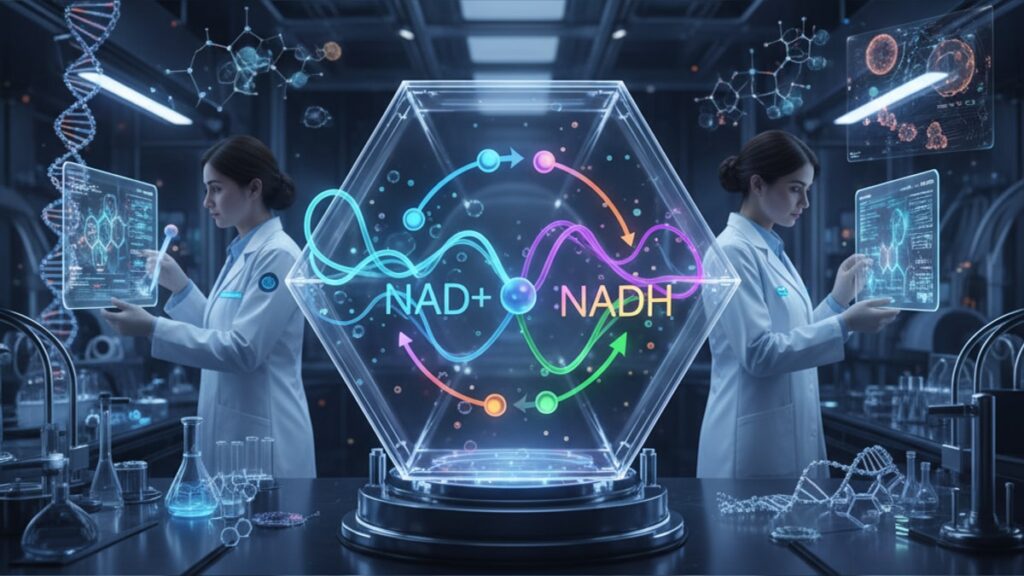
Let's get straight to it. You’re asking a fundamental question in biochemistry: is NAD+ oxidized or reduced? The quick, textbook answer is that NAD+ is the oxidized form. Simple, right?
Well, not exactly. Stopping there is like knowing the first letter of the alphabet and thinking you can write a novel. The real story—the one that matters for every researcher, biohacker, and curious mind—lies in the dynamic, perpetual dance between NAD+ and its other half, NADH. This relationship is the absolute bedrock of cellular energy production. Understanding this interplay isn't just academic; it’s essential for anyone working to unravel the mechanisms of health, aging, and metabolic function. Our team at Real Peptides deals with the intricacies of these molecular pathways daily, and we can't stress this enough: grasping this concept is non-negotiable for high-level research.
First Things First: What Are Oxidation and Reduction?
Before we can talk about NAD+, we need a quick, painless refresher on redox reactions. You might remember the mnemonic from a high school chemistry class: OIL RIG. It stands for Oxidation Is Loss, Reduction Is Gain. It’s a beautifully simple way to remember a complex process.
But loss and gain of what? Electrons.
- Oxidation: A molecule is oxidized when it loses one or more electrons. Think of it as giving something away. The molecule that does the taking is called the oxidizing agent.
- Reduction: A molecule is reduced when it gains one or more electrons. It’s receiving a gift. The molecule doing the giving is the reducing agent.
In biological systems, these electrons often travel with a proton (a hydrogen ion, H+), so we frequently talk about the transfer of hydrogen atoms. When a molecule loses a hydrogen atom, it's typically been oxidized. When it gains one, it's been reduced. This is the core transaction that powers life, and NAD+ is right in the middle of it all.
The Dynamic Duo: NAD+ (The Oxidized Form) and NADH (The Reduced Form)
Think of NAD+ and NADH as two sides of the same coin, or maybe a better analogy is a rechargeable battery. NAD+ is the depleted battery, ready to be charged up. NADH is the fully charged battery, ready to power cellular machinery.
They are both forms of Nicotinamide Adenine Dinucleotide, a critical coenzyme found in every living cell. It’s not the star of the show, but it’s the indispensable stagehand that makes the entire production possible.
NAD+: The Electron Acceptor
This is the oxidized form. The "+" sign in its name signifies its positive charge, indicating it's ready and waiting to accept electrons. We like to think of it as an empty shuttle bus, driving around the cell looking for passengers.
Where does it find them? Primarily during catabolic processes—the breakdown of molecules to release energy. When you eat food, your body breaks down glucose (sugar), fats, and proteins. During key steps in processes like glycolysis and the Krebs cycle, high-energy electrons are stripped from these fuel molecules. NAD+ is right there to pick them up. When NAD+ accepts two electrons and one proton, it becomes its other self.
It becomes NADH.
Beyond just energy, NAD+ is also a critical substrate for other enzymes, most famously sirtuins and PARPs (Poly(ADP-ribose) polymerases). Sirtuins are a class of proteins heavily involved in regulating cellular health, gene expression, and longevity. PARPs are essential for repairing damaged DNA. Neither of these crucial enzyme families can do their job without a ready supply of NAD+. They don't just use it; they consume it. This makes the available pool of NAD+ a direct regulator of our body's maintenance and repair systems.
NADH: The Electron Donor
This is the reduced form. It’s the shuttle bus that has picked up its passengers—those high-energy electrons. It’s now carrying a valuable payload, and its destination is the electron transport chain (ETC), located in the inner membrane of the mitochondria.
The ETC is the final stage of cellular respiration. It's the power plant. Here, NADH donates its electrons, passing them down a series of protein complexes like a hot potato. As the electrons move, they release energy, which is used to pump protons across the mitochondrial membrane, creating a powerful electrochemical gradient. This gradient is then used to drive an enzyme called ATP synthase, which churns out massive amounts of ATP (adenosine triphosphate). ATP is the direct energy currency of the cell. It powers everything.
One molecule of NADH dropping off its electrons at the ETC ultimately leads to the production of about 2.5 to 3 molecules of ATP. That's efficiency. NADH is, in essence, the molecular link between the food we eat and the energy we use to think, move, and live.
The NAD+/NADH Ratio: A Critical Metabolic Sensor
Here’s where it gets really interesting. It’s not just the absolute amount of NAD+ or NADH that matters. It’s their ratio.
The NAD+/NADH ratio acts as a critical sensor of the cell's metabolic state. It tells the cell whether it's a time of feast or famine, of high energy or low energy, and dictates which cellular programs to run. It’s a fundamental control switch.
-
A High NAD+/NADH Ratio: This means there's a lot of the oxidized form (NAD+) relative to the reduced form (NADH). This signals an energy-deprived state. The cell interprets this as, "We need more energy, now!" This state powerfully activates catabolic pathways to break down fuel. It also provides plenty of substrate for sirtuins and PARPs, ramping up DNA repair, reducing inflammation, and promoting cellular resilience. Things like exercise and caloric restriction are known to increase this ratio.
-
A Low NAD+/NADH Ratio: This means there's an abundance of the reduced form (NADH) compared to NAD+. This signals an energy-rich state. The cell says, "We're full, we have plenty of energy." This state promotes anabolic pathways—the building of molecules, like storing fat and creating proteins. While necessary for growth, a chronically low ratio can contribute to metabolic dysfunction and reductive stress.
Our team has found that for researchers studying metabolic diseases or aging, this ratio is often a more important biomarker than the total NAD pool. It provides a dynamic snapshot of what the cell is actually doing with its energy.
| Feature | NAD+ (Oxidized Form) | NADH (Reduced Form) |
|---|---|---|
| Full Name | Nicotinamide Adenine Dinucleotide | Nicotinamide Adenine Dinucleotide + Hydrogen |
| Chemical State | Oxidized | Reduced |
| Primary Role | Electron Acceptor | Electron Donor |
| Key Pathways | Glycolysis, Krebs Cycle, Beta-Oxidation | Electron Transport Chain |
| Electron Status | "Empty" – Ready to gain electrons | "Full" – Carrying high-energy electrons |
| Impact on Sirtuins | Required substrate; activates sirtuin activity | Does not directly activate sirtuins |
| Metabolic Signal | Signals low energy state; promotes catabolism | Signals high energy state; promotes anabolism |
Why This Distinction Is Crucial for Researchers
In the world of biotechnology and life sciences research, precision is everything. You can't afford to be ambiguous. When you're designing an experiment to study cellular metabolism, mitochondrial function, or the effects of a specific compound, knowing the difference between NAD+ and NADH is paramount.
Are you trying to fuel the electron transport chain, or are you trying to provide substrate for sirtuins? The answer determines which form of the molecule you're interested in. For many researchers investigating longevity and cellular repair mechanisms, the focus is squarely on boosting the pool of available NAD+ to support the activity of enzymes like sirtuins. This is why a significant amount of research is dedicated to NAD+ precursors—molecules the body can convert into NAD+.
This is also why the quality of research compounds is a non-negotiable element of successful science. At Real Peptides, our entire process is built around guaranteeing purity and precision. When a researcher uses a compound like our research-grade NAD+ 100mg, they need absolute confidence that they are getting exactly what the label says, free from contaminants that could skew results. That confidence is built on small-batch synthesis and rigorous quality control, ensuring that the foundational molecules of an experiment are impeccable. That same dedication to quality applies whether you're studying NAD+ or exploring the potential of compounds in our broader collection of All Peptides.
Let's be honest, this is crucial. A contaminated or improperly synthesized compound can send a research project, which can represent months or even years of work, in a completely wrong direction. It’s a catastrophic waste of time and resources.
How Our Bodies Regulate the NAD+ Pool
Our cells are incredibly resourceful. They don't just rely on getting NAD+ from our diet (primarily from vitamin B3, niacin). They have sophisticated recycling programs.
The primary pathway is the Salvage Pathway. When NAD+ is consumed by enzymes like sirtuins or PARPs, it breaks down into a molecule called nicotinamide (NAM). The salvage pathway takes this NAM and, through a series of enzymatic steps, converts it right back into NAD+. This process is relentless and highly efficient, recycling NAD+ constantly to meet cellular demands.
There are also other pathways, like the de novo pathway (building NAD+ from the amino acid tryptophan) and the Preiss-Handler pathway (using nicotinic acid), but the salvage pathway is the main workhorse.
The problem is, the efficiency of this recycling system appears to decline with age. At the same time, cellular damage and inflammation increase with age, placing a higher demand on NAD+-consuming enzymes like PARPs. It’s a perfect storm: the demand for NAD+ goes up while the cell's ability to supply it goes down. This progressive decline in NAD+ levels is now considered a hallmark of aging and is linked to a wide range of age-related conditions. This is the central reason why NAD+ has become such a formidable target for longevity research.
Practical Implications: Can We Influence Our NAD+ Levels?
So, if this NAD+/NADH ratio is so important, and NAD+ levels decline with age, what can be done about it? Research points to several powerful modulators of the NAD+ landscape.
-
Exercise: Both endurance and high-intensity training are potent activators of NAD+ synthesis. During exercise, your cells burn through ATP at a ferocious rate. This increases the AMP:ATP ratio, which activates an enzyme called AMPK. AMPK, in turn, boosts the salvage pathway, churning out more NAD+ to meet the energy demand. It’s a beautiful feedback loop.
-
Caloric Restriction & Fasting: Limiting calorie intake without malnutrition is one of the most robustly studied interventions for extending healthspan in various organisms. A key mechanism is its effect on the NAD+/NADH ratio. By creating a mild, controlled energy deficit, it pushes the ratio higher, activating the same pro-longevity pathways (like sirtuins) that a high NAD+ state promotes.
-
Diet: Consuming foods rich in vitamin B3 (niacin, nicotinamide, nicotinamide riboside) provides the raw materials for NAD+ synthesis. These include foods like turkey, chicken, mushrooms, and avocados. While diet alone may not be enough to offset the age-related decline, it's a foundational piece of the puzzle.
-
Circadian Rhythm: Our NAD+ levels naturally oscillate over a 24-hour cycle, peaking during the day when we are most active and dipping at night. This rhythm is crucial for timing metabolic processes correctly. Disrupting your circadian rhythm (through things like shift work or poor sleep hygiene) can flatten these NAD+ oscillations, leading to metabolic dysregulation. Our experience shows that researchers studying metabolism often have to control for the time of day when taking measurements, as these fluctuations can significantly impact the data.
This entire, sprawling biochemical network comes back to that one simple question: is NAD+ oxidized or reduced? The answer, as we've seen, is just the beginning. The real magic is in the transformation—the constant cycling between the oxidized NAD+ and the reduced NADH. It's a system of elegant simplicity and profound importance, driving the very essence of life at the molecular level. For any researcher looking to make an impact in the fields of aging, metabolism, or cellular health, mastering this dynamic is the first, and perhaps most important, step. When you're ready to take that step in your own research, we encourage you to Get Started Today by exploring the tools that can make your work possible.
Frequently Asked Questions
So, to be clear, is NAD+ oxidized or reduced?
▼
NAD+ is the oxidized form of Nicotinamide Adenine Dinucleotide. It has given up electrons and is ready to accept new ones, acting as an oxidizing agent in metabolic reactions.
What is the full name for NAD+?
▼
The full name is Nicotinamide Adenine Dinucleotide. The ‘+’ sign indicates its net positive charge in its oxidized state, which is key to its function as an electron acceptor.
Is NADH the ‘good’ one and NAD+ the ‘bad’ one?
▼
It’s not about good or bad; it’s about balance. Both are absolutely essential. NADH is crucial for producing ATP, while NAD+ is vital for breaking down fuel and for activating critical enzymes like sirtuins for cellular repair. The cell needs both in the right proportions to function.
Why is the NAD+/NADH ratio so important?
▼
The ratio acts as a cellular energy sensor. A high ratio (more NAD+) signals a low-energy state, triggering fuel breakdown and repair. A low ratio (more NADH) signals an energy-rich state, promoting storage and building processes.
How does exercise affect NAD+ levels?
▼
Exercise increases the demand for energy (ATP), which in turn stimulates the cell’s NAD+ recycling pathways. This leads to an increase in the NAD+/NADH ratio, activating beneficial cellular maintenance programs.
Is it true that NAD+ declines as we age?
▼
Yes, a decline in total NAD+ levels is a well-documented hallmark of aging. This is believed to be caused by a combination of reduced production and increased consumption by DNA repair enzymes, contributing to age-related cellular dysfunction.
What’s the difference between NAD+ and a peptide?
▼
They are fundamentally different molecules. NAD+ is a coenzyme, a small organic molecule that helps enzymes function. Peptides, like those we specialize in at Real Peptides, are short chains of amino acids that often act as signaling molecules.
Are NAD+ and NMN the same thing?
▼
No, they are not. NMN (Nicotinamide Mononucleotide) is a precursor molecule to NAD+. The body uses NMN as a building block in the salvage pathway to create new NAD+.
What specific role does NAD+ play in DNA repair?
▼
NAD+ is a required fuel source for a family of enzymes called PARPs. When DNA damage occurs, PARPs are activated and consume large amounts of NAD+ to carry out the repair process, making NAD+ availability critical for genomic stability.
Can you measure the NAD+/NADH ratio in a lab?
▼
Yes, measuring the NAD+/NADH ratio is possible in a research setting, typically using techniques like mass spectrometry or specific enzymatic assays on tissue or cell samples. It’s a complex but valuable measurement for metabolic studies.
What are sirtuins and why do they need NAD+?
▼
Sirtuins are a class of proteins often called ‘longevity genes’ that regulate cellular health, stress resistance, and metabolism. They are NAD+-dependent, meaning they cannot function without consuming NAD+ as a co-substrate.
How does Real Peptides ensure the quality of its research compounds?
▼
Our commitment to quality is uncompromising. We utilize small-batch synthesis for precise control and subject every batch to rigorous testing to verify purity and exact amino-acid sequencing, ensuring our clients receive reliable and consistent compounds for their research.











