





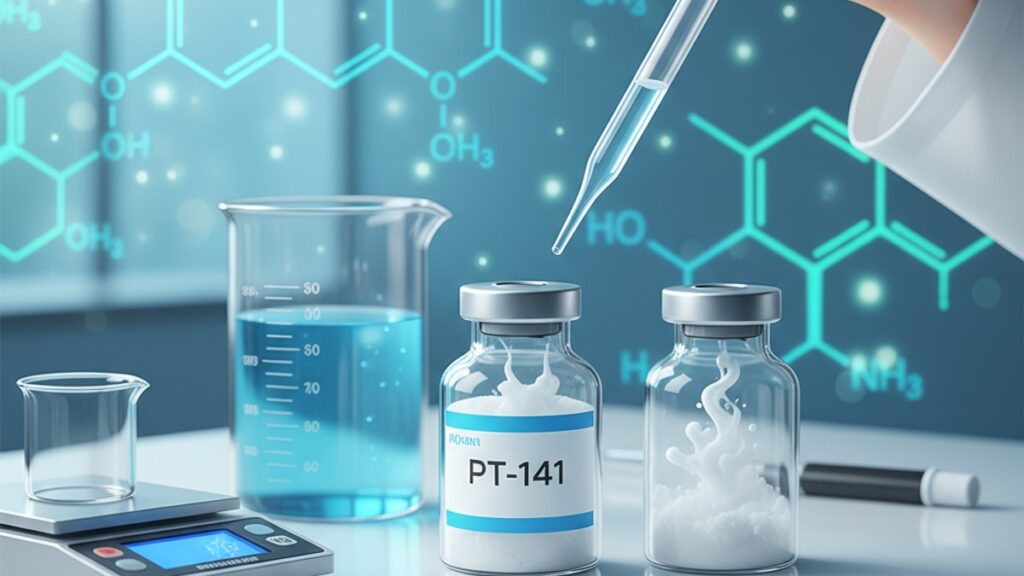
It’s a question our team hears all the time, and honestly, it’s one of the most critical steps in any research protocol involving lyophilized peptides. You have a vial of high-purity PT-141 Bremelanotide, and you have your diluent, but the path from powder to a precisely concentrated solution feels murky. How much bacteriostatic water do you actually mix with PT-141? The answer isn't just a number; it's about understanding the principle behind it to ensure your research data is valid, repeatable, and built on a foundation of accuracy.
Let's be perfectly clear: getting this wrong can compromise an entire line of study. An incorrect concentration means inaccurate dosing, and inaccurate dosing leads to skewed, unreliable results. At Real Peptides, we obsess over the purity inside the vial—our small-batch synthesis guarantees it. But once that vial is in your lab, that same level of precision must be applied to the reconstitution process. We see ourselves as partners in your research, and that means empowering you with the knowledge to handle these compounds correctly. This isn't just about mixing; it's about meticulous preparation for discovery.
Why Precision Here Is Non-Negotiable
When we talk about reconstituting peptides, we're not just 'adding water.' We are creating a new solution with a specific, known concentration, usually measured in milligrams per milliliter (mg/mL). This concentration is the bedrock of your entire experimental protocol. Every subsequent measurement and administration relies on that initial calculation being flawless.
Think about it. If your solution is accidentally twice as concentrated as you believe, every dose you administer is doubled. If it's half as concentrated, your results may show no effect, leading you to incorrectly conclude that the peptide is inactive at what you thought was a viable dosage. This is how research gets derailed. It’s how budgets get wasted. It's a catastrophic, yet completely avoidable, error.
Our experience shows that the most successful research teams are the ones who treat reconstitution with the same reverence as data analysis. They don't eyeball it. They don't guess. They calculate, they measure, and they document. The integrity of your work depends on it. A tiny miscalculation in the volume of Bacteriostatic Water can create a significant ripple effect, invalidating weeks or even months of effort. It’s that serious.
The Two Stars of the Show: PT-141 and Bacteriostatic Water
Before we dive into the math, let's quickly get reacquainted with our two key components. Understanding what they are and why they're in their specific forms is crucial.
First, you have your PT-141 (Bremelanotide). This synthetic peptide, an analogue of alpha-melanocyte-stimulating hormone (α-MSH), is a fascinating compound for researchers studying its effects as a melanocortin receptor agonist. In its raw, most stable form, it’s a lyophilized powder. Lyophilization, or freeze-drying, removes water from the peptide, making it incredibly stable for shipping and long-term storage. But in this powdered state, it's unusable for research. It needs to be brought back into a liquid solution.
That's where Bacteriostatic Water comes in. This isn't just sterile water. It's sterile water that contains 0.9% benzyl alcohol. Why the addition? The benzyl alcohol acts as a bacteriostatic agent, which means it stops bacteria from reproducing. This is absolutely critical if you plan to draw from the vial multiple times over days or weeks. Regular sterile water, once punctured, can become a breeding ground for bacteria, contaminating your entire supply. For any multi-use research protocol, bacteriostatic water isn't just a recommendation; it's a requirement for maintaining sterility and peptide integrity.
Using anything else is a gamble we’d never advise. Tap water is out of the question due to impurities and microorganisms. Even sterile water for injection is only suitable for a single-use draw, as it lacks the preservative needed to keep the solution safe over time.
The Math Behind the Mix: A Step-by-Step Breakdown
Alright, let's get down to the numbers. The goal is to calculate how much bacteriostatic water you need to add to your vial of PT-141 to achieve a specific, desired concentration. It's simpler than it looks, and we'll walk through it.
The Core Formula:
Total Peptide in Vial (mg) / Desired Concentration (mg/mL) = Volume of Water to Add (mL)
That's it. That's the whole game.
Let's use a standard 10mg vial of PT-141, like the ones we meticulously prepare at Real Peptides, for our examples.
Example 1: Creating a 10mg/mL Solution (A Simple Ratio)
This is the most straightforward calculation. You have 10mg of PT-141 and you want every 1 mL of liquid to contain 10mg of the peptide.
- Calculation: 10mg / 10mg/mL = 1 mL
- Action: You will add exactly 1 mL of bacteriostatic water to the vial.
What does this mean for dosing? With this concentration, every 0.1 mL of solution you draw will contain 1mg of PT-141. On a standard U-100 insulin syringe, 0.1 mL is marked as '10' on the barrel. So, 10 units = 1mg.
Example 2: Creating a 5mg/mL Solution (A More Flexible Ratio)
Many researchers prefer a slightly less concentrated solution because it allows for more precision when measuring smaller doses. It makes the math a little easier to manage.
- Calculation: 10mg / 5mg/mL = 2 mL
- Action: You will add exactly 2 mL of bacteriostatic water to the vial.
Now, what does this mean for dosing? With this 5mg/mL concentration, every 0.1 mL of solution will contain 0.5mg (or 500mcg) of PT-141. On that same U-100 syringe, 10 units now equals 500mcg. If you needed a 1mg dose, you'd draw 0.2 mL (20 units).
Our Team's Professional Insight: We've found that for many research applications, a concentration of 5mg/mL or even 2mg/mL (which would require 5 mL of water for a 10mg vial) is often superior. Why? It magnifies the measurement scale on your syringe, reducing the margin for error when you're working with microgram-level precision. A tiny slip of the plunger is less impactful in a more dilute solution. It's a small adjustment that can pay big dividends in data consistency.
The Reconstitution Protocol: Our Lab-Tested Method
Knowing the math is one thing; executing the procedure with the right technique is another. Aseptic technique is crucial to prevent contamination. Here's the exact protocol our experts recommend for a clean and effective reconstitution.
-
Gather Your Supplies. You'll need your vial of lyophilized PT-141, a vial of bacteriostatic water, several alcohol prep pads, and a sterile syringe for mixing (a 3mL or 5mL syringe is usually perfect for this part).
-
Prepare Your Workspace. This should be a clean, draft-free area. Wipe down the surface with a disinfectant. Wash your hands thoroughly.
-
Prep the Vials. Pop the plastic caps off both vials. Vigorously wipe the rubber stoppers on both the PT-141 vial and the bacteriostatic water vial with an alcohol prep pad. Let them air dry for a moment.
-
Draw the Bacteriostatic Water. Take your mixing syringe and draw air into it equal to the volume of water you're about to draw out (e.g., if you need 2 mL of water, pull the plunger back to the 2 mL mark). Insert the needle into the bacteriostatic water vial and inject the air. This pressurizes the vial and makes drawing the liquid out much easier. Then, invert the vial and draw your calculated amount of water (e.g., 2 mL).
-
The Gentle Introduction. This is a step where people often go wrong. Do not just inject the water forcefully into the center of the powdered peptide. This can damage the fragile peptide chains. Instead, insert the needle into the PT-141 vial, angle it so it's touching the glass wall inside, and slowly, gently depress the plunger. Let the water run down the side of the vial and onto the powder.
-
The Swirl, NOT the Shake. We can't stress this enough. Once the water is in, remove the syringe and gently swirl the vial. You can roll it between your palms. Do NOT shake it. Shaking creates foam and the mechanical agitation can shear and denature the peptide molecules, rendering them ineffective.
-
Inspect for Clarity. The powder should dissolve completely within a minute or two, leaving a solution that is perfectly clear. If you see any cloudiness, floaters, or sediment, do not use it. This indicates a problem with either the peptide's purity or the reconstitution process itself. All products from Real Peptides, when reconstituted correctly, will yield a crystal-clear solution.
Common Pitfalls and How to Sidestep Them
We've seen a few common mistakes trip up even experienced researchers. Here's a quick guide to avoiding them.
- Mistake 1: Using the Wrong Diluent. As we covered, only bacteriostatic water is appropriate for multi-use vials. Using sterile water opens the door to contamination after the first puncture, and using anything else is asking for trouble.
- Mistake 2: Shaking the Vial. It bears repeating because it's so common. Peptides are complex, folded proteins. Shaking them is like putting them in a microscopic blender. Always swirl gently until dissolved.
- Mistake 3: Inaccurate Measurements. Trust your math, but verify your measurements. Use a high-quality syringe with clear markings. For reconstitution, a larger 3mL syringe is often easier to read accurately than a tiny 1mL syringe. Measure twice, reconstitute once.
- Mistake 4: Improper Storage. Once reconstituted, PT-141 is no longer stable at room temperature. It must be stored in the refrigerator (around 2-8°C or 36-46°F). Do not freeze it. Proper refrigeration will maintain its potency for your research timeline, typically up to 30-60 days.
Dosing Calculations After Reconstitution
So, you've successfully reconstituted your vial. The next logical step is figuring out how to draw the exact dose your research protocol calls for. This requires one more simple calculation, but to make it even easier, we've put together a handy reference table.
The formula is: Desired Dose (in mg) / Solution Concentration (in mg/mL) = Volume to Draw (in mL)
Remember, 1mg = 1000mcg. Most U-100 insulin syringes hold 1mL total, and each 'unit' mark represents 0.01mL.
| Desired Research Dose | Solution Concentration | Calculation | Volume to Draw | Units on U-100 Syringe |
|---|---|---|---|---|
| 500mcg (0.5mg) | 10mg/mL | 0.5mg / 10mg/mL | 0.05 mL | 5 Units |
| 1000mcg (1.0mg) | 10mg/mL | 1.0mg / 10mg/mL | 0.1 mL | 10 Units |
| 2000mcg (2.0mg) | 10mg/mL | 2.0mg / 10mg/mL | 0.2 mL | 20 Units |
| 500mcg (0.5mg) | 5mg/mL | 0.5mg / 5mg/mL | 0.1 mL | 10 Units |
| 1000mcg (1.0mg) | 5mg/mL | 1.0mg / 5mg/mL | 0.2 mL | 20 Units |
| 2000mcg (2.0mg) | 5mg/mL | 2.0mg / 5mg/mL | 0.4 mL | 40 Units |
This table should serve as a quick guide. Always perform the calculation yourself to confirm, as your specific protocol may require different doses. The key is understanding the relationship between concentration and volume. It’s a powerful tool for precision.
Quality From Start to Finish: Why Your Source Matters
All of this meticulous technique—the careful calculations, the gentle swirling, the aseptic handling—is fundamentally pointless if the peptide you start with is subpar. If your vial doesn't contain the advertised 10mg of pure PT-141, every calculation that follows is built on a faulty premise.
This is why we're so relentless about quality at Real Peptides. Our commitment isn't just a marketing slogan; it's the entire foundation of our business. We utilize small-batch synthesis to ensure impeccable quality control and exact amino-acid sequencing. Every batch is rigorously tested for purity, so you can be absolutely certain that the amount listed on the vial is the amount in the vial. No guesswork. No fillers. Just pure, research-grade peptide.
This dedication extends across our entire catalog, from foundational compounds like BPC-157 Peptide to cutting-edge molecules. When you shop all our peptides, you're not just buying a product; you're investing in data integrity. You're ensuring that your hard work and research funding are being applied to authentic, verifiable materials.
So, when you're ready to build your next study on a foundation of uncompromised quality, we're here. You can Get Started Today and experience the difference that true purity makes.
Ultimately, mastering the reconstitution of PT-141 is a fundamental lab skill that empowers your research. It transforms a simple question of 'how much water' into a confident, precise, and repeatable protocol. By combining high-quality materials with meticulous technique, you create the optimal conditions for generating clear, unambiguous, and powerful scientific data. And that, after all, is the entire point.
Frequently Asked Questions
Can I use sterile water instead of bacteriostatic water for PT-141?
▼
You can use sterile water for a single withdrawal only. For any vial that will be punctured multiple times, you must use bacteriostatic water. Its preservative, benzyl alcohol, prevents bacterial growth and maintains sterility over time.
How long is reconstituted PT-141 good for?
▼
When reconstituted with bacteriostatic water and stored properly in a refrigerator (not frozen), PT-141 is typically stable and potent for 30 to 60 days. Always check for clarity before each use.
What happens if I accidentally shake the PT-141 vial?
▼
Shaking can damage the delicate peptide chains through a process called shearing or denaturation. This can reduce the peptide’s effectiveness. Always swirl the vial gently until the powder is fully dissolved.
Why is my reconstituted PT-141 solution cloudy?
▼
A cloudy solution is a major red flag. It can indicate bacterial contamination, poor quality peptide, or an issue with your diluent. The solution should be crystal clear. We recommend discarding any cloudy solution to ensure research integrity.
Does it matter how much water I use to mix with PT-141?
▼
Yes, it matters tremendously. The amount of water determines the final concentration (e.g., mg/mL) of your solution. This concentration is essential for calculating accurate research doses. Using an incorrect amount of water will lead to dosing errors.
How should I store the reconstituted vial of PT-141?
▼
Once mixed, the vial must be stored in a refrigerator at a temperature between 2-8°C (36-46°F). Do not store it at room temperature or in the freezer, as extreme temperatures can degrade the peptide.
Is it better to make the PT-141 solution more or less concentrated?
▼
Our team often recommends a less concentrated solution (e.g., 5mg/mL instead of 10mg/mL). This makes it easier to accurately measure smaller, more precise doses, as it increases the volume you need to draw for a given dose, reducing the margin of error.
What kind of syringe should I use for reconstitution?
▼
For the mixing process itself, a 3mL or 5mL sterile syringe works well as it’s easy to handle and measure with. For administering research doses, a U-100 insulin syringe is the standard due to its fine gradations for precise measurement.
How do I convert milligrams (mg) to micrograms (mcg)?
▼
It’s a simple conversion: 1 milligram (mg) is equal to 1000 micrograms (mcg). This is crucial for calculating doses, as protocols are often specified in mcg while concentrations are in mg/mL.
Why does the water need to be injected down the side of the vial?
▼
Injecting the water slowly down the glass wall of the vial is a gentle technique that prevents damaging the lyophilized peptide powder. A forceful stream of water directly onto the powder can harm the delicate molecular structure.
Can I pre-load syringes with PT-141 for later use?
▼
Our team generally advises against pre-loading syringes for long-term storage. There’s a higher risk of contamination, and the stability of peptides in plastic syringes over time is less studied than in glass vials. It’s best practice to draw each dose immediately before administration.
What is lyophilized powder?
▼
Lyophilization is a freeze-drying process that removes water from the peptide to make it stable for transport and storage. This results in a dry powder cake that must be reconstituted into a liquid solution before it can be used in research.











