





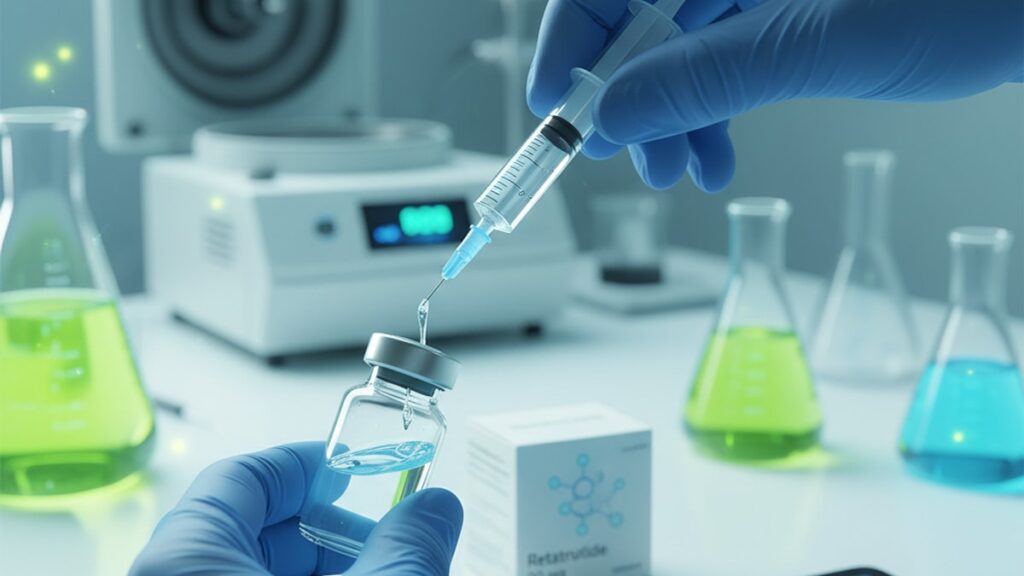
In the world of peptide research, precision isn't just a goal; it's the absolute bedrock of valid discovery. When working with a formidable compound like Retatrutide, a multi-receptor agonist with sprawling potential, every single step in your protocol matters. It's a compound that demands respect. And frankly, the most common point of failure we see isn't in the experimental design itself, but in a fundamental, often overlooked procedure: reconstitution.
Getting this wrong can compromise an entire research project before it even begins. An improperly mixed peptide can lead to inaccurate dosing, degraded compound stability, and ultimately, data that's unreliable. We've seen it happen, and it's a catastrophic waste of time, resources, and potential breakthroughs. Our mission at Real Peptides goes beyond just supplying the highest-purity compounds on the market; we're committed to empowering researchers with the knowledge to use them effectively. So, let's walk through the exact process our own team uses for reconstituting retatrutide 20 mg, ensuring your work starts on the most stable footing possible.
The Groundwork: Understanding Lyophilized Peptides
Before you even think about picking up a syringe, it's crucial to understand why this process is so delicate. The Retatrutide you receive, like most research peptides, arrives in a lyophilized state. Think of it as freeze-dried. This process removes water from the peptide under low pressure, transforming it into a stable, solid powder or 'cake' that's far easier to ship and store long-term than its liquid counterpart.
But this stability comes with a trade-off. The peptide is inert, unusable for research until it's brought back into a liquid solution. This is reconstitution. The challenge lies in the peptide's structure—a long, specific chain of amino acids. This structure is what gives the peptide its biological activity, and it's surprisingly fragile. Aggressive handling, the wrong pH, or a forceful jet of liquid can shear these delicate bonds, effectively destroying the compound. Let's be honest, this is crucial. Your entire experiment hinges on preserving this intricate molecular architecture during the transition from solid to liquid. That’s why a methodical, almost ceremonial approach is not just recommended; it’s essential.
Assembling Your Toolkit: Precision Starts Here
Success in the lab is often a direct result of meticulous preparation. You wouldn't start a complex synthesis without having every reagent measured and ready, and reconstituting a peptide is no different. Gathering the right tools beforehand prevents scrambling mid-process, which is when mistakes and contamination are most likely to occur. We can't stress this enough: work in a clean, uncluttered space.
Here’s what you absolutely need:
- Your Vial of Lyophilized Retatrutide (20 mg): The star of the show. Handle it with care. Before you begin, allow the vial to come to room temperature if it has been refrigerated. This prevents condensation from forming on the rubber stopper, which can introduce moisture and potential contaminants.
- A Suitable Diluent: This is your most important decision after choosing the peptide itself. We'll dive deep into this next, but our team’s standard is Bacteriostatic Water.
- Sterile Syringes: You'll need at least one syringe for drawing and transferring the diluent. A 3mL or 5mL syringe is typically ideal for this purpose, paired with a sterile needle (e.g., 21-23 gauge).
- Alcohol Prep Pads: For sterile technique. Never, ever skip this. Wiping the rubber stoppers (septa) of both your peptide vial and your diluent vial is a non-negotiable step to prevent bacterial contamination.
- A Clean, Dedicated Workspace: A sanitized lab bench or a dedicated clean area at your desk is sufficient. The goal is to minimize airborne contaminants.
Having everything laid out and within reach transforms the process from a hurried task into a controlled, scientific procedure. It’s a simple change that makes a world of difference.
Choosing Your Diluent: The Most Critical Variable
The liquid you choose to dissolve your peptide in—the diluent—has a profound impact on the final solution's stability and shelf-life. While there are a few options, they are not interchangeable. Our experience shows that selecting the right one from the outset saves a world of trouble down the line.
Here's a breakdown of the common choices:
| Diluent | Primary Use Case | Shelf-Life of Reconstituted Peptide | Our Recommendation |
|---|---|---|---|
| Bacteriostatic Water | Multi-use vials, studies requiring storage | Extended (up to 28 days refrigerated) | Strongly Recommended for Retatrutide. The 0.9% benzyl alcohol preservative inhibits microbial growth, which is critical if you're drawing multiple doses from the same vial over time. |
| Sterile Water | Single-use applications, immediate use | Very short (typically < 24 hours refrigerated) | Suitable only if you plan to use the entire 20 mg of Retatrutide in a single experiment immediately after mixing. It contains no preservative, making it a welcoming environment for bacteria. |
| Acetic Acid (0.6%) | Peptides with poor water solubility | Variable; can affect peptide stability | Not necessary or recommended for Retatrutide, which is soluble in bacteriostatic water. Using an acidic solution when not required can potentially alter the peptide's conformation and activity. |
For nearly all research applications involving Retatrutide, Bacteriostatic Water is the unequivocal best choice. The inclusion of benzyl alcohol as a bacteriostatic agent is the key differentiator. It allows you to safely store the reconstituted solution in the refrigerator for several weeks, drawing doses as needed for your experiments without a significant risk of contamination. Given the cost and value of a compound like Retatrutide, maximizing its usable lifespan is just smart science. This is the standard in our labs, and we believe it should be the standard in yours.
The Reconstitution Protocol: A Step-by-Step Guide
Alright, you've got your supplies, you've chosen your diluent, and your workspace is clean. Now for the main event. Follow these steps precisely. Don't rush. The entire process should take only a few minutes, but those few minutes are foundational to your research.
Step 1: Preparation and Sanitization
First, wash your hands thoroughly. Pop the plastic protective caps off both the Retatrutide vial and the Bacteriostatic Water vial. Take an alcohol prep pad and vigorously wipe the rubber stopper on each vial. Then, let them air dry for about 30-60 seconds. Don't blow on them or wipe them dry—that just reintroduces contaminants.
Step 2: Calculating Your Volume
This is where precision is paramount. You need to decide on your final concentration. A lower concentration (more diluent) can sometimes make it easier to draw very small, precise doses, while a higher concentration (less diluent) means a smaller injection volume. For a 20 mg vial of Retatrutide, here are two common scenarios our team uses:
- Scenario A (Resulting in 10 mg/mL): If you add 2 mL of bacteriostatic water to the 20 mg vial, your final concentration will be 10 mg per mL.
- Calculation: 20 mg peptide / 2 mL diluent = 10 mg/mL.
- Scenario B (Resulting in 5 mg/mL): If you add 4 mL of bacteriostatic water to the 20 mg vial, your final concentration will be 5 mg per mL.
- Calculation: 20 mg peptide / 4 mL diluent = 5 mg/mL.
For most research, Scenario A (10 mg/mL) is a very practical concentration to work with. Let's proceed using that as our example.
Step 3: Drawing the Diluent
Uncap your sterile syringe. Pull back the plunger to the 2 mL mark, drawing 2 mL of air into the syringe. Insert the needle through the center of the rubber stopper of the bacteriostatic water vial. Invert the vial and inject the 2 mL of air into it. This pressurizes the vial, making it much easier to draw the liquid out. Now, slowly pull back the plunger, drawing exactly 2 mL of the bacteriostatic water into your syringe. Check for any large air bubbles. If you see them, flick the side of the syringe gently to consolidate them at the top, then push the plunger slightly to expel the air before ensuring you still have exactly 2 mL of liquid.
Step 4: The Gentle Introduction
This is the most delicate part of the whole process. Take the syringe filled with your 2 mL of bacteriostatic water and insert the needle through the stopper of the Retatrutide vial. Now, this is where it gets interesting. Do not inject the water directly onto the lyophilized powder. This is a catastrophic error. A direct, forceful stream can damage the peptide.
Instead, angle the needle so that the tip is touching the inside glass wall of the vial. Slowly, and I mean slowly, depress the plunger, letting the water run gently down the side of the vial. The water will pool at the bottom and begin to dissolve the powder from the bottom up.
It should be a gentle cascade. Not a jet blast.
Step 5: Mixing – Swirl, Never Shake
Once all the diluent is in the vial, gently remove the syringe. Now, you need to help the peptide dissolve completely. The instinct for many is to shake the vial. Don't do it. Shaking creates foam and, more importantly, the mechanical agitation can denature the peptide, breaking those fragile bonds we talked about.
Instead, gently swirl the vial in a circular motion. You can also roll it between your palms. Be patient. It might take a minute or two, but the lyophilized cake will fully dissolve into the solution. It's a surprisingly satisfying moment.
Step 6: Final Inspection and Labeling
Once mixed, hold the vial up to a light source. The final solution should be perfectly clear. Crystal clear. If you see any cloudiness, floaters, or particulates, it could indicate a problem with either contamination or solubility. At Real Peptides, our quality control ensures impeccable purity, so if you're using our products and following this protocol, you should see a perfectly clear result every time.
Finally, take a marker and label the vial with the date of reconstitution and the final concentration (e.g., "Retatrutide 10 mg/mL, Reconstituted on [Date]"). Your future self will thank you for this bit of diligence.
Proper Storage: Protecting Your Investment
Reconstitution is only half the battle. Proper storage is what ensures the peptide remains stable and potent for the duration of your study. Once reconstituted, the vial of Retatrutide must be stored in a refrigerator, ideally between 2°C and 8°C (36°F and 46°F).
Do not store it in the refrigerator door, where temperatures fluctuate wildly. Place it in the main body of the unit. We also recommend keeping the vial in its original box or another light-blocking container to protect it from light degradation.
What about freezing? Our team advises against it for reconstituted Retatrutide. While freezing can preserve some peptides, the freeze-thaw cycle can be incredibly damaging to complex molecules like this one. Each cycle of freezing and thawing can degrade a portion of the peptide, leading to a gradual loss of potency. Refrigeration is the safer, more reliable method for maintaining stability for its usable lifespan of up to four weeks.
The Unspoken Truth: Purity is Paramount
Here’s a hard truth: the most impeccable reconstitution technique in the world cannot fix a low-purity peptide. If the starting material is flawed—containing contaminants, incorrect sequences, or synthesis byproducts—your results will be skewed from day one. You could follow every step we've outlined with flawless execution and still end up with confounding data simply because the peptide itself wasn't up to standard.
This is the entire philosophy behind Real Peptides. We obsess over purity because we know that's what our research partners depend on. Our commitment to small-batch synthesis and rigorous quality control means that when you reconstitute one of our peptides, you can be confident that you're working with the exact, high-purity molecule you ordered. This same principle applies across our entire catalog, from foundational compounds like BPC 157 Peptide to other advanced metabolic researchers like Tirzepatide. Explore our full collection of peptides and you'll see that this dedication to quality is universal.
Ultimately, your research is a chain of events, and it's only as strong as its weakest link. By starting with a verified, high-purity compound and following a meticulous reconstitution protocol, you eliminate two of the biggest potential points of failure. It sets the stage for clean, reproducible, and impactful results.
Following this protocol isn't just about mixing a powder and a liquid. It's about demonstrating a commitment to good scientific practice. It’s about respecting the integrity of the compounds you work with and, by extension, the integrity of your own research. Take your time, be precise, and lay the groundwork for discovery. If you're ready to build your next project on a foundation of absolute quality, we're here to help. Get Started Today.
Frequently Asked Questions
What exactly does lyophilized mean?
▼
Lyophilization is a sophisticated freeze-drying process used to remove water from a peptide, converting it into a stable powder. This process preserves the peptide’s delicate structure for long-term storage and shipping, making it inert until it’s reconstituted with a diluent.
Why can’t I just use tap water or bottled water to reconstitute retatrutide?
▼
Absolutely not. Tap and bottled water contain minerals, impurities, and microorganisms that can contaminate and degrade the peptide, rendering it useless for research. Always use a sterile, appropriate diluent like [Bacteriostatic Water](https://www.realpeptides.co/products/bacteriostatic-water/) for reliable results.
How long is reconstituted retatrutide 20 mg stable for?
▼
When reconstituted with bacteriostatic water and stored properly in a refrigerator (2-8°C), retatrutide is generally stable for up to 28 days. If reconstituted with sterile water, it should be used within 24 hours.
What should I do if my reconstituted solution is cloudy?
▼
A properly reconstituted solution should be perfectly clear. If it appears cloudy or has visible particles, it may indicate contamination, incomplete dissolution, or a problem with the peptide itself. We do not recommend using any solution that is not crystal clear.
Is it okay to shake the vial to mix it faster?
▼
No, you must never shake the vial. Shaking creates excessive agitation and foaming, which can damage the fragile amino acid chains through a process called denaturation. Always mix by gently swirling the vial or rolling it between your hands.
Does the 20 mg listed on the vial refer to the total powder weight?
▼
The 20 mg refers to the mass of the active peptide ingredient. The total weight of the lyophilized powder may be slightly more due to the presence of small amounts of mannitol or other cryoprotectants used to form a stable ‘cake’.
Can I pre-load syringes with reconstituted retatrutide for later use?
▼
Our team generally advises against this practice. Storing peptides in plastic syringes for extended periods can sometimes lead to adsorption of the peptide onto the plastic surface, potentially altering the delivered dose. It’s best practice to draw each dose from the vial immediately before use.
What happens if I accidentally inject the diluent directly onto the powder?
▼
Injecting the diluent directly onto the lyophilized powder can cause mechanical stress that may shear or damage some of the peptide molecules. While it may not destroy the entire vial’s contents, it can reduce the overall potency and is considered poor technique.
Does the volume of the lyophilized powder affect my final concentration calculation?
▼
For research purposes, the volume displacement of the lyophilized powder is typically considered negligible and is not factored into standard concentration calculations. The calculation is based solely on the mass of the peptide and the volume of the diluent added.
Why is it important for the vial to be at room temperature before I start?
▼
Allowing a cold vial to warm to room temperature prevents moisture from the air from condensing on the rubber stopper. This condensation can introduce water and potential contaminants into the vial when you pierce the stopper, compromising sterility.
Can I use a different volume of diluent than your examples?
▼
Yes, you can. The examples of 2 mL or 4 mL are common starting points, but you can use any volume that suits your dosing protocol. Just be sure to accurately recalculate your final concentration (Total Peptide mg / Total Diluent mL).











