


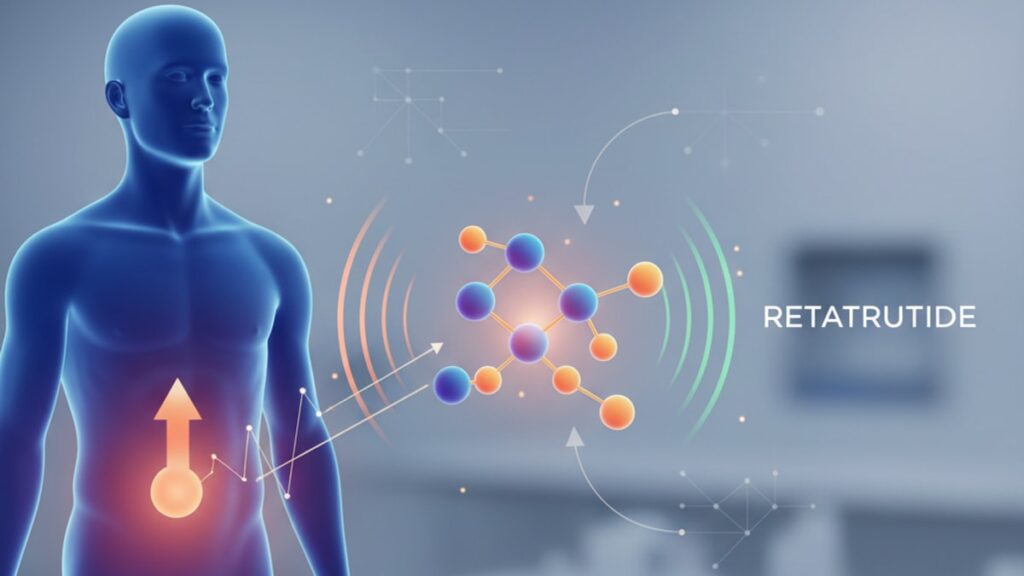
The buzz around next-generation metabolic peptides is impossible to ignore. Compounds are getting smarter, more targeted, and the results seen in clinical research are, frankly, staggering. At the forefront of this new wave is retatrutide, a molecule that's captured the attention of the entire research community. The primary focus has been on its formidable ability to induce weight loss. But as with any powerful systemic compound, the secondary questions start to bubble up. And one of the most common we've been hearing is: does retatrutide increase testosterone?
It’s a fantastic question. It cuts through the surface-level hype and gets right to the heart of how these peptides interact with our intricate endocrine system. For any researcher investigating metabolic health, understanding the hormonal ripple effects is a critical, non-negotiable piece of the puzzle. The answer isn't a simple yes or no. It's more complex, more interesting, and reveals a lot about the interconnectedness of our body's systems. Our team at Real Peptides has been deep in the data, and we're here to walk you through the real science behind retatrutide and its potential impact on testosterone.
First, What Exactly Is Retatrutide?
Before we can tackle the hormone question, we need to be crystal clear on what this peptide is and how it works. Retatrutide isn't just another GLP-1 agonist. It represents a significant leap forward in peptide engineering. It's what's known as a 'triple agonist' or, as some in the research world have nicknamed it, a 'triple G.'
This means it targets three distinct hormone receptors involved in metabolism and appetite regulation:
- GLP-1 (Glucagon-Like Peptide-1): This is the well-known target of many weight loss peptides. It helps control blood sugar, slows stomach emptying (making you feel fuller longer), and signals satiety to the brain.
- GIP (Glucose-Dependent Insulinotropic Polypeptide): This receptor also plays a role in insulin secretion and has been shown to work synergistically with GLP-1 to enhance weight loss and glycemic control.
- Glucagon (GCG): This is the game-changer. While glucagon is traditionally known for raising blood sugar, activating its receptor in a controlled way also appears to increase energy expenditure and promote fat oxidation (fat burning). It's this third mechanism that really sets retatrutide apart from its predecessors.
By hitting all three of these pathways, Retatrutide creates a powerful, multi-pronged attack on excess body fat and metabolic dysfunction. The clinical trial results speak for themselves, with studies showing an average weight loss of up to 24.2% of body weight over 48 weeks. That's not just significant; it's transformative. But we're not just here to talk about weight. We're here to talk about hormones.
The Bedrock Principle: Body Fat and Testosterone Have a Contentious Relationship
To understand retatrutide's potential role, you first have to grasp a fundamental concept of male endocrinology: excess body fat is a testosterone killer. It’s not speculation; it's established science. Our team has seen this connection confirmed time and time again across countless metabolic studies.
Here's how it works. Your fat cells (adipose tissue) aren't just inert storage depots. They are metabolically active, producing a host of hormones and enzymes. One of the most crucial enzymes they produce is called aromatase. The job of aromatase is to convert androgens, specifically testosterone, into estrogens. It's a natural process, but when you have an excess of body fat, you have an excess of aromatase factories working overtime.
This creates a catastrophic hormonal feedback loop:
- More body fat leads to more aromatase enzyme.
- More aromatase converts more of your precious testosterone into estrogen.
- Higher estrogen levels then signal your brain (specifically the pituitary gland) to shut down its own production of testosterone (via Luteinizing Hormone, or LH).
Suddenly, you're left with lower testosterone and higher estrogen. This hormonal imbalance not only kills your energy, muscle mass, and libido but also makes it even easier to store more body fat. It's a vicious cycle. On top of this, obesity is often linked with insulin resistance and chronic inflammation, both of which further suppress healthy testicular function. The bottom line is simple. For most men, reducing significant amounts of excess body fat is one of the most effective ways to naturally restore healthy testosterone levels. And this is where retatrutide re-enters the conversation.
The Direct vs. Indirect Question: How Does Retatrutide Actually Work on Hormones?
Let's address the main question head-on. Is there any evidence that retatrutide directly stimulates the Leydig cells in the testes to pump out more testosterone? Does it directly interact with the hypothalamic-pituitary-testicular axis (HPTA)?
As of now, the answer is no. There is no known mechanism by which retatrutide, or any of the GIP/GLP-1/GCG agonists, directly binds to receptors in the testes or pituitary to command more testosterone production. That's not its job. Its targets are in the pancreas, the gut, and the brain—all centered around metabolic control.
So, if you're looking for a direct replacement for something like HCG or Kisspeptin-10 (a peptide known to directly stimulate the HPTA), this isn't it. But that is absolutely not the end of the story.
Honestly, the indirect effect is far more compelling and, in our professional opinion, potentially more profound for long-term health. The direct route is a temporary fix; the indirect route represents a fundamental restoration of your body's natural hormonal environment.
The Powerful Indirect Cascade: How Retatrutide May Increase Testosterone
This is where it gets really interesting. While retatrutide doesn't flip a switch labeled 'More Testosterone,' its primary effects create a powerful downstream cascade that makes higher testosterone levels almost inevitable for individuals starting with high body fat.
Think of it this way: retatrutide doesn't build you a new house, but it clears away the swamp, lays a solid foundation, and paves the roads, making it incredibly easy for your body to build the house itself.
Here are the key mechanisms behind this powerful indirect effect:
1. Dramatic Reduction in Adipose Tissue (and Aromatase)
This is the big one. As we covered, fat tissue is the primary site of aromatase activity. The unprecedented level of fat loss observed in retatrutide trials—especially visceral fat, the most metabolically harmful type—means you are systematically dismantling the body's testosterone-to-estrogen conversion factories. With fewer factories in operation, less testosterone gets converted. The result is a higher level of free and total testosterone circulating in the bloodstream. It's simple math. We've seen it work.
2. Massive Improvement in Insulin Sensitivity
Obesity and insulin resistance go hand-in-hand. When your cells become resistant to insulin, your pancreas has to pump out more and more of it to manage blood sugar. High insulin levels are directly linked to lower levels of Sex Hormone-Binding Globulin (SHBG). SHBG is a protein that binds to testosterone in the blood. While some binding is necessary, when SHBG is too low, it can lead to faster clearance of testosterone from the body. More importantly, insulin resistance itself impairs testicular function. By dramatically improving insulin sensitivity, retatrutide helps normalize this entire system, creating a much more favorable environment for your testes to do their job properly.
3. Lowering Systemic Inflammation
Excess body fat promotes a state of chronic, low-grade inflammation. Inflammatory cytokines (cell-signaling molecules) have been shown to have a direct suppressive effect on the Leydig cells in the testes. It's like trying to run a factory during a constant city-wide riot—production is going to suffer. The substantial fat loss induced by retatrutide helps to quell this systemic inflammation, effectively lifting a major brake pedal off your body's natural testosterone production machinery.
So, while the action isn't direct, the outcome is the same—and arguably more sustainable. You're not just artificially boosting a number; you're fixing the underlying metabolic chaos that was suppressing it in the first place.
Comparing Potential Hormonal Pathways
It helps to see how retatrutide fits into the broader landscape of compounds that affect hormones. Many researchers are familiar with different mechanisms, so let's put them side-by-side. Our team put together this quick comparison to clarify the distinct pathways.
| Compound/Therapy | Primary Mechanism | Direct Testosterone Impact? | Indirect Testosterone Impact? | Key Differentiator |
|---|---|---|---|---|
| Retatrutide | GIP/GLP-1/Glucagon Agonist | No | Yes (Very Strong) | Triple-agonist action leads to profound fat loss, which reduces aromatase and inflammation. |
| Tirzepatide | GIP/GLP-1 Agonist | No | Yes (Strong) | Dual-agonist action drives significant fat loss, similar to retatrutide but without the glucagon pathway. |
| Tesamorelin | GHRH Analogue | No | Yes (Moderate) | Stimulates growth hormone release, which can reduce visceral fat and improve body composition. |
| Testosterone (TRT) | Exogenous Hormone | Yes (Direct Replacement) | No | Directly adds testosterone to the system, but shuts down the body's natural production. |
| Kisspeptin-10 | GnRH Secretagogue | Yes (Direct Stimulation) | No | Directly signals the brain to produce more LH/FSH, stimulating natural testosterone production. |
This table makes it clear. Retatrutide belongs to a class of compounds that restore hormonal balance by fixing the entire metabolic ecosystem, not by simply targeting one hormone in isolation.
Important Considerations for Researchers
For any institution or lab looking to study these fascinating hormonal connections, a few things are absolutely critical. We can't stress this enough: the integrity of your research hinges on the quality of the materials you use.
When investigating nuanced endocrine effects, the purity of your peptide is paramount. A compound that's contaminated with impurities or has an incorrect peptide sequence won't just give you bad data—it can lead you to entirely wrong conclusions. This is the entire reason we founded Real Peptides. Our commitment to small-batch synthesis and rigorous third-party testing ensures that the Retatrutide you receive is exactly what it's supposed to be, providing the reliability needed for reproducible results.
If you were designing a study to explore the question 'does retatrutide increase testosterone,' you'd want to establish clear baselines and track specific markers over time. This would include:
- Body Composition: DEXA scans to measure changes in fat mass and lean mass.
- Hormone Panel: Total Testosterone, Free Testosterone, SHBG, Estradiol (E2), Luteinizing Hormone (LH), and Follicle-Stimulating Hormone (FSH).
- Metabolic Markers: Fasting Glucose, Insulin, HbA1c, and a full lipid panel.
By tracking these variables together, you could paint a complete picture, demonstrating how reductions in fat mass and improvements in insulin sensitivity correlate directly with a rise in testosterone and a rebalancing of the T/E2 ratio. This is the kind of cutting-edge research that pushes our understanding forward, and it's what our full collection of peptides is designed to support.
To put it simply, the question isn't just if it works, but how it works. Answering that requires precision at every step, starting with the purity of the compound itself.
So, where do we land? The relationship between retatrutide and testosterone is a perfect example of sophisticated, systems-based biology. It doesn't offer a blunt, direct spike in hormones. Instead, it executes an elegant, comprehensive metabolic reset. By tackling the root causes of hormonal suppression—excess fat, insulin resistance, and inflammation—it allows the body's own endocrine system to come back online and function as it was designed to. It's not just about raising a single biomarker; it's about restoring an entire system to a healthier state of balance. The future of metabolic and endocrine research lies in understanding these intricate connections, and we're thrilled to be a part of it. If you're ready to explore these possibilities in your own research, you can Get Started Today.
Frequently Asked Questions
Is the potential testosterone increase from retatrutide permanent?
▼
The increase is tied to the metabolic improvements, specifically fat loss. If an individual were to regain the significant amount of weight lost, the associated hormonal suppression from aromatase and inflammation would likely return.
How quickly might a researcher observe hormonal changes with retatrutide?
▼
Hormonal shifts would likely track with the rate of weight loss and metabolic improvement. Meaningful changes in testosterone and estradiol could potentially be observed within the first few months of a study as body composition begins to change significantly.
Is retatrutide a steroid or a SARM?
▼
Absolutely not. Retatrutide is a peptide hormone agonist. It works by activating specific metabolic receptors, whereas steroids are synthetic versions of testosterone and SARMs selectively target androgen receptors, both operating through completely different mechanisms.
Can women use retatrutide without worrying about masculinizing effects?
▼
Yes. Since retatrutide does not directly stimulate androgen production, it does not carry the risk of virilization or masculinization in female subjects. Its effects are centered on metabolic health and weight regulation, which are relevant for both sexes.
How does retatrutide’s potential hormonal impact compare to tirzepatide?
▼
The mechanism is virtually identical. Both compounds would be expected to indirectly improve testosterone levels by driving significant fat loss and enhancing insulin sensitivity. Retatrutide’s potentially greater weight loss effect might lead to a more pronounced hormonal improvement in some subjects.
If a subject is on TRT, would retatrutide have any effect on their testosterone?
▼
If a subject is on a full replacement dose of TRT, their natural production is already suppressed. Retatrutide would not change the testosterone level provided by their therapy, but it could still lower estrogen levels by reducing aromatase activity from fat loss.
What is the most important factor for seeing a testosterone boost with retatrutide?
▼
The single most critical factor is the starting point. The effect will be most dramatic in subjects who begin with high body fat and low testosterone. A lean individual with healthy testosterone levels would not see a similar increase.
Does retatrutide affect other hormones like cortisol or thyroid?
▼
Currently, there is no strong evidence to suggest a direct, clinically significant impact on the HPA (cortisol) or HPT (thyroid) axes. The primary hormonal influence is within the metabolic and glycemic control systems, which indirectly affects sex hormones.
How does Real Peptides ensure the purity of its Retatrutide?
▼
Our team at Real Peptides is committed to the highest standards. We utilize small-batch synthesis for greater control and subject every batch to rigorous third-party testing to verify the exact amino-acid sequence, purity, and concentration, ensuring reliable and reproducible research outcomes.
Are there peptides that *do* directly increase testosterone?
▼
Yes, compounds like Kisspeptin-10 and Gonadorelin are GnRH agonists/analogues. They work by directly stimulating the pituitary gland to release LH and FSH, which in turn signal the testes to produce more testosterone. Their mechanism is completely different from retatrutide’s.
Could retatrutide help improve fertility markers in men?
▼
This is an area for future research. By reducing obesity-related inflammation and oxidative stress, it’s plausible that retatrutide could create a healthier environment for spermatogenesis. However, direct clinical data on this specific outcome is not yet available.
Does the glucagon agonism in retatrutide have any unique hormonal impact?
▼
The glucagon receptor activation primarily enhances energy expenditure and fat oxidation. While this accelerates the fat loss that drives the indirect testosterone boost, the glucagon pathway itself is not known to have a direct, independent effect on the HPTA.
