


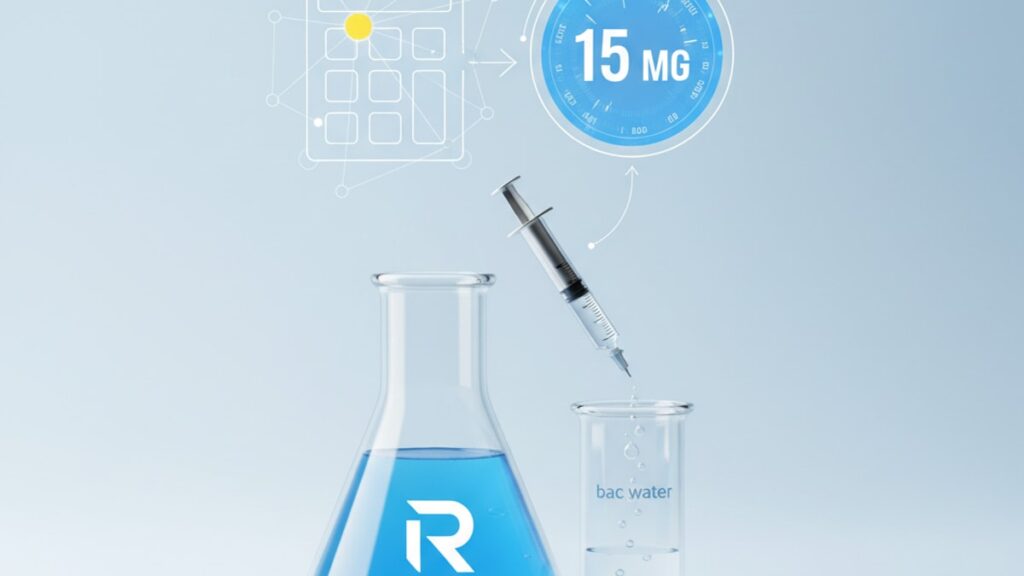
In the world of cutting-edge biological research, precision isn't just a goal; it's the entire foundation. Every variable matters. When you're working with novel compounds like the triple agonist peptide Retatrutide, the slightest miscalculation can cascade into skewed data, wasted resources, and invalidated experiments. It’s a frustrating scenario our team has heard about far too often from researchers sourcing their materials elsewhere. The integrity of your work begins long before the first data point is collected—it starts the moment you prepare your sample.
That's why we're tackling a question that seems simple on the surface but is loaded with critical details: how much bac water do you need for a 15 mg vial of Retatrutide? There isn't a one-size-fits-all answer, because the right amount depends entirely on the final concentration your research protocol demands. Forget guesswork. We’re going to walk you through the math, the method, and the reasoning so you can approach every reconstitution with the confidence that comes from knowing you’re doing it right. This isn't just about mixing powder and water; it's about upholding the standard of excellence your research deserves.
Why Precision in Reconstitution is Non-Negotiable
Let's be blunt: if your reconstitution is off, your entire experiment is compromised from the start. It’s a catastrophic point of failure that is, thankfully, entirely avoidable. When a lyophilized (freeze-dried) peptide like Retatrutide arrives, it's in a stable, powdered form. To prepare it for laboratory use, it must be reconstituted with a sterile diluent, most commonly Bacteriostatic Water. This process transforms the stable powder into a solution ready for precise measurement.
Here’s what’s at stake. An incorrect concentration—too diluted or too concentrated—means the dose administered in your study is wrong. This can lead to inconclusive or misleading results, forcing you to repeat experiments and consume more of your valuable time and budget. Our experience shows that inconsistent preparation is one of the biggest hidden variables in peptide research. One batch might be slightly off from the next, introducing subtle shifts in data that are maddeningly difficult to trace.
We can't stress this enough: the quality of your peptide is only half the battle. At Real Peptides, we go to extraordinary lengths to ensure the purity and precise amino-acid sequencing of our products through small-batch synthesis. We do this because we know that researchers depend on that molecular integrity. But all that work can be undone in seconds with a sloppy reconstitution. That’s why we see it as our responsibility to not only provide impeccable research materials but also to share the expertise needed to handle them correctly.
Accuracy is repeatability. Repeatability is the cornerstone of valid scientific inquiry. It all starts here.
Understanding the Key Components: Retatrutide and Bac Water
Before we jump into the calculations, it’s crucial to understand the two materials you’re working with. They aren't interchangeable commodities; they are specific tools for your research.
Retatrutide (LY3437943): This is a formidable research peptide, a novel agonist for three key receptors: the glucose-dependent insulinotropic polypeptide (GIP), glucagon-like peptide-1 (GLP-1), and glucagon (GCG) receptors. This triple-agonist mechanism makes it a subject of intense interest in metabolic research, exploring pathways related to energy expenditure, glucose control, and appetite regulation. Like many advanced peptides, it’s a delicate chain of amino acids that can be damaged by improper handling. When you source Retatrutide from us, you're getting a product of verified purity, ready for the most sensitive of experiments. Its potential is immense, but only if it's prepared correctly.
Bacteriostatic Water: This is the industry standard for reconstituting most research peptides, and for good reason. It’s sterile water that contains 0.9% benzyl alcohol, an agent that inhibits bacterial growth. This is a critical, non-negotiable element. Why? Because once a vial is reconstituted, it may be used over multiple sessions. The benzyl alcohol helps maintain the solution's sterility, preventing contamination each time the rubber stopper is punctured. Using simple sterile water is an option for single-use applications, but for any protocol requiring multiple draws from the same vial, bacteriostatic water is the only acceptable choice. It preserves the integrity of your expensive peptide for the duration of its use.
The Math Behind the Mix: A Step-by-Step Breakdown
This is where the 'how much bac water for 15 mg retatrutide calculator' query really gets answered. It's not a magic number; it's a simple formula based on your desired concentration. The key is to decide on your target concentration first.
The Core Formula:
Total Amount of Peptide (in mg) ÷ Desired Concentration (in mg/mL) = Total Volume of Diluent to Add (in mL)
Let’s apply this to our 15 mg vial of Retatrutide.
Scenario 1: You want a simple 1:1 ratio for easy dosing.
Let's say you want a final concentration of 1 mg per 0.1 mL. This is a common choice for simplifying dose calculations. First, we need to express that in mg/mL.
- If 0.1 mL contains 1 mg, then 1 mL (which is 10x larger) will contain 10 mg.
- So, your Desired Concentration is 10 mg/mL.
Now, plug it into the formula:
- 15 mg (Total Peptide) ÷ 10 mg/mL (Desired Concentration) = 1.5 mL of Bacteriostatic Water.
When you add 1.5 mL of bac water to the 15 mg vial, every 0.1 mL (or 10 units on a standard U-100 insulin syringe) of the solution will contain exactly 1 mg of Retatrutide. Simple.
Scenario 2: You need a lower concentration for smaller, more precise doses.
Perhaps your protocol calls for very fine dose adjustments. A more diluted solution might be better. Let's aim for a concentration of 5 mg/mL.
Let's use the formula again:
- 15 mg (Total Peptide) ÷ 5 mg/mL (Desired Concentration) = 3.0 mL of Bacteriostatic Water.
In this case, you'd add 3.0 mL of bac water. Now, to get a 1 mg dose, you'd need to draw 0.2 mL (or 20 units on a U-100 syringe). This larger volume can make it easier to measure tiny doses accurately.
From Milliliters (mL) to Syringe Units:
This is a frequent point of confusion, but it's straightforward. Most researchers use U-100 insulin syringes for dosing peptides because the markings are clear and easy to read.
- A U-100 syringe holds 1 mL in total.
- The 100 markings on the syringe barrel are called 'units'.
- Therefore, 100 units = 1 mL.
- This also means 10 units = 0.1 mL.
So, in Scenario 1, where you added 1.5 mL of water, your 1 mg dose is 10 units. In Scenario 2, where you added 3.0 mL of water, your 1 mg dose is 20 units. The math holds up. It's all about deciding on the concentration that best suits your research needs and makes your workflow simplest.
A Practical Walkthrough: Reconstituting a 15 mg Retatrutide Vial
Knowing the math is one thing. Executing the physical steps flawlessly is another. Our team has refined this process over thousands of reconstitutions, and here’s the exact procedure we recommend for ensuring the viability of your peptide.
-
Preparation is Everything: Gather your supplies on a clean, sterile surface. You'll need your vial of lyophilized Retatrutide, a vial of Bacteriostatic Water, alcohol prep pads, and a new, sterile syringe for mixing (a 3 mL or 5 mL syringe is usually best for this part).
-
Inspect and Sanitize: Pop the plastic caps off both vials. Don't assume the rubber stoppers underneath are clean. Vigorously wipe both stoppers with an alcohol pad and let them air dry for a few seconds. This is a critical step in preventing contamination.
-
Draw Your Diluent: Using your mixing syringe, draw up the precise amount of bacteriostatic water you calculated earlier. Let's use our example from Scenario 2: 3.0 mL. It's often easiest to draw slightly more than you need, then carefully push the plunger to expel air bubbles and excess liquid until the top of the plunger seal is exactly on your target measurement.
-
The Gentle Injection: This is where technique really matters. Insert the needle of the syringe through the center of the Retatrutide vial's rubber stopper. Now, angle the needle so the stream of bac water runs down the inside wall of the glass vial. Do not spray the water directly onto the lyophilized powder. This forceful action can shear and damage the delicate peptide chains. The goal is to introduce the water as gently as possible.
-
Patience and Swirling: Once all the water is in the vial, remove the syringe. You'll notice the powder beginning to dissolve. To help it along, gently swirl the vial between your fingers or roll it between your palms. NEVER SHAKE THE VIAL. Shaking creates foam and can mechanically destroy the peptide molecules, rendering your sample useless. Be patient. Most peptides will dissolve completely within a minute or two. If some powder remains, let it sit for a few more minutes and swirl again.
-
Final Inspection: The final solution should be perfectly clear. If you see any cloudiness, discoloration, or floating particles, do not use it. This indicates a problem with either the peptide's integrity or the reconstitution process. When you source from Real Peptides, this is an incredibly rare occurrence due to our rigorous quality control, but it's a check you should always perform.
Your Retatrutide is now reconstituted and ready for your research protocol. The next step is proper storage.
Common Pitfalls and How Our Team Avoids Them
We've seen it all. Honest mistakes that can unfortunately derail important research. Here are the most common errors we see and how to sidestep them completely.
- The Aggressive Shake: As mentioned above, this is the cardinal sin of peptide reconstitution. It's an instinctive action, but it's destructive. Always swirl gently.
- Using the Wrong Diluent: Using tap water or any non-sterile liquid is out of the question. It will contaminate your sample immediately. Even using sterile water when you plan to store the vial for multiple uses is a mistake, as it lacks the bacteriostatic agent to prevent microbial growth.
- Direct Injection Onto the Powder: This is a more nuanced mistake, but an important one. The force of the water jet can damage the peptide. Aiming for the side of the vial is a small detail that reflects a professional, careful approach.
- Misreading the Syringe: It happens. Double-check, and even triple-check, the volume you've drawn up before injecting. Measuring twice and injecting once is a good mantra. The difference between 15 units and 20 units might seem small, but it's a 33% error in your dose.
- Ignoring Temperature: Lyophilized peptides should be stored in the freezer for long-term stability, but you should allow the vial to come to room temperature before reconstituting. This prevents condensation from forming inside the vial. Once reconstituted, it must be stored in the refrigerator.
Avoiding these pitfalls isn't about being perfect; it's about being diligent. A consistent, careful protocol is your best insurance against bad data.
Comparison of Reconstitution Solvents
While bacteriostatic water is our strong recommendation, it's helpful to understand the other options and why they may or may not be suitable for your research.
| Solvent | Key Component | Primary Use Case | Pros | Cons |
|---|---|---|---|---|
| Bacteriostatic Water | Sterile Water + 0.9% Benzyl Alcohol | Multi-use vials | Prevents bacterial growth, extending the solution's usable life. The gold standard for most peptide research. | The benzyl alcohol can cause stinging at injection sites for in-vivo studies. |
| Sterile Water for Injection | Pure, sterile H2O | Single-use applications only | No preservatives, which may be preferable for highly sensitive cell cultures or specific protocols. | Lacks antibacterial properties. Once opened, any remaining solution should be discarded. High risk of contamination in multi-use vials. |
| Acetic Acid 0.6% | Sterile Water + Acetic Acid | Specific, hard-to-dissolve peptides | Can help solubilize certain peptides that do not dissolve well in water. | Highly situational. Can affect the peptide's stability and pH. Should only be used when explicitly required by the peptide's data sheet. |
For a versatile and robust peptide like Retatrutide, our team exclusively recommends using high-quality Bacteriostatic Water. It provides the best balance of safety, stability, and reliability for your experiments.
The Importance of Sourcing: Not All Peptides Are Created Equal
Let’s be honest, the most precise reconstitution protocol in the world can't fix a low-purity peptide. If the powder in the vial isn't what it claims to be, or if it's full of synthesis-related impurities, your research is doomed before you even uncap the vial. This is the single biggest point of failure in the entire research supply chain.
This is why we founded Real Peptides. We were tired of seeing researchers struggle with inconsistent, poorly characterized compounds from anonymous suppliers. Our commitment is to provide an unwavering standard of quality. Every peptide we offer, from metabolic powerhouses like Retatrutide and Tirzepatide to regenerative compounds like BPC 157 Peptide, undergoes rigorous testing to verify its identity and purity. Our small-batch synthesis process ensures that what's on the label is what's in the vial—nothing less.
When you're investing significant time and capital into a study, the quality of your base materials is not the place to cut corners. The peace of mind that comes from knowing your peptide is pure and accurately dosed is invaluable. It allows you to focus on the science, confident that your materials won't be a confounding variable. We encourage you to explore our full collection of peptides and see our commitment to quality across the board. When you're ready to conduct serious research, we're ready to be your trusted partner. You can Get Started Today.
Storing Your Reconstituted Retatrutide for Maximum Stability
Your job isn't done after the swirl. Proper storage is essential to maintain the peptide's integrity for the duration of your experiment.
- Refrigerate Immediately: Once reconstituted, the solution is no longer stable at room temperature for extended periods. It must be stored in a refrigerator at a temperature between 2°C and 8°C (36°F and 46°F). Do not freeze the reconstituted solution, as the freeze-thaw cycle can degrade the peptide chains.
- Protect from Light: Peptides can be sensitive to light. Storing the vial in its original box or in a dark part of the refrigerator provides an extra layer of protection against degradation.
- Mind the Shelf Life: While bacteriostatic water prevents bacterial growth, the peptide molecule itself will still degrade over time. Generally, most reconstituted peptides remain stable and potent for about 4 to 5 weeks when stored correctly. We recommend planning your experiments within this timeframe to ensure you're always working with a maximally effective compound.
Treating your reconstituted solution with the same care as your initial powder is the final step in ensuring reliable, repeatable results. It’s this end-to-end diligence that separates good research from great research.
Ultimately, mastering the reconstitution of a 15 mg Retatrutide vial is about more than just following a recipe. It's about embracing a mindset of precision. It's about understanding that every small step—from the initial calculation to the final swirl and proper storage—contributes to the validity of your work. By controlling these variables, you empower yourself to uncover clear, unambiguous insights from your experiments. That precision is the core of our philosophy at Real Peptides, and it should be the core of your lab work, too.
Frequently Asked Questions
What exactly is Retatrutide being researched for?
▼
Retatrutide is a novel investigational peptide that acts as an agonist for three receptors: GIP, GLP-1, and glucagon. Its primary area of research is in metabolic conditions, focusing on its potential effects on glucose regulation, appetite, and energy expenditure.
Why can’t I just use tap water or bottled water to mix my peptide?
▼
You absolutely must not use non-sterile water. Tap or bottled water contains minerals, impurities, and microorganisms that will contaminate your peptide, compromise your research results, and render the solution unsafe for any laboratory use.
How would the calculation change for a 10 mg vial of a different peptide?
▼
The formula remains exactly the same; only the ‘Total Amount of Peptide’ value changes. For a 10 mg vial where you want a 5 mg/mL concentration, the calculation would be: 10 mg ÷ 5 mg/mL = 2 mL of bacteriostatic water.
What physically happens to the peptide if I shake the vial too hard?
▼
Shaking introduces significant mechanical stress and can cause shearing forces that break the delicate amino acid bonds of the peptide. This process, called denaturation, effectively destroys the molecule’s structure and biological activity, making it useless for research.
How long can I store reconstituted Retatrutide in the refrigerator?
▼
When reconstituted with bacteriostatic water and stored properly between 2°C and 8°C, Retatrutide solution is generally considered stable for up to 4-5 weeks. For optimal results, we recommend planning your research within this timeframe.
What size syringe is best for reconstitution and dosing?
▼
For reconstitution, a 3 mL or 5 mL syringe is ideal for accurately measuring the bacteriostatic water. For dosing in your experiments, a U-100 insulin syringe (typically 1 mL, 0.5 mL, or 0.3 mL) is the standard choice due to its fine, easy-to-read unit markings.
Is it a good idea to pre-fill syringes for the week?
▼
Our team generally advises against pre-filling syringes for extended periods. The plastic in the syringe can potentially interact with the peptide over time, and there is a higher risk of contamination. It is best practice to draw each dose from the vial immediately before use.
Does adding more or less bac water change the peptide’s total potency?
▼
No, the total amount of peptide in the vial remains the same regardless of how much water you add. Dilution only changes the concentration (the amount of peptide per mL of liquid), not the overall potency of the compound in the vial.
Where on the rubber stopper should I insert the needle?
▼
You should always aim for the center of the rubber stopper. Most vials have a small circle or target indicating the thinnest, most easily punctured area. Avoid hitting the raised outer edge.
What should I do if I add the wrong amount of bacteriostatic water?
▼
If you add the wrong amount, do not try to remove or add more water. Simply recalculate your dosage based on the new, actual concentration. For example, if you added 4 mL instead of 3 mL to a 15 mg vial, your new concentration is 15 mg / 4 mL = 3.75 mg/mL.
Can I use sterile water instead of bacteriostatic water?
▼
You can, but only if you plan to use the entire contents of the vial in a single session. Sterile water has no preservative, so once the stopper is punctured, bacteria can be introduced and grow. For any multi-use protocol, bacteriostatic water is essential for safety and stability.
