





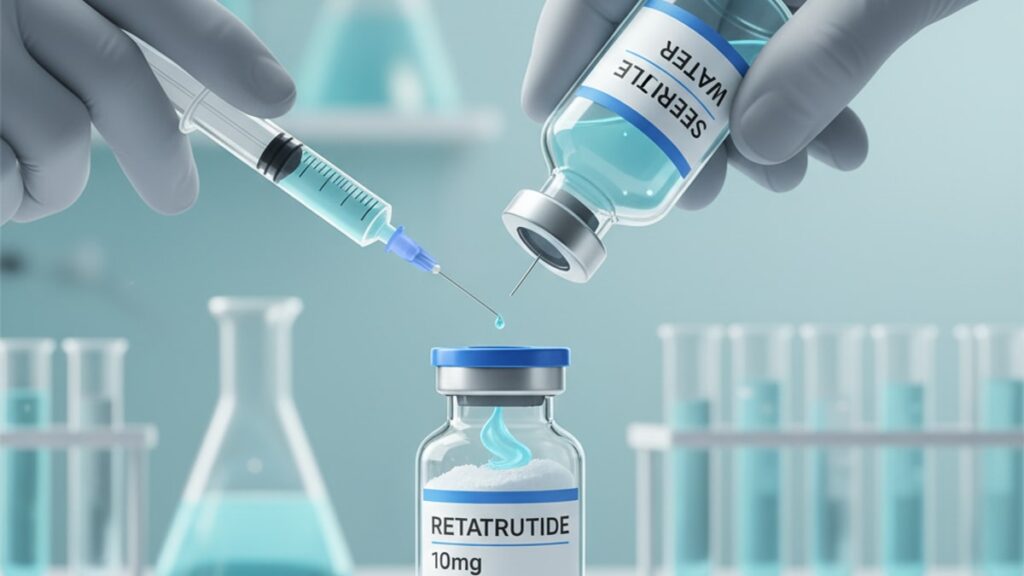
When you're working with a molecule as sophisticated as Retatrutide, precision isn't just a preference; it's the bedrock of your entire research project. We've seen countless studies compromised by something that seems simple on the surface: improper reconstitution. It’s a critical, non-negotiable step that transforms a stable, lyophilized powder into a usable solution, and getting it wrong can invalidate everything that follows. That’s why our team at Real Peptides decided it was time to create a definitive resource on this exact topic.
We’re not just a supplier. Our identity is rooted in the meticulous science of peptide synthesis. We live and breathe amino acid sequencing, purity percentages, and third-party validation because we know that’s what serious researchers demand. But our responsibility doesn't end when a vial leaves our facility. We see it as our duty to ensure that the pristine, high-purity compounds we create are handled with the same level of care in your lab. This guide is an extension of that commitment—a transfer of our in-house knowledge directly to you, so you know exactly how to reconstitute Retatrutide 10mg the right way, every single time.
What Exactly is Retatrutide and Why Purity Matters So Much
Before we dive into the 'how,' let's touch on the 'what' and 'why.' Retatrutide, also known by its research designation LY3437943, is a formidable molecule. It’s what's known as a triple agonist, targeting three different receptors: the glucagon-like peptide-1 (GLP-1), glucose-dependent insulinotropic polypeptide (GIP), and the glucagon receptor (GCG). This multi-faceted mechanism is what makes it such a compelling subject for metabolic research.
But that complexity also makes it fragile. Peptides are long chains of amino acids, and their structure is everything. Think of it like a delicate, intricate key. If you bend even one of its teeth, it will no longer fit the lock. The lyophilization (freeze-drying) process is designed to protect this structure by removing water, rendering the peptide dormant and stable for shipping and storage. The moment you add liquid back in—the process of reconstitution—you 'awaken' the molecule, but you also expose it to a world of potential risks. Temperature, agitation, and the chemical composition of your diluent can all impact its structural integrity.
This is where the quality of your starting material becomes paramount. Our entire process at Real Peptides is built around ensuring that the lyophilized powder in your vial is of the highest possible purity and structural correctness. We use small-batch synthesis for this very reason; it allows for unflinching quality control. But once it's in your hands, that responsibility shifts. All the work we put into guaranteeing purity can be undone in seconds with a sloppy technique. We can't stress this enough: your handling protocol is the final, crucial link in the chain of research integrity.
Before You Begin: Assembling Your Lab Essentials
Let’s be honest, preparation is half the battle. Rushing this process is a recipe for contamination or inaccurate dosing. Before you even think about opening a vial, take a moment to create a sterile, organized workspace and gather your tools. It’s a simple ritual that pays massive dividends.
Here’s what our lab team lays out every single time:
- Your Vial of Lyophilized Peptide: This should be a 10mg vial of high-purity Retatrutide from a source you trust implicitly. The peptide should appear as a solid, dry, white powder or a small 'puck' at the bottom of the vial.
- The Right Diluent: This is a crucial choice, and we'll dedicate the next section to it. The short answer? We strongly recommend Bacteriostatic Water.
- Sterile Syringes: You'll need at least one 1mL or 3mL syringe with a needle for the reconstitution itself. You will also need smaller, more precise syringes (like U-100 insulin syringes) for accurately measuring doses for your experiments.
- Alcohol Prep Pads: Never, ever skip this. Sterility is key. You'll need them for the vial stoppers.
- Sterile Gloves: Your hands are a major source of contamination. Always wear a fresh pair of nitrile or latex gloves.
- A Clean, Clutter-Free Workspace: A dedicated lab bench is ideal, but at a minimum, you need a disinfected, flat surface where you can work without interruption.
A common question we get is about using an empty, sterile vial for storage. While not strictly necessary, some researchers prefer to transfer the reconstituted solution to a larger sterile vial if they plan on drawing from it many times, as this can minimize the risk of repeatedly puncturing the original stopper. It's a matter of personal lab protocol, but for most, the original vial is perfectly fine.
Choosing Your Diluent: Bacteriostatic Water vs. Sterile Water
This choice might seem minor, but it has significant implications for the safety and longevity of your reconstituted peptide. The liquid you use to bring the Retatrutide back into solution is called a diluent, and not all diluents are created equal. Your two primary options are Bacteriostatic Water (BAC) and Sterile Water for Injection.
Our experience overwhelmingly points to one clear winner for multi-use peptide vials: Bacteriostatic Water.
BAC water is sterile water that contains a small but effective amount of a preservative—0.9% benzyl alcohol, to be precise. This alcohol doesn't interact with the peptide, but it does a fantastic job of preventing any opportunistic bacteria from growing in the solution after you’ve made the first puncture with a needle. Every time you insert a needle into the vial's rubber stopper, you create a potential pathway for contamination. The benzyl alcohol acts as a safeguard, keeping your solution sterile for up to 28 days when refrigerated. This is absolutely essential for research protocols that require drawing multiple doses from the same vial over a period of weeks.
Sterile Water for Injection, on the other hand, is just that: sterile water. It contains no preservative. This makes it suitable for a single, one-time use where you will use the entire contents of the vial immediately. Once you puncture the stopper, it's no longer considered sterile for future use. Any remaining solution should be discarded. For a 10mg vial of Retatrutide that will be used for multiple experiments, using sterile water is an unnecessary risk. Some researchers also mention using sterile saline (0.9% sodium chloride), but this can sometimes affect the solubility or long-term stability of certain peptides. For consistency and safety, we stick with BAC water.
Here’s a quick breakdown of why this matters so much:
| Feature | Bacteriostatic Water | Sterile Water for Injection |
|---|---|---|
| Preservative | Yes (0.9% Benzyl Alcohol) | No |
| Shelf Life (After Opening) | Up to 28 days (refrigerated) | Single-use only; discard remainder |
| Best Use Case | Multi-dose peptide vials | Single, immediate use |
| Contamination Risk | Low | High after initial use |
| Our Recommendation | Strongly Preferred | Use only with extreme caution |
The Step-by-Step Reconstitution Protocol: Our Proven Method
Alright, you’ve got your pristine workspace and your materials are assembled. Now for the main event. Follow these steps meticulously. Do not cut corners. This is the exact protocol our own scientists use, refined over years of handling these delicate molecules.
Step 1: Preparation and Inspection
Put on your gloves. Pop the protective plastic caps off both your Retatrutide vial and your Bacteriostatic Water vial. Before you go any further, visually inspect the peptide. It should be a white, solid powder. If you see any discoloration or moisture inside, do not proceed. Also, check that the rubber stoppers are clean and securely in place.
Step 2: Sterilize the Vial Tops
Take a fresh alcohol prep pad and vigorously wipe the rubber stopper of both vials. Don't just give it a quick swipe; clean it thoroughly. Then, and this is important, let it air dry completely for about 30-60 seconds. Waving it around or blowing on it will just reintroduce contaminants.
Step 3: Calculate Your Diluent Volume and Final Concentration
This is where precision is everything. Your goal is to create a solution with a known concentration, making your research dosing accurate and repeatable. For a 10mg vial, a common and easy-to-manage approach is to create a solution that is 10mg/mL.
The math is simple: To get a concentration of 10mg per 1mL, you need to add exactly 1mL of BAC water to the 10mg vial of powder.
- Total Peptide: 10mg
- Volume of Diluent to Add: 1mL
- Final Concentration: 10mg / 1mL
With this concentration, every 0.1mL (or 10 units on a U-100 insulin syringe) of the solution will contain exactly 1mg of Retatrutide. If you wanted a different concentration, say 5mg/mL, you would add 2mL of BAC water (10mg / 2mL = 5mg/mL). We recommend starting with the 1mL dilution for straightforward dosing calculations.
Step 4: Drawing the Diluent
Uncap your 1mL or 3mL reconstitution syringe. Pull the plunger back to the 1mL mark, drawing 1mL of air into the syringe. Insert the needle through the center of the rubber stopper of the BAC water vial. Push the plunger down, injecting the 1mL of air into the vial. This equalizes the pressure and makes it much easier to draw the liquid out accurately. Now, invert the vial and slowly pull the plunger back until you have exactly 1mL of BAC water in the syringe. Check for air bubbles. If you see any, gently tap the syringe to make them rise to the top and carefully expel them.
Step 5: The Gentle Introduction (This is CRITICAL)
Now, take the syringe filled with 1mL of BAC water and insert the needle into the sterilized stopper of the Retatrutide vial. Here's the most critical part of the physical process: Do not inject the water directly onto the lyophilized powder. This can cause a forceful jet that can damage or shear the peptide molecules. Instead, angle the needle so that the tip is touching the inside glass wall of the vial. Slowly and gently push the plunger, allowing the water to run down the side of the glass and pool at the bottom, gently dissolving the powder from the bottom up.
Step 6: The Art of Mixing (Absolutely No Shaking!)
Once all the water has been added, remove the syringe. You will now see the powder begin to dissolve. To help it along, you must be gentle. You can either let it sit for a few minutes to dissolve on its own, or you can gently roll the vial between your palms. A gentle swirl is also acceptable.
What you must NEVER, EVER do is shake the vial. Shaking creates powerful shearing forces and microbubbles that can literally tear the delicate peptide chains apart, rendering the molecule useless. This is not an old wives' tale; it's basic biochemistry. The reconstituted solution should be perfectly clear once dissolved. If you see any cloudiness, floaters, or discoloration, it's a sign of degradation or contamination, and the vial should be discarded.
And that's it. Simple, right? Six meticulous steps are all that stand between a pristine powder and a perfectly prepared research solution.
Proper Storage of Reconstituted Retatrutide
Your job isn't done once the powder is dissolved. Reconstituted peptides are sensitive and must be stored correctly to maintain their potency for the duration of your study. There are two enemies of peptide stability: heat and light.
Refrigeration is mandatory. The reconstituted vial must be stored in a refrigerator at a temperature between 2°C and 8°C (that's 36°F to 46°F). Do not store it in the refrigerator door, where temperatures fluctuate wildly. Place it in the main body of the fridge.
Never freeze a reconstituted peptide. The freeze-thaw cycle can be just as damaging as shaking, causing ice crystals to form that can fracture the peptide structures.
Protect it from light. Peptides are also sensitive to degradation from UV light. Keep the vial in its original box or another light-blocking container. Our experience shows that when stored properly this way, a vial of Retatrutide reconstituted with BAC water will remain stable and potent for at least 4 weeks.
Common Mistakes We See (And How to Avoid Them)
Over the years, our team has heard it all. We've troubleshooted countless research issues that ultimately traced back to a simple mistake during the reconstitution phase. Here are the most catastrophic, yet common, errors.
- The Dreaded Vial Shake: We've said it three times now, and we'll say it again. Shaking is the number one peptide killer. It's an instinctive action for mixing things, but for peptides, it's a death sentence. Always roll or swirl gently.
- Using the Wrong Liquid: This is a close second. Using tap water, distilled water, or anything other than a sterile, appropriate diluent introduces bacteria and minerals that can destroy the peptide or cause a non-sterile solution. Stick to bacteriostatic water.
- Botching the Math: Inaccurate dosing invalidates results. If you add 1.2mL of water instead of 1.0mL, your final concentration is off by 20%. That's not a rounding error; that's a failed experiment. Double-check your calculations and measure your diluent with obsessive care.
- Poor Sterile Technique: Reusing syringes, not wiping vial tops, or working in a dusty environment are all invitations for bacterial contamination. This can not only degrade your peptide but also introduce confounding variables into your research.
- Starting with a Subpar Product: This is perhaps the most insidious mistake because it happens before you even start. The entire reconstitution process is meaningless if the lyophilized powder you begin with is impure, under-dosed, or contains incorrect peptide sequences. This is why sourcing from a reputable supplier who provides transparent, third-party lab results is the most important decision you'll make. It’s the foundation of everything else. When you're ready to ensure your research is built on a solid foundation, you can Get Started Today by exploring our range of verified peptides.
Beyond Retatrutide: A Principle of Precision
The meticulous protocol we've outlined here isn't unique to Retatrutide. These core principles—sterility, gentle handling, precise calculation, and proper storage—apply to the vast majority of research peptides. Whether you're working with a dual-agonist like Tirzepatide or growth hormone secretagogues like CJC-1295/Ipamorelin, the fundamentals of proper reconstitution remain the same.
At Real Peptides, our philosophy is that we are partners in discovery. We commit to delivering peptides of uncompromising purity, and we empower researchers with the knowledge to handle them correctly. The world of peptide research is advancing at a breathtaking pace, uncovering new possibilities for understanding complex biological systems. Ensuring the validity and reproducibility of that research begins with these fundamental, foundational lab techniques.
Ultimately, mastering how to reconstitute Retatrutide 10mg is about more than just following steps. It's about adopting a mindset of precision. It’s an acknowledgment that in high-level research, there are no minor details. From our state-of-the-art synthesis lab to your research bench, every single step matters. It’s this shared commitment to excellence that truly drives science forward.
Frequently Asked Questions
How much bacteriostatic water should I add to a 10mg vial of Retatrutide?
▼
For straightforward dosing, our team recommends adding 1.0mL of bacteriostatic water. This creates a final concentration of 10mg/mL, where every 0.1mL (10 units on a U-100 syringe) contains 1mg of Retatrutide.
Can I use sterile water instead of bacteriostatic water?
▼
While you technically can, we strongly advise against it for a multi-use vial. Sterile water contains no preservative, so after the first puncture, the vial is at high risk for bacterial contamination. Always use bacteriostatic water for vials you’ll draw from more than once.
What happens if I accidentally shake the vial?
▼
Shaking can be catastrophic for the peptide’s integrity. The mechanical stress and shearing forces can break the delicate amino acid chains, rendering the molecule inactive and useless for research. Always mix by gently rolling or swirling the vial.
How long is reconstituted Retatrutide stable for?
▼
When reconstituted with bacteriostatic water and stored properly in a refrigerator (2-8°C) away from light, Retatrutide should remain stable and potent for at least 4 weeks. Never freeze the reconstituted solution.
What should the final reconstituted solution look like?
▼
The final solution should be completely clear, with no cloudiness, particles, or discoloration. Any visible change from a clear liquid is a sign of degradation or contamination, and the vial must be discarded.
Why is it so important for the water to run down the side of the vial?
▼
Injecting the diluent directly onto the lyophilized powder can create a forceful jet that can physically damage the peptide molecules. Allowing it to run down the glass wall is a much gentler method that helps preserve the compound’s structural integrity during mixing.
Can I pre-load syringes with Retatrutide for later use?
▼
We generally do not recommend this practice for long-term storage. Peptides are most stable in the sterile glass vial. While pre-loading for use within the same day may be acceptable, storing peptides in plastic syringes for extended periods can lead to degradation or adsorption to the plastic.
What is the primary difference between Retatrutide and Tirzepatide?
▼
The main difference is their mechanism of action. Tirzepatide is a dual-agonist for the GIP and GLP-1 receptors. Retatrutide is a triple-agonist, targeting the GIP, GLP-1, and Glucagon receptors, giving it a broader and different profile for metabolic research.
Do I need to let the vial warm up to room temperature before reconstituting?
▼
Yes, it’s good practice. Allowing the cold vial to sit at room temperature for about 10-15 minutes before mixing can help the powder dissolve more easily and reduces condensation. However, do not apply any external heat.
Is it normal for the peptide powder to look like a small, solid ‘puck’?
▼
Yes, absolutely. Lyophilized peptides can appear as a loose powder or a condensed, solid disc or ‘puck’ at the bottom of the vial. Both are completely normal forms and do not indicate a problem with the product.
How can I be sure of the peptide’s purity before I even start?
▼
This is why you must source from a reputable supplier. At Real Peptides, we provide third-party lab reports (like HPLC and Mass Spectrometry) for our products, giving you verifiable proof of purity and identity before you begin your critical research.
What is lyophilization?
▼
Lyophilization, or freeze-drying, is a process used to remove water from the peptide to make it stable for transport and storage. It involves freezing the material and then reducing the pressure to allow the frozen water to sublimate directly from a solid to a gas.











