



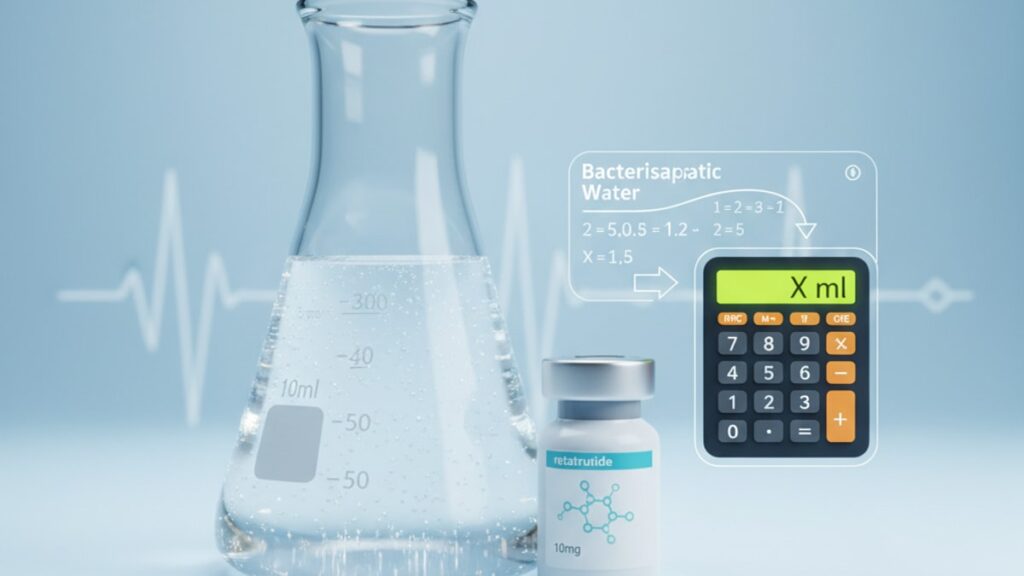
In the world of advanced peptide research, precision isn't just a goal; it's the entire foundation upon which credible discoveries are built. We've seen countless promising studies derailed by one seemingly small oversight: improper reconstitution. It’s a critical, non-negotiable element of lab work that, frankly, doesn't get the detailed attention it deserves. You can have the purest, most meticulously synthesized peptide in the world, but if the dilution is off, your data is compromised from the very first step.
That's why we're tackling a question our team hears constantly: "How much bac water for 10mg Retatrutide?" While researchers often look for a quick calculator, understanding the 'why' behind the numbers is what separates good science from great science. This isn't just about mixing a powder with a liquid. It's about ensuring a known concentration, maintaining stability, and setting your research up for impeccable, reproducible outcomes. Let's walk through the process with the detail and care it demands.
Why This Calculation Is So Critical
Let's be honest, the desire for a simple 'how much bac water for 10mg retatrutide calculator' comes from a good place. Researchers want to be efficient and eliminate the chance of human error. We get it. Your time is valuable, and your focus should be on the experiment itself, not on elementary math. However, blindly trusting a number without understanding its origin can be a catastrophic mistake.
Every variable in your research protocol needs to be controlled. The concentration of your peptide solution is one of the most significant. If you intended to administer 1mg for your study, but your solution is accidentally twice as concentrated as you think, you're now working with 2mg. This throws off dose-response curves, skews results, and can lead you to draw entirely wrong conclusions. Our experience shows that the most common errors happen right here, at the very beginning. It's a simple step, yet its downstream effects are massive.
Furthermore, the integrity of the peptide itself is at stake. Using the wrong volume or, even worse, the wrong diluent can affect the compound's solubility and stability. Peptides are intricate, delicate chains of amino acids. They aren't robust chemicals you can treat carelessly. They demand respect for their structure. That's why we at Real Peptides put so much effort into small-batch synthesis and purity verification for products like our research-grade Retatrutide. We do our part to deliver an impeccable starting material; the reconstitution step is where you carry that precision forward.
The Key Players: Retatrutide and Bacteriostatic Water
Before we jump into the numbers, it's essential to understand the two components you're working with. They aren't interchangeable, and their properties dictate the entire process.
Retatrutide: This is a novel, multi-receptor agonist peptide being investigated for its potential effects on metabolic parameters. As a research compound, its structure is complex. Like most peptides, it's shipped in a lyophilized (freeze-dried) state. This process removes water, rendering the peptide into a stable powder that is much less prone to degradation during shipping and storage. It's a delicate state of suspended animation, waiting for the right liquid to bring it into a usable solution.
Bacteriostatic Water: This is the gold standard for reconstituting most research peptides, and for very good reason. It is not just sterile water. Bacteriostatic Water is sterile water that contains 0.9% benzyl alcohol. That tiny addition makes a world of difference.
The benzyl alcohol acts as a bacteriostatic agent, which means it prevents bacteria from reproducing. It doesn't necessarily kill all bacteria on contact, but it creates an environment where they cannot multiply. This is absolutely crucial if you plan on storing the reconstituted vial and drawing multiple doses over a period of days or weeks. Using simple sterile water would create a welcoming environment for contamination every time you puncture the vial's septum. We can't stress this enough: for multi-use protocols, bacteriostatic water is the only appropriate choice.
The Core Formula for Reconstitution
Now, let's get to the heart of the matter. The math is more straightforward than you might think. You don't need a specialized calculator if you understand one simple principle. You have a known quantity of peptide in the vial (10mg), and you need to add a specific volume of liquid to achieve your desired final concentration.
Here’s the fundamental logic:
- Total Peptide: You know you have 10mg of Retatrutide.
- Desired Concentration: You need to decide how many milligrams (mg) of peptide you want per milliliter (mL) of liquid. This is entirely up to your research protocol. A common choice for easy math is 10mg/mL or 5mg/mL.
- Volume to Add: This is what you need to calculate.
The formula is simple division:
(Total Peptide in Vial (mg)) / (Desired Concentration (mg/mL)) = Total Volume of Bac Water to Add (mL)
Let’s run through two common scenarios for a 10mg vial of Retatrutide.
Scenario 1: Creating a 10mg/mL Solution
This is the simplest calculation. You want every 1mL of liquid to contain 10mg of the peptide.
- Total Peptide: 10mg
- Desired Concentration: 10mg/mL
- Calculation:
10mg / 10mg/mL = 1mL
Result: You would add exactly 1.0 mL of bacteriostatic water to the vial.
With this concentration, every 0.1 mL of solution you draw would contain 1mg of Retatrutide. This makes dosing calculations very easy.
Scenario 2: Creating a 5mg/mL Solution
Perhaps you need to administer smaller doses, and having a more dilute solution makes measurements more accurate. In this case, you want every 1mL of liquid to contain 5mg of the peptide.
- Total Peptide: 10mg
- Desired Concentration: 5mg/mL
- Calculation:
10mg / 5mg/mL = 2mL
Result: You would add exactly 2.0 mL of bacteriostatic water to the vial.
With this concentration, every 0.2 mL of solution would contain 1mg of Retatrutide. Or, every 0.1 mL would contain 0.5mg (500mcg).
See? The principle is the same. It’s all about deciding on your target concentration first. That dictates everything else.
Your Step-by-Step Reconstitution Protocol
Knowing the math is one thing; executing the procedure with proper aseptic technique is another. Our team has refined this process over years of lab work. Follow these steps meticulously to ensure both accuracy and sterility.
- Gather Your Supplies: You'll need your vial of lyophilized Retatrutide, a vial of bacteriostatic water, a sterile syringe of appropriate size (a 3mL syringe is perfect for this), two alcohol prep pads, and a sharps container for disposal.
- Prepare the Vials: Remove the protective plastic caps from both the Retatrutide and the bac water vials. Don't assume the rubber septums underneath are sterile. They aren't. Vigorously wipe both rubber tops with an alcohol prep pad and allow them to air dry for a few seconds.
- Draw the Air: Before you draw the water, you need to equalize the pressure. Pull back the plunger on your syringe to the volume you intend to draw. For example, if you're adding 2.0 mL of water, draw 2.0 mL of air into the syringe first.
- Inject the Air, Draw the Water: Insert the needle through the center of the rubber septum of the bacteriostatic water vial. Invert the vial and inject the air. This pressurizes the vial and makes drawing the liquid much easier. Now, pull back the plunger slowly to draw your calculated volume (e.g., 2.0 mL) of bac water. Check for any large air bubbles. If you see them, flick the syringe gently to get them to the top and carefully push them out while the needle is still in the vial.
- Introduce the Water to the Peptide: Now for the most delicate step. Take your syringe filled with the correct amount of bac water and insert the needle into the vial of lyophilized Retatrutide. Here's what we've learned is crucial: Do not inject the water directly onto the powdered peptide cake. This can damage the fragile molecules. Instead, angle the needle so the stream of water runs down the inside glass wall of the vial. It should gently wash over the powder.
- Gentle Dissolution: Once all the water is added, remove the syringe. Now, you need to help the peptide dissolve. DO NOT SHAKE THE VIAL. Shaking can shear and destroy the peptide chains. Instead, gently roll the vial between your fingers or palms. You can also lightly swirl it. Be patient. It should dissolve into a completely clear solution. If you see any cloudiness or particulates, something is wrong.
- Label and Store: Your Retatrutide is now reconstituted. Immediately label the vial with the date of reconstitution and the final concentration (e.g., "5mg/mL"). Store it in the refrigerator as recommended. Do not freeze it unless specifically instructed by the manufacturer's data sheet.
Following this protocol isn't just about getting it done. It's about respecting the integrity of the high-purity research compounds you've invested in. When you start with products from our extensive peptide collection, you're starting with quality. This process ensures you maintain it.
Manual Math vs. Digital Calculators
So, what about that how much bac water for 10mg retatrutide calculator you were searching for? Online tools can be a fantastic convenience for double-checking your work. They remove the potential for a simple mental math error under pressure. But they should never be a replacement for understanding the underlying principles.
Let’s compare the two approaches.
| Feature | Manual Calculation (The Method Above) | Online Peptide Calculator |
|---|---|---|
| Underlying Principle | Forces you to understand the relationship between total mass, volume, and concentration. | A 'black box' that provides an answer without showing the 'why'. |
| Flexibility | Infinitely flexible. You can adapt to any vial size, desired concentration, or peptide amount instantly. | Limited to the specific inputs the calculator was designed for. May not handle unusual concentrations. |
| Risk of Error | Potential for human calculation error, especially if rushed or distracted. | Can have programming errors or use incorrect assumptions. You're trusting an unknown source. |
| Our Recommendation | Learn this method first. It is the foundational skill for all peptide research and is a non-negotiable competency. | Use as a verification tool. After you've done the math yourself, plug the numbers into a reputable calculator to confirm your result. |
Our team's position is firm: learn to do the math yourself. It builds confidence and competence. Once you've mastered it, using a calculator as a safety check is just smart lab practice.
Common Reconstitution Mistakes We've Seen
After years in this industry, we've heard about nearly every mistake possible. Learning from them can save your research from costly and frustrating setbacks. Here are the most common pitfalls.
- Using the Wrong Diluent: The single biggest error is using sterile water for a multi-use vial. Or worse, tap water or saline not intended for injection. This introduces bacteria and can alter the peptide's properties. Stick with Bacteriostatic Water. It's the standard for a reason.
- Forgetting to Account for Syringe Hub Volume: This is a more nuanced error. Every syringe has a tiny 'dead space' in the hub and needle where fluid gets trapped. For large volumes, it's negligible. But if you are measuring very small amounts (like 0.05 mL), that dead space can represent a significant percentage of your dose, leading to under-dosing. Using insulin syringes (which have minimal dead space) is critical for administering small, precise volumes.
- Shaking the Vial: We mentioned this before, but it bears repeating. We've seen people treat a vial of peptides like a bottle of salad dressing. This is a death sentence for the delicate amino acid chains. Always roll or swirl gently.
- Incorrect Storage: Reconstituted peptides are not shelf-stable at room temperature. They must be refrigerated. Exposing the solution to heat or direct sunlight will rapidly degrade the compound, rendering your research invalid. The clock starts ticking the moment you add the bac water.
- Assuming All Peptides Are the Same: While this guide is focused on Retatrutide, different peptides can have different solubility characteristics. Some, like certain growth hormone secretagogues, might take longer to dissolve. Always be patient. If a peptide from a reputable source like Real Peptides doesn't dissolve into a clear solution, double-check your math and procedure before assuming the product is faulty.
Avoiding these common blunders is just as important as getting the initial calculation right. It's all part of a holistic approach to quality research, which is a mission we live by. Whether you're working with Tirzepatide or exploring the potential of a Wolverine Peptide Stack, the principles of careful handling and precise reconstitution are universal.
This commitment to excellence is why so many researchers trust us. They know our products are synthesized for maximum purity, providing a reliable baseline for their work. When you're ready to take the next step in your own projects, we encourage you to Get Started Today.
Ultimately, calculating how much bac water for a 10mg vial of Retatrutide is a skill that empowers you. It moves you from simply following instructions to truly understanding and controlling the variables in your experiment. It's a small step that reflects a larger commitment to scientific rigor. By mastering this simple calculation and adhering to a strict, sterile protocol, you ensure that the data you generate is built on a foundation of accuracy and integrity, giving your research the best possible chance of success.
Frequently Asked Questions
Can I use sterile water instead of bacteriostatic water for Retatrutide?
▼
You should only use sterile water if you plan to use the entire contents of the vial in a single administration. For multi-use vials, bacteriostatic water is essential as its benzyl alcohol content prevents bacterial growth after the stopper has been punctured.
What happens if I add too much or too little bac water to the 10mg Retatrutide?
▼
Adding the wrong amount of water will change the final concentration. Too little water will make the solution overly concentrated, and too much will make it too dilute. This will directly impact dosing accuracy and compromise the validity of your research data.
Why shouldn’t I shake the vial after adding the water?
▼
Peptides are complex, fragile molecules. Shaking the vial vigorously can cause mechanical stress that breaks the amino acid bonds, a process called shearing. This degrades the peptide, rendering it ineffective for research.
How long is reconstituted Retatrutide stable in the refrigerator?
▼
Generally, most reconstituted peptides stored in bacteriostatic water are stable for 28-30 days when refrigerated. However, you should always refer to the specific data sheet for the compound, as stability can vary.
The reconstituted solution looks cloudy. What should I do?
▼
A properly reconstituted peptide from a high-purity source should dissolve into a completely clear solution. If it’s cloudy or has particulates, do not use it. This could indicate a problem with solubility, contamination, or product integrity.
Does the volume of the lyophilized powder affect my calculation?
▼
For most research purposes, the volume of the lyophilized powder itself is negligible and is not factored into the calculation. The math is based on adding a specific liquid volume to the total mass of the peptide in the vial.
Can I pre-fill syringes with doses for the week?
▼
Our team generally advises against this. Storing peptides in plastic syringes for extended periods can sometimes lead to adsorption of the peptide to the plastic, potentially reducing the effective dose. It is best practice to draw each dose from the glass vial immediately before use.
What size syringe is best for reconstitution?
▼
A 3mL or 5mL syringe is ideal for reconstitution as it can easily hold the 1-2mL of bacteriostatic water typically used. For administering the final dose, a 1mL insulin syringe is preferred for its fine gradations and low dead space, ensuring accuracy.
Is it better to have a more concentrated or more dilute solution?
▼
This depends entirely on your research protocol. A more concentrated solution (e.g., 10mg/mL) requires measuring smaller volumes for each dose, while a more dilute solution (e.g., 5mg/mL) allows for larger, potentially easier-to-measure volumes. Choose the concentration that makes your target dose easiest to measure accurately.
Can I use the same formula for a 5mg vial of another peptide?
▼
Yes, the principle is universal. If you have a 5mg vial and want a 5mg/mL concentration, you would add 1mL of bac water (5mg / 5mg/mL = 1mL). The formula works for any peptide and any vial size.
Why is the peptide shipped as a powder instead of a liquid?
▼
Peptides are much more stable in a lyophilized (freeze-dried) state. Shipping them as a pre-mixed liquid would significantly shorten their shelf life and make them highly susceptible to degradation from temperature changes during transit.
What temperature should the bacteriostatic water be before I mix it?
▼
Room temperature is perfectly fine. There’s no need to chill or warm the bacteriostatic water before using it for reconstitution. The key is the gentle mixing technique, not the initial temperature.











