




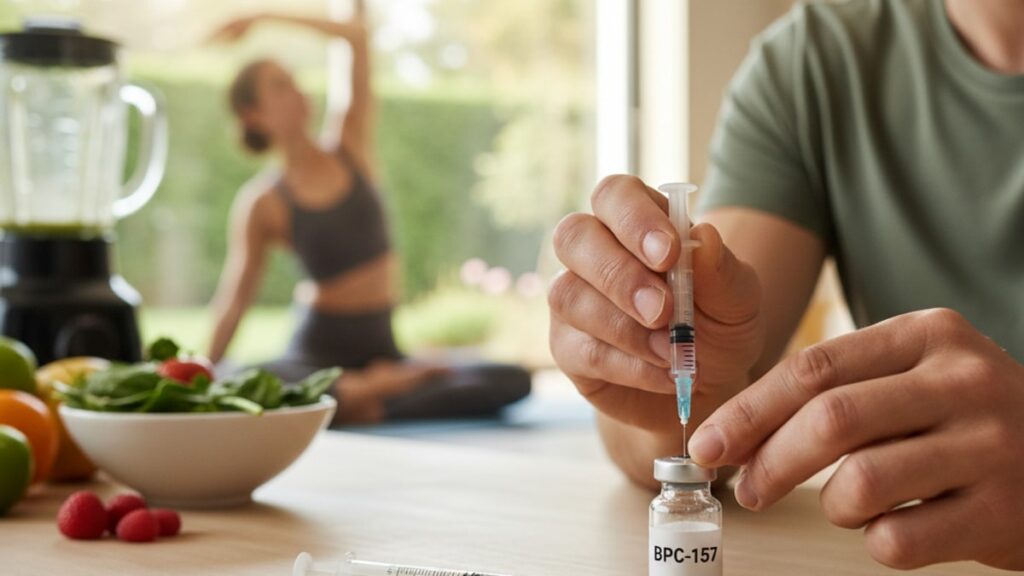
So, you’ve just received your vial of high-purity, lyophilized BPC-157. It’s a small puck of white powder, stable and ready for your next big research project. But before you can use it, you have to reconstitute it—and that’s when the clock officially starts ticking. It’s one of the most common questions our team gets, and frankly, one of the most critical: how long does BPC-157 last once mixed? Getting this wrong doesn’t just waste a valuable compound; it can completely invalidate your research data.
The answer isn't a simple number. It's a nuanced outcome dependent on a few formidable variables: your choice of solvent, your storage temperature, and the initial purity of the peptide itself. Here at Real Peptides, our entire mission is built on providing researchers with the highest-quality tools for their work, and that includes the knowledge to handle them correctly. We’ve seen firsthand how improper handling can derail promising studies. Let’s be honest, this is crucial. So, we're going to break down everything you need to know to maximize the viability of your reconstituted BPC 157 Peptide and ensure your results are both accurate and repeatable.
The Clock Starts Ticking: Why Reconstitution Matters
First, let's quickly touch on why peptides like BPC-157 arrive in a powdered, or lyophilized, state. Lyophilization is a sophisticated freeze-drying process that removes water from the peptide, rendering it exceptionally stable for shipping and long-term storage at room temperature. In this state, it can last for months, even years, without significant degradation. It’s the gold standard for preserving delicate biological compounds.
But the moment you introduce a liquid—a process called reconstitution—you change the game entirely. You’re reintroducing an aqueous environment, which 'wakes up' the peptide chain but also exposes it to the elements that cause it to break down. Water molecules, enzymes, and potential microbial contaminants can begin to cleave the peptide bonds, slowly but surely rendering the compound useless. This isn't a maybe. It's a certainty. The only question is how quickly it happens.
This is where your handling protocol becomes the single most important factor in the success of your research. A pristine, high-purity peptide can be ruined in a matter of hours if handled improperly after mixing. We can't stress this enough.
The Primary Factor: Your Choice of Solvent
Not all water is created equal. The liquid you use to reconstitute your BPC-157 has a dramatic impact on its shelf-life. You wouldn't put low-grade fuel in a high-performance engine, and the same logic applies here. Using the wrong solvent is one of the fastest ways to compromise your peptide.
Our experience shows that one choice stands head and shoulders above the rest: bacteriostatic water. Let's compare the common options.
| Solvent Type | Key Component | Shelf-Life Impact (Refrigerated) | Our Professional Recommendation |
|---|---|---|---|
| Bacteriostatic Water | Sterile Water + 0.9% Benzyl Alcohol | Excellent (4-6 weeks) | The undisputed gold standard for reconstituting most research peptides. The benzyl alcohol inhibits microbial growth. |
| Sterile Water | Purified, Sterile Water | Poor (A few days to 1 week) | Lacks a preservative. Once opened, it's a potential breeding ground for bacteria, leading to rapid contamination and degradation. |
| Normal Saline | Sterile Water + 0.9% Sodium Chloride | Not Recommended | Can alter the solution's pH and introduce ions that may interact with the peptide chain, potentially accelerating degradation. |
| Acetic Acid (0.6%) | Diluted Acetic Acid Solution | Variable / Peptide-Specific | Only used for very specific peptides that require an acidic environment for solubility. Not standard for BPC-157. |
Bacteriostatic Water (BAC Water) is our team's universal recommendation for BPC-157. The key is the 0.9% benzyl alcohol, which acts as a bacteriostatic agent. This means it doesn't necessarily kill all bacteria, but it prevents them from growing and multiplying within the vial. This single ingredient dramatically extends the peptide's usable lifespan, giving you a reliable window of several weeks for your experiments. When precision is paramount, using a high-quality Bacteriostatic Water is a non-negotiable part of the process.
Sterile Water for Injection is a distant second. While it's sterile upon opening, it contains no preservative. Every time you puncture the vial's septum with a needle, you risk introducing airborne contaminants. Without a preservative to keep them in check, these microbes can flourish, degrading your peptide in a matter of days. If you absolutely must use sterile water, you should plan to use the entire vial very, very quickly.
Storage Temperature: The Undisputed King of Peptide Longevity
If the solvent is the first line of defense, temperature is the fortress. Heat is the enemy of peptide stability. It provides the kinetic energy that accelerates the chemical reactions responsible for degradation. The colder you can keep your reconstituted BPC-157 (without causing other problems), the longer it will remain potent.
Here’s what you need to know about your storage options.
Refrigeration (2-8°C / 36-46°F): The Standard Protocol
This is the sweet spot. Storing your mixed BPC-157 in a standard laboratory or household refrigerator is the most common and effective method for short- to medium-term use. The cold temperature significantly slows down the molecular motion and enzymatic activity that would otherwise tear the peptide apart. It strikes the perfect balance between preserving the peptide and keeping it accessible for your research protocol. When stored in a refrigerator and reconstituted with BAC water, you can confidently expect your BPC-157 to maintain its integrity for about four to six weeks. Simple, right?
Freezing (-20°C / -4°F): A Double-Edged Sword
Now, this is where it gets interesting. Can you freeze mixed BPC-157 to extend its life even further? Yes. You can. Freezing can preserve a reconstituted peptide for six months or even longer. But—and this is a huge but—it comes with a major risk: freeze-thaw cycles.
Every time you freeze and then thaw a peptide solution, ice crystals form and then melt. These sharp crystals can physically shear and fracture the delicate peptide chains, a process known as mechanical degradation. A single freeze-thaw cycle might be okay, but repeated cycles are catastrophic to the peptide's structure. It's like bending a paperclip back and forth until it breaks.
Our team's advice is firm on this: if you plan to freeze your BPC-157, you must practice aliquoting. This means dividing the full reconstituted solution into smaller, single-use portions in separate sterile vials before the initial freeze. That way, you only thaw the exact amount you need for a given experiment, leaving the rest of your stock frozen and undisturbed. Do not freeze the entire master vial and thaw it every time you need to draw a dose. That’s a recipe for failure.
Room Temperature (Above 20°C / 68°F): The Danger Zone
Let's be unequivocally clear: never store reconstituted BPC-157 at room temperature for any extended period. The degradation is not slow; it's startlingly fast. At room temperature, you're looking at a viable lifespan measured in hours, not days or weeks. Leaving a vial out on the lab bench overnight could render it significantly less potent, if not entirely inert, by morning. It's the quickest way to waste your investment and generate unreliable data.
How Long Does BPC-157 Actually Last Once Mixed?
Okay, let's pull all this information together into some concrete, actionable timelines. These are the general guidelines our team operates by, assuming you’re starting with a high-purity product like the one we synthesize at Real Peptides.
- The Gold Standard (Recommended): Reconstituted with BAC water and stored consistently in a refrigerator (2-8°C), your BPC-157 should remain stable and potent for 4 to 6 weeks. This is the window for optimal research efficacy.
- The Emergency Method: Reconstituted with sterile water and stored in a refrigerator (2-8°C), the viability drops dramatically. We'd advise using the entire vial within 3 to 7 days, maximum.
- The Long-Term Storage Method: Reconstituted with BAC water, properly aliquoted into single-use amounts, and immediately frozen (-20°C), you can extend the lifespan to 6 months or more. Remember, no repeat freeze-thaw cycles.
- The Absolute No-Go: Stored at room temperature, regardless of the solvent used, you should consider the peptide's potency to be compromised within 24 to 48 hours. Honestly, though, we wouldn't trust it for precise research after just a few hours on the bench.
Recognizing the Telltale Signs of Degraded BPC-157
How can you tell if your peptide has gone bad? Sometimes, the signs are obvious. Other times, they're invisible until your experiment fails.
First, trust your eyes. A freshly and correctly reconstituted vial of BPC-157 should be perfectly clear. Crystal clear. If you notice any of the following, it’s a major red flag that degradation or contamination has occurred:
- Cloudiness or Murkiness: This often indicates bacterial growth or that the peptide has begun to fall out of solution.
- Discoloration: Any change from perfectly clear is a bad sign.
- Particulate Matter: If you see tiny floating specks or sediment, the vial is compromised.
Here's what we've learned: the most definitive sign of degradation is a loss of efficacy in your research model. Unfortunately, you only discover this after you've used the compromised compound, wasting time, resources, and potentially skewing your entire dataset. This is precisely why adhering to strict handling and storage protocols from the very beginning is not just best practice—it's the only practice for serious researchers.
Our Professional Best Practices for Handling Reconstituted Peptides
Over the years, our team has refined a protocol that ensures maximum peptide viability. It’s not complicated, but it demands meticulous attention to detail.
- Assemble the Right Tools: Before you begin, have everything ready: your lyophilized peptide vial, a vial of Bacteriostatic Water, sterile syringes, and alcohol prep pads. Working in a clean, draft-free area is essential.
- Practice Aseptic Technique: Wipe the rubber stoppers of both vials with an alcohol pad and let them air dry. This minimizes the risk of introducing contaminants. Use a new sterile syringe for every step.
- Reconstitute Gently: Draw your desired amount of BAC water into the syringe. When injecting it into the BPC-157 vial, aim the stream against the side of the glass vial, not directly onto the peptide powder. This prevents frothing. Once the water is in, do not shake the vial. Vigorous shaking can shear the peptide chains. Instead, gently roll the vial between your fingers or swirl it slowly until the powder is fully dissolved. It should dissolve easily into a clear solution.
- Label Everything: This seems obvious, but it’s amazing how often it's overlooked in a busy lab. Use a label or marker to write the date of reconstitution and the concentration directly on the vial. This removes all guesswork later.
- Immediate & Consistent Cold Storage: As soon as the peptide is dissolved, place it in the refrigerator. Don't leave it sitting out while you clean up. Every minute it spends at room temperature is a minute it's degrading faster than it needs to.
Why Peptide Purity Is a Non-Negotiable Starting Point
We've spent this entire time talking about what happens after you receive your peptide. But the reality is, the longevity of your reconstituted BPC-157 is also profoundly influenced by its quality from the moment of synthesis. A peptide is only as stable as its weakest link.
If you start with a low-purity product, you're already fighting an uphill battle. Impurities, synthesis-related fragments, and incorrect amino acid sequences can act as catalysts, accelerating the degradation process once the peptide is reconstituted. These impurities can create unstable points in the solution, leading to faster breakdown of the actual BPC-157 molecules.
This is the core of our philosophy at Real Peptides. We are relentless about purity. Our small-batch synthesis process ensures impeccable quality control, and every batch is subjected to rigorous third-party testing to verify its identity and purity is above 99%. When you start with a compound that is precisely what it claims to be, like our research-grade BPC 157 Peptide, you are giving yourself the best possible foundation for stable, long-lasting use. This commitment to quality extends across our full peptide collection, giving you the confidence you need to produce meaningful research. If you're ready to see the difference that uncompromising quality makes, you can Get Started Today.
Ultimately, the integrity of your research hinges on controlling variables. The stability of your primary compound is one of the most important variables you have direct control over. By selecting the right solvent, maintaining strict temperature control, and starting with the highest purity peptide available, you ensure that your results are a true reflection of your experimental design, not a byproduct of poor lab technique. Your hard work deserves nothing less.
Frequently Asked Questions
How long does BPC-157 last once mixed with bacteriostatic water?
▼
When mixed with bacteriostatic water and consistently stored in a refrigerator (2-8°C), BPC-157 should maintain its potency and stability for approximately 4 to 6 weeks. This is the recommended timeframe for most research applications.
Can I pre-load syringes with mixed BPC-157 for later use?
▼
Our team strongly advises against this. Plastic syringes are not designed for long-term storage of peptides, and there’s a higher risk of contamination and degradation. It’s always best to draw the required amount from the vial right before use.
What happens if I accidentally leave my mixed BPC-157 out at room temperature?
▼
If it’s only for a short period (e.g., an hour or two), it will likely have minimal impact, but it’s not ideal. If left out overnight or for a full day, significant degradation will have occurred, and we would recommend discarding the vial to ensure data accuracy.
Why shouldn’t I shake the vial after adding water?
▼
BPC-157 is a delicate chain of amino acids. Shaking the vial vigorously can create shear forces that physically break these chains apart, damaging the peptide’s structure and rendering it ineffective. Always swirl or roll it gently.
Is it okay if my reconstituted BPC-157 looks cloudy?
▼
No, this is a major red flag. A properly mixed, high-purity BPC-157 solution should be perfectly clear. Cloudiness indicates either bacterial contamination or that the peptide has begun to degrade and precipitate out of solution. The vial should not be used.
Can I use tap water or bottled water to mix my BPC-157?
▼
Absolutely not. Tap and bottled water are not sterile and contain minerals, chlorine, and microorganisms that will rapidly contaminate and degrade the peptide. Only use sterile, research-grade solvents like bacteriostatic water.
Does freezing and thawing BPC-157 really damage it?
▼
Yes, it does. The formation of ice crystals can physically damage the peptide structures. A single freeze-thaw cycle may be acceptable, but repeated cycles will significantly degrade the compound. If you must freeze it, aliquot it into single-use amounts first.
How do I know if the BPC-157 I bought is high purity?
▼
Reputable suppliers like Real Peptides will provide third-party lab testing results, such as an HPLC analysis, that verify the purity and identity of the peptide. Without this documentation, you cannot be certain of the product’s quality.
What is the difference between BPC-157 and stable BPC-157 Arginate?
▼
Standard BPC-157 (acetate salt) is the form discussed here, which requires refrigeration after mixing. BPC-157 Arginate is a formulation that has enhanced stability in liquid, but standard handling and storage protocols are still the best practice to ensure maximum potency for research.
Does the amount of water I use for reconstitution affect the shelf life?
▼
The concentration itself doesn’t significantly impact the chemical stability or shelf life. However, using the correct amount of solvent is crucial for accurate dosing in your research. Always follow your specific experimental protocol for dilution.
What’s the best place in a refrigerator to store my mixed peptide?
▼
Store it in the main body of the refrigerator, not in the door. The temperature in the door fluctuates more due to opening and closing, while the main compartment provides a more stable, cold environment for your peptide.
Can I transport my mixed BPC-157 if I need to move it between labs?
▼
Yes, but it must be kept cold. Transport it in a small cooler with a cold pack to maintain a refrigerated temperature. Avoid letting it warm up to room temperature during transit.











