


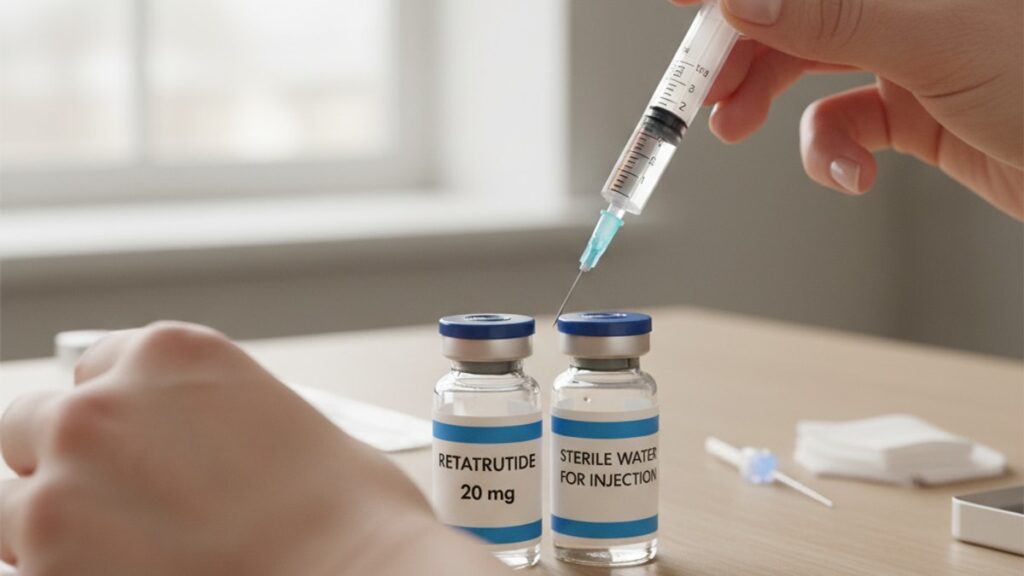
In the world of advanced biological research, precision isn't just a goal; it's the entire foundation. Every variable matters. And when you're working with a sophisticated compound like Retatrutide, the process of transforming that lyophilized (freeze-dried) powder into a viable solution for study is a critical, non-negotiable element of your success. Get it right, and your data is reliable. Get it wrong, and you've compromised the integrity of your entire experiment before it has even begun.
Our team talks to researchers every single day, and the questions surrounding how to reconstitute 20 mg retatrutide come up constantly. It's understandable. You've invested in a high-purity peptide, and the last thing you want is to degrade it through an improper mixing technique. That's why we put this guide together. We're pulling back the curtain on the exact, meticulous process our own experts recommend, ensuring you can move forward with absolute confidence in your preparation. This isn't just about mixing powder and water; it's about safeguarding the potential of your research from the very first step.
Why Proper Reconstitution is Everything
Let's be honest, this is crucial. The moment you introduce a diluent to a lyophilized peptide, you're initiating a delicate chemical process. Retatrutide, like other complex peptides such as Tirzepatide or Semaglutide, is a long-chain amino acid sequence. Its structure is what gives it its function. Aggressive handling, the wrong pH, or bacterial contamination can shear these delicate bonds or render the entire vial useless. It's a catastrophic failure point that's entirely avoidable.
Our experience shows that reconstitution errors are one of the most common sources of inconsistent research data. A researcher might report poor results, but the issue wasn't the peptide itself—it was that the peptide was inadvertently damaged during preparation. Shaking a vial instead of gently swirling it can denature the proteins, much like over-whipping an egg white. Using a non-sterile diluent can introduce bacteria that feast on the peptide, degrading it within hours. Incorrect measurements lead to unknown concentrations, making any subsequent data impossible to replicate or trust.
This is why we're so relentless about quality at Real Peptides. We go through the demanding process of small-batch synthesis to guarantee the purity and exact sequencing of the powder in the vial. That's our promise. But that promise can be undone in seconds without the proper handling protocol on the receiving end. We've seen it work. We've also seen it fail. The difference is always in the details.
Gathering Your Essential Lab Supplies
Before you even think about opening a box, you need to assemble your toolkit. Working in a clean, organized space isn't just good practice; it's a prerequisite for sterile work. You wouldn't perform surgery on a dirty table, and you shouldn't reconstitute a sensitive research compound without the right gear. It's that simple.
Here's what our team recommends having on hand:
- Your Vial of Lyophilized Retatrutide (20 mg): This is the star of the show. Upon arrival, it should be a solid, white, puck-like cake of powder at the bottom of the vial. It should not be loose or flaky. This solid form is the result of the lyophilization process, which removes water under vacuum, making the peptide stable for shipping and storage. Our 20 mg Retatrutide is a prime example of what you should be looking for.
- Bacteriostatic Water: This is your reconstitution liquid, or diluent. We can't stress this enough: you must use the correct one. Bacteriostatic Water is sterile water that contains 0.9% benzyl alcohol. This alcohol acts as a preservative, inhibiting bacterial growth after the vial has been opened and the rubber stopper has been punctured. This is absolutely critical for multi-use vials, as it preserves the peptide's integrity for weeks when stored correctly.
- Sterile Syringes: You will need at least two. One for drawing up and injecting the bacteriostatic water, and another (typically an insulin-type syringe marked in IU or mL) for drawing your precise research doses later. We recommend using a larger 3mL or 5mL syringe for the reconstitution itself, as it makes handling the volume of water easier.
- Alcohol Prep Pads: Sterility is paramount. You'll use these to vigorously wipe the rubber stoppers on both your Retatrutide vial and your bacteriostatic water vial before piercing them with a needle. This simple step prevents the introduction of contaminants from the stopper's surface into your solution.
Never, ever be tempted to cut corners here. Using tap water, distilled water, or even sterile water without the bacteriostatic agent for a multi-use vial is asking for trouble. It creates a breeding ground for bacteria that will rapidly degrade your valuable peptide.
The Diluent Decision: A Quick Comparison
While bacteriostatic water is the gold standard for most peptide reconstitution, it's helpful to understand the options. Our lab has worked with all of them, and the choice can have a real impact on your research protocol and the stability of the final solution.
| Diluent Type | Key Component | Best Use Case | Pros | Cons |
|---|---|---|---|---|
| Bacteriostatic Water | 0.9% Benzyl Alcohol | Multi-use vials for subcutaneous injection. | Inhibits bacterial growth, extends shelf life. | Benzyl alcohol can cause stinging in some applications. |
| Sterile Water | Pure H2O (Sterilized) | Single-use applications only. | No preservatives, pure solution. | No protection against bacterial growth once opened. |
| Acetic Acid (0.6%) | Acetic Acid in Water | Specific peptides requiring acidic pH. | Solubilizes certain difficult peptides. | Can damage many standard peptides; highly specific use. |
For Retatrutide, the choice is clear. You need Bacteriostatic Water. It provides the perfect balance of sterility and preservation needed for a typical research timeline.
The Math Behind the Mix: A Step-by-Step Calculation Guide
Okay, this is where a lot of people get nervous, but the math is actually straightforward once you understand the principle. Your goal is to create a solution with a known concentration, allowing you to draw precise doses for your experiments. For a 20 mg vial of Retatrutide, you have flexibility, but we'll walk through a common scenario.
Let's break it down.
The Goal: Create a solution that is easy to measure.
The Knowns:
- Total amount of peptide: 20 mg (which is equal to 20,000 mcg)
- Volume of diluent: You choose this. Let's use 4 mL for this example.
Step 1: Keep Your Units Consistent
First things first. Always convert milligrams (mg) to micrograms (mcg) to avoid errors, as research doses are often in mcg. It's a simple conversion:
- 1 mg = 1,000 mcg
- Therefore, 20 mg = 20,000 mcg of Retatrutide.
Step 2: Calculate the Final Concentration
The formula is simple: Total Peptide Amount / Total Liquid Volume = Concentration per Unit of Volume.
Using our example:
- 20,000 mcg of Retatrutide / 4 mL of Bacteriostatic Water = 5,000 mcg per 1 mL.
So, if you add 4 mL of water to your 20 mg vial, every 1 mL of solution you draw out will contain 5,000 mcg (or 5 mg) of Retatrutide. Simple, right?
Step 3: Calculate Your Research Dose
Now, how do you measure a smaller dose, say 1,000 mcg (1 mg)?
You'll use an insulin syringe, which is typically marked in units or tenths of a mL. A standard U-100 insulin syringe has 100 units per 1 mL.
Let's figure out how many mcg are in each unit mark on the syringe:
- 5,000 mcg per mL / 100 units per mL = 50 mcg per unit.
So, with this concentration, every single unit mark on your insulin syringe represents 50 mcg of Retatrutide.
To draw a 1,000 mcg dose, you would do the following calculation:
- Desired Dose / Concentration per Unit = Number of Units to Draw
- 1,000 mcg / 50 mcg per unit = 20 units.
You would simply draw the solution up to the '20' mark on your U-100 insulin syringe. That's it. You've just dosed with precision.
Our team recommends creating a concentration that makes your target dose easy to measure. If your protocol calls for very small doses, you might add more water (e.g., 8 mL) to create a more dilute solution, spreading the dose over more units and reducing the margin of error.
The Reconstitution Protocol: A Detailed Walkthrough
With your supplies gathered and your calculations done, it's time for the main event. Follow these steps meticulously. Do not rush. Every action has a purpose.
- Preparation is Key: Start by washing your hands thoroughly. Lay out your alcohol pads, syringes, and vials on a clean, disinfected surface.
- Inspect the Vials: Check your Retatrutide vial to ensure the powder is a solid cake and the vial is intact. Check the bacteriostatic water for any cloudiness or particulates. It should be perfectly clear.
- Pop the Caps: Remove the protective plastic caps from both the peptide vial and the water vial. Do not remove the rubber stoppers underneath.
- Sterilize the Stoppers: Take an alcohol prep pad and scrub the rubber stopper of the bacteriostatic water vial for at least 10-15 seconds. Do the same for the Retatrutide vial with a fresh pad. Let them air dry for a moment. This is a non-negotiable sterile procedure.
- Draw the Diluent: Uncap your larger syringe (e.g., 3mL). Pull the plunger back to the volume you calculated earlier (e.g., 4 mL). This fills the syringe with air. Insert the needle through the center of the sterilized rubber stopper on the bacteriostatic water vial. Inject the air into the vial—this equalizes the pressure and makes drawing the water out much easier. Now, invert the vial and slowly pull the plunger back, drawing your exact amount of water (4 mL in our example).
- Introduce the Diluent—Gently! This is the most delicate part of the entire process. Insert the needle of the water-filled syringe into the sterilized stopper of the Retatrutide vial. Angle the needle so that the stream of water runs down the inside wall of the glass vial. DO NOT spray the water directly onto the lyophilized powder puck. This forceful action can damage the peptide molecules. Inject the water slowly and steadily.
- The Art of the Swirl: Once all the water is in, remove the syringe. Now, you need to help the peptide dissolve. Gently swirl the vial in a circular motion or roll it between your palms. Be patient. It might take a minute or two to fully dissolve. Under no circumstances should you shake the vial. Shaking creates foam and, more importantly, can shear and destroy the delicate peptide chains. We mean this sincerely: patience here preserves your research investment.
- Final Inspection: Once mixed, the solution should be completely clear. Hold it up to a light source to check for any undissolved particles or a cloudy appearance. If it's clear, your reconstitution is complete. If it remains cloudy or has floaters, the peptide may be compromised, and it should not be used for research.
Now you have a vial of reconstituted Retatrutide, prepared with precision and ready for your study. This careful approach is what separates reliable, repeatable science from guesswork. It's the standard we uphold for all the compounds in our peptide collection.
Storage and Handling of Reconstituted Retatrutide
Your job isn't done yet. Storing the reconstituted solution properly is just as important as mixing it correctly. The benzyl alcohol in the bacteriostatic water will prevent bacterial growth, but you still need to protect the peptide from degradation by heat and light.
Here’s what you need to know:
- Refrigerate Immediately: Your reconstituted vial must be stored in a refrigerator at a temperature between 2°C and 8°C (36°F and 46°F). The door of the fridge is not the best place, as the temperature fluctuates too much. Place it in the main body of the unit.
- Do Not Freeze: Freezing a reconstituted peptide can damage its structure. The freeze-thaw cycle can cause the peptide to degrade, rendering it less effective or completely inert.
- Protect from Light: Peptides are sensitive to light. It's best practice to store the vial in its original box or in a dark container within the refrigerator to shield it from light exposure.
- Shelf Life: When reconstituted with bacteriostatic water and stored correctly, Retatrutide is typically stable for research use for up to 4 weeks. Always check your solution for any changes in clarity before each use.
Following these storage rules ensures that the first dose from the vial is just as potent and pure as the last. It’s about maintaining consistency throughout the entire lifecycle of your research material. Ready to ensure you have the best starting materials? You can Get Started Today by exploring our full range of research-grade compounds.
A Final Word on Purity and Sourcing
We've spent this entire article discussing the meticulous process of how to reconstitute 20 mg retatrutide. But there's an unspoken truth underpinning all of this: none of these steps matter if you start with an impure or improperly dosed product. It's the classic 'garbage in, garbage out' principle.
The peptide market is, frankly, a sprawling and often murky landscape. Many suppliers prioritize volume over quality, leading to products with questionable purity, incorrect peptide sequences, or the presence of harmful synthesis byproducts. Our entire philosophy at Real Peptides is built in opposition to that model. We focus on small-batch synthesis for a reason. It allows for an unwavering level of quality control, ensuring that the 20 mg of Retatrutide listed on the vial is exactly what you get—a pure, stable, and reliable compound for your research.
Your experimental results are only as good as your weakest link. By mastering the reconstitution protocol and starting with a peptide of verifiable quality, you eliminate critical variables and empower your research to yield clear, unambiguous, and powerful data. That's the real goal. It's why we do what we do.
Frequently Asked Questions
What happens if I accidentally shake the Retatrutide vial?
▼
Shaking the vial can cause the delicate peptide chains to break apart or denature, much like over-whipping an egg. This can significantly reduce or even eliminate the peptide’s effectiveness for your research. Always swirl or roll gently.
How long is reconstituted Retatrutide stable in the refrigerator?
▼
When reconstituted with bacteriostatic water and stored properly between 2°C and 8°C (36°F and 46°F), Retatrutide is generally stable for up to 4 weeks. Always inspect the solution for clarity before each use.
My reconstituted Retatrutide solution looks cloudy. What should I do?
▼
A properly reconstituted solution should be perfectly clear. If it appears cloudy, contains particles, or is discolored, the peptide may be degraded or contaminated. For safety and data integrity, it should not be used.
Can I use sterile water instead of bacteriostatic water?
▼
You can, but only if you plan to use the entire vial in a single instance. Sterile water contains no preservative, so once the stopper is punctured, bacteria can grow rapidly. For multi-use vials, bacteriostatic water is essential.
Is it okay to freeze my reconstituted peptide to make it last longer?
▼
No, we strongly advise against freezing reconstituted Retatrutide. The freeze-thaw process can damage the peptide’s complex structure, compromising its integrity and effectiveness. Refrigeration is the correct storage method.
What is the ideal volume of water to use for a 20 mg vial?
▼
There is no single ‘ideal’ volume; it depends on your desired final concentration. Adding 2 mL, 4 mL, or even 8 mL are all common choices. The key is to choose a volume that makes calculating your specific research dose simple and accurate.
Why was there a vacuum or ‘hiss’ sound when I pierced the vial?
▼
Lyophilized peptides are often sealed under a slight vacuum to ensure stability and sterility. A hiss of air entering the vial is a positive sign that the seal was intact from the factory to your lab.
Do I need to let the vial warm to room temperature before reconstituting?
▼
While not strictly mandatory, allowing the vial to sit at room temperature for 10-15 minutes before mixing can sometimes help the powder dissolve more easily. It’s a good practice but not as critical as gentle mixing.
Can I pre-load syringes with doses for the week?
▼
Our team advises against this. Storing peptides in plastic syringes for extended periods can lead to adsorption, where the peptide sticks to the plastic, reducing the actual dose delivered. It’s best practice to draw each dose fresh from the refrigerated vial.
Why shouldn’t I spray the water directly onto the peptide powder?
▼
Spraying the diluent directly onto the lyophilized puck can be too forceful, potentially damaging the peptide molecules on impact. Running the water gently down the side of the vial allows for a much more delicate and safe mixing process.
Can I mix Retatrutide with another peptide, like BPC-157, in the same vial?
▼
Absolutely not. Mixing different peptides in the same vial or syringe can cause them to degrade or interact in unpredictable ways, compromising the stability and purity of both compounds. Each peptide must be reconstituted and handled separately.
