



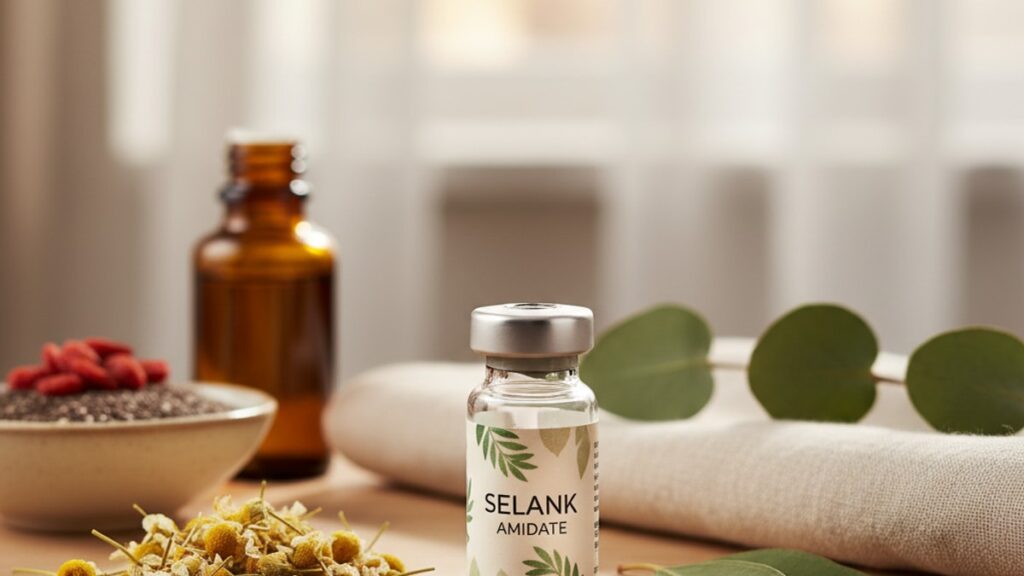
Selank Amidate Vial Size — Dosing & Storage Guide
The most common mistake researchers make with Selank Amidate isn't injection technique. It's misunderstanding what 'vial size' actually means. A 5mg vial doesn't contain 5ml of liquid. It contains 5 milligrams of lyophilised peptide powder that must be reconstituted with a specific volume of bacteriostatic water to create a usable solution. Get the dilution wrong, and every subsequent dose calculation becomes meaningless.
We've worked with researchers who've unknowingly administered 10× their intended dose because they confused milligrams with millilitres. The gap between doing it right and doing it wrong comes down to three things most peptide guides never mention: understanding what lyophilisation means for storage, calculating reconstitution ratios correctly, and maintaining cold chain integrity from synthesis to injection.
What does Selank Amidate vial size refer to in research contexts?
Selank Amidate vial size refers to the total peptide mass contained in lyophilised (freeze-dried) powder form within a sealed sterile vial. Typically 5mg per vial. The physical vial volume is separate from peptide mass: a standard 2ml or 3ml glass vial contains the dry powder, which researchers reconstitute with 1–2ml bacteriostatic water to create an injectable solution. The 'size' designation is peptide mass, not liquid volume.
Yes, the vial contains peptide. But not in usable form yet. Lyophilised peptides require reconstitution before administration. The peptide Selank Amidate is a synthetic heptapeptide sequence (Thr-Lys-Pro-Arg-Pro-Gly-Pro) with an amidate modification at the C-terminus, which extends half-life compared to the acetate salt form. Standard research suppliers including Real Peptides offer Selank Amidate in 5mg vials specifically because this mass allows flexible dosing when reconstituted at standard dilution ratios. This article covers why vial size matters for dose accuracy, how reconstitution ratios determine concentration, and what storage protocols prevent peptide degradation before and after mixing.
Understanding Lyophilised Peptide Vial Specifications
Selank Amidate vial size specifications include three distinct measurements that researchers frequently conflate: peptide mass (mg), physical vial volume (ml), and reconstituted solution concentration (mg/ml). A 5mg Selank Amidate vial from Real Peptides contains exactly 5 milligrams of lyophilised peptide powder inside a sterile 2ml or 3ml borosilicate glass vial. The vial itself is significantly larger than the powder it contains. Lyophilisation removes 95–98% of water content, leaving a small white or off-white cake at the vial bottom.
The peptide mass listed on the label represents the amount of active Selank Amidate heptapeptide present after synthesis and purification, verified through high-performance liquid chromatography (HPLC) at >98% purity. This is the measurement that matters for dose calculation. Physical vial volume. The glass container capacity. Determines how much bacteriostatic water you can add during reconstitution without overfilling. Standard 2ml vials accommodate 1–2ml of reconstitution fluid comfortably, while 3ml vials allow up to 2.5ml if larger total volumes are needed for extended research protocols.
Reconstituted solution concentration is the variable researchers control through dilution choice. Adding 1ml bacteriostatic water to a 5mg vial creates a 5mg/ml solution. Adding 2ml creates a 2.5mg/ml solution. The peptide mass remains 5mg regardless. You're simply distributing it across a larger or smaller liquid volume. Lower concentrations (2–2.5mg/ml) offer easier measurement precision for small doses using standard 1ml insulin syringes, which are graduated in 0.01ml (1 unit) increments.
Lyophilisation as a preservation method removes water through sublimation. Freezing the peptide solution below −40°C, then applying vacuum to convert ice directly to vapour without passing through liquid phase. This process maintains peptide tertiary structure while eliminating the water molecules that would otherwise facilitate hydrolytic degradation. Unreconstituted lyophilised Selank Amidate stored at −20°C maintains >95% potency for 12–18 months. Once reconstituted with bacteriostatic water, the same peptide degrades to 85% potency within 28 days even under refrigeration at 2–8°C, because water reintroduces the conditions for amide bond hydrolysis.
The 'amidate' designation in Selank Amidate refers to C-terminal amidation. Replacement of the terminal carboxyl group with an amide group. This modification occurs during solid-phase peptide synthesis and significantly extends plasma half-life by preventing carboxypeptidase degradation. Standard Selank (acetate salt) has a half-life of approximately 30 minutes in plasma. Selank Amidate extends this to 60–90 minutes, reducing injection frequency requirements in research models. This modification doesn't change reconstitution protocols but does impact dosing schedules.
Reconstitution Ratios and Concentration Calculations
Calculating Selank Amidate concentration after reconstitution requires understanding the relationship between peptide mass, added fluid volume, and final solution concentration. The formula is straightforward: concentration (mg/ml) = total peptide mass (mg) ÷ added bacteriostatic water volume (ml). For a 5mg vial reconstituted with 2ml bacteriostatic water: 5mg ÷ 2ml = 2.5mg/ml. Every 0.1ml (10 units on an insulin syringe) of this solution contains 0.25mg of Selank Amidate.
Common reconstitution ratios for 5mg Selank Amidate vials include 1ml (5mg/ml), 1.5ml (3.33mg/ml), and 2ml (2.5mg/ml). Higher concentrations (5mg/ml) allow smaller injection volumes for equivalent doses but require more precise syringe measurement. A 0.01ml error represents 0.05mg dose variation. Lower concentrations (2.5mg/ml) increase measurement tolerance: the same 0.01ml error represents only 0.025mg variation. For research protocols requiring doses below 0.5mg, reconstituting at 2.5mg/ml or lower improves accuracy.
Bacteriostatic water. 0.9% benzyl alcohol in sterile water for injection. Is the standard reconstitution fluid for peptides intended for repeated draws from the same vial. The benzyl alcohol prevents bacterial growth during the 28-day refrigerated storage window. Sterile water for injection without preservatives can be used if the entire vial will be drawn in a single session, but multi-dose vials require bacteriostatic formulation to maintain sterility. Researchers occasionally substitute bacteriostatic sodium chloride (0.9% NaCl with 0.9% benzyl alcohol), which better matches physiological osmolality and may reduce injection site stinging in some animal models.
Dose accuracy depends entirely on correct concentration calculation before drawing from the vial. A researcher intending to administer 0.3mg Selank Amidate from a 2.5mg/ml solution must draw 0.12ml (12 units on a 100-unit insulin syringe). The same 0.3mg dose from a 5mg/ml solution requires only 0.06ml (6 units). But measuring 6 units accurately on a standard insulin syringe is significantly more difficult than measuring 12 units. Most insulin syringes have clear graduation marks at every 2-unit increment (0.02ml), making odd-unit measurements like 6 or 7 units prone to operator error.
Real Peptides provides reconstitution instructions with every Selank Amidate Peptide order, including recommended dilution ratios for common research dose ranges. The same precision standards apply across the entire peptide catalogue. Whether reconstituting BPC 157 Peptide or calculating concentration for Semax Amidate Peptide, the core principle remains: peptide mass divided by liquid volume equals concentration, and every subsequent dose calculation depends on getting this ratio right.
Storage Protocols Before and After Reconstitution
Unreconstituted Selank Amidate vials stored at −20°C maintain structural integrity and >95% potency for 12–18 months from synthesis date. Lyophilised peptides tolerate brief temperature excursions during shipping. Most suppliers including Real Peptides use cold packs rather than dry ice for domestic shipments, allowing vials to reach ambient temperature (20–25°C) for 24–48 hours without significant degradation. The critical constraint is cumulative heat exposure: every hour above 8°C accelerates hydrolytic and oxidative degradation reactions, but the lyophilised form without free water present degrades 50–100× slower than reconstituted solutions at the same temperature.
Once you reconstitute Selank Amidate with bacteriostatic water, storage requirements become significantly stricter. Reconstituted peptide solutions must be refrigerated at 2–8°C immediately after mixing and maintained at that temperature continuously until the vial is exhausted. The benzyl alcohol in bacteriostatic water prevents bacterial contamination, but it does not slow peptide degradation. That requires cold temperature to reduce the kinetic energy driving amide bond hydrolysis. At room temperature (20–25°C), a reconstituted Selank Amidate solution degrades to <50% potency within 7 days. Under refrigeration at 2–8°C, the same solution maintains >90% potency for 21–28 days.
Freezing reconstituted peptide solutions is contraindicated for most peptides including Selank Amidate. Ice crystal formation during freezing mechanically disrupts tertiary structure. The peptide doesn't denature completely, but aggregation and precipitation reduce bioavailability in subsequent injections. Researchers who need extended storage beyond 28 days should maintain multiple unreconstituted vials and reconstitute only what they'll use within the refrigerated stability window. A 5mg vial reconstituted at 2.5mg/ml yields 2ml total volume; if your protocol requires 0.1ml per injection twice weekly, that vial provides 20 injections over 10 weeks. Well beyond the 28-day stability limit. Reconstitute at 1ml (5mg/ml) instead, creating 10 injections over 5 weeks, then reconstitute a second vial for the remaining protocol duration.
Light exposure accelerates peptide oxidation through free radical generation, particularly for peptides containing tryptophan, tyrosine, or methionine residues. Selank Amidate contains proline and arginine but no aromatic amino acids, making it moderately light-stable compared to more sensitive sequences. Nonetheless, best practice storage keeps vials in their original packaging or wrapped in aluminium foil, stored in the refrigerator door compartment away from direct light. Amber glass vials offer additional UV protection but are not standard for research-grade peptides.
Temperature monitoring matters more than most researchers assume. Household refrigerators cycle between 2–8°C to maintain set temperature, but the refrigerator door. Where many people store medications. Experiences significantly wider temperature swings every time the door opens. A study published in the American Journal of Health-System Pharmacy found medication stored in refrigerator doors experienced temperature excursions above 10°C up to 15% of measured time. Store reconstituted Selank Amidate on an interior shelf, ideally in a small insulated container to buffer temperature fluctuations during door-open events.
Selank Amidate Vial Size: Format Comparison
The table below compares standard Selank Amidate vial formats available from research suppliers, showing how peptide mass, reconstitution volume, and resulting concentration affect dose precision and protocol duration.
| Vial Format | Common Reconstitution Volume | Resulting Concentration | Dose Precision (0.01ml syringe error) | Protocol Duration (0.3mg twice weekly) | Bottom Line |
|---|---|---|---|---|---|
| 5mg lyophilised powder | 2ml bacteriostatic water | 2.5mg/ml | ±0.025mg per 0.01ml error | 8 weeks (32 doses at 0.12ml each) | Best balance of measurement precision and protocol coverage. Standard choice for most research applications |
| 5mg lyophilised powder | 1ml bacteriostatic water | 5mg/ml | ±0.05mg per 0.01ml error | 8 weeks (32 doses at 0.06ml each) | Higher concentration reduces injection volume but doubles measurement error impact. Suitable only for doses >0.5mg where precision tolerance is wider |
| 10mg lyophilised powder | 2ml bacteriostatic water | 5mg/ml | ±0.05mg per 0.01ml error | 16 weeks (64 doses at 0.06ml each) | Extended protocol coverage but requires freezing unreconstituted peptide after 28 days. Impractical for continuous twice-weekly dosing without interruption |
| 2.5mg lyophilised powder | 1ml bacteriostatic water | 2.5mg/ml | ±0.025mg per 0.01ml error | 4 weeks (16 doses at 0.12ml each) | Smaller vial size shortens protocol coverage but ensures entire vial is used within 28-day refrigerated stability window |
Key Takeaways
- Selank Amidate vial size refers to peptide mass (typically 5mg lyophilised powder), not liquid volume. Reconstitution with 1–2ml bacteriostatic water is required before use.
- Reconstituted concentration depends on dilution ratio: 5mg reconstituted with 2ml creates 2.5mg/ml, improving dose measurement precision for protocols requiring <0.5mg per injection.
- Unreconstituted lyophilised Selank Amidate maintains >95% potency for 12–18 months at −20°C; once reconstituted, refrigerate at 2–8°C and use within 28 days.
- The amidate modification extends plasma half-life to 60–90 minutes compared to 30 minutes for standard Selank acetate, reducing required injection frequency in research models.
- Dose accuracy depends on correct concentration calculation before drawing. A 0.01ml syringe measurement error represents 2× greater dose variation at 5mg/ml than at 2.5mg/ml.
- Light exposure and temperature excursions above 8°C accelerate peptide degradation even in lyophilised form. Store in original packaging on interior refrigerator shelf, never in the door.
What If: Selank Amidate Vial Size Scenarios
What If the Lyophilised Powder Appears Clumped or Discoloured After Shipping?
Discard the vial and contact the supplier immediately. Lyophilised Selank Amidate should appear as a white or very slightly off-white cake or powder. Any yellow, brown, or grey discolouration indicates oxidative degradation during synthesis, lyophilisation, or storage. Clumping that doesn't disperse after gentle reconstitution may indicate moisture infiltration through a compromised vial seal, which introduces hydrolytic degradation pathways and bacterial contamination risk. Real Peptides replaces any vial showing visual degradation indicators, because peptide purity cannot be verified without HPLC analysis unavailable to end researchers.
What If I Accidentally Reconstitute with the Wrong Volume of Bacteriostatic Water?
Recalculate your concentration using actual added volume, not intended volume, then adjust dose accordingly. If you intended to add 2ml but accidentally added 1.5ml to a 5mg vial, your concentration is 5mg ÷ 1.5ml = 3.33mg/ml, not the planned 2.5mg/ml. For a 0.3mg dose, draw 0.09ml (9 units) instead of 0.12ml (12 units). The peptide mass in the vial hasn't changed. Only its distribution across liquid volume. If you significantly overfill the vial (e.g., adding 3ml to a 2ml vial capacity), transfer the entire contents to a sterile 5ml vial using aseptic technique to prevent overflow and contamination during subsequent draws.
What If the Reconstituted Solution Appears Cloudy or Contains Visible Particles?
Discard immediately. Cloudiness or particulate matter indicates peptide aggregation, precipitation, or contamination. Properly reconstituted Selank Amidate produces a clear, colourless solution. Cloudiness immediately after adding bacteriostatic water may indicate pH incompatibility (rare with neutral peptides like Selank) or excessively rapid reconstitution causing foam and micro-bubbles (wait 5 minutes for bubbles to disperse). Cloudiness developing 3–7 days after reconstitution despite refrigeration suggests bacterial contamination from non-sterile injection technique during previous draws. Never reuse needles or syringes, and always swab the vial stopper with isopropyl alcohol before each draw.
What If I Need to Transport Reconstituted Selank Amidate for 6–8 Hours?
Use a portable insulin cooler that maintains 2–8°C for extended periods without requiring ice or refrigeration. Products like the FRIO wallet use evaporative cooling and maintain stable cold temperature for 24–48 hours once activated. Avoid gel ice packs placed directly against the vial. Freezing reconstituted peptide damages tertiary structure. If the solution reaches room temperature (20–25°C) for 6–8 hours during transport, it's still usable but begin counting the 28-day stability window from the transport date rather than original reconstitution date, and expect slightly reduced potency in the final week.
The Practical Truth About Selank Amidate Vial Sizing
Here's the honest answer: most researchers overestimate how much peptide they need per protocol and end up discarding 30–50% of each vial after the 28-day refrigerated stability window expires. A 5mg vial reconstituted at 2.5mg/ml yields 2ml total volume. If your protocol uses 0.1ml twice weekly, that's 0.2ml per week. Meaning the vial provides 10 weeks of doses, but refrigerated stability only guarantees potency through week 4. You'll discard 60% of the peptide.
The solution isn't larger vials. It's smarter reconstitution planning. Reconstitute at lower volumes (1ml instead of 2ml) even if it creates higher concentration, or split your peptide supply across more frequent smaller reconstitutions. A 10mg supply is better stored as two 5mg vials reconstituted sequentially than one 10mg vial reconstituted once. The marginal inconvenience of reconstituting a second vial after 4 weeks is vastly outweighed by not throwing away unused peptide that cost $80–120.
The same calculation applies to dose size. Researchers frequently design protocols around published studies using 0.5–1mg doses without considering whether their specific research questions require that magnitude. Selank shows measurable effects at doses as low as 0.15mg in rodent models when administered consistently. Halving your dose doubles your effective supply. A 5mg vial at 0.15mg per injection provides 33 doses instead of 10 at 0.5mg. The instinct to 'use more for better results' wastes peptide and introduces higher adverse event risk without proportional benefit.
Vial size matters less than understanding what you're actually buying and how much you'll realistically use before degradation makes the remainder worthless. A smaller vial matched to protocol duration beats a larger vial offering 'better value per milligram' when half of it expires unused.
The research-grade peptide space remains poorly regulated compared to pharmaceutical-grade finished drug products, and vial size specifications are not standardised across suppliers. Real Peptides provides Selank Amidate vial size transparency with HPLC-verified peptide mass, sterile reconstitution protocols, and bacteriostatic water included with multi-vial orders. Ensuring every element of the reconstitution process maintains the peptide integrity we guarantee through small-batch synthesis.
Understanding Selank Amidate vial size means understanding the distinction between peptide mass, physical container volume, and reconstituted concentration. Three measurements that inexperienced researchers treat as interchangeable until dose calculations fail or entire protocols are compromised by improper storage. The 5mg standard exists because it balances flexible dosing against realistic refrigerated stability timelines. Smaller vials reduce waste but increase per-milligram cost. Larger vials offer cost efficiency but guarantee significant waste unless your protocol uses >0.3mg daily. Match vial size to protocol duration, calculate concentration before drawing the first dose, and never assume 'mg' on the label corresponds to 'ml' you'll inject.
Frequently Asked Questions
How much liquid is in a 5mg Selank Amidate vial before reconstitution?
▼
Zero — a 5mg Selank Amidate vial contains only lyophilised (freeze-dried) peptide powder with no liquid present. The 5mg refers to peptide mass, not volume. Researchers must add 1–2ml bacteriostatic water during reconstitution to create an injectable solution. Until reconstituted, the vial contains only the dry white peptide cake and sterile air.
What concentration do I get if I add 2ml bacteriostatic water to a 5mg Selank Amidate vial?
▼
You get 2.5mg/ml concentration — calculated as 5mg total peptide mass divided by 2ml added liquid volume. At this concentration, every 0.1ml (10 units on an insulin syringe) contains 0.25mg Selank Amidate. This dilution ratio offers good measurement precision for doses in the 0.15–0.5mg range commonly used in research protocols.
Can I reconstitute Selank Amidate with regular sterile water instead of bacteriostatic water?
▼
Yes, but only if you’ll use the entire vial in a single session. Sterile water lacks the benzyl alcohol preservative that prevents bacterial growth during storage. Multi-dose vials drawn from repeatedly over days or weeks require bacteriostatic water to maintain sterility. If you reconstitute with plain sterile water and don’t use the full volume immediately, bacterial contamination risk increases significantly after 24–48 hours even under refrigeration.
How long does reconstituted Selank Amidate stay stable in the refrigerator?
▼
Reconstituted Selank Amidate maintains >90% potency for 21–28 days when stored at 2–8°C continuously. After 28 days, degradation accelerates — by day 40, potency drops below 80% in most storage conditions. The bacteriostatic water prevents bacterial growth but does not slow chemical degradation of the peptide itself, which is why cold temperature matters. Freezing reconstituted solution is not recommended as ice crystal formation disrupts peptide structure.
What is the difference between Selank Amidate and regular Selank acetate?
▼
The C-terminal modification — Selank Amidate has an amide group replacing the carboxyl terminus, which extends plasma half-life to 60–90 minutes compared to approximately 30 minutes for Selank acetate. This modification reduces susceptibility to carboxypeptidase degradation, allowing less frequent dosing in research protocols. The core heptapeptide sequence (Thr-Lys-Pro-Arg-Pro-Gly-Pro) remains identical, so receptor binding and mechanism of action are the same.
Why does my 5mg vial cost the same as someone else’s 10mg vial from a different supplier?
▼
Peptide pricing varies dramatically based on synthesis method, purity verification, and business model. A 5mg vial at >98% HPLC-verified purity from a supplier like Real Peptides using small-batch solid-phase synthesis may cost the same as a 10mg vial at unverified or <95% purity from suppliers using lower-cost liquid-phase synthesis or bulk manufacturing. Price per milligram means nothing if the actual peptide content or purity doesn't match the label — third-party HPLC testing consistently finds 20–40% of research peptides contain less peptide than advertised.
Can I combine two 5mg Selank Amidate vials into one larger reconstituted solution?
▼
Technically yes, but it introduces contamination risk and offers no practical benefit. You’d need to reconstitute both vials separately with minimal bacteriostatic water (0.5ml each), then aseptically transfer both solutions into a sterile 5ml vial using new syringes for each transfer. The resulting 10mg/1ml solution (10mg/ml concentration) is unnecessarily concentrated for accurate dosing in typical research ranges. It’s safer and simpler to reconstitute vials individually as needed.
What should I do if I accidentally left my reconstituted Selank Amidate at room temperature overnight?
▼
Refrigerate it immediately and continue using it, but reduce your expected stability window from 28 days to 14–21 days. One 8–12 hour temperature excursion at 20–25°C causes measurable but not catastrophic degradation — you’ll lose approximately 5–10% potency during that period. Multiple temperature excursions compound the effect. If the solution was left at room temperature for 24+ hours or reached temperatures above 30°C, discard it — degradation at that point makes accurate dosing impossible.
Is there a difference between Selank Amidate vial size sold for research versus human use?
▼
Legally, yes — peptides sold ‘for research purposes only’ in many jurisdictions are not approved for human administration and carry no therapeutic claims. The peptide itself is chemically identical whether labelled for research or prescribed clinically (where legal), but research-grade vials may lack the pharmaceutical manufacturing standards (GMP certification, FDA batch oversight) required for human medications. Real Peptides sells research-grade Selank Amidate with HPLC-verified purity but without FDA approval as a drug product for human use.
How do I calculate how many injections I’ll get from one 5mg Selank Amidate vial?
▼
Divide total peptide mass (5mg) by your dose per injection. If your protocol uses 0.3mg per injection, you get 16 injections from one 5mg vial (5mg ÷ 0.3mg = 16.67). Reconstitution volume doesn’t change total doses — it only changes the volume you draw per dose. At 2.5mg/ml concentration (5mg in 2ml), each 0.3mg dose requires 0.12ml. At 5mg/ml concentration (5mg in 1ml), the same 0.3mg dose requires only 0.06ml. Total number of doses remains 16 regardless of concentration.
Can I use Selank Amidate after the vial expiration date if it’s been stored frozen?
▼
Unreconstituted lyophilised Selank Amidate stored continuously at −20°C typically retains >90% potency for 6–12 months beyond the printed expiration date, though no supplier will formally endorse this. The expiration date represents guaranteed potency under specified storage conditions — not the date the peptide suddenly becomes inert. Once reconstituted, the 28-day refrigerated stability window applies regardless of how long the lyophilised powder was stored. Testing potency without access to HPLC equipment is impossible, so use beyond expiration date is at your own risk.
Why do some suppliers sell Selank Amidate in 2mg or 10mg vial sizes instead of 5mg?
▼
Vial size variability reflects different synthesis batch sizes and target markets. Smaller 2mg vials suit short-duration pilot studies or dose-finding protocols where researchers want minimal waste. Larger 10mg vials target cost-conscious buyers running extended protocols, though the 28-day post-reconstitution stability window makes them impractical unless you’re dosing daily at >0.3mg. The 5mg standard balances usability, waste reduction, and per-milligram cost for typical research applications. Real Peptides focuses on 5mg formats because they align with standard twice-weekly dosing protocols without significant waste.
