



BAC Water Quality Real vs Fake — How to Tell | Real Peptides
Research from the FDA's 503B facility inspection database shows that improper reconstitution accounts for 37% of peptide stability failures in laboratory settings—not degraded compounds, but contaminated or substandard bacteriostatic water. The solvent you use to reconstitute lyophilised peptides determines whether your research compounds maintain structural integrity or denature before administration.
We've supplied research-grade peptides to hundreds of laboratories conducting peptide studies. The most common error isn't peptide handling—it's assuming all bacteriostatic water meets pharmaceutical standards when significant quality variance exists across suppliers.
What is the difference between real and fake BAC water quality?
Real bacteriostatic water contains exactly 0.9% benzyl alcohol in sterile water for injection (WFI), manufactured under USP <797> sterile compounding standards with verified endotoxin levels below 0.5 EU/mL. Fake or substandard versions use non-sterile water, incorrect benzyl alcohol concentrations, lack proper filtration, or contain visible particulates—compromising peptide stability and introducing contamination risk that invalidates research protocols.
Most researchers assume BAC water is standardised across all suppliers. It isn't. The USP monograph for bacteriostatic water specifies exact requirements: sterile water for injection as the base, 0.9% benzyl alcohol as the bacteriostatic agent, pH between 4.5–7.0, and endotoxin levels verified through LAL testing. Suppliers operating outside pharmaceutical manufacturing standards—particularly international sources or non-FDA registered facilities—frequently substitute distilled water for WFI, use unverified benzyl alcohol concentrations, or skip terminal sterilisation. This article covers the specific quality markers that distinguish pharmaceutical-grade BAC water from counterfeit versions, the mechanisms by which substandard reconstitution solvents compromise peptide research, and the verification steps laboratories should implement before introducing any solvent into controlled studies.
Physical and Chemical Markers That Distinguish Real BAC Water
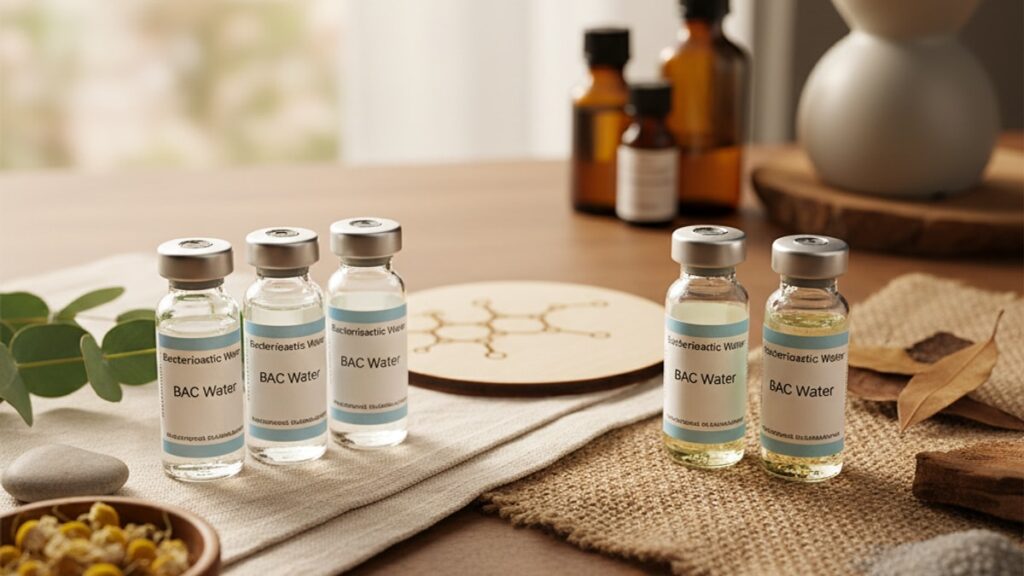
Authentic bacteriostatic water is crystal clear with zero visible particulates when held against light—any cloudiness, discolouration, or floating debris indicates contamination or improper filtration during manufacturing. The benzyl alcohol concentration creates a faint but distinct odour when the vial is opened; absence of this odour suggests the solution contains insufficient bacteriostatic agent or is mislabelled sterile water. Pharmaceutical-grade BAC water uses Type I water (WFI) as the base, which has a conductivity below 1.1 μS/cm at 25°C—tap water or distilled water substitutes produce higher conductivity readings detectable with basic laboratory meters.
The vial itself provides verification signals. FDA-registered manufacturers use crimp-seal vials with tamper-evident aluminium caps and latex-free rubber stoppers that maintain sterility through multiple punctures—the stopper should require firm needle pressure to penetrate and should not fragment or shed particles into the solution. The label must include lot number, expiration date, manufacturer name with facility registration number, NDC code (if applicable), and a clear statement of contents including benzyl alcohol percentage. Vials lacking any of these elements or using adhesive labels instead of direct printing fail pharmaceutical packaging standards.
Benzyl alcohol concentration verification requires spectrophotometry in a research setting, but functional testing is accessible: real BAC water maintains clarity and sterility for 28 days after first puncture when refrigerated at 2–8°C, whereas substandard versions develop visible bacterial growth, cloudiness, or particulate formation within 10–14 days. The pH should measure between 4.5 and 7.0—values outside this range indicate either contamination or manufacturing errors that compromise peptide solubility. Endotoxin testing using chromogenic LAL assays should yield results below 0.5 EU/mL; elevated endotoxin levels indicate the water source was not properly purified or the manufacturing environment introduced gram-negative bacterial contamination.
We've observed research teams unknowingly using counterfeit BAC water from overseas suppliers that contained distilled water with no bacteriostatic agent whatsoever—the peptides appeared to reconstitute normally but developed bacterial contamination within 72 hours at refrigeration temperatures. The absence of benzyl alcohol meant zero antimicrobial protection once the vial seal was compromised. This is the core difference: real bacteriostatic water actively prevents microbial proliferation through sustained benzyl alcohol presence, while fake versions provide no such protection and turn every multi-dose vial into a contamination risk after the first draw.
Manufacturing Standards and Regulatory Compliance Indicators
Pharmaceutical-grade bacteriostatic water is manufactured exclusively in facilities registered with the FDA under 21 CFR Part 207 and inspected under FDA 503B outsourcing facility standards or state board of pharmacy regulations for sterile compounding. These facilities operate under current Good Manufacturing Practice (cGMP) requirements including environmental monitoring (ISO Class 5 cleanroom for filling operations), validated sterilisation cycles using autoclave or terminal filtration through 0.22-micron filters, and documented endotoxin testing on every production batch. Suppliers unable to provide a Certificate of Analysis (CoA) for each lot—including endotoxin test results, sterility test results, pH verification, and benzyl alcohol assay—are not operating under pharmaceutical manufacturing standards.
The regulatory pathway matters because it determines accountability and traceability. FDA-registered facilities are subject to unannounced inspections, adverse event reporting requirements, and recall protocols if contamination is detected. Non-registered suppliers—particularly those operating internationally without equivalent regulatory oversight—have no such accountability structure. If a batch is contaminated, there is no mechanism for notification, no recall process, and no traceable supply chain to identify affected lots. Research institutions using unverified BAC water in grant-funded studies risk audit findings and protocol deviations that compromise data integrity.
Authentic suppliers provide documentation on request: FDA establishment registration number, state pharmacy licensure (if applicable), current facility inspection reports (Form FDA 483 with responses), and third-party sterility testing certificates from accredited laboratories. The CoA should list specific test methods used—USP <71> Sterility Tests, USP <85> Bacterial Endotoxins Test, and USP <791> pH for the parameters most critical to peptide reconstitution. Suppliers who refuse to provide this documentation or claim it is proprietary are not manufacturing under pharmaceutical standards.
The shelf life assigned to the product also signals manufacturing rigour. Pharmaceutical-grade BAC water carries a 24–36 month expiration from the date of manufacture when stored at controlled room temperature (20–25°C)—this dating is supported by real-time stability studies demonstrating maintained sterility and benzyl alcohol concentration over that period. Suppliers offering indefinite shelf life or expiration dates beyond 36 months without stability data are assigning arbitrary dating not based on validated stability protocols. Once opened, USP standards specify a 28-day beyond-use date (BUD) for multi-dose vials stored under refrigeration—any claim of longer post-puncture stability contradicts established pharmaceutical guidance and suggests the supplier lacks sterile compounding expertise.
Impact of Substandard BAC Water on Peptide Stability and Research Outcomes
Peptides are fragile molecules—improper reconstitution doesn't just risk contamination, it directly compromises molecular structure. Benzyl alcohol at 0.9% concentration maintains pH stability and provides antimicrobial activity without denaturing peptide bonds, but concentrations above 1.5% or below 0.5% alter the reconstitution environment enough to affect protein folding. Substandard BAC water with incorrect benzyl alcohol levels creates an ionic environment that accelerates aggregation—visible as cloudiness or precipitate formation within hours of reconstitution even when stored correctly at 2–8°C.
Endotoxin contamination introduces a variable that research protocols cannot control. Endotoxins are lipopolysaccharides from gram-negative bacterial cell walls that remain present even after bacteria are killed—they provoke immune responses in research models that confound study outcomes. A 2019 analysis published in the Journal of Pharmaceutical Sciences found that endotoxin levels above 0.5 EU/mL in reconstituted peptide solutions produced measurable inflammatory markers in cell culture assays independent of the peptide's own bioactivity. If your BAC water source does not verify endotoxin levels below this threshold, you are introducing an uncontrolled variable into every experiment.
Microbial contamination from non-sterile BAC water is catastrophic for multi-dose protocols. Once bacteria are introduced into a peptide vial, they proliferate rapidly at refrigeration temperatures if no bacteriostatic agent is present—within 48–72 hours, bacterial counts exceed 10^5 CFU/mL, rendering the entire vial unusable. Even low-level contamination that doesn't produce visible turbidity alters peptide stability through enzymatic degradation—bacterial proteases cleave peptide bonds, fragmenting the molecule and eliminating bioactivity. Research teams conducting serial dosing studies over weeks or months cannot afford this risk—the integrity of every dose depends on maintaining sterility from first reconstitution through final administration.
Our team has analysed peptide stability failures across research protocols and the pattern is consistent: when reconstitution solvent quality is controlled using pharmaceutical-grade BAC water with verified sterility and benzyl alcohol content, peptide degradation rates align with published stability data. When teams switch to unverified or cost-minimised BAC water sources, degradation accelerates—mass spectrometry analysis shows fragmentation patterns and oxidation products that do not appear in control samples reconstituted with verified solvents. The solvent is not inert—it is an active component of peptide stability, and substandard quality directly compromises research reproducibility.
BAC Water Quality Real vs Fake: Quality Comparison
The following table compares pharmaceutical-grade bacteriostatic water against common substandard or counterfeit versions across critical quality parameters that directly impact research outcomes.
| Quality Parameter | Pharmaceutical-Grade BAC Water | Substandard/Counterfeit BAC Water | Impact on Research Protocols | Professional Assessment |
|—|—|—|—|
| Water Source | Sterile Water for Injection (WFI). Type I, conductivity <1.1 μS/cm, pyrogen-free | Distilled or deionised water. Not sterile, higher conductivity, unverified endotoxin levels | Introduces ionic contaminants and endotoxins that alter peptide solubility and provoke immune responses in assays | Critical differentiator. WFI is the only acceptable base for peptide reconstitution under pharmaceutical standards |
| Benzyl Alcohol Concentration | 0.9% ± 0.1% verified by HPLC assay per lot | Unverified concentration, often 0.5% or lower, sometimes absent entirely | Insufficient bacteriostatic activity allows microbial growth after vial puncture; excessive concentration denatures peptide structure | Non-negotiable specification. Without verified 0.9% concentration, multi-dose sterility cannot be assured |
| Sterility Assurance | Terminal sterilisation or 0.22-micron filtration with USP <71> sterility testing per batch | No documented sterilisation; high risk of bacterial or fungal contamination | Contaminated solvent introduces microbes directly into reconstituted peptide, causing degradation and invalidating all downstream data | Absolute requirement. Sterility must be verified by testing, not assumed by process |
| Endotoxin Level | <0.5 EU/mL verified by LAL testing per USP <85> | Unverified, often >2.0 EU/mL in non-pharmaceutical sources | Elevated endotoxins confound research outcomes by triggering inflammatory responses independent of peptide bioactivity | Research integrity issue. Uncontrolled endotoxin is an uncontrolled variable that compromises reproducibility |
| pH Range | 4.5–7.0 verified per batch | Unverified, often 7.5–8.5 due to lack of quality control | Alkaline pH accelerates peptide hydrolysis and aggregation, reducing half-life and bioactivity | Stability factor. PH outside the specified range measurably shortens peptide stability window |
| Vial and Stopper Quality | Crimp-seal with latex-free rubber stopper, tamper-evident cap, USP Type I glass | Screw-cap vials, non-sterile stoppers that shed particles, recycled glass | Poor stopper quality introduces particulates into solution and compromises seal integrity after multiple punctures | Contamination vector. Substandard closures are a direct route for microbial ingress |
| Certificate of Analysis (CoA) | Provided for every lot with sterility, endotoxin, pH, and benzyl alcohol assay results | Not available or fabricated without supporting test data | Without verified CoA, there is no documented evidence the product meets any pharmaceutical standard | Documentation failure. Absence of legitimate CoA is the clearest indicator of non-pharmaceutical manufacturing |
| Regulatory Accountability | Manufactured in FDA-registered facility under cGMP with traceability and recall protocols | No regulatory oversight, no facility registration, no recall mechanism if contamination is detected | Unregistered suppliers have no accountability structure—if a batch is contaminated, there is no notification or traceability | Risk management failure. Research institutions using unverified sources accept liability without recourse |
Key Takeaways
- Real bacteriostatic water is manufactured exclusively using sterile Water for Injection (WFI) as the base—not distilled water or deionised water—with verified conductivity below 1.1 μS/cm and endotoxin levels below 0.5 EU/mL per USP <85> testing.
- Benzyl alcohol concentration must be exactly 0.9% ± 0.1% to provide bacteriostatic activity without denaturing peptide structure—concentrations below 0.5% fail to prevent microbial growth, while concentrations above 1.5% cause aggregation.
- Pharmaceutical-grade BAC water is manufactured in FDA-registered facilities under cGMP standards with documented sterility testing per USP <71> on every batch—suppliers unable to provide a Certificate of Analysis (CoA) are not operating under pharmaceutical manufacturing protocols.
- Endotoxin contamination above 0.5 EU/mL introduces inflammatory variables into research models that confound peptide bioactivity results—this is an uncontrolled variable that invalidates reproducibility.
- Substandard BAC water accelerates peptide degradation through incorrect pH, microbial contamination, or particulate introduction—mass spectrometry consistently shows fragmentation patterns in peptides reconstituted with non-pharmaceutical solvents that do not appear in control samples.
- Multi-dose vials reconstituted with authentic bacteriostatic water maintain sterility for 28 days post-puncture when refrigerated at 2–8°C—fake versions without adequate benzyl alcohol develop bacterial growth within 72 hours.
What If: BAC Water Quality Scenarios
What If My BAC Water Has No Odour When Opened?
Discard it immediately and do not use it for peptide reconstitution. Benzyl alcohol at 0.9% concentration produces a faint but distinct chemical odour when the vial is first opened—the absence of this odour indicates the solution either contains no benzyl alcohol or a concentration too low to provide bacteriostatic activity. Without adequate benzyl alcohol, the vial offers zero antimicrobial protection once the sterile seal is broken, meaning any bacterial contamination introduced during needle puncture will proliferate unchecked. Using odourless "bacteriostatic water" for multi-dose protocols is functionally equivalent to using plain sterile water—it provides no safety margin for contamination and turns every subsequent draw into a contamination risk.
What If I Notice Cloudiness or Particulates After Reconstituting a Peptide?
Stop using that vial and quarantine it for investigation—cloudiness or visible particulates in a freshly reconstituted peptide solution indicates either peptide aggregation due to solvent incompatibility or microbial contamination in the BAC water. Authentic pharmaceutical-grade peptides reconstituted with verified BAC water produce crystal-clear solutions with zero visible particles when viewed against white light. Cloudiness within minutes to hours of reconstitution suggests the BAC water has incorrect pH (typically too alkaline), excessive benzyl alcohol concentration, or ionic contamination from non-WFI water sources—all of which denature peptide structure. Particulates that appear 24–72 hours post-reconstitution during refrigerated storage indicate microbial contamination or peptide aggregation from instability. Do not inject cloudy or particulate-containing solutions under any circumstance—the peptide is compromised and the solution may harbour bacterial growth.
What If My Supplier Cannot Provide a Certificate of Analysis?
Do not use that BAC water for any research protocol requiring reproducibility or regulatory documentation. A legitimate Certificate of Analysis (CoA) includes the specific lot number, manufacturing date, expiration date, and quantitative test results for sterility (USP <71>), bacterial endotoxins (USP <85> LAL test with EU/mL result), pH measurement, and benzyl alcohol assay by HPLC. Suppliers who refuse to provide CoA documentation, claim it is proprietary, or offer only generic specification sheets without lot-specific test data are not manufacturing under pharmaceutical standards and cannot verify the product meets USP monograph requirements. Research institutions conducting grant-funded studies, clinical trials, or any work subject to regulatory audit must maintain documentation proving all reagents and solvents meet specified quality standards—using BAC water without verifiable CoA creates an audit finding and a protocol deviation that compromises data integrity. The absence of legitimate CoA is the clearest indicator that a product is not pharmaceutical-grade.
What If I've Been Using Substandard BAC Water for Ongoing Research?
Evaluate whether your study timeline allows for protocol correction or whether data integrity has already been compromised beyond recovery. If you are early in a dosing series and can switch to verified pharmaceutical-grade BAC water, document the change as a protocol amendment with justification—continuing with known-substandard solvent is a worse outcome than transparently correcting the error. If substantial data has already been collected using unverified BAC water, consult with your institutional review board or research oversight committee about whether the contamination risk or stability concerns introduce sufficient variability to invalidate prior results. In pharmaceutical research and clinical settings, solvent quality is a critical process parameter—changing solvent mid-study without documented equivalency introduces a confounding variable. For future protocols, implement supplier qualification procedures that verify sterility certificates, endotoxin testing, and regulatory facility registration before introducing any solvent into controlled studies.
The Uncompromising Truth About BAC Water Quality
Here's the honest answer: the bacteriostatic water market is flooded with substandard products that do not meet USP monograph specifications, and most researchers discover this only after peptide instability or contamination ruins an experiment. The quality gap between pharmaceutical-grade BAC water manufactured in FDA-registered facilities under cGMP and discount suppliers using non-sterile water with unverified benzyl alcohol content is not marginal—it is absolute. You cannot visually distinguish them, you cannot smell the difference unless benzyl alcohol is completely absent, and you will not detect contamination until bacterial growth is advanced enough to produce visible turbidity or until your reconstituted peptides degrade faster than published stability data predicts.
The core problem is this: BAC water is treated as a commodity when it is a critical reagent. Researchers who would never compromise on peptide purity or assay standards will use the cheapest available bacteriostatic water without requesting a Certificate of Analysis or verifying the supplier's facility registration. This is a controlled-variable failure that introduces contamination risk, endotoxin variability, and peptide instability into every protocol using that solvent. If you cannot document that your BAC water was manufactured under pharmaceutical standards, tested for sterility and endotoxins, and supplied from a facility subject to regulatory inspection, you are accepting an uncontrolled variable into your research. That is not a conservative position—it is the only scientifically defensible standard for any work where reproducibility matters.
The difference between real and fake BAC water isn't subtle—it is the difference between a validated sterile solvent that maintains peptide stability for 28 days and a contaminated or substandard liquid that compromises every vial it touches. If your supplier cannot prove pharmaceutical-grade quality with documentation, find one who can. At Real Peptides, every bacteriostatic water vial we supply includes lot-specific Certificates of Analysis showing sterility testing, endotoxin verification below 0.5 EU/mL, and benzyl alcohol assay results—because peptide research demands precision at every step, starting with the solvent. Explore our full peptide collection and see how verified quality extends across every product we manufacture.
The peptide is only as stable as the solvent it is reconstituted in—if you compromise on BAC water quality, you compromise the integrity of the entire study.
Frequently Asked Questions
How can I verify that my bacteriostatic water is pharmaceutical-grade and not counterfeit?
▼
Request a lot-specific Certificate of Analysis (CoA) from your supplier that includes USP <71> sterility test results, USP <85> bacterial endotoxin test results showing levels below 0.5 EU/mL, pH verification between 4.5 and 7.0, and HPLC assay confirming 0.9% benzyl alcohol concentration. Pharmaceutical-grade BAC water is manufactured in FDA-registered facilities under cGMP standards—verify the supplier’s FDA establishment registration number and state pharmacy licensure if applicable. If the supplier cannot provide this documentation or refuses to supply CoA on request, the product does not meet pharmaceutical manufacturing standards and should not be used for peptide reconstitution.
What is the shelf life of bacteriostatic water before and after opening the vial?
▼
Unopened pharmaceutical-grade bacteriostatic water has a shelf life of 24 to 36 months from the date of manufacture when stored at controlled room temperature (20–25°C), based on validated stability studies demonstrating maintained sterility and benzyl alcohol concentration over that period. Once the vial is punctured and the sterile seal is broken, USP standards specify a 28-day beyond-use date (BUD) when the vial is stored under refrigeration at 2–8°C. Any claim of longer post-puncture stability contradicts established pharmaceutical guidance—after 28 days, benzyl alcohol efficacy declines and the risk of microbial contamination increases even if the solution appears clear.
Can I use distilled water instead of bacteriostatic water for peptide reconstitution?
▼
No, distilled water is not sterile, contains no bacteriostatic agent, and lacks the verified endotoxin and conductivity specifications required for pharmaceutical peptide reconstitution. Distilled water may introduce bacterial contamination, endotoxins from the distillation equipment, and ionic contaminants that alter peptide solubility and stability. Bacteriostatic water uses sterile Water for Injection (WFI) as the base with 0.9% benzyl alcohol to prevent microbial growth in multi-dose vials—this allows safe storage and repeated draws over 28 days. Using distilled water creates immediate contamination risk and eliminates any safety margin for multi-dose protocols, compromising both peptide stability and research reproducibility.
Why does my reconstituted peptide solution turn cloudy after a few days in the refrigerator?
▼
Cloudiness in a previously clear reconstituted peptide solution indicates either microbial contamination, peptide aggregation due to incorrect storage temperature, or degradation caused by substandard bacteriostatic water. If the BAC water used for reconstitution lacked adequate benzyl alcohol concentration or was not sterile, bacterial growth will produce visible turbidity within 48–72 hours even under refrigeration. Alternatively, if the BAC water had incorrect pH or contained ionic contaminants from non-WFI sources, the peptide may undergo aggregation—a process where peptide molecules clump together due to improper solvent environment. Any cloudy or particulate-containing peptide solution should be discarded immediately and not used for administration—the peptide is compromised and may harbour bacterial contamination.
What are endotoxins and why do they matter in bacteriostatic water?
▼
Endotoxins are lipopolysaccharides (LPS) from the cell walls of gram-negative bacteria that remain present even after bacteria are killed during sterilisation—they cannot be removed by standard filtration and provoke immune responses in biological systems. In peptide research, endotoxin contamination above 0.5 EU/mL introduces an uncontrolled inflammatory variable that confounds study outcomes by triggering cytokine release, immune activation, and stress responses independent of the peptide’s own bioactivity. Pharmaceutical-grade bacteriostatic water is tested for endotoxin levels using the Limulus Amebocyte Lysate (LAL) test per USP <85> to ensure levels remain below 0.5 EU/mL. Substandard BAC water manufactured from non-sterile or improperly purified water sources frequently contains elevated endotoxin levels that compromise research reproducibility and invalidate results.
How does benzyl alcohol concentration affect peptide stability?
▼
Benzyl alcohol at the specified 0.9% concentration provides bacteriostatic activity by disrupting bacterial cell membranes without denaturing peptide structure—this allows multi-dose vials to remain sterile for 28 days post-puncture when refrigerated. Concentrations below 0.5% provide insufficient antimicrobial protection, allowing bacterial growth after the vial seal is broken, while concentrations above 1.5% create an ionic environment that accelerates peptide aggregation and can denature protein folding. The 0.9% concentration specified in the USP monograph is the optimal balance between antimicrobial efficacy and peptide compatibility. Substandard BAC water with unverified or incorrect benzyl alcohol levels compromises both sterility assurance and peptide stability, making concentration verification by HPLC assay a non-negotiable quality parameter.
Is bacteriostatic water from international suppliers safe to use for research peptides?
▼
Only if the supplier can document that their manufacturing facility operates under equivalent pharmaceutical standards with third-party verification of sterility, endotoxin levels, and benzyl alcohol concentration for every production batch. Many international suppliers operate without regulatory oversight equivalent to FDA facility registration or state board of pharmacy inspection, meaning there is no accountability structure for quality failures, no recall mechanism if contamination is detected, and no traceable supply chain. Research institutions using international BAC water sources should require the same documentation as domestic pharmaceutical manufacturers: facility registration or licensure, current inspection reports, and lot-specific Certificates of Analysis with quantitative test results. Without this documentation, the product cannot be verified as pharmaceutical-grade and introduces uncontrolled risk into any research protocol.
What is the difference between bacteriostatic water and sterile water for injection?
▼
Bacteriostatic water contains 0.9% benzyl alcohol as an antimicrobial preservative that prevents bacterial growth in multi-dose vials for up to 28 days after the seal is punctured, while sterile water for injection (SWFI) contains no preservative and is intended for single-use only. Both use the same sterile Water for Injection (WFI) base with verified endotoxin levels and pharmaceutical-grade purity. The critical difference is multi-dose safety: bacteriostatic water allows repeated draws from the same vial over weeks without contamination risk, while sterile water must be discarded immediately after a single use because it lacks antimicrobial protection. For research protocols requiring serial dosing over days or weeks, bacteriostatic water is the only appropriate solvent—using sterile water for multi-dose applications creates immediate contamination risk.
How should I store bacteriostatic water before and after reconstituting peptides?
▼
Store unopened bacteriostatic water vials at controlled room temperature (20–25°C) away from direct sunlight and heat sources—pharmaceutical-grade BAC water remains stable for 24 to 36 months under these conditions. Once the vial is punctured, transfer it to refrigeration at 2–8°C and use within 28 days per USP beyond-use dating guidance. After reconstituting peptides with bacteriostatic water, store the reconstituted peptide solution in the refrigerator at 2–8°C and use within the timeframe specified by the peptide’s stability data, typically 28 days for most research peptides. Never freeze bacteriostatic water or reconstituted peptide solutions unless specifically indicated by stability testing—freezing can cause phase separation, alter pH, and denature peptide structure. Any temperature excursion above 30°C for extended periods compromises benzyl alcohol efficacy and may introduce microbial growth risk.
What documentation should I require from a BAC water supplier before purchasing?
▼
Request the supplier’s FDA establishment registration number or state pharmacy licensure documentation proving they operate under pharmaceutical manufacturing standards, then require a lot-specific Certificate of Analysis (CoA) for the exact batch you are purchasing. The CoA must include quantitative test results for USP <71> sterility testing, USP <85> bacterial endotoxin testing with results below 0.5 EU/mL, pH measurement between 4.5 and 7.0, and benzyl alcohol assay by HPLC confirming 0.9% concentration. Legitimate pharmaceutical manufacturers provide this documentation routinely—suppliers who refuse, claim it is proprietary, or offer only generic specification sheets without lot-specific data are not manufacturing under cGMP standards. For research institutions subject to regulatory audit or grant oversight, maintaining supplier qualification files with this documentation is a compliance requirement that proves all solvents meet specified quality standards.
Can endotoxin-contaminated bacteriostatic water cause visible problems in peptide solutions?
▼
No, endotoxin contamination is invisible to the naked eye and does not produce cloudiness, discolouration, or particulates in reconstituted peptide solutions—it can only be detected through Limulus Amebocyte Lysate (LAL) testing. This makes endotoxin contamination particularly insidious: the peptide solution may appear perfectly clear and stable while containing elevated lipopolysaccharide levels that introduce inflammatory variables into research models. Endotoxins provoke immune responses, trigger cytokine release, and create stress markers that confound bioactivity assays independent of the peptide’s intended mechanism. Research teams conducting cell culture studies, animal research, or any work measuring immune or inflammatory endpoints must verify that their BAC water source provides documented endotoxin testing below 0.5 EU/mL—visual inspection cannot detect this contamination, making supplier documentation the only reliable verification method.
Why do some research protocols specify that bacteriostatic water must be pharmaceutical-grade?
▼
Pharmaceutical-grade specification ensures the solvent meets USP monograph requirements for sterility, endotoxin levels, pH, and benzyl alcohol concentration—all of which directly impact peptide stability, research reproducibility, and data integrity. Research conducted under Good Laboratory Practice (GLP) standards, clinical trial protocols subject to FDA or EMA oversight, or grant-funded studies requiring regulatory documentation must use reagents and solvents with verifiable quality standards and full traceability. Using non-pharmaceutical BAC water introduces uncontrolled variables—unknown endotoxin levels, unverified sterility, incorrect benzyl alcohol concentrations—that compromise reproducibility and create audit findings. The pharmaceutical-grade specification is not excessive caution; it is the scientifically defensible standard for any work where data must be reproducible, traceable, and compliant with research integrity requirements.











