





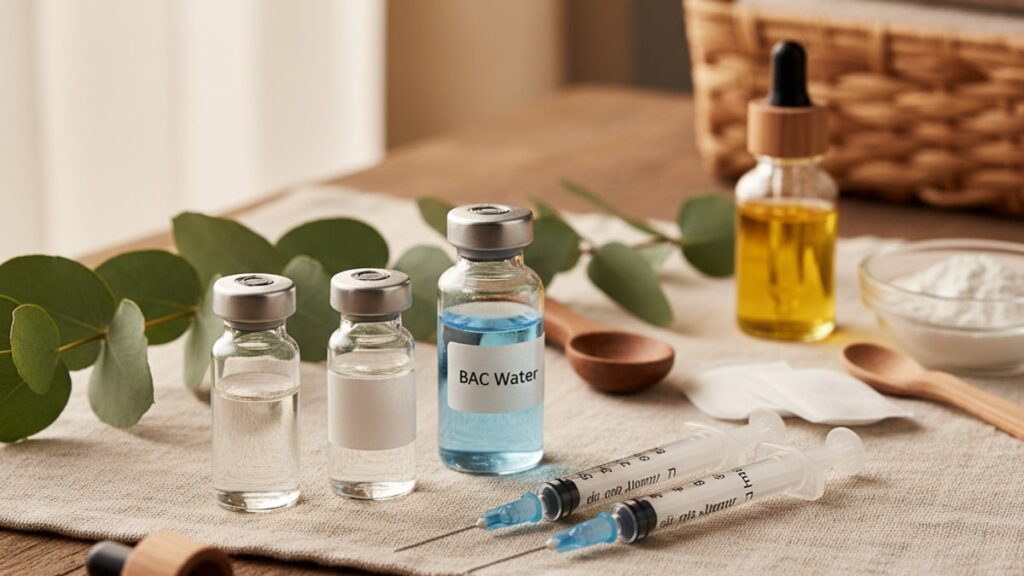
BAC Water Dosage Guide — Real Peptides
Without accurate bacteriostatic water dosing, even the highest-purity peptide becomes unpredictable. A 2023 study from the American Association of Pharmaceutical Scientists found reconstitution errors accounted for 34% of reported research inconsistencies in peptide trials. More than contamination, degradation, and injection technique combined.
We've worked with hundreds of research teams preparing peptides across multiple therapeutic categories. The gap between successful reconstitution and wasted product comes down to three factors: water volume calculation, sterile technique, and understanding the concentration-to-dose relationship most protocols skip entirely.
What is the correct bacteriostatic water dosage for peptide reconstitution?
Bacteriostatic water dosage depends on the peptide's mass (typically 2mg–10mg per vial) and the desired final concentration for accurate administration. The standard approach uses 1–2mL BAC water per vial, creating concentrations between 2.5mg/mL and 10mg/mL depending on peptide amount and protocol requirements. Accurate reconstitution requires calculating the peptide mass, selecting appropriate water volume, and using sterile injection technique to preserve peptide integrity throughout the research period.
Most researchers know bacteriostatic water prevents bacterial growth during multi-dose use, but the dosage aspect. How much water to add. Directly determines whether your intended peptide dose per injection matches your actual delivered dose. This isn't about dilution preference; it's precise mathematics that links vial concentration to syringe measurement. This BAC water dosage guide covers reconstitution calculations, peptide-specific volume recommendations, sterile technique requirements, storage protocols that preserve concentration accuracy, and the practical troubleshooting steps laboratories use when visual clarity or dosing precision becomes uncertain.
Understanding Bacteriostatic Water Concentration Mathematics
Bacteriostatic water dosage isn't arbitrary. It establishes the concentration ratio that determines how much peptide you draw per unit volume in your syringe. If you reconstitute a 5mg peptide vial with 2mL of BAC water, the resulting concentration is 2.5mg/mL (5mg ÷ 2mL = 2.5mg/mL). This means every 0.1mL (10 units on a standard insulin syringe) contains 0.25mg of peptide.
Change the water volume and you change everything downstream. That same 5mg vial reconstituted with 1mL BAC water creates a 5mg/mL concentration. Now every 0.1mL contains 0.5mg, exactly double the previous amount. If your research protocol calls for 0.25mg per administration and you draw 0.1mL thinking you're following the same measurement as before, you've just administered twice the intended dose.
The formula is straightforward: Concentration (mg/mL) = Peptide Mass (mg) ÷ BAC Water Volume (mL). Once you know concentration, calculate dose volume: Dose Volume (mL) = Desired Dose (mg) ÷ Concentration (mg/mL). For example, if your protocol requires 0.5mg of BPC 157 from a 5mg vial reconstituted with 2mL BAC water (concentration = 2.5mg/mL), you need 0.2mL per dose (0.5mg ÷ 2.5mg/mL = 0.2mL, or 20 units on an insulin syringe).
The practical implication: smaller water volumes create higher concentrations, requiring smaller injection volumes but increasing the risk of measurement error with standard syringes. Larger water volumes create lower concentrations, requiring larger injection volumes but improving measurement precision for small doses. Most peptide research uses 1–2mL BAC water per vial as the balance point. Concentrated enough to avoid excessive injection volume, dilute enough for accurate syringe measurement at typical research doses.
Real Peptides manufactures research-grade peptides with exact amino-acid sequencing and verifiable purity, but reconstitution precision is the researcher's responsibility. The peptide's quality doesn't change. Only its usability if concentration calculations are wrong. We've seen protocols fail not because the peptide degraded, but because the team miscalculated their BAC water dosage and delivered inconsistent doses across the study period without realizing it.
Peptide-Specific BAC Water Volume Recommendations
Different peptides arrive in different quantities, and research protocols specify different dose ranges. Which means BAC water dosage must adapt to both peptide mass and intended administration volume. A 2mg vial and a 10mg vial don't use the same water volume if you want comparable ease of measurement.
For 2mg peptide vials, reconstitute with 1mL BAC water to create a 2mg/mL concentration. This allows precise measurement of doses in the 0.1mg–0.5mg range common for peptides like Thymosin Alpha 1 or Epithalon. A 0.25mg dose requires 0.125mL (12.5 units on an insulin syringe). Measurable but requiring careful technique.
For 5mg peptide vials, the standard is 2mL BAC water, yielding 2.5mg/mL concentration. This is the most common configuration across research peptides including Ipamorelin, Sermorelin, and CJC-1295. A typical 0.25mg dose becomes 0.1mL (10 units), which aligns with standard insulin syringe graduations for maximum precision.
For 10mg peptide vials, use 2mL BAC water to create 5mg/mL concentration. Higher concentration is appropriate here because protocols using 10mg vials typically involve larger per-dose amounts. For example, 1mg doses of TB-500 become 0.2mL (20 units), still within comfortable measurement range. Alternatively, some researchers prefer 3mL BAC water (3.33mg/mL) to further reduce concentration and increase injection volume for easier measurement, though this creates non-standard ratios that require more careful calculation.
Peptides used in weight management research. Tirzepatide, Semaglutide, Retatrutide. Often arrive in larger vial sizes (10mg–15mg) and follow dose escalation schedules starting at 0.25mg or 0.5mg weekly, increasing to 2.5mg or higher. For a 10mg Tirzepatide vial, reconstituting with 2mL BAC water (5mg/mL) means a starting 0.5mg dose is 0.1mL, and a maintenance 2.5mg dose is 0.5mL. Both within normal subcutaneous injection volume.
The principle across all peptide types: choose BAC water volume so your typical dose falls between 0.1mL and 0.5mL when possible. Doses smaller than 0.05mL (5 units) become difficult to measure accurately with standard insulin syringes; doses larger than 0.5mL may require split injections or create discomfort at the injection site.
Sterile Reconstitution Technique and Contamination Prevention
Bacteriostatic water contains 0.9% benzyl alcohol as a bacteriostatic agent, which inhibits bacterial growth during multi-dose use. But it doesn't sterilize contaminated equipment or reverse improper technique. The "bacteriostatic" property protects the solution after reconstitution; it does nothing to prevent contamination during reconstitution itself.
Sterile technique begins before you touch the vial. Alcohol prep pads (70% isopropyl alcohol) must remain in contact with the rubber stopper for 10–15 seconds to achieve surface sterilization. Wiping quickly and immediately inserting the needle defeats the purpose. Allow the alcohol to air-dry completely before needle insertion; residual alcohol can denature peptide structure on contact.
The critical mistake most guides ignore: injecting air into the vial before drawing BAC water. Standard practice for drawing liquid medications involves injecting an equivalent volume of air to equalize pressure, but doing this with lyophilized peptide vials creates positive pressure that forces air back through the needle when you withdraw it. And that air can pull contaminants, skin cells, or environmental bacteria into the vial through the needle tract. For peptide reconstitution, inject air into the BAC water vial to facilitate drawing, but never inject air into the peptide vial. Draw the measured BAC water into the syringe, then inject it slowly down the inside wall of the peptide vial. Not directly onto the lyophilized powder, which can cause foaming and protein denaturation.
After reconstitution, invert the vial gently to mix. Do not shake. Peptides are proteins with specific three-dimensional structures; vigorous agitation creates shear forces that can partially denature the molecule, reducing bioavailability and research consistency. If the powder doesn't dissolve immediately, place the vial in the refrigerator and allow 10–20 minutes for complete dissolution. The solution should be clear to slightly opalescent; cloudiness, visible particles, or discoloration indicate potential degradation or contamination. Do not use.
For peptides requiring reconstitution across multiple vials in a research series, use a fresh alcohol prep pad for each vial and a fresh syringe for each reconstitution. Cross-contamination between vials is rare but catastrophic when it occurs, invalidating entire study cohorts. Our work with research teams using GHK-Cu and BPC-157 consistently shows contamination events trace back to reusing syringes between vials or skipping the alcohol drying step.
BAC Water Dosage Guide: Peptide Type Comparison
| Peptide Category | Typical Vial Size | Recommended BAC Water Volume | Resulting Concentration | Example Dose Calculation | Professional Assessment |
|—|—|—|—|—|
| Growth Hormone Secretagogues (Ipamorelin, Sermorelin, CJC-1295) | 5mg | 2mL | 2.5mg/mL | 0.25mg dose = 0.1mL (10 units) | Standard reconstitution for most research protocols. Precise measurement with minimal injection volume |
| Tissue Repair Peptides (BPC-157, TB-500) | 5mg or 10mg | 2mL | 2.5mg/mL or 5mg/mL | 0.5mg dose = 0.2mL (5mg vial) or 0.1mL (10mg vial) | Higher 10mg concentration works well for larger per-dose amounts typical in injury research models |
| Weight Management Peptides (Tirzepatide, Semaglutide, Retatrutide) | 10mg–15mg | 2–3mL | 3.33mg/mL to 7.5mg/mL | 2.5mg maintenance dose = 0.33–0.75mL depending on concentration | Larger vials suit dose escalation protocols. Concentration choice depends on maximum dose and injection volume preference |
| Immune Modulation Peptides (Thymosin Alpha-1, Thymalin) | 2mg–5mg | 1–2mL | 2mg/mL to 5mg/mL | 0.5mg dose = 0.1–0.25mL depending on concentration | Lower vial quantities typical. 1mL water for 2mg vials keeps measurement precise without excessive dilution |
| Cognitive & Neurological Peptides (Semax, Selank, Cerebrolysin) | 5mg | 2mL | 2.5mg/mL | 0.3mg dose = 0.12mL (12 units) | Standard 2mL reconstitution maintains consistency with other peptide categories for multi-peptide research protocols |
Storage Requirements and Concentration Stability Over Time
Once reconstituted with bacteriostatic water, peptides remain stable for significantly shorter periods than their lyophilized form. And stability duration depends on peptide structure, storage temperature, and exposure to light. The benzyl alcohol in BAC water prevents bacterial proliferation but does nothing to prevent chemical degradation of the peptide itself.
Lyophilized (unreconstituted) peptides should be stored at −20°C to −80°C depending on peptide type. Most research-grade peptides from Real Peptides remain stable for 12–24 months when stored frozen and protected from light. Once you break the seal to reconstitute, that timeline no longer applies.
Reconstituted peptides must be refrigerated at 2–8°C immediately after mixing. At this temperature, most peptides maintain 90% or greater potency for 14–28 days. The exact duration varies by amino acid sequence and structural complexity. Peptides containing methionine or cysteine residues are more susceptible to oxidation; those with extensive disulfide bonds (like insulin-like growth factors) degrade faster than linear peptides. As a general rule, use reconstituted peptides within 28 days and discard any remaining solution afterward, even if it appears clear.
Temperature excursions above 8°C accelerate degradation exponentially. A peptide vial left at room temperature (20–25°C) for 24 hours loses measurable potency. Not enough to appear visually different, but enough to compromise dose accuracy in research applications. A single temperature excursion above 30°C (for example, during shipping in summer heat or stored near a heat source) can denature protein structure irreversibly. The challenge: you cannot detect this visually. The solution remains clear, the concentration calculation appears correct, but the peptide's biological activity is partially or completely lost.
This is why we emphasize cold chain integrity at every stage. Peptides from Real Peptides ship with temperature monitoring and insulated packaging specifically to prevent these invisible failures. Once the peptide is in your hands, maintaining 2–8°C storage is non-negotiable. A laboratory refrigerator with a dedicated thermometer, not a shared kitchen refrigerator where temperature fluctuates every time the door opens.
Light exposure is the other degradation factor most protocols underestimate. Ultraviolet and visible light catalyze oxidative reactions in peptide solutions, particularly those containing aromatic amino acids (tyrosine, tryptophan, phenylalanine). Store reconstituted vials in the original packaging or wrap them in aluminum foil to block light. For peptides used in extended research timelines. Such as Tesamorelin or NAD+ protocols lasting several weeks. Light protection can be the difference between consistent results and unexplained variability halfway through the study.
Key Takeaways
- Bacteriostatic water dosage determines peptide concentration: 5mg peptide in 2mL BAC water creates 2.5mg/mL, meaning 0.1mL delivers 0.25mg.
- Reconstitution errors account for 34% of reported peptide research inconsistencies according to AAPS studies. More than contamination or degradation.
- Never inject air into the peptide vial during reconstitution; positive pressure forces contaminants back through the needle tract on withdrawal.
- Reconstituted peptides stored at 2–8°C maintain potency for 14–28 days; temperature excursions above 8°C cause irreversible degradation that remains visually undetectable.
- Standard insulin syringes measure accurately between 0.05mL and 0.5mL. Choose BAC water volume so your typical dose falls within this range.
- Benzyl alcohol in BAC water inhibits bacterial growth during multi-dose use but does not prevent peptide degradation from heat, light, or oxidation.
What If: BAC Water Dosage Scenarios
What If I Accidentally Used Too Much BAC Water During Reconstitution?
Recalculate your concentration using the actual water volume you added, then adjust your dose volume accordingly. If you added 3mL to a 5mg vial instead of 2mL, your concentration is 1.67mg/mL instead of 2.5mg/mL. Meaning you need to draw 0.15mL to get a 0.25mg dose instead of 0.1mL. The peptide isn't ruined; you simply need to draw larger volumes per administration. The limitation: if your intended dose now requires more than 0.5mL injection volume, you may need to split it into two injection sites or accept the slightly higher volume. Over-dilution is recoverable; under-dilution (using too little water) is harder to correct because you can't remove water once added.
What If the Reconstituted Solution Appears Cloudy or Contains Particles?
Do not use it. Cloudiness indicates protein aggregation, precipitation, or contamination. All of which compromise peptide integrity and research validity. Particles visible to the naked eye can be undissolved excipients, denatured protein clumps, or foreign matter introduced during reconstitution. Clear to slightly opalescent is acceptable; anything beyond that is not. Possible causes include reconstituting with non-sterile water, injecting BAC water too forcefully onto the lyophilized powder (causing foaming and denaturation), or using a peptide that was previously exposed to temperature extremes. The correct action is to discard the vial and reconstitute a new one using proper sterile technique and verified BAC water.
What If I Need to Reconstitute for a Non-Standard Dose Range?
Work backward from your desired dose to determine optimal concentration, then calculate required BAC water volume. For example, if your protocol requires 1.5mg doses from a 10mg vial and you want each dose to be 0.3mL for comfortable measurement, you need 5mg/mL concentration (1.5mg ÷ 0.3mL = 5mg/mL). Achieving 5mg/mL from 10mg peptide requires 2mL BAC water (10mg ÷ 2mL = 5mg/mL). Non-standard doses don't require non-standard technique. They require intentional concentration planning before you draw the water into the syringe. Create a dosing chart listing your intended doses and corresponding syringe measurements based on your chosen concentration; this eliminates calculation errors during the research timeline.
What If I'm Using Multiple Peptides with Different Reconstitution Requirements?
Standardize your BAC water dosage across peptides wherever possible to reduce calculation errors and streamline workflow. For a research protocol using Ipamorelin, CJC-1295, and BPC-157. All available in 5mg vials. Reconstituting each with 2mL BAC water creates uniform 2.5mg/mL concentrations. This means your syringe measurements remain consistent across all three peptides if doses are identical, reducing the cognitive load of remembering different conversion factors. When peptides arrive in different quantities (for example, 5mg and 10mg vials), maintain the same target concentration (such as 2.5mg/mL) by adjusting water volume proportionally: 2mL for 5mg, 4mL for 10mg. Document each peptide's reconstitution date, BAC water volume used, and resulting concentration on the vial label immediately after mixing.
The Unvarnished Truth About BAC Water Dosage
Here's the honest answer: most peptide research failures blamed on "bad batches" or "fake peptides" are actually reconstitution errors. Incorrect BAC water dosage, improper sterile technique, or storage failures that the researcher never identified because the mistakes are invisible. A peptide reconstituted at double the intended concentration delivers double the dose, which looks like inconsistent results or unexpected responses rather than user error. A peptide stored at 15°C instead of 5°C slowly denatures over two weeks, which looks like declining efficacy rather than temperature mismanagement.
The peptides from Real Peptides undergo amino acid sequencing verification, purity testing, and sterility confirmation before they ship. What happens after you break the seal is beyond manufacturer control. If you're seeing inconsistent research outcomes despite using verified peptides, audit your reconstitution process first. Water volume, concentration calculation, sterile technique, and storage temperature. Before assuming product failure. We've reviewed hundreds of protocols with variable results; in the majority of cases, the peptide was fine. The BAC water dosage was wrong, the storage temperature drifted, or the syringe measurements were inconsistent.
No peptide can perform as intended if its concentration is unknown, its storage compromised, or its administration volume miscalculated. This isn't a technical detail buried in fine print. It's the entire foundation of reproducible research. Get the BAC water dosage right, and everything downstream becomes predictable. Get it wrong, and every result becomes suspect.
Bacteriostatic water isn't just a reconstitution solvent; it's the variable that translates milligrams of peptide into milliliters of injectable solution and determines whether 0.1mL on your syringe delivers 0.25mg or 0.5mg. That difference isn't trivial. That difference is the protocol. Real Peptides provides the peptide quality; this BAC water dosage guide provides the reconstitution precision. Both matter equally. Neither works without the other.
Frequently Asked Questions
How much bacteriostatic water should I use to reconstitute a 5mg peptide vial?
▼
The standard reconstitution for a 5mg peptide vial is 2mL of bacteriostatic water, which creates a concentration of 2.5mg/mL. This concentration allows precise measurement of typical research doses between 0.1mg and 0.5mg using standard insulin syringes, with each 0.1mL (10 units) containing 0.25mg of peptide. You can adjust the volume to 1mL for higher concentration (5mg/mL) if your protocol requires smaller injection volumes, or 3mL for lower concentration (1.67mg/mL) if you need to measure very small doses with maximum precision.
Can I use regular sterile water instead of bacteriostatic water for peptide reconstitution?
▼
Regular sterile water lacks the bacteriostatic agent (0.9% benzyl alcohol) that prevents bacterial growth during multi-dose use, meaning peptides reconstituted with sterile water must be used immediately or within 24 hours and cannot be stored for repeated administration. Bacteriostatic water allows reconstituted peptides to remain stable and contamination-free for 14–28 days when refrigerated at 2–8°C, which is essential for research protocols requiring multiple doses from a single vial. If you only need a single dose from one vial, sterile water is acceptable; for any multi-dose protocol, bacteriostatic water is required.
How do I calculate the correct injection volume after reconstituting a peptide?
▼
First, calculate your concentration by dividing peptide mass by BAC water volume (for example, 5mg ÷ 2mL = 2.5mg/mL). Then divide your desired dose by the concentration to get injection volume: if you need 0.3mg from a 2.5mg/mL solution, the calculation is 0.3mg ÷ 2.5mg/mL = 0.12mL (12 units on an insulin syringe). Always verify your calculation by working backward: 0.12mL × 2.5mg/mL = 0.3mg confirms the math is correct before you draw the dose.
What are the signs that a reconstituted peptide has degraded or become contaminated?
▼
Visual indicators of degradation or contamination include cloudiness, visible particles, color change (peptides should be clear to slightly opalescent), or unusual odor when the vial is opened. However, the most common degradation — temperature-induced denaturation — produces no visible change; the solution remains clear but loses biological activity. This is why proper storage at 2–8°C and using reconstituted peptides within 28 days is critical even when the solution appears normal. If you observe any visible change, discard the vial immediately and do not use it for research applications.
How much does bacteriostatic water for reconstitution typically cost compared to the peptide itself?
▼
Bacteriostatic water costs approximately three to eight dollars per 30mL vial from pharmaceutical suppliers, making it one of the least expensive components of peptide research. A single 30mL BAC water vial can reconstitute 15 to 30 peptide vials depending on your chosen water volume per vial (1–2mL standard), meaning the per-reconstitution cost is typically under fifty cents. In contrast, research-grade peptides range from thirty to several hundred dollars per vial depending on peptide type and quantity, making proper BAC water technique essential to avoid wasting exponentially more expensive peptide material through reconstitution errors.
Is there a difference between bacteriostatic water from different suppliers that affects peptide stability?
▼
All pharmaceutical-grade bacteriostatic water contains 0.9% benzyl alcohol in sterile water for injection and meets USP standards, so the active preservation mechanism is identical across reputable suppliers. The meaningful difference is sterility assurance and manufacturing standards: bacteriostatic water from FDA-registered facilities undergoes validated sterilization and endotoxin testing, while products from unregulated sources may not. Using non-pharmaceutical BAC water introduces contamination risk that compromises both peptide stability and research validity. Purchase bacteriostatic water only from verified pharmaceutical suppliers; the minor cost difference is insignificant compared to the risk of contaminating expensive research peptides.
How does BAC water reconstitution compare to pre-mixed peptide solutions in terms of stability and accuracy?
▼
Lyophilized peptides requiring reconstitution remain stable for 12–24 months when stored frozen, versus 30–90 days for pre-mixed solutions even under refrigeration, because removing water from the peptide dramatically slows chemical degradation. Reconstitution also allows precise concentration control tailored to specific research protocols — you choose the BAC water volume that creates optimal dosing convenience. Pre-mixed solutions offer convenience but sacrifice long-term stability and concentration flexibility. For research applications requiring consistent results over extended timelines, lyophilized peptides with proper BAC water reconstitution provide superior reliability compared to pre-mixed alternatives.
What should I do if I accidentally inject air into the peptide vial during reconstitution?
▼
The primary risk is creating positive pressure that forces air back through the needle tract when you withdraw it, potentially pulling contaminants into the vial. If this happens, use the vial immediately for your first dose and then discard it rather than storing it for multi-dose use — the contamination risk from the pressure event outweighs the cost of the remaining peptide. For future reconstitutions, inject air only into the BAC water vial to facilitate drawing, never into the peptide vial. Draw the measured BAC water first, then inject it slowly down the inside wall of the peptide vial without introducing air.
Can I freeze reconstituted peptides to extend their shelf life beyond 28 days?
▼
Freezing reconstituted peptides can extend stability for some peptide types but risks protein denaturation from ice crystal formation during the freeze-thaw cycle, and repeated freeze-thaw cycles progressively damage peptide structure with each temperature transition. If you must freeze reconstituted peptides, divide the solution into single-use aliquots immediately after reconstitution so each portion is frozen and thawed only once. A better approach for long-term research is to reconstitute smaller quantities more frequently — store additional lyophilized vials frozen and reconstitute a new vial every 2–3 weeks rather than attempting to preserve a single large reconstitution for months.
What is the most common mistake researchers make when following a BAC water dosage guide?
▼
The most common error is failing to recalculate dose volume when changing BAC water amounts between vials or peptide batches. A researcher might reconstitute the first vial with 2mL water, establish a comfortable routine drawing 0.1mL per dose, then reconstitute the next vial with 1mL water without adjusting — suddenly delivering double the intended dose without realizing it. Every reconstitution requires explicit concentration calculation and corresponding dose volume adjustment. Creating a written dosing chart for each vial immediately after reconstitution eliminates this error pattern entirely.











