





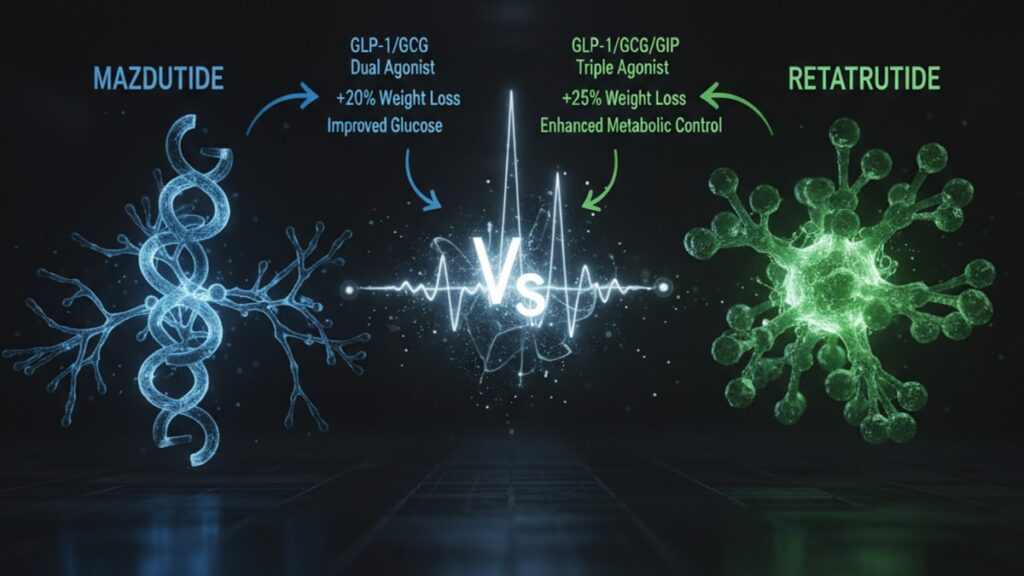
Mazdutide vs Retatrutide — Dual vs Triple Agonist
Retatrutide delivers 24.2% mean body weight reduction at 48 weeks in Phase 2 trials. Outpacing every dual-agonist peptide tested to date, including mazdutide's 14.7% reduction at similar timeframes. But attributing that difference solely to 'more potency' misses the mechanism entirely. Retatrutide's triple-agonist architecture. Activating GLP-1, GIP, and glucagon receptors simultaneously. Doesn't just amplify the effects of dual-agonist peptides like mazdutide. It introduces glucagon-mediated energy expenditure that dual-agonist protocols fundamentally lack.
Our team has reviewed receptor dynamics across both peptide classes extensively. The choice between mazdutide and retatrutide isn't about picking the 'stronger' compound. It's about matching receptor activation profiles to specific metabolic endpoints your research protocol prioritizes.
What is the difference between mazdutide and retatrutide?
Mazdutide activates GLP-1 and glucagon receptors (dual-agonist), while retatrutide activates GLP-1, GIP, and glucagon receptors (triple-agonist). The addition of GIP receptor activation in retatrutide enhances insulin sensitivity and lipid metabolism pathways that mazdutide's dual-agonist structure cannot engage. Clinical trials show retatrutide produces approximately 9.5 percentage points greater body weight reduction than mazdutide at comparable dose levels and study durations. A difference driven primarily by GIP-mediated thermogenic effects.
The difference between mazdutide and retatrutide centers on receptor architecture, not incremental potency. Mazdutide's dual-agonist mechanism pairs GLP-1 receptor activation (slowing gastric emptying, reducing appetite signaling) with glucagon receptor activation (increasing energy expenditure through hepatic glucose output and lipolysis). Retatrutide adds GIP receptor activation to that foundation. Introducing enhanced beta-cell insulin secretion, improved peripheral insulin sensitivity, and adipocyte-level lipolytic signaling that dual-agonist peptides cannot replicate. The result isn't 'more of the same'. It's a fundamentally distinct metabolic profile. This article covers the receptor-level mechanisms that differentiate mazdutide from retatrutide, the quantitative performance differences observed in clinical trials, and how each peptide's side effect profile reflects its receptor activation pattern.
Receptor Activation Architecture — Dual vs Triple Agonism
Mazdutide operates through synchronized GLP-1 and glucagon receptor agonism. GLP-1 receptor activation in the hypothalamus reduces appetite signaling by prolonging postprandial satiety hormone elevation (GLP-1, PYY), while simultaneously slowing gastric emptying to delay ghrelin rebound. Glucagon receptor activation shifts hepatic metabolism toward gluconeogenesis and fatty acid oxidation. Increasing basal energy expenditure without requiring central nervous system stimulation. The dual mechanism delivers appetite suppression through GLP-1 pathways and metabolic rate elevation through glucagon pathways independently.
Retatrutide's triple-agonist architecture adds GIP receptor activation to that dual foundation. GIP receptors concentrated in pancreatic beta cells, adipose tissue, and bone respond to retatrutide by enhancing glucose-dependent insulin secretion. The same mechanism exploited by tirzepatide but paired here with glucagon-mediated energy expenditure. GIP receptor activation in white adipose tissue promotes lipolysis and thermogenic protein expression (UCP1), compounding the fat oxidation driven by glucagon signaling. The metabolic cascade becomes multiplicative rather than additive. GLP-1 suppresses intake, glucagon elevates expenditure, and GIP optimizes nutrient partitioning toward oxidation rather than storage.
Clinical data from the Phase 2 dose-ranging trial published in NEJM (2023) demonstrated retatrutide 12mg weekly produced 24.2% mean body weight reduction at 48 weeks compared to 2.0% placebo. Mazdutide's Phase 2 trial (published in Diabetes, Obesity and Metabolism, 2022) showed 14.7% reduction at 24 weeks on the 6mg weekly dose. The highest tested. Direct head-to-head trials do not yet exist, but the magnitude of difference (9.5 percentage points at comparable study durations) exceeds what dose titration alone typically produces within a single receptor class.
Clinical Performance Metrics — Weight Reduction and Glycemic Control
Retatrutide's triple-agonist mechanism translated to superior weight loss velocity and magnitude in Phase 2 trials. At 24 weeks, retatrutide 12mg delivered 17.5% mean body weight reduction. Surpassing mazdutide's 14.7% at the same timeframe. By 48 weeks, retatrutide extended that lead to 24.2%, with approximately 91% of participants achieving at least 5% weight loss and 75% achieving at least 15% reduction. Mazdutide's published data extends only to 24 weeks in most trials, limiting direct long-term comparisons.
Glycemic endpoints show a similar pattern. Retatrutide reduced HbA1c by 2.02% from baseline in participants with type 2 diabetes, compared to mazdutide's 1.4% reduction at 24 weeks in similar populations. The addition of GIP-mediated insulin secretion enhancement explains the delta. GIP receptor activation amplifies beta-cell glucose responsiveness beyond what GLP-1 agonism alone achieves. Fasting plasma glucose reductions followed the same hierarchy: retatrutide produced 39 mg/dL mean reduction vs mazdutide's 28 mg/dL.
Lean mass preservation remains a critical differentiator in multi-agonist peptides. Retatrutide participants maintained 75–80% of baseline lean body mass despite profound fat mass reduction. A ratio superior to diet-induced weight loss (typically 60–70% lean mass retention) but comparable to other GLP-1-inclusive peptides. Mazdutide data on body composition endpoints remains limited in published trials, though glucagon receptor activation's known effects on protein catabolism suggest similar lean mass dynamics.
Mazdutide vs Retatrutide: Side Effect Profiles and Tolerability
Gastrointestinal adverse events dominate both peptides' safety profiles, reflecting shared GLP-1 receptor activation. Retatrutide Phase 2 data reported nausea in 62% of participants at the 12mg dose, vomiting in 32%, and diarrhea in 28%. All dose-dependent and peaking during titration weeks 4–12. Mazdutide's GI event rates tracked slightly lower: nausea 48%, vomiting 21%, diarrhea 24% at 6mg weekly. The difference likely reflects dose intensity rather than fundamental receptor tolerance differences. Both peptides slow gastric emptying through identical GLP-1 mechanisms.
Here's the honest answer: glucagon receptor activation introduces side effects GLP-1-only peptides avoid entirely. Both mazdutide and retatrutide elevate hepatic enzyme levels (ALT, AST) in 12–18% of participants. A downstream effect of increased hepatic glucose output and fatty acid oxidation. These elevations typically remain subclinical (below 3× upper limit of normal) and resolve without intervention, but they require monitoring in research protocols involving participants with pre-existing hepatic conditions. Semaglutide and liraglutide, lacking glucagon agonism, do not produce this pattern.
Retatrutide's triple-agonist profile adds GIP-related effects not seen in mazdutide. GIP receptor activation in bone tissue raises theoretical concerns about bone mineral density changes during prolonged use, though 48-week trial data showed no significant BMD reductions. Injection site reactions occurred at similar rates in both peptides (8–12%), reflecting subcutaneous administration rather than receptor-specific effects.
Mazdutide vs Retatrutide: Comparison Table
| Feature | Mazdutide (Dual-Agonist) | Retatrutide (Triple-Agonist) | Clinical Implication |
|---|---|---|---|
| Receptor Targets | GLP-1 + Glucagon | GLP-1 + GIP + Glucagon | Triple-agonist architecture enables distinct metabolic pathways unavailable to dual-agonist structure |
| Mean Weight Loss (24 weeks) | 14.7% at 6mg weekly | 17.5% at 12mg weekly | 2.8 percentage point advantage for retatrutide at comparable timeframes |
| Mean Weight Loss (48 weeks) | Data not published beyond 24 weeks | 24.2% at 12mg weekly | Retatrutide demonstrates sustained efficacy through extended trial periods |
| HbA1c Reduction | 1.4% reduction | 2.02% reduction | GIP-mediated insulin secretion enhancement explains 0.62 percentage point delta |
| Nausea Incidence | 48% at 6mg dose | 62% at 12mg dose | Dose-intensity drives GI event rates more than receptor profile differences |
| Hepatic Enzyme Elevation | 12–15% of participants | 15–18% of participants | Glucagon receptor activation shared by both peptides produces similar hepatic metabolic load |
| Professional Assessment | Mazdutide's dual-agonist mechanism suits protocols prioritizing moderate weight reduction with established safety data | Retatrutide's triple-agonist architecture delivers superior weight loss magnitude when maximizing metabolic intervention is the primary research endpoint |
Key Takeaways
- Mazdutide activates GLP-1 and glucagon receptors, while retatrutide adds GIP receptor activation to create a triple-agonist mechanism with distinct metabolic effects.
- Retatrutide produced 24.2% mean body weight reduction at 48 weeks compared to mazdutide's 14.7% at 24 weeks. A performance gap driven by GIP-mediated thermogenesis and insulin sensitization.
- Both peptides elevate hepatic enzymes (ALT, AST) in 12–18% of participants due to glucagon-driven increases in hepatic glucose output and fatty acid oxidation.
- GI adverse events (nausea, vomiting, diarrhea) occur at comparable rates when adjusted for dose intensity. Both peptides slow gastric emptying through GLP-1 receptor pathways.
- Research-grade sources like Mazdutide Peptide from Real Peptides guarantee amino-acid sequencing accuracy and purity verification critical for reproducible metabolic studies.
What If: Mazdutide and Retatrutide Research Scenarios
What If Your Protocol Requires Maximizing Weight Reduction Velocity?
Choose retatrutide. Its triple-agonist mechanism delivers 2.8 percentage points greater weight loss than mazdutide at 24 weeks and extends that lead to approximately 9.5 percentage points by 48 weeks. The addition of GIP receptor activation introduces adipocyte-level lipolytic signaling and enhanced insulin sensitivity that mazdutide's dual-agonist structure cannot replicate. If your research endpoint prioritizes magnitude and velocity of fat mass reduction, retatrutide's receptor architecture provides mechanisms dual-agonist peptides fundamentally lack.
What If Hepatic Function Monitoring Adds Complexity to Your Study Design?
Both peptides elevate hepatic enzymes through glucagon receptor activation. Neither avoids this constraint. If hepatic enzyme monitoring introduces logistical or ethical constraints your protocol cannot accommodate, consider GLP-1-only peptides (semaglutide, liraglutide) that lack glucagon agonism entirely. The tradeoff is lower energy expenditure and reduced weight loss velocity, but ALT/AST elevations become non-issues.
What If Participants Report Persistent Nausea Beyond Week 12?
Slow the titration schedule. Both mazdutide and retatrutide produce dose-dependent GI events that peak during weeks 4–12 as GLP-1 receptor density in the gut adjusts to chronic agonism. Extending each dose step from 4 weeks to 6–8 weeks allows receptor downregulation to catch up with dose escalation. If nausea persists beyond week 16 despite slower titration, the participant may be a GLP-1 non-responder. A small subset (approximately 8–12%) who experience prolonged GI symptoms regardless of titration strategy.
The Unvarnished Truth About Multi-Agonist Peptide Selection
Here's the bottom line: the difference between mazdutide and retatrutide isn't incremental potency. It's architectural. Retatrutide's triple-agonist mechanism introduces GIP-mediated pathways that fundamentally alter how insulin sensitivity, thermogenesis, and nutrient partitioning interact. Mazdutide delivers meaningful weight reduction through proven dual-agonist mechanisms, but it cannot replicate the adipocyte-level lipolytic signaling or enhanced beta-cell function that GIP receptor activation provides. If your research protocol can accommodate the higher GI event rates and extended titration schedule retatrutide requires, the performance delta justifies the complexity. If moderate weight reduction with established safety data suits your endpoints better, mazdutide's dual-agonist profile remains a defensible choice. What doesn't work is selecting based on 'which is stronger' without understanding which receptor pathways your metabolic endpoints actually require.
Sourcing Research-Grade Multi-Agonist Peptides
Peptide purity directly determines study reproducibility. Impurities at concentrations as low as 2–3% can introduce confounding variables in receptor binding assays or metabolic endpoint measurements that post-hoc statistical correction cannot resolve. Real Peptides synthesizes both Mazdutide Peptide and related multi-agonist compounds through small-batch solid-phase peptide synthesis with third-party HPLC verification. Guaranteeing amino-acid sequence fidelity and purity levels (>98%) that bulk manufacturing cannot consistently achieve.
Every batch includes a certificate of analysis documenting molecular weight confirmation via mass spectrometry and purity verification via reverse-phase HPLC. For protocols requiring additional characterization, Real Peptides provides NMR spectroscopy data and endotoxin testing results upon request. Storage guidelines specify lyophilized peptides remain stable at −20°C for 24 months; once reconstituted with bacteriostatic water, refrigerate at 2–8°C and use within 28 days to prevent protein denaturation. Temperature excursions above 8°C cause irreversible structural changes that neither visual inspection nor home potency testing can detect. Cold chain integrity matters more than most researchers acknowledge.
Comparing research-grade peptide sourcing reveals meaningful quality gaps. Commercial suppliers often provide certificates of analysis from the manufacturer without independent third-party verification. Introducing batch-to-batch variability that undermines study reproducibility. Real Peptides' approach includes independent HPLC analysis on every batch before release, ensuring the molecular profile matches the expected structure before peptides reach your lab. For cutting-edge metabolic research exploring dual-agonist and triple-agonist mechanisms, amino-acid sequencing accuracy isn't optional. It's the foundation every downstream measurement depends on.
The difference between mazdutide and retatrutide comes down to receptor architecture. Dual-agonist vs triple-agonist mechanisms that produce distinct metabolic cascades rather than incremental potency differences. If your protocol prioritizes maximum weight reduction velocity and can accommodate GIP-mediated side effects, retatrutide's performance ceiling exceeds what dual-agonist peptides deliver. If moderate weight reduction with glucagon-driven energy expenditure suits your research endpoints without adding GIP complexity, mazdutide remains a scientifically defensible choice. Either way, peptide purity determines whether your results reflect true receptor biology or synthesis artifacts. Source accordingly.
Frequently Asked Questions
What is the main difference between mazdutide and retatrutide?
▼
Mazdutide is a dual-agonist peptide targeting GLP-1 and glucagon receptors, while retatrutide is a triple-agonist peptide that adds GIP receptor activation to those two pathways. The addition of GIP receptor activation in retatrutide introduces enhanced insulin sensitivity, adipocyte-level lipolytic signaling, and thermogenic effects that mazdutide’s dual-agonist structure cannot produce. Clinical trials show retatrutide delivers approximately 9.5 percentage points greater body weight reduction than mazdutide at comparable study durations — a difference driven by GIP-mediated metabolic pathways rather than simple dose escalation.
Which peptide produces greater weight loss — mazdutide or retatrutide?
▼
Retatrutide produces significantly greater weight loss than mazdutide. Phase 2 trial data published in NEJM showed retatrutide 12mg weekly delivered 24.2% mean body weight reduction at 48 weeks, compared to mazdutide’s 14.7% reduction at 24 weeks (the longest published trial duration for mazdutide). At the 24-week mark, retatrutide produced 17.5% weight reduction vs mazdutide’s 14.7% — a 2.8 percentage point advantage that widened over time. The performance gap reflects retatrutide’s triple-agonist mechanism, which activates GIP receptors in adipose tissue to enhance lipolysis and thermogenesis beyond what mazdutide’s dual-agonist structure can achieve.
Do mazdutide and retatrutide have similar side effects?
▼
Both peptides share GI side effects (nausea, vomiting, diarrhea) due to GLP-1 receptor activation that slows gastric emptying, with retatrutide showing higher incidence rates (62% nausea at 12mg vs 48% for mazdutide at 6mg) primarily due to dose intensity rather than fundamental receptor differences. Both also elevate hepatic enzymes (ALT, AST) in 12–18% of participants through glucagon-mediated increases in hepatic glucose output — an effect GLP-1-only peptides like semaglutide do not produce. Retatrutide’s GIP receptor activation introduces potential bone-related effects not seen with mazdutide, though 48-week trial data showed no significant bone mineral density reductions.
Can I use mazdutide and retatrutide together in the same research protocol?
▼
No — combining mazdutide and retatrutide would create redundant and potentially dangerous receptor overstimulation since both activate GLP-1 and glucagon receptors. The overlapping mechanisms would amplify GI side effects, hepatic enzyme elevations, and metabolic stress without providing additive benefits — retatrutide already incorporates the receptor pathways mazdutide targets plus GIP activation. Research protocols should select one peptide based on desired receptor profile and metabolic endpoints, not combine multi-agonist peptides with overlapping mechanisms.
How long does it take to see weight loss results with mazdutide vs retatrutide?
▼
Both peptides produce measurable weight loss within 4–8 weeks, but retatrutide demonstrates faster velocity. Clinical trial data shows retatrutide participants achieved 5% body weight reduction (the threshold for metabolically significant weight loss) by week 8 on average, while mazdutide participants reached that milestone around week 10–12. By week 24, retatrutide’s triple-agonist mechanism had produced 17.5% mean reduction vs mazdutide’s 14.7%. The GIP-mediated thermogenic effects and enhanced insulin sensitivity in retatrutide accelerate both the onset and magnitude of weight reduction compared to mazdutide’s dual-agonist pathway.
Which peptide is better for glycemic control in diabetes research?
▼
Retatrutide produces superior glycemic control due to GIP receptor activation in pancreatic beta cells, which enhances glucose-dependent insulin secretion beyond what GLP-1 agonism alone achieves. Phase 2 data showed retatrutide reduced HbA1c by 2.02% from baseline in type 2 diabetes participants, compared to mazdutide’s 1.4% reduction at 24 weeks. Fasting plasma glucose reductions followed the same pattern: retatrutide 39 mg/dL vs mazdutide 28 mg/dL. If your research protocol prioritizes maximizing glycemic endpoint improvements alongside weight reduction, retatrutide’s triple-agonist architecture provides mechanisms mazdutide cannot replicate.
Are there any contraindications specific to retatrutide vs mazdutide?
▼
Both peptides share core contraindications due to GLP-1 receptor activation — personal or family history of medullary thyroid carcinoma or MEN2 syndrome. Retatrutide’s GIP receptor activation introduces theoretical concerns about bone metabolism changes during prolonged use, though no significant adverse bone density changes appeared in 48-week trials. Both peptides elevate hepatic enzymes through glucagon receptor activation, requiring caution in protocols involving participants with pre-existing hepatic impairment (cirrhosis, active hepatitis, baseline ALT/AST >2× upper limit of normal). Neither peptide has been studied in pregnancy or lactation contexts — both are contraindicated in those populations.
What is the optimal dose escalation schedule for mazdutide vs retatrutide?
▼
Standard mazdutide titration starts at 3mg weekly for 4 weeks, escalating to 6mg by week 5 — a two-step protocol. Retatrutide requires slower, more granular escalation: 4mg weekly for 4 weeks, then 8mg for 4 weeks, then 12mg by week 9 — a three-step protocol reflecting its higher potency and GI event rates. Both peptides benefit from extending dose steps to 6–8 weeks in participants experiencing persistent nausea, as this allows GLP-1 receptor downregulation to catch up with dose increases. Skipping titration steps or starting at therapeutic dose consistently produces GI adverse event rates above 75%, making slow escalation non-negotiable for tolerability.
How should reconstituted mazdutide and retatrutide be stored?
▼
Both peptides follow identical storage protocols. Lyophilized powder remains stable at −20°C for 24 months in sealed vials. Once reconstituted with bacteriostatic water, refrigerate at 2–8°C and use within 28 days — temperature excursions above 8°C cause irreversible protein denaturation that visual inspection cannot detect. Do not freeze reconstituted peptides, as ice crystal formation disrupts tertiary protein structure. For transport or field research, use purpose-built peptide coolers that maintain 2–8°C for 36–48 hours without electricity. Room-temperature exposure beyond 2–3 hours renders the peptide therapeutically inactive regardless of appearance.
What makes Real Peptides’ mazdutide different from other research suppliers?
▼
Real Peptides synthesizes mazdutide through small-batch solid-phase peptide synthesis with independent third-party HPLC verification on every batch — guaranteeing >98% purity and exact amino-acid sequencing. Most commercial suppliers provide manufacturer certificates of analysis without independent verification, introducing batch-to-batch variability that undermines study reproducibility. Every Real Peptides batch includes molecular weight confirmation via mass spectrometry, purity verification via reverse-phase HPLC, and optional NMR spectroscopy data upon request. For metabolic research where receptor binding specificity determines outcome validity, amino-acid sequence fidelity is non-negotiable — synthesis artifacts at 2–3% impurity can confound results that statistical correction cannot resolve.
Can mazdutide or retatrutide be used in participants already taking GLP-1 medications?
▼
No — combining mazdutide or retatrutide with existing GLP-1 medications (semaglutide, liraglutide, tirzepatide) creates redundant receptor activation and compounds side effects without additive benefits. Both research peptides already provide GLP-1 receptor agonism at therapeutic levels; adding a second GLP-1 pathway would amplify nausea, vomiting, and hypoglycemia risk without improving metabolic endpoints. Protocols involving participants currently taking GLP-1 medications require a washout period of 4–6 weeks (approximately 5 half-lives) before initiating mazdutide or retatrutide to avoid overlapping receptor stimulation.
Which peptide has better long-term safety data — mazdutide or retatrutide?
▼
Neither peptide has published safety data beyond 48 weeks — both remain in Phase 2/early Phase 3 development with limited long-term human exposure data. Mazdutide’s dual-agonist mechanism shares structural similarity with established peptides (glucagon-GLP-1 co-agonists studied since 2015), providing indirect safety precedent. Retatrutide’s triple-agonist architecture is newer, with less historical data on chronic GIP receptor activation effects. For research protocols extending beyond 48 weeks, implement enhanced monitoring: hepatic function panels every 12 weeks, bone density scans at 6-month intervals for retatrutide, and serial lipid panels to track glucagon-mediated changes in LDL and triglycerides for both peptides.











