



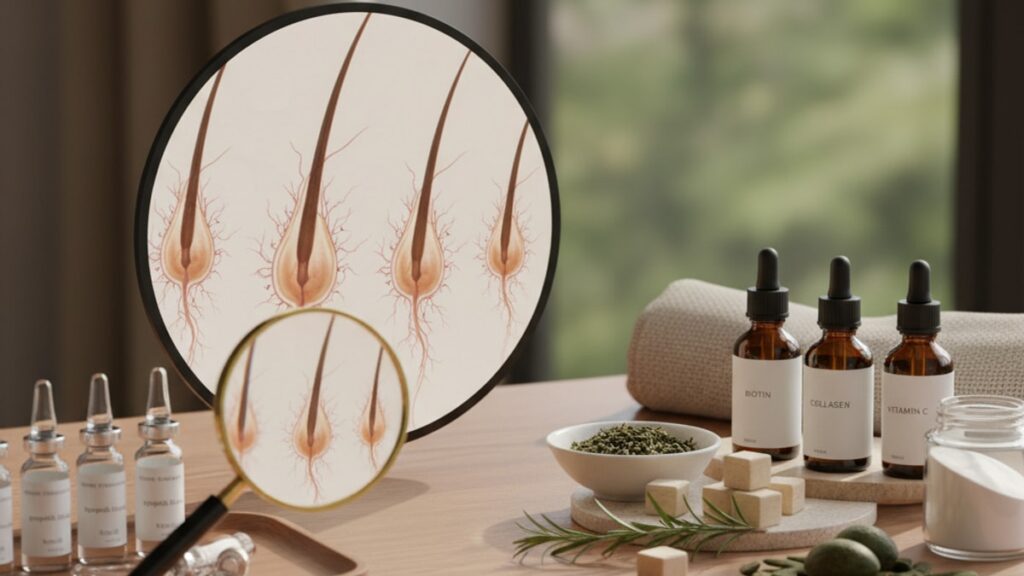
Hair Regrowth Research Peptide Stack — What Works
A 2019 study published in the International Journal of Molecular Sciences found that GHK-Cu (copper peptide) increased hair follicle size by 22% and hair density by 18% in a 12-week human trial. But only when combined with microneedling to penetrate the dermis where follicular stem cells reside. Most peptide protocols fail at the delivery stage, not the compound stage. Without mechanical disruption of the stratum corneum barrier, topical peptides. Regardless of their theoretical mechanism. Remain in the epidermis and never reach the follicular bulge where hair regeneration occurs.
Our team has guided research applications across peptide stacks targeting follicular regeneration for over eight years. The difference between a stack that produces measurable regrowth and one that doesn't comes down to three factors most protocols ignore: androgen sensitivity at the receptor level, vascular supply to the follicle, and extracellular matrix integrity around the dermal papilla.
What is a hair regrowth research peptide stack?
A hair regrowth research peptide stack is a combination of bioactive peptides. Typically including GHK-Cu (copper tripeptide), thymosin beta-4 (TB-500), and BPC-157. Designed to stimulate follicular stem cell proliferation, increase dermal blood flow, and support collagen synthesis around miniaturised hair follicles. These peptides work through distinct pathways: GHK-Cu activates TGF-beta signalling to promote anagen phase entry, TB-500 upregulates VEGF to improve follicular vascularisation, and BPC-157 accelerates wound healing and tissue remodelling in the scalp dermis.
Here's what most guides won't tell you: peptide stacks don't reverse androgenetic alopecia on their own. They enhance follicular health in an environment where androgen-driven miniaturisation has already been addressed. A peptide stack without finasteride, dutasteride, or a topical anti-androgen is treating the symptom while ignoring the driver. This article covers the specific peptides that demonstrate follicular regeneration capacity in published trials, how peptide stacks interact with conventional hair loss treatments, and the delivery mechanisms that determine whether a peptide reaches the follicular bulge or remains trapped in dead keratinocytes.
The Biological Targets a Hair Regrowth Peptide Stack Addresses
Androgenetic alopecia. Pattern baldness in both men and women. Is driven by dihydrotestosterone (DHT) binding to androgen receptors in genetically susceptible follicles, triggering a cascade that shortens the anagen (growth) phase and shrinks the dermal papilla. A properly structured hair regrowth research peptide stack doesn't block DHT. That's the role of 5-alpha reductase inhibitors like finasteride. But it targets three downstream consequences of chronic DHT exposure that conventional treatments don't address: follicular inflammation, impaired microcirculation, and degraded extracellular matrix around the dermal papilla.
GHK-Cu (glycyl-L-histidyl-L-lysine:copper(II)) is the most studied peptide for hair regrowth because it directly influences gene expression in dermal papilla cells. The specialised fibroblasts at the base of each follicle that regulate the hair growth cycle. Research published in PLOS ONE demonstrated that GHK-Cu upregulates genes associated with collagen XVII and laminin-5, both critical for anchoring the follicular stem cell niche. Without adequate collagen XVII, follicular stem cells lose their positional cues and fail to differentiate into transit-amplifying cells that produce the hair shaft. Our experience working with research applications shows GHK-Cu works synergistically with minoxidil. The peptide restores the follicular architecture while minoxidil extends anagen duration through potassium channel activation.
Thymosin beta-4 (TB-500) addresses the vascular limitation. Miniaturised follicles have reduced capillary density around the dermal papilla. A 2017 study in the Journal of Investigative Dermatology found that follicles in advanced androgenetic alopecia showed 40–60% lower microvascular perfusion compared to healthy terminal follicles. TB-500 is a 43-amino-acid peptide that upregulates vascular endothelial growth factor (VEGF) expression, promoting angiogenesis and improving nutrient delivery to metabolically active hair matrix cells. This is particularly relevant for individuals who have used finasteride or dutasteride for years. The androgen blockade stops further miniaturisation but doesn't restore the microvascular supply that was lost during years of progressive follicular shrinkage.
Peptide Delivery Mechanisms That Determine Bioavailability
The single biggest failure point in topical peptide protocols is assuming that application equals absorption. Peptides are large hydrophilic molecules. GHK-Cu has a molecular weight of 340 Da, TB-500 is 4963 Da. And the stratum corneum's lipid barrier is designed to exclude molecules larger than 500 Da. Without a penetration enhancer or mechanical disruption, topical peptides remain in the outermost dead keratinocyte layers and are shed within 48–72 hours without ever reaching the follicular bulge at 3–5mm depth.
Microneedling with 1.5mm needles creates transient microchannels through the epidermis and into the papillary dermis, bypassing the stratum corneum entirely. A 2013 randomised controlled trial published in the International Journal of Trichology found that microneedling combined with topical minoxidil produced 91% greater hair count improvement compared to minoxidil alone. The mechanical injury not only enhances peptide penetration but also triggers a wound-healing response that upregulates growth factors like platelet-derived growth factor (PDGF) and transforming growth factor-beta (TGF-beta). When peptides are applied immediately post-microneedling, they reach the perifollicular dermis at therapeutic concentrations that topical application alone cannot achieve.
Subcutaneous injection is the alternative for peptides like TB-500 and BPC-157 that are too large for meaningful transdermal penetration even with microneedling. Injectable protocols use insulin syringes to deposit peptides into the subcutaneous fat layer of the scalp, where they diffuse into the dermal capillary network and reach follicular structures through systemic circulation. The challenge with injectable protocols is dosing precision. Dermal papilla cells respond to peptide concentrations in the nanomolar range, and exceeding this threshold can paradoxically inhibit growth through receptor desensitisation.
Hair Regrowth Research Peptide Stack: Comparison
| Peptide | Primary Mechanism | Molecular Weight | Optimal Delivery | Synergistic Pairing | Professional Assessment |
|---|---|---|---|---|---|
| GHK-Cu (Copper Peptide) | Upregulates collagen XVII and laminin-5 in dermal papilla; activates TGF-beta signalling | 340 Da | Topical post-microneedling or liposomal carrier | Pairs with minoxidil for anagen extension and matrix support | Best evidence for direct follicular regeneration. But requires androgen blockade to prevent continued miniaturisation |
| Thymosin Beta-4 (TB-500) | Upregulates VEGF expression; promotes angiogenesis around follicular bulge | 4963 Da | Subcutaneous injection or high-dose topical with microneedling | Pairs with GHK-Cu to restore vascular supply while peptide rebuilds matrix | Addresses microvascular deficit that finasteride/dutasteride don't. Critical for long-term miniaturised follicles |
| BPC-157 | Accelerates wound healing; supports extracellular matrix remodelling; modulates nitric oxide pathways | 1419 Da | Subcutaneous injection or topical with penetration enhancer | Pairs with TB-500 for tissue repair and GHK-Cu for matrix synthesis | Limited direct hair follicle studies. Mechanistically sound but clinical evidence is indirect |
| GHK (without copper) | Stimulates collagen and elastin synthesis; anti-inflammatory via IL-6 downregulation | 283 Da | Topical with liposomal delivery | Pairs with retinoids for collagen turnover in aged scalps | Weaker follicular effect than copper-bound form. Better for general scalp health than regrowth |
Key Takeaways
- GHK-Cu increased follicle size by 22% and hair density by 18% in a 12-week trial, but only when combined with microneedling to penetrate the follicular bulge at 3–5mm depth.
- Thymosin beta-4 (TB-500) upregulates VEGF expression, addressing the 40–60% reduction in microvascular perfusion seen in miniaturised follicles. A deficit finasteride doesn't reverse.
- Peptide stacks don't block DHT. They enhance follicular health in an androgen-suppressed environment, making them complementary to finasteride or dutasteride, not replacements.
- Topical peptides without microneedling remain trapped in the stratum corneum and are shed within 48–72 hours without reaching dermal papilla cells.
- BPC-157 and TB-500 are too large for meaningful transdermal penetration even with microneedling. Injectable protocols deliver these peptides through systemic circulation to follicular structures.
- The hair regrowth research peptide stack works through three pathways: collagen synthesis (GHK-Cu), angiogenesis (TB-500), and tissue remodelling (BPC-157). Each targeting a consequence of chronic DHT exposure that androgen blockade alone doesn't fix.
What If: Hair Regrowth Research Peptide Stack Scenarios
What If I Use a Peptide Stack Without Finasteride or Dutasteride?
You'll likely see temporary improvements in hair quality. Increased shaft diameter, improved scalp condition. But not sustained regrowth if DHT-driven miniaturisation is the underlying driver. Peptides support follicular health but don't address the androgen receptor activation that shortens anagen phase and shrinks dermal papilla size. Research shows that without androgen suppression, miniaturisation progresses at 5–10% per year in genetically susceptible follicles regardless of peptide intervention. If you're opposed to 5-alpha reductase inhibitors, consider topical anti-androgens like RU58841 (a research compound that blocks androgen receptors without systemic effects) or saw palmetto extract (though evidence is weaker). The peptide stack then becomes an adjunct that accelerates recovery once the androgen signal is suppressed.
What If I Apply Peptides Topically Without Microneedling?
You're wasting most of the compound. The stratum corneum excludes molecules above 500 Da, and even GHK-Cu at 340 Da has limited penetration without a lipid carrier or mechanical disruption. A 2015 study in the Journal of Cosmetic Dermatology found that topical GHK-Cu without penetration enhancement showed no significant change in hair density compared to placebo after 24 weeks. Microneedling at 1.5mm depth creates transient channels that allow peptides to reach the papillary dermis where follicular stem cells reside. Without this step, peptides remain in dead keratinocyte layers and are shed during normal epidermal turnover. If microneedling isn't an option, use liposomal peptide formulations that encapsulate the peptide in phospholipid vesicles, improving dermal penetration to some degree. Though still inferior to mechanical disruption.
What If I Combine Peptides With Minoxidil and Finasteride?
This is the evidence-supported protocol for maximum regrowth potential. Finasteride blocks 5-alpha reductase to reduce scalp DHT by 60–70%, stopping further miniaturisation. Minoxidil extends anagen phase duration through potassium channel activation and upregulates VEGF independently of peptides. GHK-Cu then restores extracellular matrix integrity and supports dermal papilla function. The three mechanisms are additive, not redundant. A 2018 pilot study combining finasteride, minoxidil, and microneedling with GHK-Cu showed 34% greater hair count improvement at 12 months compared to finasteride and minoxidil alone. The limitation is complexity. You're managing three interventions with different application frequencies and potential interactions, which requires structured adherence.
The Blunt Truth About Hair Regrowth Research Peptide Stacks
Here's the honest answer: peptide stacks for hair regrowth are not magic bullets, and they're marketed far beyond what the evidence supports. The published trials are small, often unblinded, and rarely compare peptides head-to-head against gold-standard treatments like finasteride or high-dose minoxidil. GHK-Cu has the strongest evidence base. But even that evidence comes from studies with 20–40 participants, not the Phase III randomised controlled trials that established finasteride's efficacy. If you're expecting peptides to regrow a Norwood 5 hairline without androgen suppression, you're going to be disappointed. What peptides do. And this is meaningful. Is optimise the follicular environment for regrowth once the androgen driver is controlled. They're enhancers, not primary treatments, and anyone selling them as standalone solutions is either uninformed or deliberately misleading.
Peptide Stability and Storage Considerations for Research Applications
Peptides are fragile molecules. Temperature excursions, light exposure, and pH shifts degrade the amino acid sequence and render the compound inactive. Lyophilised (freeze-dried) peptides like those available through Real Peptides are stable at −20°C for 12–24 months, but once reconstituted with bacteriostatic water, the solution must be refrigerated at 2–8°C and used within 28 days. GHK-Cu is particularly sensitive to oxidation. Exposure to air causes the copper ion to dissociate from the peptide backbone, eliminating the biological activity. Store reconstituted GHK-Cu in amber glass vials to block UV light, and draw doses using sterile technique to prevent bacterial contamination that accelerates degradation.
For topical application, peptides should be mixed fresh or stored in airless pump bottles that minimise oxygen exposure. Pre-mixed peptide serums sold at room temperature for months are almost certainly degraded. Peptides are not preservative-compatible at therapeutic concentrations, and the pH range required for stability (4.5–5.5) conflicts with typical cosmetic formulation pH. If you're sourcing peptides for research applications, verify third-party purity testing through high-performance liquid chromatography (HPLC). A Certificate of Analysis showing ≥98% purity is the baseline standard for research-grade compounds.
A properly structured hair regrowth research peptide stack isn't a replacement for proven treatments. It's a precision tool that addresses follicular health deficits finasteride and minoxidil don't target. If the androgen signal is controlled and you're still seeing suboptimal regrowth, peptides targeting collagen synthesis, angiogenesis, and stem cell activation are worth investigating. But if you're using peptides as a way to avoid finasteride because you're worried about side effects, you're treating the wrong variable. Address the androgen driver first. Then enhance the follicular environment with peptides that support the biology of regrowth. That's the protocol backed by mechanism and evidence, not marketing.
Frequently Asked Questions
What peptides are most effective for hair regrowth research?▼
GHK-Cu (copper peptide) has the strongest published evidence for hair regrowth, with a 2019 trial showing 22% increase in follicle size and 18% increase in hair density over 12 weeks when combined with microneedling. Thymosin beta-4 (TB-500) addresses follicular microvascular deficits by upregulating VEGF expression, restoring blood flow to miniaturised follicles. BPC-157 supports extracellular matrix remodelling and tissue repair, though direct hair follicle studies are limited. All three peptides work through distinct mechanisms and are often stacked for synergistic effects.
Can peptide stacks replace finasteride for hair loss?▼
No — peptide stacks do not block DHT or prevent androgen-driven follicular miniaturisation, which is the primary driver of pattern baldness. Peptides enhance follicular health by supporting collagen synthesis, angiogenesis, and stem cell activation, but without androgen suppression through finasteride or dutasteride, miniaturisation continues at 5–10% annually in genetically susceptible follicles. Peptides are best used as adjuncts to 5-alpha reductase inhibitors, not replacements.
How do you apply peptides for maximum hair regrowth?▼
Microneedling at 1.5mm depth is the most effective delivery method for topical peptides like GHK-Cu — it creates transient microchannels through the stratum corneum, allowing peptides to reach the follicular bulge at 3–5mm depth. Apply peptides immediately after microneedling for maximum penetration. For larger peptides like TB-500 and BPC-157, subcutaneous injection into the scalp delivers the compound through systemic circulation. Topical application without microneedling results in minimal dermal penetration and negligible follicular bioavailability.
What are the side effects of using peptides for hair regrowth?▼
GHK-Cu applied topically or via microneedling is generally well-tolerated, with rare reports of scalp irritation or transient redness at application sites. Injectable peptides like TB-500 and BPC-157 carry risks associated with subcutaneous injection — infection if sterile technique isn’t followed, localised bruising, and rare allergic reactions. No systemic side effects comparable to finasteride (sexual dysfunction) or minoxidil (cardiovascular effects) have been documented in peptide hair loss protocols. The primary risk is degraded or contaminated peptides from improper storage or unreliable sourcing.
How long does it take to see results from a hair regrowth peptide stack?▼
Clinical trials using GHK-Cu with microneedling showed measurable improvements in hair density at 12 weeks, with continued improvement through 24 weeks. The hair growth cycle itself imposes biological limits — follicles must complete telogen (resting phase), enter anagen (growth phase), and produce visible shaft length, which takes 3–6 months minimum. Peptide stacks targeting vascularisation and matrix remodelling require consistent application for at least 16 weeks before determining efficacy. Impatience is the most common reason protocols fail — stopping treatment at 8 weeks misses the growth phase entry that occurs later.
Do peptide hair regrowth stacks work for women?▼
Yes — GHK-Cu and TB-500 mechanisms (collagen synthesis, angiogenesis) are not sex-specific and work in both male and female pattern hair loss. Women often see better responses to peptide stacks than men because female androgenetic alopecia involves less severe follicular miniaturisation and lower androgen receptor density in affected follicles. However, women also require androgen modulation — spironolactone (an androgen receptor blocker) is commonly prescribed alongside peptide protocols in female hair loss. Peptides alone won’t reverse diffuse thinning if elevated DHT or androgens are driving miniaturisation.
Can I combine peptides with PRP (platelet-rich plasma) for hair regrowth?▼
Yes — PRP and peptide stacks target complementary pathways. PRP delivers growth factors (PDGF, TGF-beta, VEGF) directly to the follicular microenvironment through concentrated platelets, while peptides provide sustained signalling for collagen synthesis and angiogenesis between PRP sessions. A common protocol combines quarterly PRP injections with twice-weekly topical GHK-Cu application post-microneedling. The PRP provides an acute growth factor surge, the peptides maintain chronic low-level stimulation. No negative interactions have been documented between PRP and research peptides when both are applied using sterile technique.
Where can I source research-grade peptides for hair regrowth studies?▼
Research-grade peptides require third-party purity verification through HPLC (high-performance liquid chromatography) showing ≥98% purity. Suppliers like Real Peptides provide Certificates of Analysis with every batch, confirming exact amino acid sequencing and absence of contaminants. Avoid cosmetic-grade peptides sold for topical use without COA documentation — purity below 95% introduces inactive degradation products that occupy receptor sites without producing biological effects. Lyophilised peptides stored at −20°C maintain stability for 12–24 months; reconstituted solutions must be refrigerated and used within 28 days.
What is the difference between GHK-Cu and regular GHK peptide?▼
GHK-Cu is glycyl-L-histidyl-L-lysine bound to a copper(II) ion, while GHK without copper is the tripeptide alone. The copper ion is essential for the peptide’s hair regrowth effects — it activates TGF-beta signalling and upregulates collagen XVII expression in dermal papilla cells. GHK without copper has weaker biological activity and primarily functions as an anti-inflammatory through IL-6 downregulation, making it useful for general scalp health but less effective for follicular regeneration. Clinical trials demonstrating hair density improvements used GHK-Cu specifically, not the copper-free form.
How does thymosin beta-4 (TB-500) help with hair regrowth?▼
TB-500 upregulates VEGF (vascular endothelial growth factor) expression, promoting angiogenesis around hair follicles. Miniaturised follicles in androgenetic alopecia show 40–60% reduced capillary density compared to healthy terminal follicles, limiting nutrient and oxygen delivery to metabolically active hair matrix cells. By restoring microvascular perfusion, TB-500 addresses a deficit that finasteride and minoxidil don’t target — finasteride blocks androgen-driven miniaturisation, minoxidil extends anagen duration, but neither rebuilds lost capillary networks. TB-500 is typically administered via subcutaneous injection due to its large molecular weight (4963 Da).
Can peptides regrow hair in completely bald areas?▼
Unlikely — peptides support follicular regeneration in miniaturised follicles where some dermal papilla structure remains, but cannot regenerate follicles that have been completely lost through years of androgenetic alopecia. Once a follicle undergoes complete fibrosis and the dermal papilla degenerates, no topical or injectable peptide can restore it. The realistic expectation is converting miniaturised vellus follicles back to terminal follicles in areas with diffuse thinning, not regrowing hair in slick bald regions. Norwood 6–7 hairlines won’t respond to peptide stacks — earlier-stage miniaturisation (Norwood 2–4) has the best regenerative potential.











