





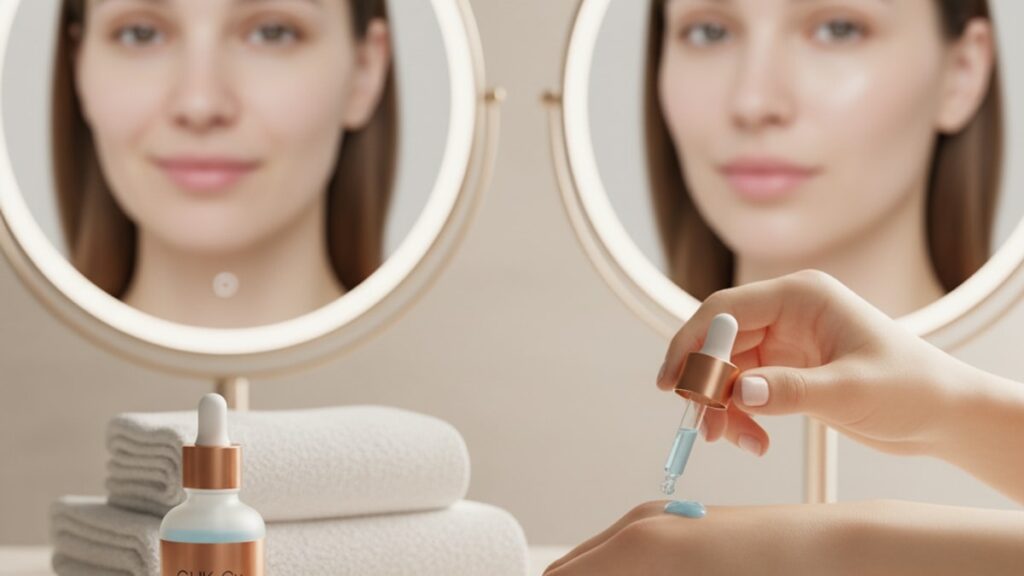
You've heard the buzz. Maybe you saw it mentioned in a dermatology forum, a biohacking group, or a scientific journal discussing tissue regeneration. GHK-Cu, or the copper peptide, has made a significant, sometimes dramatic, leap from the confines of the research lab into the mainstream consciousness. It’s no longer an obscure compound; it’s a sought-after ingredient, and the question our team hears constantly is no longer what it is, but a much more practical one: where to buy topical GHK-Cu serum that actually works?
And let's be honest—this is crucial. The market has become a sprawling, often confusing landscape. A quick search floods you with everything from high-end cosmetic brands charging a fortune to anonymous online vendors with questionable credentials. Sifting through the noise to find a potent, pure, and stable product is becoming increasingly challenging. It’s a difficult, often moving-target objective. We're here to cut through that noise with our team's collective experience in peptide synthesis and quality control, giving you an unflinching look at what truly matters.
The Copper Peptide Conundrum: What Are You Really Buying?
Before we even touch on sourcing, we need to establish a baseline. What is GHK-Cu? At its core, it's a naturally occurring tripeptide (glycyl-L-histidyl-L-lysine) with a strong affinity for copper ions (Cu2+). This combination isn't just a simple mixture; it's a complex that plays a formidable role in biological processes. We've seen its effects in countless studies on wound healing, collagen synthesis, anti-inflammatory responses, and even hair growth stimulation. It’s a signaling peptide, which means it communicates with cells, encouraging them to behave in a more youthful, regenerative way.
But here's the catch that trips up so many people. The effectiveness of a GHK-Cu serum isn't just about having GHK-Cu listed on the label. Not even close. It hinges entirely on three non-negotiable factors: purity, concentration, and the stability of the final formulation. A failure in any one of these areas doesn't just reduce the product's efficacy—it can render it completely inert or, in a worst-case scenario, introduce unknown contaminants. Our team at Real Peptides lives and breathes this principle daily; precision in the lab translates directly to reliability in application.
We've seen it all. Powders that aren't what they claim to be, serums with concentrations so low they're functionally useless, and formulations that degrade within weeks of being opened. It’s a frustrating reality for consumers and researchers alike. So, when you're looking for where to buy topical GHK-Cu serum, you're not just shopping for a product. You're shopping for scientific integrity.
Navigating the Marketplace: Your Main Options
When you start your search, you'll generally find GHK-Cu products sold through three primary channels. Each has its own set of pros and cons, and understanding them is the first step toward making an informed choice. Our experience shows that no single channel is inherently perfect; it’s about knowing what to look for within each.
-
Direct-to-Consumer (DTC) Skincare Brands: These are the polished, well-marketed serums you'll find on social media and in high-end beauty stores. They often come in beautiful packaging and are formulated with other complementary ingredients like hyaluronic acid or antioxidants. The primary advantage here is user experience and accessibility. The downside? It can be incredibly difficult to verify the actual quality and concentration of the GHK-Cu they use. Marketing often overshadows the science, and getting access to a Certificate of Analysis (CoA) is rare. They are selling a cosmetic experience, not necessarily a high-potency active.
-
Specialty Peptide Suppliers & Research Labs: This is our world. Companies like us specialize in synthesizing high-purity peptides for research purposes. While many, like Real Peptides, focus on providing the raw material for lab use, some suppliers also offer pre-formulated serums. The massive advantage here is transparency. Reputable suppliers will always provide third-party lab testing results (CoAs) that verify the purity, identity, and concentration of the peptide. You know exactly what you're getting. The potential downside is that the formulations might be more basic, focused on delivering the active ingredient without the cosmetic elegance of a DTC brand. For those who prioritize potency over fragrance and texture, this is often the best route.
-
Third-Party Marketplaces (Amazon, eBay, etc.): We can't stress this enough—this is the riskiest channel by a significant margin. While the convenience is undeniable, the lack of oversight is a catastrophic flaw. These platforms are flooded with private-label products from unknown sources. Verification is nearly impossible, quality control is non-existent, and the risk of receiving a counterfeit, diluted, or contaminated product is exceptionally high. We've heard horror stories from researchers who've wasted time and resources on bunk materials from these sites. Unless you can trace the seller back to a legitimate, verifiable lab with transparent testing, we strongly advise against this option.
Here’s a simple breakdown from our team's perspective:
| Source Type | Purity & Transparency | Formulation & User Experience | Cost | Risk Level |
|---|---|---|---|---|
| DTC Skincare Brands | Often Opaque (CoAs rarely available) | High (Elegant, multi-ingredient formulas) | High | Moderate |
| Specialty Peptide Suppliers | Very High (Third-party CoAs standard) | Basic to Moderate (Focus on the active) | Moderate to High | Low |
| Third-Party Marketplaces | Extremely Low (Verification is impossible) | Varies Wildly (Often poor quality control) | Low to Moderate | Very High |
It's comprehensive.
The Red Flags: How to Spot a Questionable GHK-Cu Supplier
Okay, so you understand the different channels. Now, how do you vet a specific company or product? Your goal is to find a supplier who operates with the same rigor as a scientific research company. Anything less is a gamble.
Here’s what our quality control team looks for—and what you should, too:
-
No Third-Party Lab Reports: This is the biggest red flag of all. A legitimate company is proud of its product's purity and will gladly show you the proof. If they can't or won't provide a recent, batch-specific Certificate of Analysis (CoA) from an independent lab, walk away. Don't accept internal testing data; it must be from a verifiable third party. This isn't just a suggestion; it's a critical, non-negotiable element of due diligence.
-
Vague Concentration Claims: Look for precise numbers. Phrases like "powerful copper peptide blend" or "high-potency formula" are meaningless marketing speak. You want to see a specific percentage, like 1%, 2%, or 3% GHK-Cu. If the concentration isn't clearly stated, the company is likely hiding the fact that it's incredibly low.
-
Unrealistic Prices: High-purity peptide synthesis is an expensive, multi-step process. If you find a serum priced dramatically lower than all competitors, be extremely skeptical. Quality costs money. The bargain-basement price often comes from cutting corners—using low-grade raw materials, skipping purification steps, or severely diluting the final product. You get what you pay for, and in the world of peptides, a cheap price often means a useless product.
-
Over-the-Top Marketing Claims: Does the website promise to make you look 20 years younger overnight? Does it use phrases like "miracle cure"? Reputable, science-based companies are measured and realistic in their claims. They let the data speak for itself. Hyperbolic marketing is often used to distract from a lack of scientific substance.
-
Lack of Company Information: Who are you buying from? A trustworthy company will have a clear "About Us" page, a physical address (even if it's a lab facility), and accessible customer service. If the seller is an anonymous entity with only a contact form, that's a sign they aren't willing to stand behind their product.
Honestly, though. Trust your gut. If a supplier feels shady, they probably are.
Concentration and Color: What You Need to Know
This is where it gets interesting. One of the unique properties of GHK-Cu is its vibrant blue color, which comes from the copper ion complexed with the peptide. The intensity of this blue is directly related to the concentration of GHK-Cu in the solution. This provides a helpful—though not foolproof—visual clue about the product's potency.
Here’s a general guide our chemists use:
-
Faint, Sky Blue (Almost Clear): This typically indicates a very low concentration, likely well under 1%. Many mass-market products fall into this category. While not useless, the effects will be subtle and take a very long time to become apparent, if at all.
-
Rich, Royal Blue: This is the sweet spot for most topical applications, usually indicating a concentration between 1% and 3%. This is potent enough to deliver the well-documented benefits of GHK-Cu without being overly aggressive on the skin.
-
Deep, Inky Blue (Almost Opaque): This signals a very high concentration, often above 3%. While it might seem like more is better, high concentrations can be irritating for some skin types and may not necessarily provide proportionally greater benefits. It's often reserved for targeted spot treatments rather than all-over facial application.
But wait, there's a crucial caveat. Some companies can—and do—add blue dye (like Blue No. 1) to their formulas to mimic the appearance of a high-concentration product. It’s a deceptive trick. So how can you tell the difference? A true GHK-Cu solution's color is part of the solution itself. A dyed product might look less uniform or may even stain fabric differently. Ultimately, though, the only way to be 100% certain is to rely on the supplier's CoA, which should state the exact concentration. The visual test is a good first pass, but it's not a substitute for proper documentation.
The Science of Stability: Why the Formulation Matters
Let’s say you’ve found a supplier with verified, high-purity GHK-Cu at a great concentration. You're all set, right? Not quite. The peptide itself is only half the battle. The other half is the serum it's delivered in—the formulation.
Peptides are delicate molecules. They can be degraded by pH shifts, exposure to certain enzymes, or interaction with other chemical ingredients. A well-designed formulation protects the GHK-Cu and ensures it can penetrate the skin to do its job. A poorly designed one can break it down before it ever reaches the target cells.
This is where deep expertise in cosmetic chemistry becomes invaluable. The base of the serum—whether it's water, hyaluronic acid, or a lipid solution—matters. The preservatives used to keep it free of bacteria matter. The pH of the final product matters immensely. GHK-Cu is most stable in a pH range of roughly 5.5 to 7.0. A formula that is too acidic or too alkaline will literally tear the peptide apart over time, leaving you with an expensive blue liquid that does nothing.
This is another reason why buying from a specialty supplier is often a safer bet. Companies that specialize in peptides understand their fragility. They formulate for stability and efficacy, not just for a pleasing scent or texture. When you're evaluating a product, look to see if the company discusses its formulation philosophy. Do they mention pH balancing? Do they use ingredients known to enhance peptide stability and penetration? These are signs of a company that understands the science beyond just the hero ingredient.
We've noticed that—many brands simply buy bulk GHK-Cu and dump it into a generic serum base without any thought to stability. The product might be potent on the day it's made, but by the time it reaches you, it could be a shadow of its former self. That's why at Real Peptides, our small-batch synthesis and rigorous quality control at every step are paramount. It ensures that what's in the vial is exactly what's on the label, in its most stable and active form. When you're ready to find a reliable source, you can Get Started Today by exploring partners who share this commitment to quality.
For a more visual deep-dive into the chemistry of peptide stability, our team has put together some great explainers over on our YouTube channel, which you can find at https://www.youtube.com/@MorelliFit. We break down these complex topics into easy-to-understand concepts.
DIY GHK-Cu Serum: A Word of Caution from Our Team
With the availability of raw GHK-Cu powder from research chemical suppliers, many enthusiasts are tempted to mix their own serums. The appeal is obvious: you can control the concentration and it seems more cost-effective. However, our team means this sincerely—we strongly advise against this unless you have a background in chemistry and a proper sterile setup.
The risks are significant. First, there's the issue of accurate measurement. You need a highly precise milligram scale to work with potent powders like GHK-Cu. A slight miscalculation can result in a formula that is either ineffective or dangerously potent. Second, and more importantly, is the risk of microbial contamination. Without the proper sterile equipment and preservatives, you can easily introduce bacteria, mold, or yeast into your homemade serum. Applying a contaminated product to your skin can lead to serious infections, breakouts, and inflammation—the very things you're trying to avoid.
Furthermore, as we discussed, creating a stable, pH-balanced formula that effectively delivers the peptide into the skin is a complex science. Simply mixing GHK-Cu powder with distilled water is not enough. You're likely creating an unstable solution that will degrade quickly and have poor skin penetration.
For the vast majority of people, the risks and complexities of a DIY approach far outweigh the potential benefits. It's much safer and more effective to purchase a professionally formulated product from a reputable source that has already done the hard work of ensuring stability, safety, and efficacy.
So, when considering where to buy topical GHK-Cu serum, the decision isn't just about the active ingredient. It's about trusting the entire process—from synthesis to formulation to bottling. It's about finding a partner whose commitment to quality is as relentless as your commitment to achieving your desired results. That's the key.
FAQs About Sourcing GHK-Cu Serum
Frequently Asked Questions
What is the best concentration of GHK-Cu serum to start with?
▼
Our team generally recommends starting with a 1% GHK-Cu concentration. This is effective for most applications, from promoting collagen to reducing inflammation, without being overly potent for first-time users. You can always move to a higher concentration later if needed.
How can I verify a company’s third-party lab test (CoA)?
▼
A valid CoA should be from a known, independent laboratory. You can often check the lab’s legitimacy with a quick search. The report should also be recent and include a batch or lot number that matches the product you’re purchasing.
Why is my GHK-Cu serum not bright blue?
▼
The intensity of the blue color is directly tied to the GHK-Cu concentration. If your serum is a very pale blue or nearly clear, it likely contains a very low concentration of the peptide, typically less than 1%. A richer blue indicates a higher potency.
Can I use GHK-Cu with other skincare actives like Vitamin C or retinoids?
▼
It’s best to be cautious. GHK-Cu is pH-sensitive. Highly acidic products like L-ascorbic acid (Vitamin C) can potentially destabilize the peptide. We recommend using them at different times of the day—for example, Vitamin C in the morning and GHK-Cu at night.
How should I store my GHK-Cu serum to maintain its potency?
▼
To protect the peptide from degradation, we advise storing your serum in a cool, dark place, away from direct sunlight and heat. The refrigerator is an excellent option for long-term storage to maximize its shelf life and stability.
Is GHK-Cu powder better than a pre-made serum?
▼
For research, powder offers maximum control. For topical use, a professionally formulated serum is far safer and more effective. Formulations are designed for stability and skin penetration, and they eliminate the significant risk of contamination and inaccurate dosing that comes with DIY mixing.
Does the type of copper used with GHK matter?
▼
Yes, it’s critical. The peptide complex should be with Copper II (Cu2+). This is the biologically active and stable form. Reputable suppliers who synthesize GHK-Cu will always use the correct copper salt in their process to create the effective complex.
How long does it take to see results from a topical GHK-Cu serum?
▼
Results vary based on concentration, formulation, and individual factors. Generally, users may notice improvements in skin hydration and texture within a few weeks, with more significant changes in firmness and fine lines appearing after 2-3 months of consistent use.
Is it safe to buy GHK-Cu from Amazon?
▼
Our team strongly advises against it. The risk of receiving counterfeit, diluted, or contaminated products from unvetted sellers on large marketplaces is extremely high. Stick to specialty suppliers who provide verifiable, third-party proof of their product’s purity and potency.
What does ‘research-grade’ mean for a topical product?
▼
For us at Real Peptides, ‘research-grade’ signifies the highest standard of purity and identity, verified by rigorous testing. When applied to topicals, it means the active ingredient is pure and accurately concentrated, providing a reliable and potent foundation for the formula.
Can GHK-Cu help with acne scars?
▼
Research suggests GHK-Cu’s ability to remodel tissue and stimulate collagen can be beneficial for improving the appearance of scars, including atrophic acne scars. Consistent, long-term use is typically required to see noticeable improvement in scar texture and depth.
Are there any side effects of using topical GHK-Cu?
▼
GHK-Cu is generally very well-tolerated. However, those with very sensitive skin or using very high concentrations (above 3%) might experience some initial redness or irritation. We always recommend a patch test before applying it to your entire face.











