



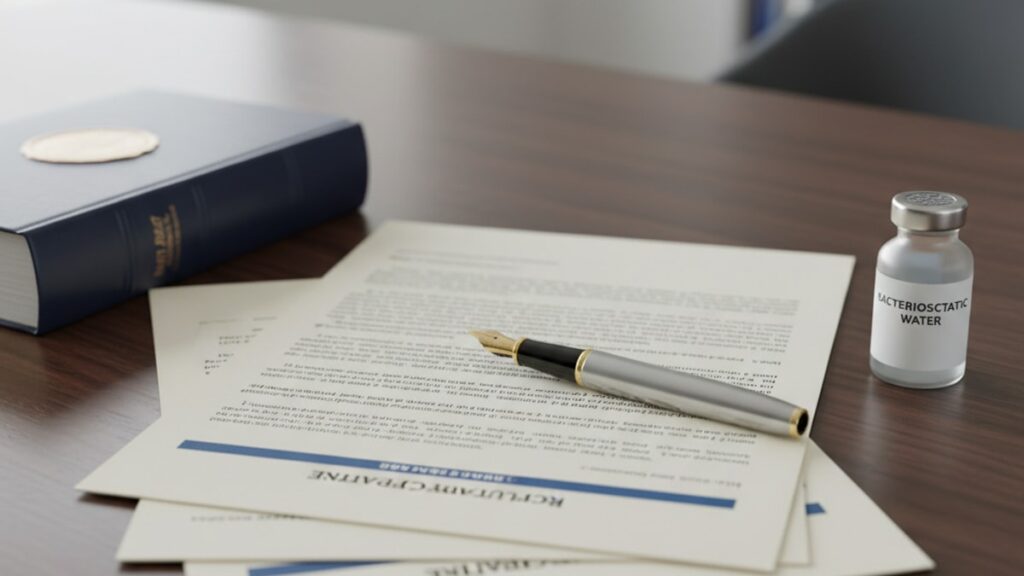
Is BAC Water Legal? (Regulatory Status Explained)
Bacteriostatic water sits in a regulatory grey zone most researchers don't understand until they need it. Unlike saline or sterile water, BAC water contains 0.9% benzyl alcohol as a preservative—a distinction that changes how it's classified, who can sell it, and what constitutes legal purchase. The confusion stems from inconsistent state-level pharmacy regulations and the fact that BAC water serves both legitimate research applications and, historically, unauthorized medication reconstitution.
We've guided hundreds of research labs through peptide reconstitution protocols. The single most common question isn't about technique—it's about whether ordering bacteriostatic water online creates compliance risk. Here's what every peptide researcher needs to know before placing an order.
Is bacteriostatic water legal to purchase and use for research purposes?
Bacteriostatic water is legal when purchased from FDA-registered 503B outsourcing facilities or state-licensed compounding pharmacies for legitimate research applications. It is not a controlled substance under federal law, but some states require a prescription for any compounded sterile preparation—including BAC water. Legality depends on supplier credentials and intended use, not the product itself.
The critical distinction most buyers miss: BAC water legal status doesn't turn on what the product is—it turns on where it comes from and what you intend to do with it. Purchasing from an unlicensed supplier or misrepresenting research use creates liability regardless of federal classification. The product itself carries no DEA schedule, no prescription requirement at the federal level, and no usage restrictions beyond standard sterile technique. State pharmacy boards, however, treat compounded sterile preparations differently—some classify BAC water as a prescription-only item even when used strictly for non-human research.
This article covers the federal regulatory framework that governs BAC water production, the state-level prescription requirements that vary by jurisdiction, and the specific compliance standards that separate legal research-grade suppliers from gray-market distributors. You'll learn exactly what credentials to verify before purchase and why sourcing matters more than price.
Federal Regulatory Framework for Bacteriostatic Water
Bacteriostatic water legal classification at the federal level falls under FDA oversight of compounded sterile preparations—not as a finished drug product with an NDA (New Drug Application), but as a component produced by registered compounding facilities. The FDA distinguishes between 503A (traditional compounding pharmacies serving individual prescriptions) and 503B (outsourcing facilities that can produce larger batches without patient-specific prescriptions). For research-grade BAC water, 503B registration is the gold standard because it allows production and distribution at scale without requiring a prescription for every unit sold.
The regulatory pathway matters because BAC water is not simply distilled water with preservative added in a home lab. It must meet USP (United States Pharmacopeia) standards for sterility, particulate matter, pH (4.5–7.0), and benzyl alcohol concentration (0.9% ± 0.1%). Facilities producing BAC water must operate under current Good Manufacturing Practices (cGMP), submit to FDA inspection, and report adverse events through MedWatch. These aren't optional certifications—they're legal requirements for any entity distributing BAC water commercially, whether to healthcare providers or research institutions.
When you see "FDA-registered" on a supplier's website, verify it refers to 503B outsourcing facility registration—not just facility registration, which is a lower bar that doesn't authorize sterile compounding. Real Peptides sources Bacteriostatic Water exclusively from 503B-registered facilities that undergo biannual FDA inspection and maintain full cGMP compliance—a standard that eliminates the compliance ambiguity surrounding BAC water legal sourcing. The difference between a registered supplier and an unregistered one isn't academic: unregistered suppliers operating without 503B status are, by definition, distributing a compounded sterile preparation in violation of federal law, regardless of how they label it.
One mechanism most guides ignore: the preservative itself—benzyl alcohol—is what distinguishes bacteriostatic water from sterile water for injection. Benzyl alcohol prevents bacterial growth in multi-dose vials by disrupting microbial cell membrane integrity, allowing a single vial to remain sterile through multiple needle punctures over 28 days when refrigerated. This extended-use window is why BAC water became the standard for peptide reconstitution, but it's also why regulatory oversight exists. Benzyl alcohol at concentrations above 1% becomes cytotoxic; below 0.8%, antimicrobial efficacy drops sharply. The 0.9% target is a narrow therapeutic window that requires pharmaceutical-grade quality control.
State Prescription Requirements and Research Exemptions
While federal law establishes production standards, state pharmacy boards control distribution—and this is where BAC water legal status becomes jurisdiction-specific. Approximately 18 states classify any compounded sterile preparation as prescription-only, even when the end use is non-human research. States including California, New York, Texas, and Florida maintain this requirement. Other states allow over-the-counter sale of compounded sterile preparations to registered research institutions or licensed laboratories without individual prescriptions.
The compliance gap emerges when researchers purchase BAC water online without understanding their state's classification. A supplier operating legally in Nevada (which permits non-prescription sales of research-grade compounded products) may unknowingly ship to a buyer in Illinois (which requires prescriptions for all compounded injectables). The buyer isn't violating federal law—BAC water remains unscheduled and legal to possess—but the transaction may violate Illinois pharmacy board regulations governing compounded drug distribution.
Research exemptions exist in most states but require documentation. A laboratory conducting peptide stability studies, for example, can typically purchase BAC water without a prescription if they provide a business license, institutional affiliation, or research protocol summary demonstrating legitimate scientific use. The key phrase in most state exemptions is "not for human administration"—this distinction protects suppliers and buyers alike, provided the use case aligns with the stated purpose.
Here's the honest answer: if you're ordering BAC water for personal peptide reconstitution at home without a prescription, you're operating in a gray zone. The product itself isn't illegal to possess in any state, but the supplier's ability to sell it to you without verifying prescription or research credentials depends entirely on where both parties are located. Real Peptides verifies research intent for every order and maintains state-specific compliance protocols that align with pharmacy board regulations—eliminating the buyer's compliance burden. This verification isn't bureaucratic overhead; it's what separates legal research supply from unregulated distribution.
Supplier Credentials That Determine BAC Water Legal Sourcing
Not all bacteriostatic water suppliers operate under equivalent regulatory oversight. The credentials that matter for BAC water legal sourcing include 503B outsourcing facility registration (verifiable via FDA's public database), state pharmacy board licensure in the state of manufacture, and USP <797> compliance for sterile compounding environments. A supplier that meets all three operates within the legal framework; one that meets only one or two does not.
USP <797> compliance governs the physical environment where sterile preparations are compounded—ISO Class 5 cleanrooms (fewer than 100 particles ≥0.5 microns per cubic foot of air), laminar airflow hoods, and personnel gowning protocols that prevent microbial contamination. Facilities audited under USP <797> must document environmental monitoring, media fill testing (sterility assurance), and beyond-use dating protocols. These aren't aspirational standards; they're enforceable requirements tied to state licensure. A compounding pharmacy that loses USP <797> certification loses the legal authority to produce BAC water.
The verification process is straightforward: request the supplier's 503B registration number and cross-reference it against the FDA's Outsourcing Facilities database (publicly searchable). If the facility appears with an active registration and no warning letters, it's operating legally at the federal level. Then verify state licensure by checking the relevant state pharmacy board's online licensure lookup tool. A supplier unwilling to provide these credentials is either unlicensed or operating outside the compounding framework—both disqualify them as legal sources.
One red flag: suppliers marketing BAC water as "research chemical" or "not for human use" without displaying 503B registration or pharmacy board licenses. This labeling doesn't exempt the product from compounding regulations—it's a compliance workaround that shifts legal risk onto the buyer. The phrase "not for human use" has no regulatory meaning in the context of sterile injectable preparations; it's a liability disclaimer, not a legal classification. Legitimate research suppliers don't rely on disclaimers—they rely on facility credentials and manufacturing standards that meet federal and state oversight.
Our approach at Real Peptides reflects this compliance standard: every batch of Bacteriostatic Water includes third-party testing for sterility, endotoxin levels (≤0.5 EU/mL per USP standards), and benzyl alcohol concentration—documentation we provide on request because our sourcing partners operate under full regulatory transparency. This level of verification is what separates research-grade supply chains from distributors operating in regulatory gray zones.
BAC Water Legal Status: Production vs Possession Comparison
| Legal Question | Production Requirements | Possession Requirements | Enforcement Risk | Professional Assessment |
|---|---|---|---|---|
| Can I produce BAC water at home for research? | Requires state pharmacy license, 503B registration, USP <797> cleanroom, cGMP compliance—home production is illegal | Possession of personally produced BAC water violates state compounding laws; no federal possession statute exists | High—state pharmacy boards actively investigate unlicensed sterile compounding | Home production is unambiguous violation; possession without production less enforced but still legally questionable |
| Can I purchase BAC water without prescription from 503B facility? | Supplier must hold 503B registration and verify buyer's research intent or institutional affiliation | Legal in states without compounded sterile preparation prescription mandates (varies by state) | Low at federal level; moderate at state level if shipped to prescription-required jurisdiction | Legal if supplier verifies research use and complies with destination state pharmacy board rules |
| Can I import BAC water from non-FDA facilities? | Foreign facilities not subject to FDA 503B oversight; importation of compounded sterile preparations requires FDA approval | Possession of imported non-FDA-approved compounded injectables violates FDCA Section 801 | High—CBP flags compounded injectables; FDA issues import alerts | Do not import—no legal pathway for non-approved compounded sterile preparations |
| Can research institutions purchase in bulk without prescription? | Supplier must document institutional buyer credentials (business license, research protocol, facility type) | Legal when purchased from 503B-registered supplier with institutional verification | Very low—institutional research exemptions well-established in most states | Standard compliance pathway for universities, private labs, biotech firms |
| Is benzyl alcohol content regulated? | Must meet USP monograph specification: 0.9% ± 0.1%; deviations render product adulterated under FDCA | Possession of off-spec BAC water not illegal but creates product liability if used in research with adverse outcomes | Moderate—FDA inspections focus on manufacturer compliance, not end-user possession | Always verify third-party benzyl alcohol assay—off-spec concentration indicates manufacturing deficiency |
Key Takeaways
- Bacteriostatic water is legal when purchased from FDA-registered 503B outsourcing facilities that meet USP <797> sterile compounding standards and maintain state pharmacy board licensure.
- Federal law does not classify BAC water as a controlled substance or require prescriptions, but approximately 18 states mandate prescriptions for all compounded sterile preparations regardless of end use.
- Research institutions and laboratories can legally purchase BAC water in most states without prescriptions by providing documentation of legitimate scientific use and institutional affiliation.
- Supplier credentials determine legality more than product labeling—verify 503B registration via FDA's public database and state pharmacy licensure before purchase.
- Benzyl alcohol concentration must fall within 0.8–1.0% to meet USP standards; off-specification product indicates inadequate quality control and violates FDA cGMP requirements.
- Home production of bacteriostatic water violates state compounding laws in all 50 states; possession of personally produced BAC water creates legal liability even in states without prescription mandates.
- "Not for human use" labeling has no regulatory meaning for compounded sterile preparations and does not exempt suppliers from 503B registration or state licensure requirements.
What If: BAC Water Legal Scenarios
What If I Order BAC Water Online and It Arrives Without Documentation?
Request a Certificate of Analysis (CoA) from the supplier immediately. Legitimate 503B facilities provide batch-specific documentation showing sterility testing, endotoxin levels, benzyl alcohol assay, and pH verification. If the supplier cannot or will not provide a CoA, discard the product—undocumented BAC water carries contamination risk and indicates the supplier operates outside regulatory compliance. The absence of documentation suggests the product was not produced under cGMP conditions, which means sterility and preservative concentration cannot be verified. Using undocumented BAC water in peptide reconstitution introduces variables that compromise research reproducibility and, in worst-case scenarios, introduces microbial contamination that destroys the peptide being reconstituted.
What If My State Requires a Prescription But I'm Conducting Non-Human Research?
Contact the supplier and provide proof of institutional affiliation or research protocol documentation. Most 503B facilities maintain compliance pathways for research buyers in prescription-required states by verifying scientific use before shipment. If you're an independent researcher without institutional backing, you may need to work with a compounding pharmacy that offers telehealth consultation services—some facilities connect research buyers with licensed prescribers who review the intended use and issue prescriptions specifically for research applications. This isn't a workaround; it's a compliant solution that satisfies state pharmacy board requirements while maintaining research access.
What If I Accidentally Purchase BAC Water from an Unlicensed Supplier?
Possession of BAC water is not illegal in any state, but using unlicensed product in research creates data integrity issues and potential liability if contamination or off-spec formulation affects outcomes. Dispose of the product and source replacement from a verified 503B facility. The bigger concern isn't legal penalty—it's that unlicensed suppliers often distribute BAC water produced in non-sterile environments with inconsistent benzyl alcohol content. A peptide reconstituted with contaminated or under-preserved BAC water may degrade within days instead of weeks, creating false-negative results that waste both the peptide and the research time invested.
What If I'm Traveling Internationally and Need to Transport BAC Water?
Do not attempt to transport compounded sterile preparations across international borders without pharmaceutical documentation and customs pre-clearance. BAC water is classified as a compounded injectable, which most countries regulate as a prescription medication requiring import permits. U.S. Customs and Border Protection (CBP) flags compounded injectables on both outbound and inbound travel, and many countries classify undeclared injectable liquids as controlled imports subject to confiscation and fines. If international research requires BAC water, source it from a licensed compounding pharmacy or hospital pharmacy in the destination country rather than transporting it yourself.
The Clear Truth About BAC Water Legal Compliance
Here's the bottom line: bacteriostatic water legal status is straightforward at the product level and complex at the transaction level. The product itself—sterile water containing 0.9% benzyl alcohol—is not a controlled substance, carries no DEA schedule, and is legal to possess in all 50 states. What determines legality is who made it, where they're licensed, and whether the buyer's stated use aligns with the supplier's distribution authority under state pharmacy board regulations.
The regulatory complexity exists because BAC water occupies the intersection of pharmaceutical manufacturing (governed by FDA cGMP rules), compounding pharmacy practice (governed by state boards), and research supply (governed by institutional oversight and documentation requirements). A supplier that cuts corners on any one of these frameworks creates legal exposure for the buyer—not because the buyer did anything wrong, but because the transaction itself occurred outside the compliance structure.
The clearest risk isn't prosecution—it's contamination. Unlicensed suppliers don't face FDA inspection, don't submit to USP <797> environmental monitoring, and don't conduct sterility testing on every batch. The result is product that looks identical to pharmacy-grade BAC water but may contain bacterial endotoxins, particulate matter, or benzyl alcohol concentrations outside the narrow therapeutic range that ensures both sterility and safety. For peptide researchers, this isn't a legal issue—it's a scientific integrity issue. Contaminated BAC water doesn't just create compliance risk; it destroys the peptides it's meant to reconstitute.
At Real Peptides, we eliminated the compliance ambiguity by sourcing BAC water exclusively from facilities that meet the highest regulatory standard: FDA-registered 503B outsourcing facilities with active state pharmacy licenses and full USP <797> certification. Every batch includes third-party sterility verification and benzyl alcohol assay results, and we verify research intent for every order to maintain alignment with state-specific distribution regulations. This approach reflects the same precision we apply to peptide synthesis—where quality control isn't optional, and regulatory compliance isn't negotiable.
If your BAC water supplier can't show you their 503B registration number, can't produce a Certificate of Analysis, or markets the product with vague "research use only" disclaimers without facility credentials to back it up—find a different supplier. The legal risk is secondary to the research risk, and both are entirely avoidable when you source from facilities operating under full regulatory transparency.
Frequently Asked Questions
Is bacteriostatic water legal to buy without a prescription?
▼
Yes, at the federal level—bacteriostatic water is not a controlled substance and carries no DEA schedule. However, approximately 18 states classify all compounded sterile preparations as prescription-only, including BAC water. In these states, suppliers must verify a prescription or research exemption before sale. Legal purchase depends on both the supplier’s 503B registration and your state’s pharmacy board regulations.
Can I make bacteriostatic water at home for research use?
▼
No. Home production of bacteriostatic water violates state compounding pharmacy laws in all 50 states, which require sterile compounding to occur in licensed facilities under USP <797> cleanroom standards. Even if you possess pharmaceutical-grade benzyl alcohol and sterile water, combining them outside a licensed pharmacy creates an illegal compounded sterile preparation. Possession of home-produced BAC water may also create liability if used in research that produces adverse outcomes.
What credentials should a legal BAC water supplier have?
▼
A legal supplier must hold FDA 503B outsourcing facility registration (verifiable in the FDA’s public Outsourcing Facilities database), active state pharmacy board licensure in the state where the product is manufactured, and USP <797> compliance certification for sterile compounding. Suppliers unable to provide these credentials are operating outside federal and state regulatory frameworks, regardless of product labeling or disclaimers.
Is benzyl alcohol concentration in BAC water regulated by law?
▼
Yes. USP (United States Pharmacopeia) monograph standards require benzyl alcohol concentration of 0.9% ± 0.1% in bacteriostatic water. Concentrations below 0.8% fail to provide adequate antimicrobial preservation; concentrations above 1.0% become cytotoxic. FDA-registered 503B facilities must test and document benzyl alcohol content for every batch under cGMP quality control requirements. Off-specification product is considered adulterated under the Federal Food, Drug, and Cosmetic Act.
Can research institutions purchase BAC water in bulk legally?
▼
Yes, provided they purchase from 503B-registered suppliers and provide institutional documentation (business license, research protocol summary, or institutional affiliation verification). Most states recognize research exemptions that allow bulk purchase without individual prescriptions when the buyer demonstrates legitimate scientific use and confirms the product will not be administered to humans. This is the standard compliance pathway for universities, private research labs, and biotech firms.
How does BAC water legality compare to sterile water for injection?
▼
Sterile water for injection (SWFI) is an FDA-approved finished drug product with an established NDA, making it available over-the-counter without prescription in all states. Bacteriostatic water, by contrast, is a compounded sterile preparation produced by registered compounding pharmacies under 503A or 503B frameworks, which subjects it to state-level prescription requirements in some jurisdictions. The preservative (benzyl alcohol) is what triggers compounded classification rather than finished drug product status.
What happens if I order BAC water from an unlicensed supplier?
▼
Possession of BAC water is not illegal, but purchasing from unlicensed suppliers creates contamination risk and research integrity issues. Unlicensed suppliers operate outside FDA oversight and USP <797> sterile compounding standards, meaning sterility, benzyl alcohol concentration, and endotoxin levels are not verified. Using such product in peptide reconstitution may introduce bacterial contamination or off-spec preservative levels that destroy the peptide or produce unreliable research outcomes. Legal liability is secondary to the scientific risk.
Can I travel internationally with bacteriostatic water?
▼
No. Most countries classify compounded sterile injectables as prescription medications requiring import permits and customs pre-clearance. U.S. Customs and Border Protection flags undeclared injectable liquids on both outbound and inbound travel, and unauthorized importation of compounded drugs violates FDA import regulations under FDCA Section 801. If research abroad requires BAC water, source it from a licensed pharmacy or hospital facility in the destination country rather than transporting it across borders.
Why do some BAC water suppliers label products ‘not for human use’?
▼
The phrase ‘not for human use’ is a liability disclaimer, not a regulatory classification. It has no legal meaning under FDA compounding regulations and does not exempt suppliers from 503B registration, state licensure, or USP <797> compliance requirements. Legitimate research suppliers rely on facility credentials and documented manufacturing standards rather than disclaimers to establish legality.
What documentation should come with legally purchased BAC water?
▼
Every batch should include a Certificate of Analysis (CoA) documenting sterility testing (USP <71> sterility assay), bacterial endotoxin levels (≤0.5 EU/mL per USP <85>), benzyl alcohol concentration (0.9% ± 0.1%), pH verification (4.5–7.0), and beyond-use dating. This documentation proves the product was manufactured under cGMP conditions by a facility meeting FDA and USP standards. Suppliers unable to provide batch-specific CoAs are operating outside pharmaceutical quality control frameworks.











