


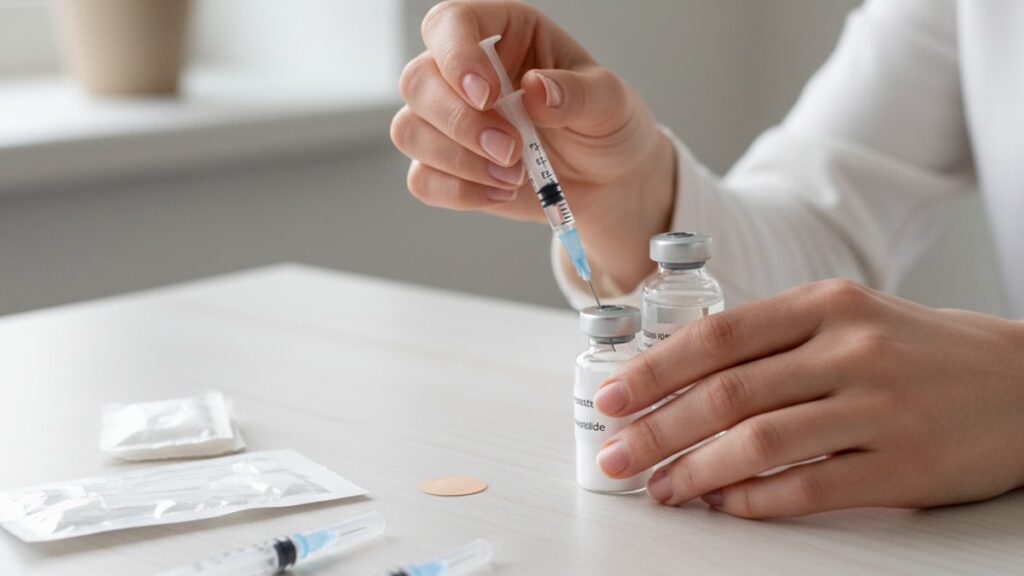
In the sprawling landscape of metabolic research in 2026, few peptides generate as much excitement and potential as tirzepatide. Its unique dual-agonist mechanism continues to open new avenues of inquiry, making it a cornerstone compound in labs focused on endocrinology, weight management, and related metabolic pathways. But here’s a truth our team has seen play out countless times: the most promising research can be completely undermined before it even begins. The culprit? Improper handling during a deceptively simple, yet absolutely critical, procedure.
We’re talking about reconstitution. The process of turning that stable, lyophilized powder into a usable liquid solution is where precision meets potential. Get it right, and you have a reliable, accurately dosed compound ready for your experiment. Get it wrong, and you risk peptide degradation, inaccurate concentrations, and ultimately, invalid data. At Real Peptides, where we live and breathe peptide integrity through our small-batch synthesis, we believe that providing a pure product is only half the battle. The other half is empowering researchers with the knowledge to handle it correctly. That’s why we’re laying out the definitive process for how to reconstitute Tirzepatide—the right way.
First, Why Is Tirzepatide Lyophilized?
Before we dive into the 'how,' it’s essential to understand the 'why.' When you receive a vial of high-purity tirzepatide, it arrives as a delicate, white, cake-like powder. This isn't just for show; it's the result of lyophilization, or freeze-drying. This process is a non-negotiable element for maintaining the peptide's long-term stability.
Peptides, especially complex ones like tirzepatide, are essentially long chains of amino acids. In a liquid state, these chains are susceptible to degradation from temperature fluctuations, microbial contamination, and oxidation. They can break down, rendering them useless for research. Lyophilization removes the water content under vacuum, locking the peptide into a solid, stable state. This dramatically extends its shelf life, making it possible to ship and store without losing potency. Think of it as a state of suspended animation, preserving the peptide’s precise structure until you’re ready to use it. When you reconstitute it, you are, in essence, waking it up for your experiment.
The Non-Negotiable Need for Proper Technique
Let’s be honest. It's tempting to rush through the prep work to get to the core of your research. But with peptides, the preparation is the research. The reconstitution step is a formidable gatekeeper of data quality. A single misstep here can have a catastrophic domino effect on your results.
Our experience shows that improper reconstitution can lead to several major problems:
- Peptide Degradation: Vigorous shaking or using the wrong diluent can physically shear the peptide bonds or cause aggregation, destroying the compound’s biological activity. Your experiment is over before it starts.
- Inaccurate Concentration: Miscalculating the amount of diluent results in a solution that is either too weak or too strong. This completely invalidates any dose-dependent findings.
- Contamination: Using non-sterile equipment or techniques can introduce bacteria into the vial, which not only compromises the experiment but can also degrade the peptide over time. This is especially critical for studies involving cell cultures or in vivo models.
This isn't about being needlessly fussy; it's about scientific rigor. The purity we guarantee in every vial of Tirzepatide is the starting point. Your technique carries that standard through to your results.
Assembling Your Reconstitution Toolkit
Success starts with having the right tools on hand. Working in a chaotic or unprepared environment is a recipe for error. Before you even think about touching the vials, our team recommends assembling everything you need in a clean, dedicated workspace.
Here’s your essential checklist:
- Vial of Lyophilized Tirzepatide: The star of the show. Ensure it’s from a reputable source that guarantees purity, like the small-batch products we craft at Real Peptides.
- Reconstitution Diluent: This is your most important decision after the peptide itself. We almost universally recommend Bacteriostatic Water.
- Sterile Syringes: You’ll need at least one. A 3mL or 5mL syringe is typically ideal for accurately measuring and transferring the diluent. You will also need smaller syringes (e.g., 0.5mL or 1mL insulin-type syringes) for measuring your final doses for your research application.
- Alcohol Prep Pads: For sterilizing the vial stoppers. Do not skip this.
- Sterile Gloves: A basic but critical component of aseptic technique.
Having these items ready prevents cross-contamination and ensures a smooth, precise process. It’s a simple step that pays huge dividends in data reliability.
Choosing Your Diluent: A Critical Decision
Not all clear liquids are created equal. The diluent you choose to reconstitute your peptide with has a significant impact on its stability and shelf-life post-reconstitution. While several options exist, they serve different purposes, and choosing the wrong one can be a costly mistake. We’ve found that this choice is one of the most common points of confusion for researchers new to peptides.
Here’s a breakdown of the common options. This is important.
| Diluent Type | Key Ingredient(s) | Primary Use Case & Recommendation |
|---|---|---|
| Bacteriostatic Water | Sterile water + 0.9% Benzyl Alcohol | Highly Recommended. The benzyl alcohol acts as a preservative, inhibiting bacterial growth. This is essential for vials that will be used multiple times over days or weeks. It is the gold standard for most research peptides, including tirzepatide. |
| Sterile Water for Injection | Pure, sterile water | Suitable for immediate, single-use applications only. It contains no preservative, so once the vial's stopper is punctured, the risk of contamination grows with each passing hour. We only recommend this if the entire reconstituted vial will be used in one session. |
| 0.9% Sodium Chloride (Saline) | Sterile water + 0.9% NaCl | Primarily used when the peptide solution needs to be isotonic for certain cell culture or in vivo applications. Can sometimes cause peptide aggregation, so it should only be used if a specific research protocol demands it. For general reconstitution, BAC water is superior. |
| Acetic Acid Solution (Diluted) | Sterile water + ~0.6% Acetic Acid | Used for very specific peptides that have poor solubility in water. This is not recommended for tirzepatide, which dissolves readily in bacteriostatic water. Using an acidic solution unnecessarily can alter the peptide's structure and pH. |
For tirzepatide, the verdict from our team is clear: use Bacteriostatic Water. It provides the stability and safety needed for multi-dose research protocols, ensuring your peptide remains potent and uncontaminated from the first draw to the last.
How to Reconstitute Tirzepatide: A Precise, Step-by-Step Protocol
Alright, you've gathered your supplies and selected your diluent. Now comes the main event. Follow these steps meticulously. Precision is your best friend here. We're going to walk through this as if we were guiding a new technician in our own lab.
Step 1: Prepare Your Workspace & Vials
First things first: create a sterile field. Wipe down your work surface with a disinfectant. Wash your hands thoroughly and put on your sterile gloves. Remove the plastic protective caps from both your tirzepatide vial and your bacteriostatic water vial. Take an alcohol prep pad and vigorously scrub the rubber stoppers on top of both vials. Let them air dry for about 30-60 seconds. This simple act kills surface contaminants.
Step 2: Allow Vials to Reach Room Temperature
If you've been storing your lyophilized peptide or bacteriostatic water in the refrigerator, let them sit at room temperature for 15-20 minutes. Reconstituting a cold peptide with cold liquid can sometimes affect solubility. A room-temperature process ensures everything dissolves smoothly.
Step 3: Calculate Your Final Concentration
This is where math meets methodology. You need to decide on your desired concentration. A common and easy-to-manage concentration is 5mg per 1mL. Let's use a 10mg vial of tirzepatide as our example.
- Goal: Create a solution where every 1mL of liquid contains 5mg of tirzepatide.
- Your Vial: Contains 10mg of tirzepatide powder.
- Calculation: To get a 5mg/mL concentration from a 10mg vial, you need to add 2mL of bacteriostatic water. (10mg peptide / 2mL water = 5mg/mL).
If you wanted a concentration of 10mg/mL, you would add 1mL of water. If you wanted 2.5mg/mL, you'd add 4mL. We recommend starting with a simple calculation like 2mL or 4mL to make future dosing math straightforward.
Step 4: Draw the Bacteriostatic Water
Take your 3mL sterile syringe. Uncap the needle. Pull the plunger back to the 2mL mark (or whatever volume you calculated) to draw air into the syringe. Puncture the rubber stopper of the bacteriostatic water vial with the needle. Inject the 2mL of air into the vial—this equalizes the pressure and makes it much easier to draw the liquid out. Now, invert the vial and slowly pull the plunger back, drawing exactly 2mL of bacteriostatic water into the syringe. Check for air bubbles. If you see any large ones, flick the syringe gently to make them rise to the top and carefully push the plunger to expel them.
Step 5: The Critical Injection Technique
This is the most important physical step. We can't stress this enough. Take the syringe filled with bacteriostatic water and carefully puncture the rubber stopper of the tirzepatide vial. Now, do not inject the water directly onto the lyophilized powder. This can cause foaming and potentially damage the peptide. Instead, angle the needle so the stream of water runs down the inside glass wall of the vial. Slowly and gently depress the plunger, allowing the water to flow down the side and pool at the bottom.
This gentle introduction allows the powder to dissolve without agitation.
Step 6: Dissolving the Peptide
Once all the water has been added, remove the syringe. Now, you need to mix. NEVER SHAKE THE VIAL. Shaking is aggressive and can denature the delicate peptide chains. Instead, gently roll the vial between your fingers or palms. You can also swirl it in a slow, circular motion. The powder should dissolve completely within a minute or two, resulting in a perfectly clear solution. That’s it. Simple, right?
Step 7: Final Inspection and Labeling
Look at the solution. It should be crystal clear. If you see any cloudiness, floaters, or particulates, it could indicate a problem with either the peptide's solubility or potential contamination. High-quality peptides like ours should dissolve without issue. If your solution is clear, you’ve successfully reconstituted your tirzepatide. We recommend labeling the vial with the date of reconstitution and the final concentration (e.g., "Tirzepatide 5mg/mL, Recon 15-OCT-2026").
Storing Your Reconstituted Tirzepatide
Your job isn't done yet. Proper storage is paramount to preserving the peptide's potency for the duration of your research.
Once reconstituted with bacteriostatic water, the vial must be stored in a refrigerator, typically between 2°C and 8°C (36°F and 46°F). Do not store it in the refrigerator door, where temperatures fluctuate. Place it in the main body of the fridge for a stable environment. When stored this way, a reconstituted vial of tirzepatide is generally stable for up to 4-6 weeks.
What about freezing? Our team generally advises against freezing reconstituted tirzepatide for most standard research applications. While freezing can extend the life of some peptides, tirzepatide can be sensitive to freeze-thaw cycles, which may cause aggregation and a loss of potency. For typical experimental timelines, refrigeration provides ample stability without the risks associated with freezing.
The Real Peptides Difference: Purity as the Foundation
We've spent a lot of time on technique, but the most impeccable technique in the world can't fix a subpar starting material. This is where the core philosophy of Real Peptides becomes so critical. The entire process we've outlined hinges on one assumption: that the lyophilized powder in your vial is pure, accurately dosed, and structurally intact.
That's why we’re relentless about our small-batch synthesis process. We don't mass-produce. Each batch is crafted with an unflinching focus on achieving the exact amino-acid sequence. This ensures that what’s on the label is exactly what’s in the vial. When you start with a compound of verifiable purity, you can trust that your careful reconstitution process will yield a solution that delivers reliable, repeatable results. It removes a massive variable from your research equation. When you're ready to Explore High-Purity Research Peptides, you'll see this commitment across our entire catalog, from metabolic compounds like Retatrutide to regenerative peptides like BPC 157 Peptide.
Following these precise steps for reconstitution isn't just about following rules; it's about respecting the integrity of the research itself. It ensures that the powerful potential of a compound like tirzepatide can be studied with the accuracy and confidence that groundbreaking science demands. It's a critical skill, and now you have a definitive protocol to master it.
Frequently Asked Questions
How long is reconstituted tirzepatide good for?
▼
When reconstituted with bacteriostatic water and stored properly in a refrigerator (2°C to 8°C), tirzepatide is typically stable for 4 to 6 weeks. Always label your vial with the date of reconstitution to keep track.
What happens if I shake the vial instead of swirling it?
▼
Shaking the vial can be catastrophic for the peptide. The forceful agitation can shear the delicate amino acid chains, a process called denaturation, which destroys the peptide’s biological activity and renders it useless for research.
My reconstituted tirzepatide looks cloudy. What should I do?
▼
A cloudy or particulate-filled solution is a red flag. It could indicate poor solubility, contamination, or that the peptide has degraded. We do not recommend using a cloudy solution, as it will produce unreliable results. High-purity tirzepatide should dissolve into a perfectly clear liquid.
Can I use sterile water instead of bacteriostatic water?
▼
You can, but only if you plan to use the entire contents of the vial immediately in a single session. Sterile water contains no preservatives, so once opened, the vial is highly susceptible to bacterial contamination. For multi-dose use, bacteriostatic water is the only safe and effective option.
Why do I need to inject air into the bacteriostatic water vial first?
▼
Injecting a volume of air equal to the liquid you plan to withdraw equalizes the pressure inside the sealed vial. This prevents a vacuum from forming, making it significantly easier and more accurate to draw the water into the syringe.
What is the best concentration to mix tirzepatide at?
▼
There is no single ‘best’ concentration, as it depends on your research protocol’s dosing requirements. However, mixing to a simple, round number like 5mg/mL (by adding 2mL of water to a 10mg vial) makes subsequent dose calculations much easier.
Do I need to wear gloves when reconstituting peptides?
▼
Yes, absolutely. Wearing sterile gloves is a fundamental part of aseptic technique. It prevents oils, bacteria, and other contaminants from your hands from coming into contact with the vials, syringe, or needle, ensuring the sterility of your final solution.
Is it safe to store reconstituted tirzepatide at room temperature?
▼
No. Once in a liquid state, tirzepatide is no longer stable at room temperature and will begin to degrade rapidly. It must be kept refrigerated at all times to maintain its potency and integrity.
Why is it important to inject the water down the side of the vial?
▼
Injecting the diluent slowly down the inside wall of the vial allows the lyophilized powder to dissolve gently. Spraying it directly onto the powder can cause foaming and may physically damage the peptide structure, similar to the effects of shaking.
Can I pre-load syringes with reconstituted tirzepatide for later use?
▼
Our team generally advises against pre-loading syringes for long-term storage. The plastic and rubber components of a syringe are not designed for preserving peptide stability over many days. It’s always best practice to draw each dose from the refrigerated vial just prior to its intended use in your experiment.
What’s the difference between lyophilized and regular powder?
▼
Lyophilized powder is created through a specialized freeze-drying process that removes water under a vacuum. This preserves the delicate structure of compounds like peptides for long-term stability. A regular powder is simply the compound in its solid crystalline form, which is often less stable.
Does the brand of bacteriostatic water matter?
▼
Yes, quality and sterility are key. It’s important to source your bacteriostatic water from a reliable supplier that guarantees it is sterile and contains the correct 0.9% concentration of benzyl alcohol as a preservative. Using a compromised diluent will compromise your entire experiment.
