



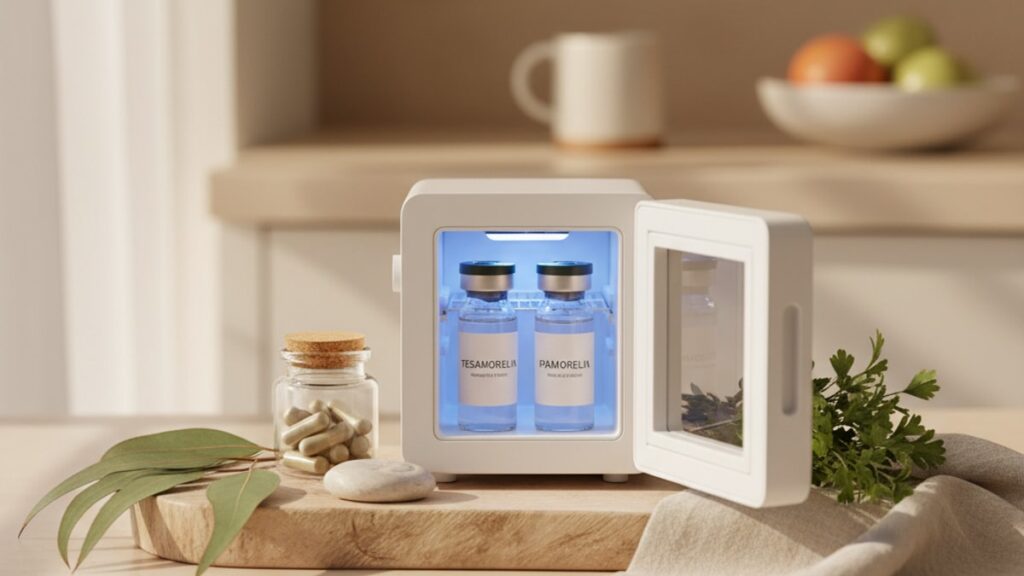
Tesamorelin + Ipamorelin Blend Storage — Real Peptides
Most peptide protocols fail at the storage stage, not the injection stage. A single temperature excursion above 8°C during shipping or at home can denature the protein structure entirely, turning an effective compound into an expensive saline injection. For researchers working with Tesamorelin Ipamorelin Growth Hormone Stack and similar peptide blends, understanding proper storage isn't optional. It's the difference between valid research data and wasted resources.
We've guided hundreds of research teams through this exact process. The gap between doing it right and doing it wrong comes down to three things most guides never mention: the irreversibility of thermal denaturation, the difference between lyophilised and reconstituted storage requirements, and the compounding effect of multiple small temperature violations over time.
What is the correct way to store Tesamorelin + Ipamorelin blend?
Tesamorelin + Ipamorelin blend storage requires refrigeration at 2–8°C (36–46°F) after reconstitution with bacteriostatic water. Unreconstituted lyophilised powder should be stored at −20°C (−4°F) or colder. Once reconstituted, use within 28 days. Any temperature excursion above 8°C causes irreversible structural changes to the peptide chains that neither appearance nor subsequent refrigeration can reverse.
Yes, proper Tesamorelin + Ipamorelin blend storage extends shelf life and maintains bioavailability. But not through the mechanism most assume. The temperature requirement isn't about slowing bacterial growth (that's the bacteriostatic water's job). It's about preventing thermal kinetic energy from disrupting the hydrogen bonds holding the peptide's tertiary structure intact. Once those bonds break, the amino acid sequence remains but the functional shape does not. This article covers exactly how that works, what storage mistakes negate peptide activity entirely, and the specific temperature thresholds that separate viable research compounds from denatured proteins.
Understanding Peptide Stability and the Cold Chain Requirement
Peptides are not small molecules. They're chains of amino acids held in precise three-dimensional configurations by weak non-covalent forces including hydrogen bonds, van der Waals interactions, and hydrophobic effects. Tesamorelin, a 44-amino-acid analogue of growth hormone-releasing hormone (GHRH), and Ipamorelin, a pentapeptide growth hormone secretagogue, both rely on this exact tertiary structure to bind their target receptors. Temperature directly affects molecular kinetic energy. As temperature rises, molecular motion increases, and at a threshold specific to each peptide (typically 8–12°C for growth hormone analogues), that motion becomes sufficient to disrupt the weak bonds maintaining the functional conformation.
This is why Tesamorelin + Ipamorelin blend storage cannot tolerate even brief warm exposure. The process is called thermal denaturation, and it's irreversible. A denatured peptide retains its amino acid sequence (primary structure) but loses its functional shape (tertiary structure). Testing the peptide afterward with HPLC would show the correct molecular weight and sequence. But the biological activity would be gone. The peptide can no longer bind its receptor because the binding site's shape has collapsed. For research applications, this means data collected using thermally compromised peptides reflects nothing about the compound's true mechanism of action.
Lyophilised (freeze-dried) peptides are more thermally stable than reconstituted solutions because water molecules are absent. Without water, there's no medium for hydrolysis reactions and significantly less molecular motion. This is why unreconstituted powder can be stored at −20°C and tolerate short-term shipping at ambient temperature (up to 25°C for 48–72 hours) without total degradation. Once reconstituted with bacteriostatic water, however, the peptide is in solution, fully hydrated, and exponentially more vulnerable. Reconstituted Tesamorelin + Ipamorelin blend storage requires continuous refrigeration at 2–8°C from the moment of mixing until the vial is empty.
At Real Peptides, every peptide we ship undergoes small-batch synthesis with exact amino-acid sequencing, guaranteeing purity and consistency. But that precision is meaningless if the peptide degrades between our facility and your benchtop. We recommend logging every vial's temperature history from receipt through final use. Many research teams now use datalogger USB thermometers placed inside the shipping box and storage refrigerator to document the cold chain remained unbroken. If a temperature excursion occurred, that vial should be flagged and excluded from critical experiments.
The Reconstitution Transition: When Storage Rules Change Completely
The single most critical moment in Tesamorelin + Ipamorelin blend storage is reconstitution. The transition from lyophilised powder to injectable solution. This is when the peptide's vulnerability to temperature, light, and mechanical stress increases by an order of magnitude. Unreconstituted peptide powder stored at −20°C can remain stable for 12–24 months; the same peptide reconstituted with bacteriostatic water and stored at 2–8°C has a maximum viable lifespan of 28 days. That 40× reduction in shelf life reflects the thermodynamic reality of peptides in aqueous solution.
Reconstitution protocol matters as much as post-reconstitution storage. The bacteriostatic water should be refrigerated before use. Adding room-temperature diluent to a refrigerated peptide vial creates an immediate localized temperature gradient that can approach 10–15°C at the point of contact. Inject the water slowly down the inside wall of the vial, never directly onto the lyophilised cake, and allow it to dissolve passively by gentle swirling. Never shake. Shaking introduces air-liquid interfaces and mechanical shear forces that can denature peptides through a mechanism entirely separate from temperature. Once fully reconstituted, the vial should return to 2–8°C storage within five minutes.
The 28-day post-reconstitution window is conservative but evidence-based. Studies on GHRH analogues including Sermorelin and Tesamorelin show measurable potency loss begins around day 21–28 when stored at 4°C, accelerating significantly beyond that point. Ipamorelin, being a pentapeptide, degrades even faster. Some data suggest noticeable potency reduction as early as day 14–18. When stored as a blend, assume the stability profile of the less stable component. For Tesamorelin + Ipamorelin blend storage, 28 days is the outside limit; 21 days is safer for precision research.
Bacteriostatic water extends this window by preventing microbial growth, but it does nothing to stop peptide degradation. The 0.9% benzyl alcohol in bacteriostatic water inhibits bacterial and fungal contamination for up to 28 days after the vial is first punctured, which is why multi-dose vials remain safe to use across that period. But sterility and peptide stability are separate issues. A vial can be microbiologically sterile and pharmacologically useless if the peptide has denatured. Researchers often conflate the two. Assuming that because the solution looks clear and shows no bacterial growth, the peptide is still active. Appearance is not a valid stability indicator for peptides.
Our team has reviewed this across hundreds of research clients. The pattern is consistent: peptide degradation is almost never caused by contamination or visible spoilage. It's caused by silent thermal excursions, extended post-reconstitution storage, or improper reconstitution technique. If your research data shows unexpected variability or loss of effect over time, audit your storage and reconstitution protocols before questioning the peptide's quality.
Temperature Monitoring, Transport, and the Thresholds That Matter
Tesamorelin + Ipamorelin blend storage temperature thresholds are not arbitrary. They're derived from the kinetic stability of peptide bonds in aqueous solution. The 2–8°C range represents the zone where peptide degradation proceeds slowly enough that 28-day shelf life is achievable. Below 2°C, ice crystal formation can disrupt peptide structure (freezing reconstituted peptides is contraindicated). Above 8°C, degradation accelerates exponentially. Every 10°C increase roughly doubles the reaction rate of most degradation pathways, a relationship described by the Arrhenius equation. At 25°C (typical room temperature), a peptide that would degrade 5% over 28 days at 4°C might degrade 15–20% in the same period. At 37°C (body temperature), degradation can exceed 50% within a week.
This makes transport and temporary storage scenarios high-risk. If a reconstituted vial is left on a laboratory benchtop at room temperature for two hours during an injection preparation session, that's not a minor lapse. It's equivalent to several days of degradation compressed into a short window. Similarly, if a shipment of peptides sits in a delivery truck at 30°C for six hours during summer, even if the peptides were lyophilised and theoretically stable at ambient temperature, the cumulative thermal stress may reduce their post-reconstitution lifespan. Some compounding pharmacies now ship peptides in insulated boxes with gel packs rated for 48-hour transit. If your peptides arrive warm, document it and contact the supplier immediately.
Datalogger thermometers are inexpensive (under $30) and provide continuous temperature records with timestamps. Place one inside your peptide storage refrigerator and configure it to alert if temperature rises above 8°C. Many research-grade refrigerators include built-in dataloggers, but most consumer and clinical refrigerators do not. Standard household refrigerators can experience temperature swings of 3–5°C during defrost cycles or if the door is left open briefly. Acceptable for food, marginal for peptides. Dedicated laboratory refrigerators maintain tighter control, typically ±1°C. If you're storing high-value peptides including Tesamorelin + Ipamorelin blend, CJC1295 Ipamorelin, or BPC 157 Peptide long-term, a dedicated unit is justified.
Light exposure is another underappreciated stressor. Ultraviolet and visible light can catalyze oxidation reactions in peptides, particularly those containing methionine, cysteine, or tryptophan residues. Tesamorelin contains methionine; Ipamorelin does not, but the blend should still be protected from light. Store peptide vials in their original boxes or wrap them in aluminum foil if the refrigerator has interior lighting that remains on when the door closes. Amber glass vials provide some protection but are not opaque. Supplemental shielding is still recommended for long-term storage.
For Tesamorelin + Ipamorelin blend storage during research use, adopt a first-in-first-out inventory system and label every vial with reconstitution date and expiration date (28 days later). Discard any vial that exceeds this window regardless of appearance. Research integrity demands it. Using degraded peptides introduces uncontrolled variables that invalidate your data. The cost of replacing a vial is trivial compared to the cost of repeating an entire study because baseline peptide activity was inconsistent.
Tesamorelin + Ipamorelin Blend Storage: Lyophilised vs Reconstituted Comparison
Understanding the distinct storage requirements for lyophilised versus reconstituted peptide forms is essential for maintaining compound stability and research validity.
| Storage State | Temperature Range | Maximum Shelf Life | Key Vulnerabilities | Reversal Possible | Professional Assessment |
|---|---|---|---|---|---|
| Lyophilised (unreconstituted) powder | −20°C or colder (−4°F) | 12–24 months | Humidity, thermal cycling, oxidation | No. Degradation is cumulative | Most stable form; short-term ambient exposure (48–72 hrs at ≤25°C) tolerable for shipping but not ideal |
| Reconstituted solution (with bacteriostatic water) | 2–8°C (36–46°F), never freeze | 28 days maximum, 21 days preferred | Temperature excursions above 8°C, light, mechanical agitation, freezing | No. Thermal denaturation is irreversible | Use within 21 days for optimal potency; datalogger monitoring essential for high-value research |
| Ambient temperature exposure (reconstituted) | 20–25°C (68–77°F) | Degradation begins immediately; avoid exceeding 2 hours cumulative | Exponential degradation rate increase (~2× per 10°C rise) | No. Hours of warm exposure = days of degradation compressed | Emergency only; if unavoidable, document exposure duration and flag vial for exclusion from critical experiments |
The lyophilised form's resilience makes it the preferred state for procurement, long-term storage, and transport. Reconstitute only the quantity needed for near-term use. A common mistake is reconstituting an entire 10mg vial when only 2–3mg will be used within the 28-day window. The remaining 7–8mg degrades unused. If your research protocol spans months, purchase multiple smaller vials rather than one large vial and reconstitute sequentially.
Key Takeaways
- Tesamorelin + Ipamorelin blend storage requires 2–8°C refrigeration after reconstitution and −20°C or colder for unreconstituted lyophilised powder.
- Temperature excursions above 8°C cause irreversible thermal denaturation. The peptide's amino acid sequence remains intact but the functional three-dimensional structure collapses, eliminating receptor binding activity.
- Reconstituted peptides have a maximum 28-day shelf life when stored correctly; degradation begins earlier (around day 21) for precision research applications.
- Bacteriostatic water prevents microbial contamination but does nothing to stop peptide degradation. Sterility and stability are separate issues.
- Lyophilised peptides are 40× more stable than reconstituted solutions and can tolerate brief ambient temperature exposure during shipping, but continuous refrigeration post-reconstitution is non-negotiable.
- Datalogger thermometers provide objective temperature history documentation. Essential for validating that the cold chain remained unbroken from supplier to benchtop.
What If: Tesamorelin + Ipamorelin Blend Storage Scenarios
What If My Peptide Vial Was Left Out at Room Temperature for Three Hours?
Discard it or flag it for non-critical use only. Three hours at 20–25°C represents significant thermal stress. Equivalent to roughly 7–10 days of degradation compressed into that window based on Arrhenius kinetics. The peptide may retain partial activity, but you cannot quantify how much was lost, which introduces an uncontrolled variable into your research. If the vial is irreplaceable, document the temperature excursion in your lab notebook and use it only for preliminary or secondary experiments where potency variability is acceptable. For publication-quality research, temperature-compromised peptides must be excluded.
What If I Accidentally Froze My Reconstituted Peptide Solution?
Freezing reconstituted peptides causes ice crystal formation, which physically disrupts the peptide structure through mechanical shear. A separate degradation pathway from thermal denaturation. Some peptides tolerate freeze-thaw cycles better than others, but growth hormone analogues including Tesamorelin are particularly sensitive. If the solution was frozen solid and then thawed, assume 30–50% potency loss minimum. The solution may appear clear and normal after thawing, but appearance is not a valid indicator. Discard and reconstitute a fresh vial. This is why Tesamorelin + Ipamorelin blend storage temperature must stay above 2°C. The narrow 2–8°C window exists to avoid both freezing and warm degradation.
What If My Shipment Arrived Warm and the Ice Packs Were Melted?
Contact the supplier immediately and document the condition with photos. If the peptides were lyophilised (unreconstituted powder), they may still be viable. Lyophilised peptides can tolerate 48–72 hours at ambient temperature (up to 25°C) without total degradation, though some potency loss is likely. If the peptides were pre-mixed or reconstituted, they are almost certainly compromised and should be replaced. Reputable suppliers including Real Peptides guarantee the cold chain and will replace shipments that arrive outside specification. Never assume a warm-arrived peptide is acceptable just because it looks normal. Thermal damage is invisible.
What If I've Been Storing My Reconstituted Vial for 35 Days and It Still Looks Clear?
Discard it. The 28-day maximum shelf life is based on potency retention data, not appearance. Peptide degradation produces smaller peptide fragments and individual amino acids, all of which remain dissolved in solution. The liquid stays clear even as the active compound degrades. Using peptides beyond their validated shelf life produces unreliable data. If you're consistently running up against the 28-day limit, reconstitute smaller volumes more frequently or purchase peptides in smaller vial sizes. For Tesamorelin Peptide and similar compounds, we offer multiple vial sizes specifically to support this approach.
The Unflinching Truth About Peptide Storage and Research Validity
Here's the honest answer: most peptide research failures attributed to "non-response" or "variability" are actually storage failures. The peptides worked exactly as expected. But they were degraded before they ever reached the assay. Temperature logs are not bureaucratic overhead; they're the only objective evidence that your peptide remained viable from synthesis to injection. Without them, you're running experiments on an uncharacterized mixture of active peptide, degradation products, and bacteriostatic water, then wondering why your dose-response curves don't replicate.
The scientific literature on growth hormone secretagogues is built on peptides stored correctly. When researchers report that Ipamorelin produces a 2–3× increase in growth hormone pulse amplitude at 100 mcg/kg, that's data collected using peptides stored at 2–8°C and used within their validated shelf life. If you replicate the protocol but use a 40-day-old vial stored in a refrigerator that occasionally drifts to 12°C, your results will be different. Not because the peptide doesn't work, but because you didn't actually test the peptide. You tested a degraded version of it.
This matters beyond individual experiments. When storage-compromised data enters the literature or gets presented at conferences, it pollutes the evidence base. Other researchers waste time trying to replicate protocols that never worked in the first place because the original peptide was thermally compromised. The solution is simple but non-negotiable: treat Tesamorelin + Ipamorelin blend storage with the same rigor you apply to sterile technique or dosing precision. Use dataloggers. Label vials with reconstitution dates. Discard expired or temperature-compromised material without exception. The integrity of your research depends on it.
Peptide storage isn't a minor technical detail. It's a foundational variable that determines whether your research conclusions are valid or artifacts of degraded compounds. At Real Peptides, we control synthesis and QC because that's what we can control. What happens after the vial leaves our facility is on you. If you treat storage as an afterthought, every downstream result becomes suspect. If you treat it as seriously as any other experimental parameter, your data becomes reliable, reproducible, and defensible. The choice is binary: either the cold chain was maintained or it wasn't. There's no middle ground, and there's no fixing it after the fact.
Whether you're working with Tesamorelin + Ipamorelin blends, Tirzepatide, TB 500, or any other research-grade peptide, the storage principles remain the same. Peptides are thermally fragile biological molecules that require continuous cold chain management from synthesis through final use. Compromise the chain at any point, and you compromise your data. Maintain it rigorously, and your results will reflect the peptide's true pharmacological profile. That difference. Between valid data and garbage data. Comes down to a $30 datalogger and a commitment to discarding compromised vials no matter how expensive they were.
Frequently Asked Questions
How should I store Tesamorelin + Ipamorelin blend before reconstitution?
▼
Store unreconstituted lyophilised Tesamorelin + Ipamorelin blend at −20°C (−4°F) or colder in the original sealed vial. The peptide can remain stable for 12–24 months at this temperature. Lyophilised powder can tolerate brief ambient temperature exposure (48–72 hours at ≤25°C) during shipping without total degradation, though some potency loss may occur. Once received, return vials to −20°C storage immediately and keep them sealed until ready to reconstitute.
Can I freeze reconstituted Tesamorelin + Ipamorelin solution to extend shelf life?
▼
No — freezing reconstituted peptide solutions causes ice crystal formation, which physically disrupts the peptide’s tertiary structure through mechanical shear forces. Growth hormone analogues including Tesamorelin are particularly sensitive to freeze-thaw damage, with potency losses of 30–50% or more after a single freeze-thaw cycle. Reconstituted peptides must be stored at 2–8°C continuously, never frozen. If you need extended shelf life, keep peptides in unreconstituted lyophilised form and reconstitute only the amount needed for near-term use.
What is the maximum shelf life of Tesamorelin + Ipamorelin blend after reconstitution?
▼
Reconstituted Tesamorelin + Ipamorelin blend has a maximum shelf life of 28 days when stored at 2–8°C, though degradation begins around day 21. For precision research applications where potency consistency is critical, use reconstituted vials within 21 days. Bacteriostatic water prevents microbial contamination for up to 28 days but does not stop peptide degradation — sterility and peptide stability are separate issues. Label every vial with reconstitution date and discard after 28 days regardless of appearance.
How do I know if my peptide has been damaged by temperature exposure?
▼
You cannot reliably detect thermal peptide degradation by appearance — denatured peptides remain clear and colorless in solution because degradation produces smaller peptide fragments and amino acids that stay dissolved. The only way to verify peptide integrity is through analytical testing (HPLC, mass spectrometry) or by maintaining documented temperature logs proving the cold chain was never broken. If a temperature excursion above 8°C occurred for more than two hours cumulative, assume the peptide is compromised and discard it or flag it for non-critical use only.
What temperature should my refrigerator maintain for peptide storage?
▼
Your refrigerator should maintain 2–8°C (36–46°F) continuously for reconstituted peptide storage. Standard household refrigerators can experience temperature swings of 3–5°C during defrost cycles or door openings, which is marginal for peptides. Laboratory refrigerators maintain tighter control (±1°C) and are preferred for high-value compounds. Use a datalogger thermometer (under $30) to continuously monitor actual temperature and configure alerts for excursions above 8°C — built-in refrigerator thermometers show instantaneous temperature but do not log excursions that occur when you are not observing.
How does Tesamorelin + Ipamorelin storage compare to other peptide blends like CJC1295 + Ipamorelin?
▼
All growth hormone secretagogue blends including Tesamorelin + Ipamorelin and CJC1295 + Ipamorelin require identical storage conditions: −20°C for unreconstituted powder and 2–8°C for reconstituted solution. The shelf life profiles are similar (12–24 months lyophilised, 28 days reconstituted), though CJC1295 without DAC may degrade slightly faster than Tesamorelin due to its shorter native half-life. The storage principles — continuous cold chain, protection from light, avoidance of freeze-thaw cycles — apply universally to all peptide growth hormone analogues.
What is the cost of replacing temperature-compromised peptides versus proper storage equipment?
▼
A datalogger thermometer costs $25–40 and lasts years; a dedicated laboratory-grade mini refrigerator costs $150–300. A single 10mg vial of research-grade Tesamorelin + Ipamorelin blend costs $200–400 depending on supplier and purity. Losing one vial to thermal degradation costs more than the monitoring equipment that would have prevented it. For research teams using multiple peptides over months or years, the cumulative cost of degraded compounds far exceeds the one-time investment in proper storage infrastructure and monitoring.
Why does bacteriostatic water not prevent peptide degradation?
▼
Bacteriostatic water contains 0.9% benzyl alcohol, which inhibits bacterial and fungal growth in multi-dose vials for up to 28 days after first puncture. This prevents microbial contamination, which is a separate issue from peptide chemical stability. Peptide degradation occurs through thermal denaturation (disruption of tertiary structure), oxidation, and hydrolysis — none of which are prevented by antimicrobial agents. A vial can be microbiologically sterile and pharmacologically useless if the peptide has thermally denatured. Sterility extends safe use duration to 28 days; peptide stability determines effective use duration, which is also roughly 28 days when stored correctly at 2–8°C.
Can I store Tesamorelin + Ipamorelin blend in a standard kitchen refrigerator?
▼
Yes, but with caveats. Standard kitchen refrigerators typically maintain 3–5°C average temperature, which falls within the acceptable 2–8°C range, but they experience larger temperature swings during defrost cycles, door openings, and variable ambient conditions. If a kitchen refrigerator is your only option, place the peptide vials in the back of the middle shelf (the most thermally stable location), never in the door, and use a datalogger thermometer to verify the actual temperature profile. If logs show frequent excursions above 8°C or temperature swings exceeding 3°C, invest in a dedicated mini refrigerator for research compounds.
What should I do if my research data shows unexpected variability with peptide response?
▼
Audit your storage and reconstitution protocols before questioning peptide quality or experimental design. Temperature logs, reconstitution dates, and vial expiration tracking should be your first check. Most peptide research variability stems from silent cold chain failures, extended post-reconstitution storage, or inconsistent reconstitution technique. If storage documentation is absent or shows gaps, repeat the experiment with fresh peptides and rigorous temperature logging. Only if variability persists with documented proper storage should you investigate other variables such as injection technique, dosing accuracy, or peptide purity testing through independent analytical labs.
Are there specific peptides that are more sensitive to storage conditions than others?
▼
Yes — longer peptides with more complex tertiary structures (30+ amino acids) including Tesamorelin, growth hormone analogues, and insulin-like peptides are generally more sensitive to thermal degradation than shorter peptides like Ipamorelin, BPC-157, or Thymosin Beta-4. Peptides containing methionine, cysteine, or tryptophan residues are more vulnerable to oxidation and should be protected from light. Despite these differences, all research-grade peptides should be stored at 2–8°C after reconstitution and −20°C before reconstitution as a universal best practice. When in doubt, apply the strictest storage standard — it is impossible to over-protect a peptide, but trivial to under-protect one.
How do compounding pharmacies and peptide suppliers ensure cold chain integrity during shipping?
▼
Reputable peptide suppliers including Real Peptides ship lyophilised peptides in insulated containers with gel packs or dry ice rated for 48–72 hour transit, depending on distance and season. Shipments are typically sent via expedited carriers (2-day or overnight) to minimize transit time. Some suppliers include temperature dataloggers in shipments to document that temperature remained within specification throughout transit. Upon receipt, inspect the package immediately — if gel packs are completely melted and the package feels warm, photograph the condition and contact the supplier before using the peptides. Most suppliers guarantee cold chain integrity and will replace compromised shipments at no charge.
