





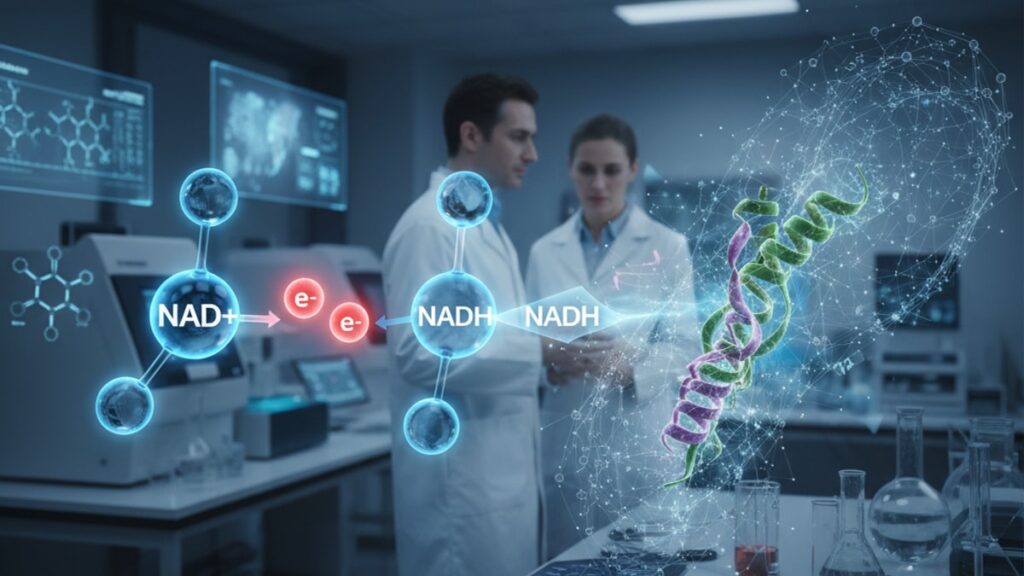
It’s a question that sounds like it belongs in a high-level biochemistry course, yet the answer is at the very core of what keeps us alive. What do the electrons added to NAD+ do? It’s not just a trivial chemical reaction. It's the spark. The fundamental transaction that powers nearly every single thing your body does, from thinking a thought to lifting a finger. It's the microscopic engine of life, and our team at Real Peptides has spent years working with the compounds that influence these foundational biological processes.
Frankly, understanding this process is crucial for any serious researcher in the biotech space. It’s the difference between seeing cellular processes as a list of abstract pathways and truly grasping the dynamic, energetic reality of life. We're not just talking about textbook diagrams here; we're talking about the relentless, moment-to-moment energy transfer that separates living organisms from inert matter. So, let's break down exactly what happens when this tiny but mighty molecule gets its energetic upgrade.
First, What Is NAD+ Anyway?
Before we can talk about adding electrons, we need a clear picture of our starting player: NAD+. The acronym stands for Nicotinamide Adenine Dinucleotide, but you can think of it more simply. Imagine it as a fleet of tiny, empty delivery trucks inside each of your cells. Its job is to pick up a very specific, very valuable cargo—high-energy electrons—and transport them to where they're needed most.
NAD+ is a coenzyme, a helper molecule that enzymes need to do their jobs. In its oxidized form (which is what the "+" signifies), it's ready and waiting, poised to accept electrons. It's found in every living cell, from bacteria to humans, which tells you just how fundamental it is. Without NAD+, the central metabolic processes that break down food into energy would grind to a halt. It’s a critical, non-negotiable element of cellular function.
Its structure allows it to easily accept and donate electrons, making it the perfect biological shuttle. This ability to cycle between an oxidized state (NAD+) and a reduced state (NADH) is its entire purpose. It’s a rechargeable battery, constantly being drained and recharged to keep the cellular economy humming.
The Big Moment: Adding Electrons to NAD+
Now for the main event. When you eat food, your body breaks down molecules like glucose through processes such as glycolysis and the Krebs cycle. During these breakdowns, chemical bonds are broken, and this releases energy in the form of high-energy electrons. But this energy can't just float around randomly; it needs to be captured and transported efficiently.
This is where NAD+ steps in.
An NAD+ molecule swoops in and accepts a pair of these high-energy electrons (2e-) along with a hydrogen ion (a proton, H+). This chemical reaction is called reduction. The moment NAD+ accepts these particles, it is reduced to become NADH. That's the key transformation.
NAD+ + 2e- + H+ → NADH
This isn't just a minor tweak. It's a profound shift in the molecule's energetic state. The empty delivery truck (NAD+) is now fully loaded (NADH). It has captured the raw energy liberated from your food and is holding it in a stable, transportable form. This single event is one of the most important energy-capturing steps in all of biology.
Meet NADH: The High-Energy 'Charged' Form
So, NAD+ becomes NADH. What's the big deal? The NADH molecule is now the cellular equivalent of a fully charged power bank. The electrons it carries aren't just any electrons; they are buzzing with potential energy, ready to be unleashed to do work. Our team often describes NADH as the cell's primary shuttle for high-potential energy.
Think of it this way: breaking down a sugar molecule is like a controlled explosion. NAD+ and other electron carriers are the mechanisms that capture the force of that explosion. Instead of the energy being lost as heat, it's neatly packaged into the chemical bonds of NADH.
This newly formed NADH molecule doesn't just sit around. It has a single, critical destination: the mitochondria. Specifically, it heads for the inner mitochondrial membrane, which is where the main power plants of the cell are located. This is where the energy it's carrying will finally be converted into the universal energy currency that cells actually spend.
That currency is ATP (Adenosine Triphosphate).
The Electron Transport Chain: Cashing in the Energy
This is where those captured electrons finally perform their ultimate task. When NADH arrives at the inner mitochondrial membrane, it encounters a series of protein complexes known as the Electron Transport Chain (ETC). It’s a cascade, a production line for energy conversion.
NADH donates its two high-energy electrons to the very first complex in the chain. As soon as it does this, it reverts back to its original NAD+ form, ready to go back and pick up another load of electrons. The truck is empty again and can return to service. It's an incredibly efficient cycle.
But what about the electrons? They get passed down the line, from one protein complex to the next, like a hot potato. Each time an electron moves to the next complex in the chain, it moves to a slightly lower energy state. It's like a ball bouncing down a flight of stairs. With each bounce, a little puff of energy is released. The cell doesn't waste this energy.
This released energy is used to do something remarkable: it powers the protein complexes to pump protons (H+) from the inner part of the mitochondria (the matrix) into the space between the inner and outer membranes. This creates a powerful electrochemical gradient—a high concentration of protons on one side of the membrane and a low concentration on the other. It’s like building up water behind a dam. A massive amount of potential energy is now stored in this proton gradient.
ATP Synthesis: The Ultimate Payoff
This is it. This is the entire point.
The accumulated proton gradient creates a powerful force. The protons desperately want to flow back into the mitochondrial matrix to equalize the concentration, but they can only pass through one specific channel: a magnificent molecular machine called ATP synthase.
As protons rush through ATP synthase, they cause a part of it to spin—literally, like a water wheel or a turbine. This spinning motion provides the mechanical energy needed to stick a third phosphate group onto a molecule of ADP (Adenosine Diphosphate), creating ATP. The conversion is staggering. For every two electrons that NADH delivers to the start of the chain, enough energy is generated to produce roughly 2.5 to 3 molecules of ATP.
So, to answer the original question directly: what do the electrons added to NAD+ do?
They provide the power to create the proton gradient that drives the synthesis of the vast majority of ATP in your cells. They are the direct link between the energy locked in your food and the usable energy that fuels your existence. Without this electron transfer, you wouldn't have the energy to read this sentence.
| Feature | NAD+ (Oxidized Form) | NADH (Reduced Form) |
|---|---|---|
| Full Name | Nicotinamide Adenine Dinucleotide | Nicotinamide Adenine Dinucleotide + Hydrogen |
| Role | Electron Acceptor | Electron Donor |
| Energy State | Low-Energy / "Empty" | High-Energy / "Charged" |
| Primary Function | Accepts electrons from metabolic reactions (e.g., glycolysis) | Donates electrons to the Electron Transport Chain |
| Relative Abundance | High in a metabolically active, energy-demanding state | High in a resting, energy-rich state |
| Analogy | Empty delivery truck or uncharged battery | Full delivery truck or charged battery |
Beyond Energy: Other Roles of the NAD+/NADH Cycle
While powering ATP production is its star role, the NAD+/NADH system is far more than a one-trick pony. The ratio of NAD+ to NADH in the cell is a critical metabolic sensor. It tells the cell about its energy status, and this information influences a host of other vital processes.
One of the most researched areas involves a family of proteins called sirtuins. Sirtuins are often called "longevity genes" because they play crucial roles in cellular health, stress resistance, and DNA repair. Here's the catch: sirtuins require NAD+ to function. They consume it as a substrate. When NAD+ levels are high, sirtuin activity increases, helping to maintain cellular health. When NAD+ levels fall (as they often do with age), sirtuin activity declines, potentially contributing to the aging process.
Another critical function is DNA repair. An enzyme called PARP-1 (Poly (ADP-ribose) polymerase 1) is a first responder to DNA damage. When it detects a break in a DNA strand, it rushes to the site to signal for repairs. To do this, it uses NAD+ as a fuel source, consuming it in the process. Significant DNA damage can therefore lead to a depletion of cellular NAD+ pools, diverting it away from energy production and other essential functions.
This makes the NAD+ cycle a central hub that integrates metabolic status with cellular maintenance and defense. It’s a sprawling, interconnected network, and a testament to biological efficiency.
Why Purity Matters in NAD+ Research
As a company dedicated to providing researchers with the highest-purity compounds, we see firsthand why precision is paramount. When you're studying processes as fundamental as cellular respiration or sirtuin activation, the purity of your reagents is not a luxury; it's a prerequisite for valid data. We've found that even minor impurities can introduce confounding variables, skewing results and leading to incorrect conclusions.
This is why every batch of our research compounds, including our NAD+ 100mg, undergoes rigorous testing to ensure it meets the exacting standards required for sensitive biological assays. Researchers investigating the intricate dance between energy metabolism and cellular aging need to be absolutely certain that their observations are due to the compound of interest, not an unknown contaminant.
Our experience shows that this commitment to quality extends to all areas of metabolic and mitochondrial research. Scientists studying related pathways with compounds like the mitochondrial-targeted antioxidant SS 31 Elamipretide or the mitochondrial-derived peptide Mots C Peptide rely on the same guarantee of purity. It's the bedrock of reproducible science. If you're building a complex experiment, you have to trust your foundation. We recommend you explore our full collection of peptides to see how our commitment to quality spans the entire research spectrum.
The Bigger Picture in Health and Longevity
The scientific community's interest in NAD+ has exploded over the past couple of decades. A growing body of research suggests that NAD+ levels naturally decline with age in many tissues. This decline has been linked to numerous age-related hallmarks, from reduced mitochondrial function to impaired DNA repair and increased inflammation. Consequently, strategies to maintain or boost NAD+ levels are now a formidable area of longevity and therapeutic research.
Understanding what the electrons added to NAD+ do is the first step to appreciating why this molecule is so critical. It’s not just about energy; it’s about the cell's ability to sense its environment, protect its genetic code, and maintain its function over time. The simple act of an electron shuttle lies at the heart of some of the most complex questions in biology.
For researchers looking to explore these pathways, the journey begins with reliable tools and a deep understanding of the fundamentals. The path to discovery is challenging, but it's built on these elegant, foundational principles of biochemistry. If your lab is ready to delve into this fascinating field, we're here to provide the high-purity compounds you need to Get Started Today.
The journey of an electron from a glucose molecule to the end of the electron transport chain is a microscopic odyssey. But it's this journey, repeated trillions of times per second in your body, that defines the energetic boundary between stillness and life. It's a process of staggering elegance, and it all starts with NAD+ picking up its precious cargo.
Frequently Asked Questions
What’s the main difference between NAD+ and NADH?
▼
NAD+ is the oxidized, or low-energy, form of the molecule, ready to accept electrons. NADH is the reduced, high-energy form that is carrying electrons to be used for energy production. Think of NAD+ as an empty truck and NADH as a full one.
Where do the electrons that are added to NAD+ come from?
▼
These high-energy electrons are primarily released during the breakdown of food molecules. Key metabolic pathways like glycolysis (breaking down sugar) and the Krebs cycle strip electrons from these molecules, which are then captured by NAD+.
Why is the NAD+ to NADH ratio so important for the cell?
▼
The ratio acts as a critical sensor of the cell’s metabolic state. A high NAD+/NADH ratio signals a low-energy state, activating processes to generate more energy. A low ratio indicates an energy-rich state, signaling the cell to store resources.
What happens to NADH after it donates its electrons?
▼
Once NADH donates its electrons to the electron transport chain in the mitochondria, it is oxidized back into NAD+. This regenerated NAD+ is then free to return to other metabolic pathways to pick up another pair of electrons, continuing the cycle.
How do sirtuins use NAD+?
▼
Sirtuins are a class of proteins involved in cellular health and longevity. They are enzymes that require NAD+ as a co-substrate to perform their functions, which include DNA repair and regulating gene expression. They actually consume NAD+ in the process.
Does exercise affect NAD+ levels?
▼
Yes, exercise has a significant impact. Physical activity increases the cell’s demand for ATP, which speeds up the entire NAD+/NADH cycle. This process can stimulate the production of new NAD+ and enhance mitochondrial efficiency over time.
Is NADH just used for making ATP?
▼
While its primary role is donating electrons for ATP synthesis, NADH is also used in other anabolic (building) reactions in the cell. However, its function in the electron transport chain is by far its most significant contribution to cellular energy.
What is ‘reduction’ in this context?
▼
In chemistry, reduction is the gain of electrons. When NAD+ accepts two electrons and a proton, it becomes ‘reduced’ to form NADH. The molecule that donates the electrons is said to be ‘oxidized’.
Can a cell have too much NADH?
▼
An excessively low NAD+/NADH ratio (meaning too much NADH relative to NAD+) can signal a state of reductive stress. This can inhibit key metabolic enzymes and disrupt cellular balance, so maintaining the proper ratio is crucial for health.
How is this process related to the oxygen we breathe?
▼
Oxygen plays the final, critical role. It is the terminal electron acceptor at the very end of the electron transport chain. The electrons that NADH delivered are ultimately passed to oxygen, which combines with protons to form water, completing the process.
What is FAD, and how is it different from NAD+?
▼
FAD (Flavin Adenine Dinucleotide) is another important electron carrier, similar to NAD+. It also picks up electrons during metabolism to become FADH2. The main difference is that FADH2 donates its electrons at a later point in the electron transport chain, resulting in the production of slightly less ATP per molecule.
Why is NAD+ purity important for researchers?
▼
Our experience shows that in sensitive cellular experiments, impurities can act as inhibitors or activators of various enzymes, leading to false results. Using high-purity NAD+, like the research-grade compounds we supply, ensures that any observed effects are directly attributable to the molecule being studied.











