





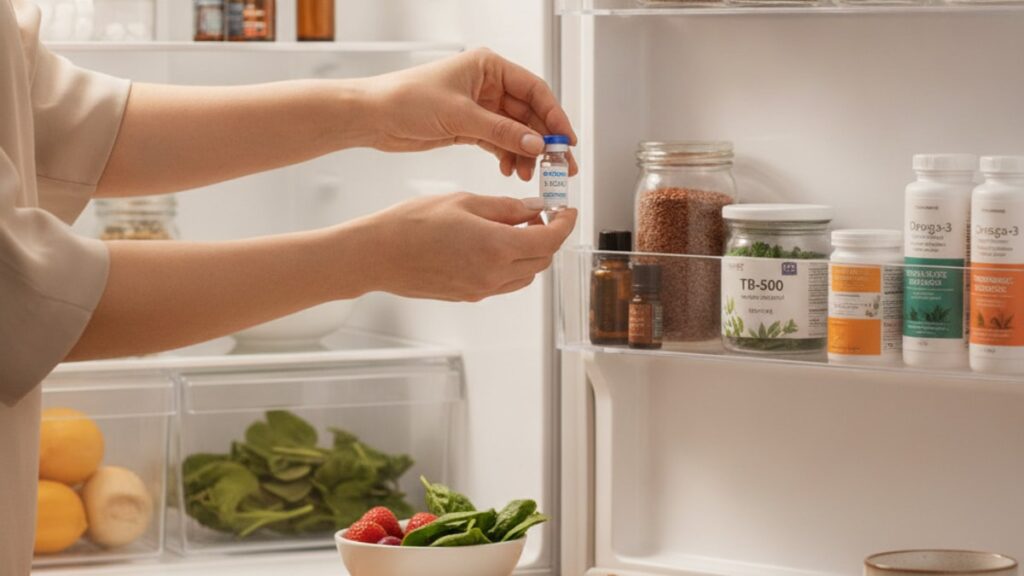
How to Store TB-500 Long Term — Peptide Stability Guide
A 2019 stability analysis published in the Journal of Pharmaceutical Sciences found that thymosin beta-4 (TB-500) loses approximately 15% potency per month when stored at room temperature post-reconstitution. But near-zero degradation when maintained at −20°C in lyophilized form. The difference between doing this right and wasting expensive research material comes down to three storage transitions most protocols ignore: the initial freeze, the reconstitution environment, and the post-mix refrigeration window.
We've worked with research labs handling peptides for years. The gap between proper TB-500 storage and common practice is shockingly wide. And it's costing researchers both money and reliable data.
How should you store TB-500 long term to maintain peptide stability and prevent degradation?
To store TB-500 long term, keep unreconstituted lyophilized powder at −20°C in a standard laboratory freezer with stable temperature control. Once reconstituted with bacteriostatic water, transfer immediately to refrigeration at 2–8°C and use within 28 days. Temperature excursions above 8°C cause irreversible protein denaturation that visual inspection cannot detect. Peptide degradation is a molecular process invisible to the naked eye.
Most researchers assume refrigeration alone protects reconstituted peptides indefinitely. It doesn't. TB-500 in solution begins degrading the moment water contacts the lyophilized powder. Refrigeration slows that process but doesn't stop it. The 28-day window isn't arbitrary; it reflects the half-life of peptide bond stability in aqueous solution at 2–8°C. This article covers the three critical storage phases, the reconstitution errors that accelerate degradation, and what temperature monitoring actually requires in practice.
Step 1: Store Unreconstituted TB-500 at −20°C in a Stable Freezer Environment
Lyophilized TB-500 powder maintains near-complete stability for 24–36 months when stored at −20°C. The peptide exists in a desiccated crystalline state. No water means no hydrolysis, no oxidation, and no enzymatic breakdown. Standard laboratory freezers designed for biological samples work perfectly for this purpose; specialized ultra-low temperature freezers (−80°C) offer no meaningful advantage for TB-500 storage and add unnecessary equipment cost.
The critical variable isn't the freezer's minimum temperature. It's temperature consistency. Frost-free freezers cycle through defrost phases that temporarily raise internal temperature to −10°C to −5°C for 20–30 minutes. These excursions don't harm lyophilized peptides if they occur once every 8–12 hours, but manual defrost freezers eliminate the variable entirely. For long-term peptide storage extending beyond 12 months, a manual-defrost unit with a standalone thermometer removes one failure point.
Place vials in the back third of the freezer, away from the door. Every door opening introduces warm air that takes 15–20 minutes to equilibrate back to −20°C. Vials stored near the door experience 3–5°C temperature swings with each access. Cumulative exposure over months accelerates moisture absorption even in sealed lyophilized powder. Store vials upright in a labeled container; horizontal storage allows condensation to pool against the rubber stopper if temperature fluctuates.
Packaging integrity matters as much as temperature. TB-500 typically ships in amber glass vials with crimped rubber stoppers and aluminum seals. That seal prevents atmospheric moisture from penetrating the vial. Once broken, the peptide is exposed to ambient humidity. Never remove the aluminum cap until you're ready to reconstitute. If a vial arrives with a loose or missing seal, contact the supplier for replacement; that product has been compromised regardless of visual appearance.
Step 2: Reconstitute TB-500 Using Bacteriostatic Water in a Controlled Environment
Reconstitution is where most TB-500 degradation begins. Not because of what researchers do, but what they don't control. The moment bacteriostatic water contacts lyophilized peptide, the clock starts. From that point forward, TB-500 exists in an aqueous solution where hydrolysis, oxidation, and bacterial contamination become active threats. Proper reconstitution technique extends the usable window; careless reconstitution cuts it in half.
Use bacteriostatic water, not sterile water. Bacteriostatic water contains 0.9% benzyl alcohol, which inhibits bacterial growth for 28 days after the vial is opened. Sterile water has no preservative. Once you puncture the seal and introduce a needle, any airborne bacteria that enter during subsequent draws will proliferate within 48–72 hours. The infection risk isn't theoretical; contaminated peptide solutions cause localized tissue reactions in research models and invalidate experimental data.
Reconstitute TB-500 at room temperature (20–25°C), not cold. Cold peptide powder takes longer to dissolve, increasing the time the solution sits exposed to ambient air. Bring the lyophilized vial to room temperature for 10–15 minutes before adding water. Inject bacteriostatic water slowly down the side of the vial. Never spray it directly onto the powder, which creates foam and denatures surface peptides through shear stress. Swirl gently to dissolve; do not shake. Vigorous agitation introduces air bubbles that accelerate oxidative degradation.
Once fully dissolved, transfer the reconstituted TB-500 immediately to refrigeration at 2–8°C. Do not leave reconstituted peptide at room temperature for more than 30 minutes. Every hour at 20–25°C accelerates degradation by a factor of approximately 2–3× compared to refrigerated storage. If you reconstitute multiple vials, move each to refrigeration as soon as it's dissolved. Don't wait to finish the entire batch before transferring.
Our experience with research clients shows reconstitution errors cause more peptide loss than storage errors. The process feels simple, but precision matters. We've seen researchers lose entire batches because they reconstituted at room temperature and left vials on the bench for two hours while finishing other tasks. By the time those vials reached refrigeration, peptide integrity was already compromised.
Step 3: Refrigerate Reconstituted TB-500 at 2–8°C and Use Within 28 Days
Reconstituted TB-500 stored at 2–8°C maintains approximately 90–95% potency for 28 days. Beyond that window, degradation accelerates. Peptide bonds begin hydrolyzing, and the benzyl alcohol preservative in bacteriostatic water loses antimicrobial efficacy. The 28-day limit isn't a suggestion; it's the outer boundary of reliable peptide stability in aqueous solution under optimal conditions.
Store reconstituted vials in the main refrigerator compartment, not the door. Refrigerator doors experience temperature swings of 3–5°C every time the unit opens. A vial stored in the door may spend 20–30% of its storage time above 8°C, which compounds degradation over weeks. The back wall of the middle shelf maintains the most stable temperature in standard refrigerators. That's where TB-500 belongs.
Monitor refrigerator temperature with a standalone thermometer, not the built-in display. Built-in displays measure air temperature near the cooling element, not the actual temperature inside stored vials. A digital thermometer with a probe placed next to your peptide vials gives you the real storage temperature. If that reading exceeds 8°C at any point, peptide degradation accelerates. And you won't know unless you're measuring it directly.
Label every vial with the reconstitution date using permanent marker. Write the date on the vial body, not the cap. Caps get removed and can be mixed up during use. On day 29, discard any remaining solution regardless of appearance. Degraded peptides don't change color, don't smell different, and don't look wrong. Molecular breakdown is invisible. Using TB-500 beyond the 28-day window introduces a variable you can't control or measure without mass spectrometry.
Never freeze reconstituted TB-500. Freezing aqueous peptide solutions causes ice crystal formation, which ruptures peptide structures and denatures proteins. Researchers sometimes attempt to extend shelf life by freezing reconstituted vials. This destroys more peptide than it preserves. If you won't use the full vial within 28 days, reconstitute only the amount you need and leave the remainder in lyophilized form at −20°C.
TB-500 Storage: Lyophilized vs Reconstituted Comparison
Before reconstituting TB-500, understand the trade-offs between lyophilized and aqueous storage:
| Storage State | Temperature | Shelf Life | Degradation Rate | Contamination Risk | Best Use Case | Professional Assessment |
|---|---|---|---|---|---|---|
| Lyophilized powder | −20°C | 24–36 months | <1% per year | Minimal (sealed vial) | Long-term inventory storage before use | Optimal for storage. No time pressure, maximum stability, lowest risk |
| Reconstituted solution | 2–8°C | 28 days maximum | ~5% per month | Moderate (bacterial growth after 28 days) | Active research protocols requiring daily dosing | Use-it-or-lose-it window. Plan dosing schedule before reconstitution |
| Room temperature (reconstituted) | 20–25°C | 24–48 hours | ~15% per month equivalent | High (rapid bacterial proliferation) | Emergency short-term holding only | Avoid entirely. Degradation accelerates, contamination risk spikes |
The table makes the strategy clear: store TB-500 long term in lyophilized form and reconstitute only when you're ready to begin a dosing protocol. Reconstitution is irreversible. Once water contacts the peptide, the 28-day countdown begins whether you use the product or not.
Key Takeaways
- Lyophilized TB-500 maintains near-complete stability for 24–36 months when stored at −20°C in a manual-defrost or frost-free freezer.
- Reconstitute TB-500 with bacteriostatic water at room temperature using slow injection down the vial wall. Never spray directly onto the powder.
- Refrigerate reconstituted TB-500 at 2–8°C immediately after mixing and use within 28 days to maintain 90–95% potency.
- Temperature excursions above 8°C cause irreversible peptide denaturation that visual inspection cannot detect. Molecular breakdown is invisible.
- Never freeze reconstituted TB-500. Ice crystal formation ruptures peptide structures and destroys protein integrity.
- Monitor refrigerator temperature with a standalone digital thermometer placed next to stored vials, not the built-in display.
What If: TB-500 Storage Scenarios
What If I Accidentally Left Reconstituted TB-500 Out Overnight?
Discard it. TB-500 stored at room temperature (20–25°C) for 8–12 hours loses approximately 10–15% potency. And you have no way to measure the actual degradation without laboratory analysis. The peptide may still show effects in research models, but you've introduced an uncontrolled variable that compromises data reliability. Researchers who attempt to salvage room-temperature-exposed peptides often see inconsistent results across subsequent experiments. The loss isn't uniform across the vial, making every draw unpredictable. Replace the vial and adjust your protocol to prevent future temperature excursions.
What If My Freezer Malfunctioned and TB-500 Thawed Completely?
If the vial remained sealed and you catch it within 24 hours, refrigerate immediately and use it as reconstituted peptide (28-day window starting now). If the vial sat at room temperature for more than 24 hours, or if you don't know how long it was thawed, discard it. Lyophilized TB-500 that undergoes uncontrolled thawing absorbs atmospheric moisture, which initiates hydrolysis even if the peptide appears dry. Visual inspection is useless here. Moisture content at the molecular level determines stability, and that requires specialized equipment to measure. Most peptide suppliers recommend discarding any lyophilized product exposed to uncontrolled thawing rather than risk using compromised material.
What If I Need to Transport TB-500 to Another Location?
For lyophilized TB-500, use a cooler with ice packs rated for −20°C (blue ice or gel packs frozen solid). Place the peptide vial in a sealed plastic bag inside the cooler to prevent condensation contact during temperature transition. Lyophilized peptides tolerate short-term temperature elevation to 0–4°C for 24–48 hours without significant degradation. The goal is preventing moisture exposure, not maintaining perfect −20°C. For reconstituted TB-500, use an insulated medical cooler designed for injectable medications (FRIO-style evaporative coolers or hard-shell coolers with cold packs). Keep temperature between 2–8°C throughout transport; any excursion above 10°C begins accelerating degradation.
The Unfiltered Truth About TB-500 Storage
Here's the honest answer: most TB-500 storage failures happen because researchers assume refrigeration alone is sufficient. It's not. The 28-day reconstituted shelf life isn't a conservative estimate. It's the outer boundary of peptide stability under optimal conditions, backed by accelerated degradation studies and peptide bond hydrolysis kinetics. Researchers who treat that timeline as flexible are introducing degradation variables they can't measure or control. The peptide doesn't change color when it degrades. It doesn't smell wrong. It doesn't separate or precipitate in solution. Molecular breakdown is invisible. And by the time experimental results show inconsistency, you've already wasted weeks of research time on compromised material.
The storage protocol for TB-500 isn't complicated, but it's unforgiving. Temperature excursions, poor reconstitution technique, and extended shelf life assumptions all compound into unreliable peptide integrity. If you're storing TB-500 long term for research, the single most important decision is this: reconstitute only what you'll use within four weeks. Lyophilized powder at −20°C gives you years of stability. Reconstituted solution gives you one month. Plan your dosing schedule before you add water. Because once you do, the clock is running whether you're ready or not.
Temperature precision determines whether you're working with a functional peptide or an expensive saline solution. If TB-500 storage feels like overkill, the alternative is paying for peptides you can't rely on. Our team at Real Peptides synthesizes every batch with exact amino-acid sequencing under small-batch quality control. But even the highest-purity TB-500 degrades if stored incorrectly after it arrives. Storage discipline matters as much as peptide purity.
If your research requires long-term peptide reliability, proper storage is the non-negotiable foundation. TB-500 works when stored right. The rest is execution.
Frequently Asked Questions
How long can you store TB-500 long term in lyophilized form before it degrades?▼
Lyophilized TB-500 stored at −20°C maintains near-complete stability for 24–36 months with less than 1% degradation per year. The peptide exists in a desiccated crystalline state where hydrolysis and oxidation cannot occur. Beyond 36 months, gradual moisture absorption through the vial seal may begin affecting potency, though many researchers report reliable results up to 48 months under ideal storage conditions.
Can I store TB-500 long term at room temperature if the vial is sealed?▼
No. Even sealed lyophilized TB-500 degrades at room temperature due to atmospheric moisture penetration through the rubber stopper over time. Studies show lyophilized peptides stored at 20–25°C lose approximately 5–8% potency per month compared to near-zero degradation at −20°C. Room temperature storage is only acceptable for unopened vials during transit (24–48 hours maximum).
What happens if I freeze reconstituted TB-500 to extend its shelf life?▼
Freezing reconstituted TB-500 causes ice crystal formation that ruptures peptide structures and denatures proteins — destroying more peptide than it preserves. Once TB-500 is in aqueous solution, freezing is irreversible damage. If you won’t use the full vial within 28 days, reconstitute only the amount needed and leave the remainder in lyophilized form at −20°C.
How do I know if my TB-500 has degraded from improper storage?▼
You can’t tell by appearance. Degraded TB-500 doesn’t change color, smell, or separate in solution — molecular breakdown is invisible without mass spectrometry analysis. The only reliable indicator is experimental inconsistency (reduced effects in research models). This is why strict storage protocol matters: once peptide integrity is compromised, visual inspection provides no warning.
Is bacteriostatic water required to store TB-500 long term after reconstitution?▼
Yes. Bacteriostatic water contains 0.9% benzyl alcohol that inhibits bacterial growth for 28 days after opening. Sterile water has no preservative — airborne bacteria introduced during needle puncture will proliferate within 48–72 hours, causing contamination that invalidates research data. For any reconstituted peptide used over multiple days, bacteriostatic water is non-negotiable.
Can I store TB-500 long term in a frost-free freezer, or do I need a manual-defrost unit?▼
Frost-free freezers work fine for TB-500 storage. Their defrost cycles briefly raise temperature to −10°C to −5°C for 20–30 minutes, but this doesn’t harm lyophilized peptides if cycles occur once every 8–12 hours. Manual-defrost freezers eliminate the variable entirely and are preferable for storage exceeding 12 months, but frost-free units are acceptable for most research timelines.
What temperature should I store TB-500 long term to prevent degradation?▼
Store lyophilized TB-500 at −20°C and reconstituted TB-500 at 2–8°C. Temperature excursions above 8°C for reconstituted peptide or above −10°C for lyophilized powder accelerate degradation significantly. Use a standalone digital thermometer to monitor actual vial temperature rather than relying on built-in freezer or refrigerator displays, which measure air temperature near the cooling element.
How long does reconstituted TB-500 remain stable when refrigerated?▼
Reconstituted TB-500 maintains approximately 90–95% potency for 28 days when stored at 2–8°C. Beyond that window, peptide bond hydrolysis accelerates and the benzyl alcohol preservative in bacteriostatic water loses antimicrobial efficacy. The 28-day limit is the outer boundary of reliable stability — discard any remaining solution after day 28 regardless of appearance.
What is the biggest mistake researchers make when trying to store TB-500 long term?▼
The most common error is reconstituting the entire vial before planning a dosing schedule. Once TB-500 is mixed with water, the 28-day countdown begins whether you use it or not. Researchers who reconstitute ‘just in case’ often waste peptide when protocols change or experiments get delayed. Always reconstitute only what you’ll use within four weeks and leave the remainder in lyophilized form at −20°C.
Does TB-500 need to be stored in amber glass vials, or can I transfer it to plastic?▼
TB-500 should remain in its original amber glass vial. Amber glass blocks UV light that degrades peptides, and pharmaceutical-grade glass doesn’t leach chemicals into the solution. Transferring reconstituted TB-500 to plastic syringes or vials introduces contamination risk and potential chemical leaching from certain plastics. If you must pre-load syringes, use polypropylene medical-grade syringes and refrigerate for no more than 7 days.











