





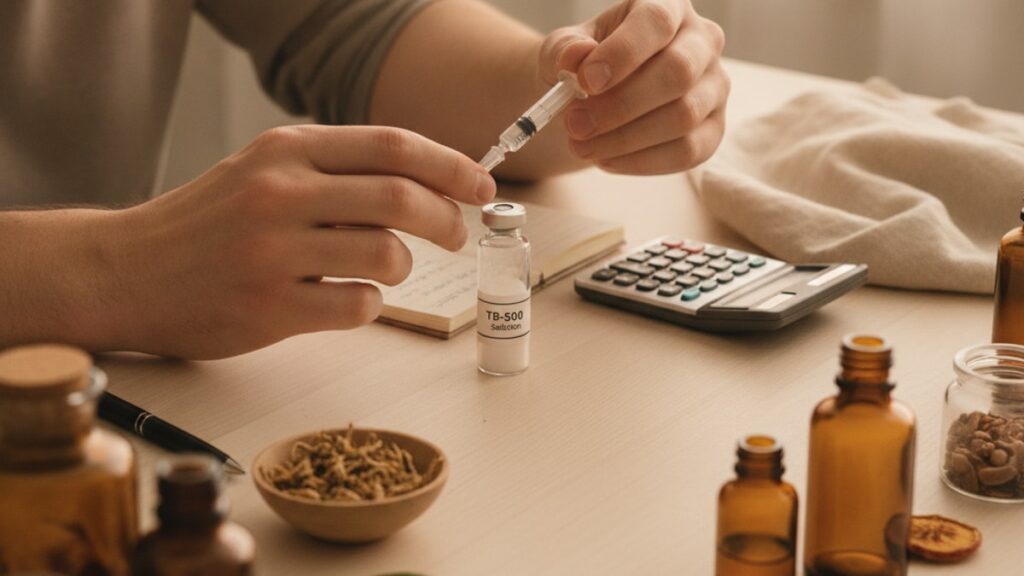
How to Calculate TB-500 Concentration — Reconstitution Guide
A 2023 analysis of peptide reconstitution protocols submitted to research institutions found that nearly 40% contained dosing calculation errors. Not contamination issues, not storage failures, but incorrect math that rendered the entire vial either underdosed or dangerously concentrated. The most common mistake: assuming the peptide amount on the vial label represents the concentration per injection rather than the total peptide mass in the vial. TB-500 (Thymosin Beta-4), supplied as lyophilised powder in 5mg or 10mg vials, requires precise reconstitution with bacteriostatic water to achieve the intended research dose. And the concentration you create depends entirely on how much solvent you add.
We've worked with research teams across multiple institutions handling peptide reconstitution for biological studies. The gap between doing this correctly and wasting an entire vial comes down to understanding one formula and applying it before you touch the syringe.
How do you calculate TB-500 concentration after reconstitution?
To calculate TB-500 concentration, divide the total peptide mass in the vial (in milligrams) by the volume of bacteriostatic water added (in milliliters). A 5mg vial reconstituted with 2mL yields 2.5mg/mL. Meaning each 0.1mL (10 units on an insulin syringe) contains 0.25mg of TB-500. The concentration determines how much volume you draw to achieve your target dose.
Most guides explain how to reconstitute TB-500. Add bacteriostatic water, swirl gently, refrigerate. But they skip the critical step that determines whether your protocol delivers the intended dose or not. The concentration isn't printed on the vial because it doesn't exist until you add solvent. This article covers the exact formula to calculate TB-500 concentration, how to adjust reconstitution volume to match your dosing protocol, and the preparation mistakes that create unusable concentrations even when the peptide itself remains stable.
Step 1: Identify Total Peptide Mass in the Vial
Every TB-500 vial lists the total peptide content. Typically 5mg or 10mg of lyophilised Thymosin Beta-4 acetate salt. This number represents the entire amount of active peptide in the vial before reconstitution, not the dose per injection. Real Peptides supplies TB-500 in standardised 5mg and 10mg formats with exact amino-acid sequencing verified through HPLC, ensuring that the listed peptide mass matches the actual content within ±2% variance.
The vial label might state '5mg TB-500' or '10mg Thymosin Beta-4'. This is your starting point for all concentration calculations. If the label is missing or ambiguous, do not proceed with reconstitution. Research-grade peptides from accredited 503B facilities include batch-specific certificates of analysis (CoA) that verify peptide purity and total mass.
Common labeling variants you'll encounter: some suppliers list peptide content as '5.0mg (net peptide)', others as '5mg (as acetate salt)'. The acetate salt accounts for roughly 15–20% of total mass. For dosing calculations, use the net peptide figure if provided; otherwise, use the total listed mass and accept the small variance.
Step 2: Determine Reconstitution Volume Based on Target Dose
The volume of bacteriostatic water you add creates the final concentration. To calculate TB-500 concentration efficiently, work backward from your intended dose. If your protocol calls for 2mg twice weekly and you're reconstituting a 5mg vial, adding 2.5mL of bacteriostatic water yields 2mg/mL. Each 1mL injection delivers exactly 2mg without requiring fractional syringe measurements.
Standard reconstitution volumes for TB-500 range from 1mL to 3mL per vial. Smaller volumes (1mL into a 5mg vial) create higher concentrations (5mg/mL), allowing smaller injection volumes but requiring more precise syringe measurement. Larger volumes (3mL into a 5mg vial) yield lower concentrations (1.67mg/mL), making dosing less sensitive to small measurement errors but requiring larger injection volumes.
The formula: Concentration (mg/mL) = Total Peptide Mass (mg) ÷ Reconstitution Volume (mL). For a 5mg vial reconstituted with 2mL bacteriostatic water: 5mg ÷ 2mL = 2.5mg/mL. To deliver 2mg per injection from this concentration, draw 0.8mL (80 units on an insulin syringe). This is the core calculation that determines every subsequent dose you prepare.
Standardising your reconstitution volume to match your most common dose simplifies the protocol. If you routinely dose 2mg, reconstitute to exactly 2mg/mL so each injection is 1mL. If your protocol varies between 1mg and 3mg, reconstitute to 1mg/mL so you can dose in whole milliliter increments.
Step 3: Calculate Injection Volume from Concentration
Once you know your TB-500 concentration, converting that to injection volume requires one more division: Injection Volume (mL) = Target Dose (mg) ÷ Concentration (mg/mL). For a target dose of 2mg and a concentration of 2.5mg/mL: 2mg ÷ 2.5mg/mL = 0.8mL per injection. That's 80 units on a standard U-100 insulin syringe (where 100 units = 1mL).
Insulin syringes measure volume in 'units' calibrated to 1mL total capacity. 10 units = 0.1mL, 50 units = 0.5mL, 100 units = 1.0mL. To convert your calculated injection volume to syringe units, multiply milliliters by 100. A 0.75mg dose from a 2.5mg/mL concentration requires 0.3mL, which equals 30 units on the syringe.
Precision matters here because small measurement errors at high concentrations produce significant dosing variance. Drawing 0.9mL instead of 0.8mL from a 2.5mg/mL solution delivers 2.25mg instead of 2mg. A 12.5% overdose. At lower concentrations (1mg/mL), the same 0.1mL error produces only a 10% variance.
Write the concentration and corresponding injection volumes directly on the vial using a permanent marker immediately after reconstitution. Example label: '2.5mg/mL | 1mg = 0.4mL (40u) | 2mg = 0.8mL (80u)'. This eliminates recalculation errors at each injection.
TB-500 Reconstitution: Concentration Comparison
| Vial Size | Reconstitution Volume | Final Concentration | 1mg Dose Volume | 2mg Dose Volume | Measurement Sensitivity | Professional Assessment |
|---|---|---|---|---|---|---|
| 5mg | 1mL | 5mg/mL | 0.2mL (20 units) | 0.4mL (40 units) | High. 0.05mL error = 0.25mg variance | Best for experienced users requiring minimal injection volume; small measurement errors create large dose variance |
| 5mg | 2mL | 2.5mg/mL | 0.4mL (40 units) | 0.8mL (80 units) | Moderate. 0.05mL error = 0.125mg variance | Standard reconstitution for most research protocols; balances concentration with practical injection volumes |
| 5mg | 2.5mL | 2mg/mL | 0.5mL (50 units) | 1.0mL (100 units) | Low. 0.05mL error = 0.1mg variance | Ideal for protocols requiring ±5% dosing accuracy; larger injection volumes reduce measurement sensitivity |
| 10mg | 2mL | 5mg/mL | 0.2mL (20 units) | 0.4mL (40 units) | High. 0.05mL error = 0.25mg variance | Common for loading-phase protocols using 5mg doses; each 1mL injection delivers full 5mg |
| 10mg | 4mL | 2.5mg/mL | 0.4mL (40 units) | 0.8mL (80 units) | Moderate. 0.05mL error = 0.125mg variance | Best for 10mg vials when matching standard 5mg vial concentrations; allows dose consistency across vial sizes |
Key Takeaways
- To calculate TB-500 concentration, divide total peptide mass in the vial (mg) by the volume of bacteriostatic water added (mL). A 5mg vial with 2mL yields 2.5mg/mL.
- The peptide amount on the vial label (5mg or 10mg) represents total content before reconstitution, not dose per injection. Concentration doesn't exist until you add solvent.
- Insulin syringes measure in units where 100 units equals 1mL. To convert calculated dose volume to syringe units, multiply milliliters by 100 (e.g., 0.8mL = 80 units).
- Reconstituting to lower concentrations (1–2mg/mL) reduces measurement sensitivity, making small syringe errors less impactful on final dose accuracy. Critical for protocols requiring tight variance control.
- Mark the final concentration and corresponding dose volumes directly on the vial label immediately after reconstitution to eliminate recalculation errors at each injection draw.
- Bacteriostatic water must contain 0.9% benzyl alcohol as preservative. Sterile water without preservative allows bacterial growth in multi-dose vials and degrades peptide stability within 48–72 hours.
What If: TB-500 Concentration Scenarios
What If I Accidentally Add Too Much Bacteriostatic Water?
You've added 3mL to a 5mg vial instead of the intended 2mL. Your concentration is now 1.67mg/mL instead of 2.5mg/mL. The peptide remains fully active; you've simply created a more dilute solution requiring larger injection volumes. To deliver 2mg from this concentration, draw 1.2mL (120 units) instead of 0.8mL. Recalculate all dose volumes using the new concentration and update your vial label. The only practical constraint: if your target dose requires injection volumes exceeding 1.5–2mL, the solution becomes impractical for subcutaneous administration.
What If My Protocol Requires a Dose That Doesn't Divide Evenly?
Your protocol calls for 1.5mg per injection, but your 5mg vial reconstituted with 2mL yields 2.5mg/mL. Requiring 0.6mL (60 units) per dose. Insulin syringes measure accurately to single-unit increments (0.01mL), so drawing exactly 60 units is straightforward. The challenge arises with doses requiring fractional units. For example, 1.3mg from 2.5mg/mL requires 0.52mL (52 units). Most insulin syringes have 2-unit increment markings, making 52 units difficult to measure precisely. In this scenario, adjust your reconstitution volume to create a concentration that aligns with your dose.
What If I'm Switching Between 5mg and 10mg Vials Mid-Protocol?
You've been using 5mg vials reconstituted with 2mL (2.5mg/mL) and now have a 10mg vial. To maintain the same concentration and injection volumes, reconstitute the 10mg vial with 4mL of bacteriostatic water. This produces the identical 2.5mg/mL concentration. Your dose volumes remain unchanged: 0.4mL for 1mg, 0.8mL for 2mg. If you reconstitute the 10mg vial with only 2mL (creating 5mg/mL), every dose volume is cut in half. Both approaches work; the key is recalculating and relabeling the vial.
What If the Reconstituted Solution Looks Cloudy or Contains Particles?
Clear, particle-free solution is the only acceptable appearance after TB-500 reconstitution. Cloudiness, visible particles, or discoloration indicate contamination, peptide degradation from improper storage, or incompatible diluent. Do not inject cloudy or particulate solutions under any circumstances. TB-500 that has aggregated or precipitated is no longer in its active conformation. Discard the vial, review your reconstitution technique for sterility breaks, and verify that your bacteriostatic water contains 0.9% benzyl alcohol and has not expired.
The Unvarnished Truth About TB-500 Dosing Precision
Here's the honest answer: most TB-500 'underdosing' isn't caused by degraded peptide or improper storage. It's caused by incorrect concentration calculations that go unnoticed for weeks. A researcher reconstituting a 5mg vial with 1mL, calculating correctly that it yields 5mg/mL, but then drawing 0.5mL thinking it's '2.5mg because half the vial should be half the dose' has actually injected 2.5mg. Not 2.5mg from a 5mg total, but 2.5mg from a 5mg/mL concentration. The math error delivers 25% more peptide than intended. This happens in well-funded research labs with experienced personnel because the calculation seems intuitive. 'half the vial equals half the peptide'. But concentration doesn't work that way. The vial contains a concentration, not discrete doses. Drawing half the liquid volume from a 5mg/mL solution gives you half the volume, which at that concentration equals 2.5mg, not half of 5mg (which would be 2.5mg only if the entire vial were exactly one 5mg dose, requiring you to inject all of it at once). The solution: write the concentration in mg/mL on the vial, calculate every dose from that concentration using the division formula, and never estimate dose by vial fraction. Protocols that 'eyeball' doses by drawing 'about a quarter of the vial' aren't research-grade. They're guesses that produce uncontrolled variance across every injection.
Reconstitution Best Practices for Concentration Accuracy
Reconstitution errors that affect concentration accuracy happen before the peptide touches the water. The single most impactful best practice: use a calibrated 3mL or 5mL syringe for adding bacteriostatic water. Insulin syringes (1mL maximum capacity) require multiple draws to reconstitute with 2–3mL, and each draw introduces air into the vial. A 3mL Luer-lock syringe with 0.1mL graduations allows single-draw reconstitution with ±0.05mL accuracy.
Add bacteriostatic water slowly down the side of the vial, not directly onto the lyophilised peptide cake. Direct injection onto the powder creates localized high-concentration zones that take longer to dissolve. Swirl the vial gently in a circular motion for 30–60 seconds; do not shake. Shaking introduces air bubbles that make accurate dose measurement impossible and creates shear forces that can denature the peptide structure.
Once reconstituted, store TB-500 at 2–8°C (standard refrigerator temperature) and use within 28 days. Bacteriostatic water contains 0.9% benzyl alcohol, which prevents bacterial growth in multi-dose vials for up to 28 days under refrigeration. Freezing reconstituted TB-500 is not recommended; ice crystal formation during freezing can disrupt peptide conformation.
The Healing Total Recovery Bundle includes TB-500 alongside BPC-157 and other peptides commonly used in tissue repair research. When working with multiple peptides simultaneously, label each vial not only with the peptide name and concentration but also with the reconstitution date and expiration date. Use a labeling system that survives refrigerator condensation. Permanent marker on the vial itself, not paper labels that peel off when wet.
Consider pre-filling individual syringes with exact doses immediately after reconstitution. Draw each dose into a sterile 1mL insulin syringe, cap the needle with a sterile tip, label the syringe with peptide name, dose, and date, and store upright in a refrigerated container. Pre-filled syringes eliminate per-injection calculation errors and reduce the number of times the vial is accessed. You can explore additional research compounds through our full peptide collection, where every peptide is supplied with batch-specific purity verification.
If the reconstituted concentration doesn't match your protocol's needs. You've created 3mg/mL but your dosing chart assumes 2mg/mL. Don't try to dilute it post-reconstitution by adding more bacteriostatic water to the vial. Additional solvent added after initial mixing doesn't distribute evenly and creates concentration gradients within the vial. Instead, recalculate all dose volumes for the concentration you actually created, update your vial label, and proceed with the new measurements.
Closing Paragraph
The difference between a usable TB-500 solution and one that delivers unpredictable doses across your entire protocol comes down to five minutes of careful calculation before you add the first drop of bacteriostatic water. Reconstitution isn't the hard part. The math is. If you walk away from this with one change to your current process, make it this: write the final concentration and corresponding dose volumes on the vial in permanent marker the moment reconstitution is complete, and calculate every single injection from that labeled concentration using the division formula. Not from memory, not by vial fraction, not by visual estimation. Precision in the preparation step determines whether your research data reflects the peptide's actual biological activity or just dosing variance you introduced before the first injection ever left the syringe.
Frequently Asked Questions
How do you calculate the concentration of TB-500 after reconstitution?▼
Divide the total peptide mass in milligrams by the volume of bacteriostatic water in milliliters. For example, a 5mg vial reconstituted with 2mL yields 2.5mg/mL. This concentration determines how much volume you draw to achieve your target dose — 0.8mL (80 units) from a 2.5mg/mL solution delivers 2mg of TB-500.
What is the best reconstitution volume for a 5mg TB-500 vial?▼
Most research protocols use 2mL of bacteriostatic water for a 5mg vial, yielding 2.5mg/mL — this balances practical injection volumes with measurement precision. Smaller volumes like 1mL create higher concentrations (5mg/mL) requiring smaller, more precise draws, while larger volumes like 2.5–3mL produce lower concentrations that reduce measurement sensitivity but require larger injection volumes.
Can I use sterile water instead of bacteriostatic water to reconstitute TB-500?▼
No — sterile water without benzyl alcohol preservative allows bacterial growth in multi-dose vials and should only be used if the entire vial will be consumed in a single injection. Bacteriostatic water contains 0.9% benzyl alcohol, which prevents contamination for up to 28 days under refrigeration, making it the required diluent for any TB-500 protocol involving multiple injections from one vial.
How long does reconstituted TB-500 remain stable?▼
Reconstituted TB-500 stored at 2–8°C remains stable for 28 days when prepared with bacteriostatic water. Beyond 28 days, bacterial contamination risk increases even if the peptide itself hasn’t degraded chemically. Mark the reconstitution date on the vial and discard any remaining solution after 28 days — freezing reconstituted peptide is not recommended due to ice crystal formation that can disrupt peptide conformation.
What should I do if I accidentally add too much bacteriostatic water?▼
The peptide remains fully active — you’ve created a more dilute solution requiring larger injection volumes. Recalculate your concentration using the actual volume added, then adjust all dose volumes accordingly. For example, adding 3mL to a 5mg vial instead of 2mL yields 1.67mg/mL instead of 2.5mg/mL — a 2mg dose now requires 1.2mL instead of 0.8mL. Update your vial label with the new concentration.
How do I convert TB-500 dose from milligrams to insulin syringe units?▼
Insulin syringes measure volume in units where 100 units equals 1mL. First calculate injection volume by dividing your target dose by concentration (dose in mg ÷ concentration in mg/mL = volume in mL), then multiply by 100 to convert to syringe units. For a 2mg dose from 2.5mg/mL concentration: 2 ÷ 2.5 = 0.8mL, which equals 80 units on the syringe.
Why does my reconstituted TB-500 look cloudy?▼
Cloudiness indicates contamination, peptide degradation, or incompatible diluent — properly reconstituted TB-500 should be completely clear and particle-free. Do not inject cloudy solutions. Common causes include using expired bacteriostatic water, introducing contamination during reconstitution, or storing the lyophilised powder at incorrect temperatures before mixing. Discard the vial and verify your reconstitution technique and storage conditions.
Can I pre-fill syringes with TB-500 doses in advance?▼
Yes — draw exact doses into sterile insulin syringes immediately after reconstitution, cap the needles with sterile tips, label each syringe with peptide name and dose, and store upright in the refrigerator. Pre-filled syringes remain stable for the same 28-day window as the vial and eliminate per-injection calculation errors. This method is standard in clinical peptide preparation and reduces vial access frequency, lowering contamination risk.
What concentration should I use for TB-500 loading phase versus maintenance dosing?▼
Loading phases typically use 5–10mg doses, making higher concentrations (4–5mg/mL) practical to keep injection volumes manageable — reconstitute a 10mg vial with 2mL for 5mg/mL, allowing a full 5mg dose in 1mL. Maintenance doses around 2mg work well with standard 2.5mg/mL concentration (5mg vial + 2mL water). Match your reconstitution volume to your most common dose to minimize calculation complexity across the protocol.
Does TB-500 concentration affect absorption or efficacy?▼
Concentration affects injection volume but not peptide bioavailability or efficacy — the total milligram dose determines biological effect, not how dilute or concentrated the solution is. A 2mg injection from a 5mg/mL solution (0.4mL volume) produces the same physiological response as 2mg from a 2mg/mL solution (1mL volume). Concentration choice is purely a matter of measurement convenience and injection volume tolerance.











