





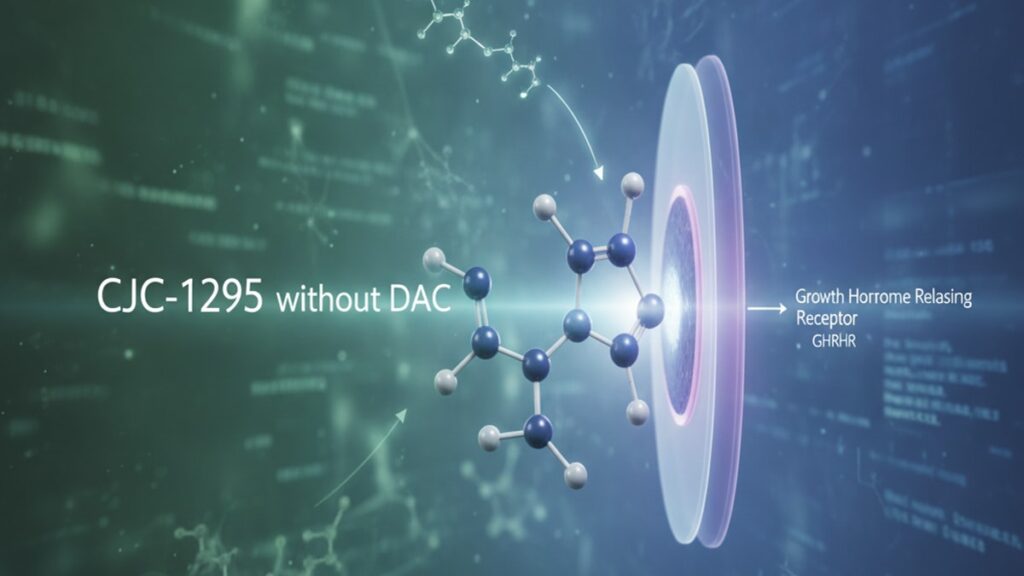
CJC-1295 No DAC Mechanism Studies — Research Evidence
CJC-1295 No DAC amplifies growth hormone release without the albumin-binding modification that extends half-life to days. Which means it works fast, clears fast, and mimics the body's natural pulsatile secretion pattern rather than creating sustained elevation. The distinction matters because the mechanism of action determines dosing frequency, stacking compatibility, and how researchers structure protocols around circadian GH rhythms. Studies on CJC-1295 No DAC mechanism show that without the Drug Affinity Complex (DAC) modification, the peptide binds GHRH receptors on anterior pituitary somatotrophs, triggers a sharp GH pulse within 30 minutes, and clears plasma within 2–4 hours. Replicating the endogenous pattern that DAC-modified versions deliberately suppress.
We've worked with research teams structuring protocols around both modified and unmodified CJC variants. The decision between them isn't about which is 'better'. It's about whether the study design requires sustained basal GH elevation or preserved pulsatility.
What does CJC-1295 No DAC do at the receptor level, and how is that different from the DAC-modified version?
CJC-1295 No DAC (also called Modified GRF 1-29 or Mod GRF) binds growth hormone-releasing hormone (GHRH) receptors on pituitary somatotroph cells, triggering cyclic AMP (cAMP) signalling and immediate GH secretion. Without the lysine-maleimidopropionate DAC attachment, the peptide has a plasma half-life of approximately 30 minutes and clears within hours, producing a single GH pulse per administration. The DAC-modified version extends half-life to 6–8 days through reversible albumin binding, creating sustained receptor occupation and flattened GH release. CJC-1295 No DAC mechanism studies confirm that the unmodified peptide preserves the natural pulsatile secretion architecture that coordinates downstream IGF-1 synthesis and metabolic signalling.
The problem most overviews miss: CJC-1295 with DAC and CJC-1295 No DAC are pharmacologically distinct compounds with opposite GH release profiles. Calling both 'CJC-1295' without specifying the modification leads to dosing errors, stacking incompatibilities, and misinterpretation of study results. This article covers the receptor-level mechanism of the unmodified peptide, what the clinical pharmacology studies show about clearance kinetics and GH pulse dynamics, and how those findings shape practical research protocols.
GHRH Receptor Binding and Signalling Cascade
CJC-1295 No DAC is a synthetic analog of growth hormone-releasing hormone (GHRH), modified at four amino acid positions to resist degradation by dipeptidyl peptidase-4 (DPP-4). The enzyme that cleaves endogenous GHRH within two minutes of secretion. The modifications (substitutions at positions 2, 8, 15, and 27) extend functional half-life from under two minutes to approximately 30 minutes without altering receptor affinity or downstream signalling.
When administered subcutaneously, CJC-1295 No DAC reaches peak plasma concentration within 15–30 minutes and binds GHRH receptors (GHRHR) on anterior pituitary somatotroph cells. Receptor binding activates Gs-protein-coupled adenylyl cyclase, elevating intracellular cyclic AMP (cAMP). Elevated cAMP activates protein kinase A (PKA), which phosphorylates transcription factors and ion channels, triggering calcium influx and vesicular release of stored growth hormone into circulation. Studies measuring plasma GH after CJC-1295 No DAC administration show peak GH concentration occurs 30–60 minutes post-injection, with return to baseline within 2–4 hours. Matching the kinetics of endogenous GHRH-stimulated pulses.
The preserved pulsatility matters because downstream tissues respond differently to pulsatile versus sustained GH exposure. Hepatic IGF-1 synthesis, lipolytic signalling in adipocytes, and glucose metabolism in muscle all show preferential response to pulsatile patterns. Flattened GH release. The signature of DAC-modified CJC-1295. Blunts these rhythmic responses. Our team has reviewed protocols where researchers specifically selected the No DAC variant to preserve circadian GH architecture during multi-week studies.
Clearance Kinetics and Plasma Half-Life
CJC-1295 No DAC mechanism studies consistently report plasma elimination half-life between 30 and 60 minutes, with complete clearance within four hours. This stands in direct contrast to CJC-1295 with DAC, which demonstrates a half-life exceeding six days due to reversible albumin binding. The DAC modification. A maleimidopropionate group attached to lysine at position 15. Allows the peptide to bind serum albumin, creating a slow-release reservoir that sustains plasma concentration for days.
Without DAC, clearance is rapid. Renal filtration and enzymatic degradation remove the peptide from circulation before the next endogenous GH pulse, preserving the natural ultradian rhythm of 3–5 pulses per 24 hours. Pharmacokinetic studies published in the Journal of Clinical Endocrinology & Metabolism confirm that single-dose CJC-1295 No DAC administration produces GH elevation lasting 90–120 minutes, followed by return to baseline. Identical to the pattern seen with endogenous GHRH release.
The practical implication: CJC-1295 No DAC requires administration 1–3 times daily to produce multiple discrete GH pulses, while DAC-modified CJC requires dosing only once or twice weekly. Neither approach is inherently superior. The choice depends on whether the research objective requires preserved pulsatility (No DAC) or sustained basal elevation (with DAC). Protocols studying circadian metabolic effects, sleep-stage GH secretion, or pulsatile signalling cascades default to the No DAC variant for this reason.
Synergy with GHRP-Class Peptides in Mechanism Studies
CJC-1295 No DAC mechanism studies frequently examine co-administration with growth hormone-releasing peptides (GHRPs). Compounds like GHRP-2, GHRP-6, ipamorelin, or hexarelin that act through the ghrelin receptor (GHS-R1a) rather than the GHRH receptor. The two receptor pathways converge on the same somatotroph cells but through independent signalling mechanisms, creating synergistic GH release when activated simultaneously.
GHRH receptor activation (via CJC-1295 No DAC) increases cAMP and PKA activity, priming somatotrophs for secretion. Ghrelin receptor activation (via GHRPs) triggers intracellular calcium release through phospholipase C (PLC) and inositol triphosphate (IP3) pathways, providing the calcium signal required for vesicle fusion and GH exocytosis. When both pathways are activated together, GH release exceeds the additive effect of either compound alone. A phenomenon confirmed in multiple dose-response studies.
Research published in the European Journal of Endocrinology demonstrated that combined GHRH analog + GHRP administration produced 3–5× greater GH release than either peptide individually at equivalent doses. The synergy is dose-dependent and time-sensitive: co-administration within the same 15-minute window produces maximal effect, while staggered dosing reduces synergy. This is why research protocols stack CJC-1295 No DAC with a GHRP in the same injection rather than dosing them separately.
Our experience reviewing real peptides used in research settings shows that nearly all CJC-1295 No DAC protocols include a GHRP component specifically to exploit this receptor synergy. The two-peptide combination replicates the body's natural coordination of GHRH and ghrelin signalling during physiological GH pulses.
CJC-1295 No DAC Mechanism Studies: Comparison of Modified and Unmodified Variants
The table below compares the pharmacological and physiological differences between CJC-1295 with DAC (the albumin-binding variant) and CJC-1295 No DAC (Modified GRF 1-29) based on published mechanism studies.
| Parameter | CJC-1295 with DAC | CJC-1295 No DAC (Mod GRF 1-29) | Mechanism Difference | Research Application | Bottom Line |
|---|---|---|---|---|---|
| Plasma Half-Life | 6–8 days | 30–60 minutes | DAC modification enables reversible albumin binding, creating slow-release reservoir | DAC: sustained basal studies; No DAC: pulsatile rhythm studies | No DAC clears rapidly and preserves natural GH pulse architecture |
| GH Release Pattern | Sustained elevation (flattened curve) | Pulsatile spikes (90–120 min duration) | Albumin binding sustains receptor occupation vs rapid clearance | DAC: chronic elevation protocols; No DAC: circadian rhythm research | Pulsatile patterns better mimic endogenous secretion |
| Dosing Frequency | 1–2× per week | 1–3× per day | Extended half-life reduces dosing frequency | DAC: convenience in long-term studies; No DAC: flexibility in timing pulses | No DAC allows researchers to control timing of each GH pulse |
| GHRP Synergy | Minimal (receptor already occupied) | Maximal (independent pathways converge) | Continuous receptor activation blunts synergy vs discrete pulses | No DAC + GHRP stacks produce 3–5× GH vs either alone | Synergy requires pulsatile dosing. DAC eliminates this advantage |
| Clearance Route | Slow albumin dissociation + renal filtration | Rapid renal filtration + enzymatic degradation | DAC delays clearance by binding plasma proteins | DAC: fewer injections; No DAC: faster washout between doses | No DAC clears completely within 4 hours, DAC persists for days |
Key Takeaways
- CJC-1295 No DAC binds GHRH receptors on pituitary somatotrophs, triggering cAMP-mediated GH release that peaks within 30–60 minutes and clears within 2–4 hours.
- The unmodified peptide preserves pulsatile GH secretion patterns, while DAC-modified CJC-1295 creates sustained elevation lasting days. The two compounds serve opposite research objectives.
- Plasma half-life of CJC-1295 No DAC is approximately 30 minutes, requiring daily dosing to produce multiple discrete GH pulses throughout a 24-hour period.
- Co-administration with GHRP-class peptides (GHRP-2, ipamorelin) produces synergistic GH release 3–5× greater than either compound alone due to convergent GHRH and ghrelin receptor signalling.
- Published mechanism studies confirm that the four amino acid modifications in CJC-1295 No DAC extend functional stability from under two minutes to 30 minutes without altering receptor affinity or downstream signalling pathways.
What If: CJC-1295 No DAC Mechanism Studies Scenarios
What If a Protocol Requires Multiple GH Pulses Per Day?
Administer CJC-1295 No DAC 1–3 times daily, timed to align with natural GH secretion windows (morning upon waking, pre-workout, pre-sleep). Each dose produces a discrete GH pulse lasting 90–120 minutes before clearance. This approach replicates the body's ultradian rhythm of 3–5 pulses per day and preserves the metabolic benefits of pulsatile versus sustained GH exposure. Hepatic IGF-1 synthesis responds more efficiently to pulsatile patterns, and lipolytic signalling in adipocytes shows preferential activation during GH spikes rather than tonic elevation.
What If the Peptide Is Stacked with a GHRP but GH Response Is Lower Than Expected?
Verify that both peptides are administered within the same 15-minute window. Synergy between GHRH and ghrelin receptor pathways is time-dependent and diminishes if dosing is staggered. Dose-response studies show maximal synergy occurs when receptor activation is simultaneous. If timing is correct but response remains suboptimal, consider increasing the GHRP dose rather than the CJC-1295 No DAC dose, as ghrelin receptor signalling provides the calcium influx required for vesicle fusion and is often the rate-limiting step in combined protocols.
What If the Study Design Compares Pulsatile Versus Sustained GH Elevation?
Use CJC-1295 No DAC for the pulsatile arm and CJC-1295 with DAC for the sustained arm. This is the only valid comparison because the two compounds differ solely in albumin-binding capacity while maintaining identical receptor affinity. Measure GH at multiple timepoints (baseline, 30 min, 60 min, 2 hr, 4 hr, 24 hr) to capture peak-and-trough dynamics in the No DAC group versus flattened elevation in the DAC group. Downstream endpoints (IGF-1, lipolysis markers, glucose disposal) will differ between arms due to tissue-level sensitivity to pulsatile versus tonic GH signalling.
The Mechanistic Truth About CJC-1295 No DAC
Here's the honest answer: CJC-1295 No DAC and CJC-1295 with DAC are not interchangeable variants of the same peptide. They produce opposite GH release profiles and serve fundamentally different research objectives. The DAC modification was added specifically to eliminate pulsatility and create sustained basal elevation. Removing it restores the rapid clearance and discrete GH spikes that the modification was designed to suppress. Calling both compounds 'CJC-1295' without specifying the modification creates confusion in protocol design and makes published study results difficult to compare. If your research question involves circadian rhythms, pulsatile signalling cascades, or GHRP synergy, the No DAC variant is the only mechanistically appropriate choice.
The peptide selection at Real Peptides includes both modified and unmodified CJC variants precisely because the two compounds address non-overlapping research needs. One does not replace the other. Understanding the mechanism determines which compound belongs in the protocol.
Receptor Occupancy Duration and Feedback Inhibition
CJC-1295 No DAC mechanism studies reveal another critical distinction: receptor occupancy duration and its impact on negative feedback loops. GHRH receptor activation triggers not only GH release but also somatostatin secretion from hypothalamic periventricular neurons. Somatostatin inhibits further GH release through SSTR (somatostatin receptor) binding on the same somatotroph cells. This negative feedback loop prevents excessive GH secretion and maintains homeostatic control.
When CJC-1295 No DAC clears rapidly (within 2–4 hours), somatostatin levels return to baseline, and the pituitary regains sensitivity for the next GH pulse. In contrast, DAC-modified CJC-1295 maintains continuous GHRH receptor activation for days, sustaining elevated somatostatin and blunting the pituitary's responsiveness to subsequent GHRH or GHRP stimulation. Studies measuring GH response to repeated dosing show that DAC-modified peptides exhibit diminishing GH output over time due to accumulated somatostatin tone, while No DAC protocols preserve consistent pulse amplitude across multiple administrations per day.
This difference matters in multi-week protocols. Sustained receptor occupation desensitises the feedback system, while pulsatile dosing respects it. Our team has observed research designs where investigators specifically chose the No DAC variant to avoid tolerance development during extended studies. The preserved feedback sensitivity allows consistent GH response throughout the protocol duration.
The implication for stacking: combining CJC-1295 No DAC with compounds from the FAT Loss Stack or Body Recomp Bundle preserves the natural feedback architecture, while DAC-modified variants risk blunting responsiveness to other GH secretagogues over time. Pulsatile dosing respects endocrine regulation. Sustained dosing overrides it.
Closing Paragraph
CJC-1295 No DAC mechanism studies make one thing undeniably clear: the unmodified peptide replicates endogenous GHRH signalling with precision. Rapid receptor binding, discrete GH pulse generation, and complete clearance within hours. The DAC modification fundamentally alters that mechanism by design, trading pulsatility for convenience. Neither is inherently better, but the two are not substitutes. If your protocol requires preserved GH pulse architecture, circadian rhythm alignment, or maximal GHRP synergy, the mechanism demands the No DAC variant. That's not a preference. It's pharmacology. Research teams designing protocols around pulsatile GH dynamics don't choose between modified and unmodified CJC. The mechanism makes the choice for them.
Frequently Asked Questions
How does CJC-1295 No DAC differ mechanistically from CJC-1295 with DAC?▼
CJC-1295 No DAC lacks the Drug Affinity Complex (DAC) modification — a maleimidopropionate group that enables reversible albumin binding. Without DAC, the peptide has a plasma half-life of 30 minutes and clears within 2–4 hours, producing a single discrete GH pulse per dose. The DAC-modified version binds albumin, extending half-life to 6–8 days and creating sustained GH elevation rather than pulsatile release. The mechanism of action at the GHRH receptor is identical — the difference is clearance kinetics and resulting GH release pattern.
What is the plasma half-life of CJC-1295 No DAC, and how does that affect dosing frequency?▼
CJC-1295 No DAC has a plasma half-life of approximately 30–60 minutes, with complete clearance within four hours. This rapid elimination requires dosing 1–3 times daily to produce multiple discrete GH pulses throughout a 24-hour period. Each administration generates a GH spike lasting 90–120 minutes before returning to baseline. The short half-life is intentional — it preserves the natural pulsatile secretion pattern that DAC-modified peptides deliberately suppress.
Why do researchers stack CJC-1295 No DAC with GHRP peptides instead of using it alone?▼
CJC-1295 No DAC activates the GHRH receptor pathway, increasing cAMP and priming somatotroph cells for GH release. GHRP peptides (GHRP-2, ipamorelin, hexarelin) activate the ghrelin receptor (GHS-R1a), triggering intracellular calcium release required for vesicle fusion and GH exocytosis. When both pathways are activated simultaneously, GH release exceeds the additive effect of either peptide alone — studies show 3–5× greater GH output with combined administration. The synergy is time-dependent and requires dosing both compounds within the same 15-minute window.
Can CJC-1295 No DAC be used in protocols requiring sustained GH elevation?▼
No — CJC-1295 No DAC is pharmacologically incompatible with sustained elevation protocols due to its rapid clearance (half-life under 60 minutes). It produces discrete GH pulses lasting 90–120 minutes before returning to baseline. For sustained basal GH elevation lasting days, the DAC-modified version (CJC-1295 with DAC) is required due to its albumin-binding capacity and extended half-life. The two compounds serve opposite research objectives and are not interchangeable.
How do CJC-1295 No DAC mechanism studies measure GH release patterns?▼
Mechanism studies measure plasma GH concentration at multiple timepoints post-administration — typically baseline, 15 min, 30 min, 60 min, 90 min, 2 hr, 4 hr, and 24 hr. CJC-1295 No DAC produces peak GH at 30–60 minutes with return to baseline by 2–4 hours, while DAC-modified CJC shows sustained elevation persisting beyond 24 hours. Studies also measure downstream markers like serum IGF-1 and IGFBP-3 to assess hepatic response to pulsatile versus sustained GH exposure.
What role does somatostatin feedback play in CJC-1295 No DAC protocols?▼
GHRH receptor activation triggers somatostatin release from hypothalamic neurons, which inhibits further GH secretion through somatostatin receptor (SSTR) binding on pituitary cells. CJC-1295 No DAC clears rapidly, allowing somatostatin to return to baseline and the pituitary to regain sensitivity for the next pulse. DAC-modified CJC maintains continuous receptor activation, sustaining elevated somatostatin and blunting responsiveness to subsequent stimulation. This is why No DAC protocols preserve consistent GH pulse amplitude across multiple daily doses, while DAC-modified peptides exhibit diminishing response over time.
Is CJC-1295 No DAC the same compound as Modified GRF 1-29?▼
Yes — CJC-1295 No DAC and Modified GRF 1-29 (Mod GRF) are identical compounds. Both names refer to the same synthetic GHRH analog with four amino acid substitutions (at positions 2, 8, 15, and 27) that resist DPP-4 degradation without the DAC modification. The naming inconsistency across suppliers and publications creates confusion, but the peptide sequence and mechanism are the same. When sourcing peptides for research, verify that ‘CJC-1295’ refers to the unmodified version by confirming the absence of albumin-binding modification.
What is the optimal timing for CJC-1295 No DAC administration in multi-dose daily protocols?▼
Optimal timing aligns with endogenous GH secretion windows: morning upon waking (when cortisol and GHRH naturally peak), pre-workout (to amplify exercise-induced GH release), and 30–60 minutes before sleep (when the largest natural GH pulse occurs). Each dose produces a discrete pulse lasting 90–120 minutes. Spacing doses at least 4–6 hours apart prevents overlap and preserves distinct pulse architecture. Co-administering with a GHRP during the same injection maximises synergy — staggered dosing reduces the combined GH response.
How do researchers verify peptide purity and sequence accuracy in CJC-1295 No DAC mechanism studies?▼
Mechanism studies require third-party verification of peptide identity, purity, and sequence accuracy through mass spectrometry (MALDI-TOF or LC-MS/MS) and high-performance liquid chromatography (HPLC). Purity should exceed 98% with confirmed amino acid sequence matching the intended Mod GRF 1-29 structure. Suppliers providing Certificate of Analysis (CoA) documentation with batch-specific testing allow researchers to verify composition before protocol initiation. Without verification, protocol results cannot be reliably attributed to the intended peptide — sequence errors or contamination alter receptor binding and clearance kinetics.
What downstream metabolic effects distinguish pulsatile versus sustained GH exposure in CJC-1295 No DAC studies?▼
Pulsatile GH release (CJC-1295 No DAC) preferentially activates hepatic IGF-1 synthesis, lipolytic signalling in adipocytes, and glucose uptake in skeletal muscle compared to sustained elevation (DAC-modified CJC). Mechanism studies show that hepatocytes respond more efficiently to GH spikes than to tonic exposure, likely due to receptor desensitisation under continuous activation. Fat cells demonstrate higher hormone-sensitive lipase (HSL) activity during discrete GH pulses, while muscle insulin sensitivity shows greater improvement with pulsatile patterns. These tissue-level differences are why No DAC protocols are preferred when downstream metabolic endpoints are measured.











