



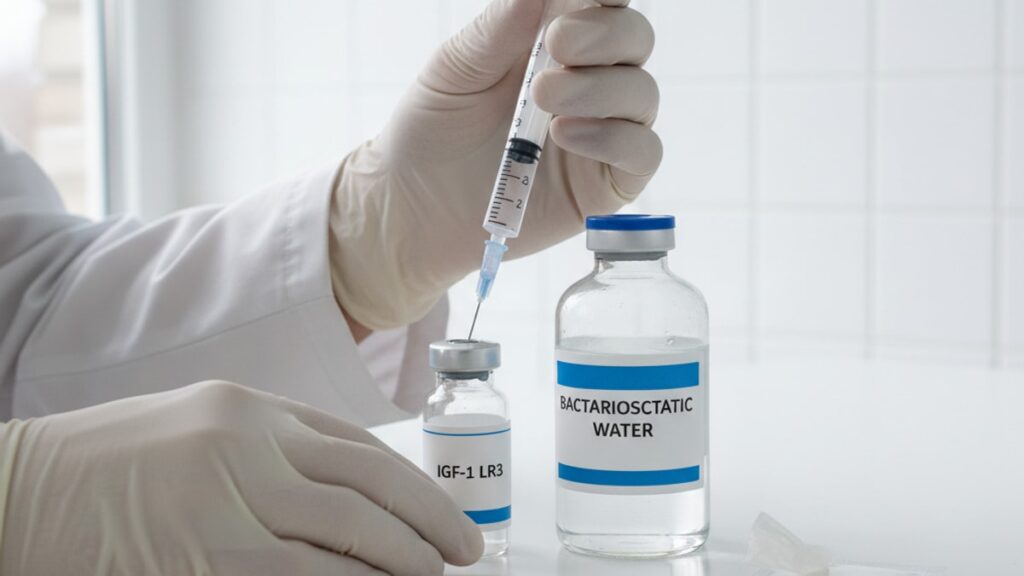
In the world of advanced biological research, precision isn't just a goal; it's the entire foundation upon which credible data is built. When you're working with potent and delicate compounds like peptides, even the smallest deviation in protocol can have a cascading, often catastrophic, effect on your results. This is especially true for lyophilized (freeze-dried) peptides, which require a careful, methodical process of reconstitution before they can be used in any experimental setting.
Our team fields a lot of questions, but one of the most frequent and fundamentally important is about how to mix IGF-1 LR3 with bacteriostatic water. It seems straightforward on the surface, but the nuances are what separate valid, repeatable outcomes from compromised, useless data. Getting this wrong doesn’t just waste valuable material; it wastes time and undermines the very integrity of your research. We've seen it happen, and it's why we're so committed to providing not just high-purity peptides, but also the expert knowledge to handle them correctly.
First, Why Does This Process Matter So Much?
Before we dive into the step-by-step mechanics, let's talk about the why. Understanding the materials you're working with is paramount. IGF-1 LR3 is a long-acting analogue of human Insulin-Like Growth Factor-1. It's a complex polypeptide, and its delicate chain of amino acids is what gives it its specific biological activity. In its lyophilized form, it's stable. But the moment you introduce a liquid, you begin a process that can either preserve its structure or degrade it into oblivion.
This is where your choice of solvent comes in. For many research peptides, the gold standard is Bacteriostatic Water. Why? Because it’s not just sterile water. Bacteriostatic water contains 0.9% benzyl alcohol, which acts as a preservative. This small addition is a game-changer. It inhibits bacterial growth, allowing the reconstituted solution to remain stable and viable for multi-use applications over a period of weeks when stored correctly. Using simple sterile water, by contrast, creates a solution that's highly susceptible to contamination after the first puncture of the vial's septum. For any study requiring multiple administrations from the same vial, bacteriostatic water is a non-negotiable element.
Our experience shows that the source of both the peptide and the water is the first checkpoint for quality. Starting with a product that has questionable purity or an imprecise peptide sequence, like those often found from less reputable suppliers, means your experiment is flawed from the get-go. At Real Peptides, our commitment to small-batch synthesis and rigorous quality control ensures that the IGF-1 LR3 you receive is exactly what it's supposed to be, giving your research a solid, reliable starting point.
Assembling Your Reconstitution Toolkit
Preparation is everything. Walking into this process without the right tools is like a surgeon trying to operate with a butter knife. It’s messy, and the outcome will be disastrous. We can't stress this enough: have everything laid out, clean, and ready before you even think about opening your peptide vial.
Here’s what our lab team recommends you have on hand:
- Your Vial of Lyophilized IGF-1 LR3: Handle it with care. These vials are small and the powder within is precious.
- Your Vial of Bacteriostatic Water: Ensure the seal is intact and it's within its expiration date.
- A Syringe: A 3ml or 5ml syringe is typically used for drawing the bacteriostatic water. The volume depends on your desired final concentration.
- An Administration Syringe: This is usually a smaller insulin syringe, marked in IU (International Units) or small mL increments, for accurately measuring your research doses.
- Alcohol Prep Pads: You'll need several. Sterility is key.
Seems simple, right? It is. But skipping even one of these items can introduce contaminants or cause inaccuracies.
| Tool | Primary Function | Why It's Critical | Our Recommendation |
|---|---|---|---|
| Lyophilized Peptide | The active compound for your research. | The entire experiment hinges on its purity and integrity. | Always source from a reputable U.S. supplier like Real Peptides. |
| Bacteriostatic Water | The sterile solvent for reconstitution. | Prevents bacterial growth, ensuring solution stability for multi-use vials. | Use only sealed, in-date Bacteriostatic Water. |
| Large Syringe (3-5ml) | To accurately measure and transfer the water. | Ensures you achieve the correct concentration of peptide per ml. | Choose a size that allows for easy and precise measurement of your total volume. |
| Alcohol Prep Pads | To sterilize vial tops and injection sites. | The single most important tool for preventing contamination. | Use a fresh pad for each surface. Never reuse. |
| Insulin Syringe | To accurately draw and administer research doses. | Allows for precise, micro-level measurements required in most protocols. | U-100 insulin syringes are standard for peptide research. |
The Step-by-Step Protocol: How to Mix IGF-1 LR3 with Bacteriostatic Water
Okay, you've got your tools, you understand the 'why,' and you're ready to go. Let's walk through this process with the meticulous care it deserves. We mean this sincerely: follow these steps exactly. Don't rush.
Step 1: Preparation and Sterilization
First things first, let both the vial of IGF-1 LR3 and the bacteriostatic water come to room temperature. This is a subtle but important point. Injecting cold liquid into the lyophilized powder can sometimes affect its dissolution. It’s not always a catastrophic failure, but we aim for impeccable procedure here.
Wash your hands thoroughly. Put on gloves if your lab protocol requires it. Now, take an alcohol prep pad and vigorously wipe the rubber stoppers (septa) of both the IGF-1 LR3 vial and the bacteriostatic water vial. Let them air dry for a few seconds. Do not blow on them. This creates a sterile entry point for your syringe.
Step 2: Drawing the Bacteriostatic Water
Uncap your larger 3ml or 5ml syringe. Pull back the plunger to the exact volume of bacteriostatic water you plan to use. For example, if you have a 1mg (1000mcg) vial of IGF-1 LR3 and you want a final concentration of 1000mcg/ml, you'll draw up exactly 1ml of water. If you wanted a concentration of 500mcg/ml, you'd draw up 2ml.
Now, insert the needle through the rubber stopper of the bacteriostatic water vial. Invert the vial and inject the air from your syringe into the vial. This equalizes the pressure and makes it much easier to draw the liquid out smoothly. Now, pull the plunger back and draw your desired volume of water into the syringe.
Check for air bubbles. If you have any, point the needle up, flick the side of the syringe to get the bubbles to the top, and gently push the plunger to expel them. Ensure you still have the correct volume afterward.
Step 3: Reconstituting the IGF-1 LR3
This is the most delicate part of the process. You're now going to introduce the water to the peptide.
Take your syringe filled with bacteriostatic water and carefully insert the needle through the sterilized rubber stopper of the IGF-1 LR3 vial. Here's the critical technique: Do not inject the water directly onto the lyophilized powder. This can damage the fragile peptide structure through sheer force.
Instead, angle the needle so that the stream of water runs down the inside wall of the glass vial. Depress the plunger slowly and gently. Let the water trickle down the side and pool at the bottom. This allows the powder to dissolve gently rather than being blasted apart.
Step 4: Dissolving the Peptide
Once all the water has been added, remove the syringe. Now, you need to help the peptide dissolve fully. Whatever you do, do not shake the vial. Shaking creates foam and can shear the amino acid chains, rendering the peptide useless. This is probably the single most common and destructive mistake we see.
Instead, gently swirl the vial between your fingers. You can also roll it gently between your palms. Be patient. It might take a few moments, but the powder will completely dissolve, leaving you with a clear liquid. If you see any cloudiness or particulates after gentle swirling, it could be a sign of a problem with the peptide or the reconstitution process.
And that's it. Your IGF-1 LR3 is now reconstituted and ready for research use.
For those who are more visual learners, our team often points researchers to helpful video resources. You can find many detailed guides online, and we sometimes break down these processes on our own channels, like the MorelliFit YouTube channel, which covers a range of related topics.
Storing Your Reconstituted Peptide: The Key to Longevity
Mixing the peptide is only half the battle. Storing it correctly is what ensures its stability and potency for the duration of your study. Once reconstituted, IGF-1 LR3 must be kept refrigerated. The ideal temperature range is between 2°C and 8°C (36°F and 46°F). Do not freeze it.
Your refrigerator door is not a good place for it. The temperature fluctuations from opening and closing the door can degrade the peptide over time. We recommend placing it in an opaque container (to protect it from light) in the main body of the fridge, preferably towards the back where the temperature is most stable.
Properly reconstituted with bacteriostatic water and stored in these conditions, IGF-1 LR3 will typically remain stable and potent for about 3 to 4 weeks. This is a stark contrast to peptides mixed with sterile water, which should ideally be used in a single session due to the high risk of bacterial growth.
A Note on Calculations and Dosing for Research
This is where precision becomes mathematical. Understanding how to calculate the dose from your reconstituted vial is absolutely essential for accurate research. Let's use a common scenario.
- Vial Size: 1mg of IGF-1 LR3 (which is 1000mcg)
- Amount of Bac Water Added: 2ml
- Final Concentration: 1000mcg / 2ml = 500mcg per 1ml
Now, let's say your research protocol calls for a 50mcg dose. You need to figure out how much volume to draw into your insulin syringe.
An insulin syringe is typically a U-100 syringe, meaning 1ml is divided into 100 units (ticks on the side). So, 1ml = 100 units.
Here's the calculation:
- Find mcg per unit: Since you have 500mcg in 100 units (1ml), you have 500 / 100 = 5mcg per unit.
- Find units per dose: Your desired dose is 50mcg. So, 50mcg / 5mcg per unit = 10 units.
Therefore, for a 50mcg dose, you would draw the solution up to the 10-unit mark on your insulin syringe. It's simple math, but it's critically important to double-check it every time. A small miscalculation can lead to a tenfold error in dosing, completely invalidating your experimental data.
This same principle of careful reconstitution applies to many other research peptides, such as the popular BPC 157 Peptide or TB 500 Thymosin Beta 4. The volumes might change, but the core principles of sterility, gentle handling, and precise measurement remain the same. It's a foundational skill for anyone serious about peptide research.
Ultimately, the success of your work hinges on controlling variables. The quality of your starting materials is the first and most important variable. The precision of your preparation is the second. By mastering the protocol for how to mix IGF-1 LR3 with bacteriostatic water, you're not just following steps; you're ensuring that the data you collect is built on a foundation of accuracy and reliability. If you're ready to ensure your research starts with the highest quality materials, you can explore our full range of peptides and Get Started Today.
This meticulous approach is what separates amateurs from professionals. It’s what ensures that when you publish or present your findings, you can stand behind your data with complete confidence, knowing that every step, from sourcing to synthesis to reconstitution, was handled with the unflinching precision that science demands.
Frequently Asked Questions
Can I use sterile water instead of bacteriostatic water to mix IGF-1 LR3?
▼
While you technically can, we strongly advise against it for multi-use vials. Sterile water contains no preservative, so once the vial is punctured, it’s susceptible to bacterial contamination. Bacteriostatic water contains 0.9% benzyl alcohol, which prevents this growth, keeping the solution stable for weeks.
What happens if I accidentally shake the vial after adding the water?
▼
Shaking can be catastrophic for the peptide’s integrity. The mechanical stress can shear the delicate amino acid chains, effectively destroying the compound. If you’ve shaken it vigorously, the peptide is likely compromised and should not be used for reliable research.
The reconstituted IGF-1 LR3 solution looks cloudy. What should I do?
▼
A properly reconstituted solution should be perfectly clear. Cloudiness can indicate a problem with the peptide’s purity, a contamination issue, or improper mixing. We recommend discarding the vial, as using a cloudy solution could produce unreliable and unpredictable results.
How long is reconstituted IGF-1 LR3 good for?
▼
When mixed with bacteriostatic water and stored properly in a refrigerator (2-8°C), IGF-1 LR3 is generally stable for 3 to 4 weeks. Do not freeze it, and keep it away from light.
I accidentally injected the water directly onto the peptide powder. Is it ruined?
▼
It’s not ideal, but it may not be completely ruined. The primary risk is damaging some of the peptide molecules. Gently swirl the vial to dissolve it and proceed, but be aware that the potency of your solution might be slightly reduced, which could affect the consistency of your data.
How do I calculate the right amount of bacteriostatic water to add?
▼
This depends on your desired final concentration. A common practice is to add 1ml or 2ml of water to a 1mg vial. Adding 1ml to 1mg gives you 1000mcg/ml, while adding 2ml gives you 500mcg/ml. Choose a volume that makes your research dose calculations simple and accurate.
Is it normal for the vial to have a vacuum or pressure when I puncture it?
▼
Yes, it’s very common for lyophilized peptide vials to be sealed under a slight vacuum to ensure stability. This is why we recommend injecting a volume of air equal to the liquid you plan to withdraw to equalize the pressure, making it easier to draw the fluid.
Can I pre-load syringes with my research doses for the week?
▼
Our team generally advises against this practice. While it seems convenient, storing peptides in plastic syringes for extended periods can lead to potential degradation as the solution interacts with the plastic and rubber plunger. It’s always best to draw each dose fresh from the refrigerated vial right before use.
Does the brand of bacteriostatic water matter?
▼
Yes, quality control matters for everything in your lab. Always use a trusted source for your [Bacteriostatic Water](https://www.realpeptides.co/products/bacteriostatic-water/) to ensure it is sterile and contains the correct concentration of benzyl alcohol. Using a sub-par solvent can compromise your entire peptide vial.
What’s the difference between IGF-1 LR3 and regular IGF-1?
▼
IGF-1 LR3 is a long-acting analogue. It has been modified with an arginine substitution at the third position (LR3) and an extended N-terminus, which significantly increases its biological half-life compared to endogenous IGF-1. This modification makes it more stable and potent in research settings.
Why is the peptide in a powder form to begin with?
▼
Peptides are lyophilized (freeze-dried) to ensure long-term stability. In a liquid state, the amino acid chains would degrade relatively quickly. The powder form keeps the compound inert and stable for shipping and storage until it’s ready for reconstitution.
