





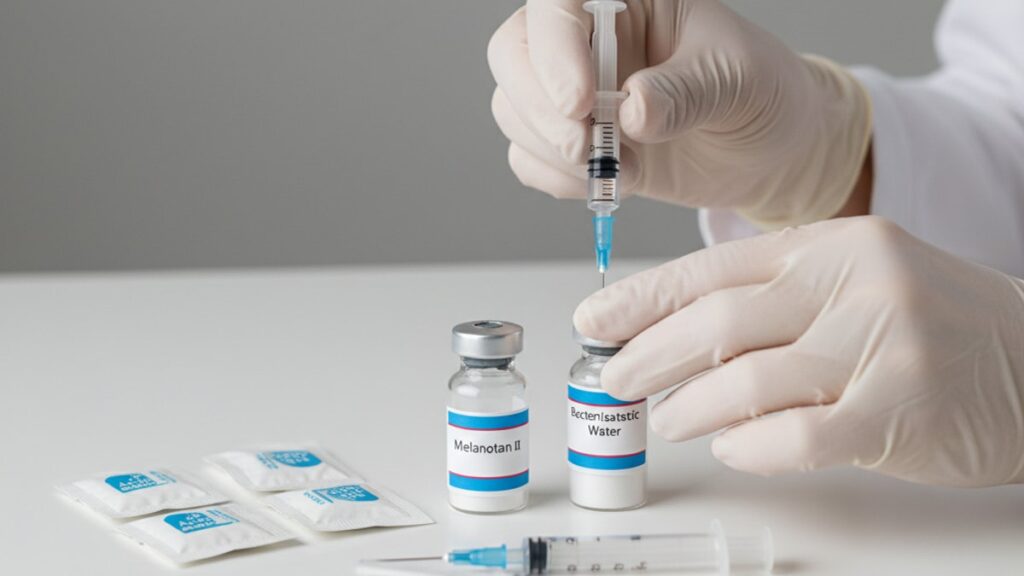
You’ve done the hard part. You’ve vetted your sources, chosen a supplier committed to purity, and now you have a vial of high-quality, lyophilized peptide in your lab. But let’s be honest, this is where so many promising research projects go sideways. The most pristine, accurately synthesized Melanotan 2 MT2 10mg is only as good as its preparation. Improperly mixing it doesn't just reduce its efficacy; it can completely invalidate your results.
Our team has seen it all. We've heard from researchers frustrated with inconsistent outcomes, only to discover the root cause was a simple, avoidable misstep during the reconstitution phase. It's a critical, non-negotiable element of peptide handling. That’s why we’ve put together this protocol. It’s not just a set of instructions; it’s a reflection of our deep-seated commitment to scientific integrity, ensuring the precision we craft in our lab is carried through to yours.
Why Proper Reconstitution is Non-Negotiable
First, what are we even talking about? Reconstitution is the process of adding a liquid diluent—a solvent—to a freeze-dried (lyophilized) powder to return it to a stable, usable liquid form. Peptides are shipped as powders for one simple reason: stability. In their lyophilized state, they are remarkably resilient to temperature fluctuations and degradation during shipping. Once you add liquid, the clock starts ticking.
This is the moment of truth. How you handle this process dictates the peptide's viability. If you introduce contaminants, you've compromised the entire experiment. If you use the wrong techniques, you can physically damage the delicate amino acid chains, rendering the peptide useless. Think of it like this: we meticulously build a complex, high-performance engine in our U.S.-based facility, and reconstitution is the equivalent of adding the right oil. Using the wrong kind, or adding it carelessly, will lead to catastrophic failure. It's that serious.
Every vial of Melanotan 2 we produce represents a promise of purity and potential. Your handling protocol is what unlocks it. Get it right, and you have a reliable tool for your research. Get it wrong, and you’re just working with expensive, cloudy water.
Gathering Your Essential Lab Supplies
Before you even think about touching the vials, you need to assemble your toolkit. Working with research peptides demands a laboratory mindset, which means preparation and sterility are paramount. Cutting corners here is not an option.
Here’s what you absolutely must have on hand:
- Your Vial of Melanotan 2: This is your primary research compound. Ensure it's been stored correctly according to the supplier's instructions (typically in a cool, dark place or freezer for long-term storage) before you begin.
- Bacteriostatic Water: This is your diluent. We can't stress this enough: you need the right kind of water. We’ll dive deeper into this in a moment, but for now, know that high-quality Bacteriostatic Water is the gold standard.
- A Sterile Syringe (3ml or 5ml): This larger syringe is specifically for transferring the bacteriostatic water into the peptide vial. It's your mixing tool.
- Sterile Administration Syringes (Insulin Syringes): These are typically 0.5ml or 1ml syringes, marked in units (U), used for accurately measuring and administering the final reconstituted solution.
- Alcohol Prep Pads: Sterility is everything. You'll need these to wipe the rubber stoppers on both your peptide vial and your bacteriostatic water vial.
Don’t even consider starting without every single one of these items. Having everything laid out on a clean, disinfected surface is the first step toward a successful reconstitution. It’s a professional process that demands professional preparation.
Choosing Your Diluent: Bac Water vs. Sterile Water
This is a frequent point of confusion, so let's clear it up. The liquid you use to mix your Melanotan 2 matters immensely. You can't just grab any water; you need a sterile, appropriate solvent to ensure the longevity and safety of your research compound.
Our experience shows that the choice of diluent is one of the most critical factors for preserving a peptide's integrity after reconstitution, especially for vials that will be used multiple times. Your two primary options are Bacteriostatic Water and Sterile Water for Injection. They are not the same.
Here's what we've learned:
| Feature | Bacteriostatic Water | Sterile Water for Injection |
|---|---|---|
| Preservative | Contains 0.9% Benzyl Alcohol | None |
| Shelf Life After Opening | Up to 28 days | Single-use only |
| Best For | Multi-use peptide vials | Single-dose, immediate-use applications |
| Our Team's Recommendation | Strongly Recommended | Not ideal for MT2 research protocols |
Bacteriostatic Water is sterile water that includes 0.9% benzyl alcohol. That small amount of alcohol acts as a bacteriostatic agent, meaning it prevents bacteria from reproducing and growing in the solution. This is absolutely essential for a multi-use vial. Each time you puncture the stopper to draw a dose, you create a potential entry point for airborne contaminants. Benzyl alcohol is your safeguard, keeping the solution sterile for up to four weeks.
Sterile Water for Injection, on the other hand, is just that—sterile water with no preservative. Once you open it or puncture the vial, it's no longer guaranteed to be sterile. It's designed for single-use applications where the entire contents are used immediately. Using it for a multi-dose Melanotan 2 vial is asking for trouble. Bacterial growth can not only degrade the peptide but also pose a significant safety risk.
For any research involving peptides from our full collection, our unwavering recommendation is to use Bacteriostatic Water. It’s a simple choice that protects your investment and ensures the consistency of your data from the first dose to the last.
The Step-by-Step Protocol: How to Mix Melanotan 2
Alright, you’ve got your supplies, you understand the 'why,' and you're ready to go. Follow these steps precisely. Don't rush. Precision is your best friend in the lab.
Step 1: Preparation and Sanitation
This isn't just a suggestion; it's a rule. Start by thoroughly washing your hands with soap and water. Then, prepare your workspace by wiping it down with a disinfectant. Pop the plastic caps off both the Melanotan 2 vial and the Bacteriostatic Water vial. Vigorously wipe the rubber stoppers on both vials with a fresh alcohol prep pad and allow them to air dry for a moment.
This simple act drastically reduces the risk of contamination. Every subsequent step depends on this clean foundation.
Step 2: Calculating Your Ratio
Now for some simple but crucial math. You need to decide how much water to add, which determines the final concentration of your solution. A standard vial of Melanotan 2 MT2 10mg contains 10 milligrams of the peptide. The amount of water you add will dictate how many micrograms (mcg) are in each unit of your insulin syringe.
Here are the two most common mixing ratios:
- Adding 1mL (100 units) of Bac Water:
- Your vial will contain 10mg of MT2 in 1mL of solution.
- This means every 0.1mL (or 10 units on an insulin syringe) contains 1mg (1000mcg) of MT2.
- Every 1 unit on the syringe contains 100mcg of MT2.
- Adding 2mL (200 units) of Bac Water:
- Your vial will contain 10mg of MT2 in 2mL of solution.
- This means every 0.1mL (or 10 units on an insulin syringe) contains 0.5mg (500mcg) of MT2.
- Every 1 unit on the syringe contains 50mcg of MT2.
Which should you choose? Our experience shows that for most research protocols, using 2mL of water is preferable. It allows for more precise measurements of smaller doses, as each unit on the syringe represents a smaller amount of the peptide. This enhanced precision can be critical in early-stage research or when titrating doses. For this guide, we'll proceed assuming a 2mL dilution.
Step 3: Drawing the Bacteriostatic Water
Take your 3mL mixing syringe. Pull the plunger back to the 2mL (or 200 on a U-100 syringe) mark, drawing 2mL of air into the syringe. Insert the needle through the rubber stopper of the Bacteriostatic Water vial. Inject the air into the vial. This equalizes the pressure, making it much easier to draw the liquid out without a struggle.
With the needle still in the vial, turn it upside down and slowly pull the plunger back, drawing exactly 2mL of water into the syringe. Check for any large air bubbles. If you see them, gently flick the side of the syringe to make them rise to the top, then carefully push the plunger to expel the air. Ensure you still have exactly 2mL of water.
Step 4: Reconstituting the Melanotan 2
This is the most delicate part of the entire process. Take the syringe filled with Bac Water and carefully insert the needle through the stopper of the Melanotan 2 vial. You are NOT going to blast the water directly onto the powder. This is a huge mistake we see people make; the force can shear the peptide bonds.
Instead, angle the syringe so the needle is pointing at the glass side of the vial. Slowly, gently, and deliberately push the plunger, allowing the water to run down the inside wall of the glass and pool with the powder at the bottom. The goal is to be as gentle as possible. Once all the water is in, slowly withdraw the needle.
Step 5: Dissolving the Peptide
Your first instinct might be to shake the vial to mix it. Do not do this. Shaking creates foam and, more importantly, the agitation can damage—or denature—the complex peptide molecules. It's the equivalent of putting a delicate silk shirt in a heavy-duty washing machine.
Instead, gently roll the vial between your fingers or palms. You can also slowly swirl it. The lyophilized powder should dissolve quite easily. Continue this gentle motion until the solution is completely clear. A properly synthesized, high-purity peptide like those from Real Peptides should dissolve fully, leaving no clumps or cloudiness. If your solution remains cloudy, it could indicate a problem with either the peptide's quality or your reconstitution technique.
And that's it. You've successfully and safely mixed your Melanotan 2.
Proper Storage After Mixing: Preserving Potency
Now that your peptide is in a liquid state, it's far more fragile. Proper storage is mandatory to protect its integrity for the duration of your research.
Once reconstituted, the Melanotan 2 vial must be stored in a refrigerator. The ideal temperature range is between 2°C and 8°C (36°F and 46°F). Do not freeze it. The freeze-thaw cycle can be just as damaging to peptide structures as vigorous shaking. Kept in the refrigerator and handled with sterile technique, a properly reconstituted vial of Melanotan 2 should remain potent for at least 30 to 45 days.
Always store the vial upright and in a place where it won't be knocked around. Light can also degrade peptides over time, so keeping it in its original box or a dark part of the fridge is a good practice.
Avoiding Common Pitfalls: What Our Experience Shows
Over the years, our team has consulted with countless researchers. We've identified a few recurring mistakes that can sabotage results. Avoiding these is just as important as following the steps correctly.
- The Cardinal Sin: Shaking the Vial. We've said it twice, and we'll say it again. Never, ever shake a peptide vial. Roll or swirl gently. Patience is key.
- Using the Wrong Water. Using tap water, distilled water, or even sterile water without a preservative is a recipe for disaster. Tap water contains impurities and microorganisms that will destroy the peptide and are unsafe. Stick with Bacteriostatic Water—it's the professional standard for a reason.
- Sloppy Sterile Technique. Reusing syringes, not wiping vial tops, or working on a dirty surface introduces bacteria. This compromises your solution and your research data. Every step should be performed with clinical precision.
- Starting with a Low-Quality Product. The most flawless mixing technique in the world can't fix an impure or under-dosed peptide. Your entire research process is built on the quality of your starting materials. This is the core philosophy at Real Peptides. We ensure that every peptide, from popular compounds like BPC-157 to niche molecules like Epithalon, meets the highest standards of purity through small-batch synthesis and rigorous verification. Your results depend on it.
The Science Behind Melanotan 2: A Quick Look
Understanding your research compound is part of responsible handling. Melanotan 2 is a synthetic analogue of a naturally occurring peptide hormone called alpha-melanocyte-stimulating hormone (α-MSH). In the body, α-MSH is a key player in stimulating melanogenesis—the process that produces melanin, the pigment responsible for skin and hair color.
MT2 was designed to be a more potent and longer-lasting version of α-MSH. It works by binding to a class of receptors known as melanocortin receptors (MCRs). While its primary affinity is for MC1R (related to pigmentation), it also significantly affects MC3R and MC4R, which are involved in metabolism, appetite, and sexual function. This broad activity profile is what makes it such a fascinating compound for research.
It's important to distinguish it from its cousins. Melanotan 1 is more selective for the MC1R, making its effects more focused on pigmentation. PT-141 (Bremelanotide), another melanocortin agonist, is studied primarily for its effects on sexual arousal via different receptor pathways. Each has a unique profile for specific research applications. For those who enjoy a deeper dive, our team often explores the nuances between these compounds on our YouTube channel, providing visual guides and scientific breakdowns.
Following this protocol for how to mix Melanotan 2 ensures that the powerful potential of this peptide is preserved, allowing for accurate and repeatable findings in your lab. It's about respecting the science from start to finish.
This meticulous approach is the bedrock of good science. The integrity of your data, the validity of your conclusions, and the success of your project all hinge on getting these fundamental steps right, every single time. When you're ready to ensure your research is built on a foundation of purity and precision, we're here to help you Get Started Today.
Frequently Asked Questions
What is the best liquid to mix Melanotan 2 with?
▼
Our team unequivocally recommends using Bacteriostatic Water. It contains 0.9% benzyl alcohol, which acts as a preservative to prevent bacterial growth in the vial, ensuring the solution remains sterile for up to 28 days.
Can I use tap water or bottled water to mix my peptide?
▼
Absolutely not. Using non-sterile water like tap or bottled water is extremely dangerous. It will contaminate your peptide with bacteria and impurities, ruining the research compound and posing a significant health risk.
How do I know if I’ve mixed my Melanotan 2 correctly?
▼
A correctly mixed solution will be perfectly clear, with no floating particles, cloudiness, or discoloration. The lyophilized powder should dissolve completely with gentle swirling or rolling, not shaking.
Why shouldn’t I shake the vial after adding water?
▼
Shaking the vial can damage the fragile amino acid chains that make up the peptide, a process called denaturation. This can render the peptide ineffective. Always gently roll or swirl the vial to dissolve the powder.
How long does mixed Melanotan 2 last in the refrigerator?
▼
When reconstituted with bacteriostatic water and stored properly in a refrigerator (2-8°C or 36-46°F), Melanotan 2 is typically stable and potent for 30 to 45 days. Never freeze the reconstituted solution.
What’s the difference between mixing with 1mL versus 2mL of water?
▼
The amount of water determines the solution’s concentration. Using 2mL makes the solution less concentrated, which allows for more precise measurement of smaller doses. We generally recommend 2mL for better dosing accuracy in research.
What should I do if my mixed solution is cloudy?
▼
A cloudy solution is a red flag. It could indicate poor quality peptide, bacterial contamination, or that it was reconstituted incorrectly. We do not recommend using a solution that is cloudy or has particles in it.
Do I need to inject air into the bacteriostatic water vial first?
▼
Yes, this is a highly recommended technique. Injecting an equal amount of air into the vial before drawing the water equalizes the pressure inside, making it much easier to withdraw the liquid smoothly and accurately.
Where is the best place to store the unmixed, lyophilized MT2 vial?
▼
For long-term storage, the unmixed, lyophilized powder should be kept in a freezer. For short-term storage (a few weeks), a cool, dark place like a refrigerator is sufficient. This preserves its stability before reconstitution.
Can I pre-load syringes with doses for the week?
▼
Our team advises against pre-loading syringes for extended periods. While convenient, it increases the risk of contamination and potential degradation of the peptide, as plastic syringes are not designed for long-term storage.
What kind of syringe do I need for mixing?
▼
For the mixing process itself, you’ll need a larger sterile syringe, typically 3mL or 5mL, to accurately transfer the bacteriostatic water. For administration, you’ll use a much smaller insulin syringe marked in units.
