





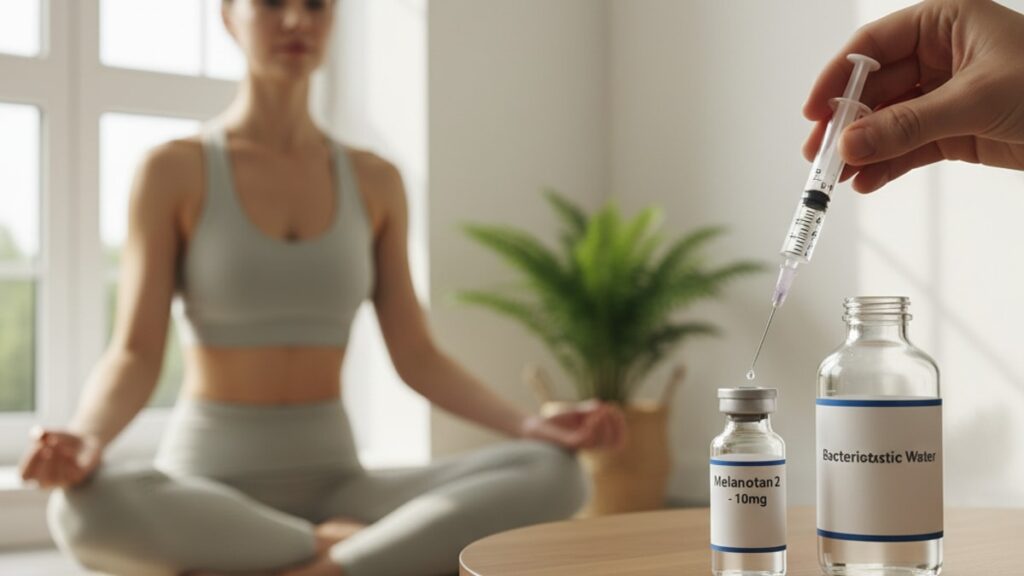
Let's get straight to it. This is one of the most frequent, and frankly, one of the most critical questions we encounter from the research community: how much water to add to 10mg Melanotan 2? It seems simple, but the precision of your entire research project hinges on getting this one step right. An error here doesn't just throw off your measurements; it can compromise the integrity of the peptide, leading to skewed data and wasted resources. It’s a frustrating and entirely avoidable scenario.
Here at Real Peptides, our dedication to quality doesn't end when a product leaves our facility. We're committed to ensuring researchers have the knowledge to handle these sensitive compounds correctly. When you invest in a premium, high-purity product like our Melanotan 2 MT2 10mg, you're starting with the best possible material. Our goal is to empower you to maintain that standard throughout your work. This guide isn't just a set of instructions; it's a transfer of our collective experience, designed to give you clarity and confidence in the lab.
Why Reconstitution Math Is Non-Negotiable
Before we jump into the numbers, it’s vital to understand why this matters so much. Peptides like Melanotan 2 are delivered in a lyophilized (freeze-dried) state for a reason. This powder form is incredibly stable, ensuring the complex chain of amino acids remains intact during shipping and long-term storage. It's a delicate balance. The moment you introduce a liquid—a process called reconstitution—you start a countdown timer on the peptide's stability.
Proper reconstitution is about two things: accuracy and preservation.
- Accuracy: The amount of diluent (the water) you add directly determines the final concentration of your solution. If you want to administer a dose of, say, 500 micrograms (mcg), you need to know exactly how many units on your syringe correspond to that dose. Guesswork leads to catastrophic data inconsistencies. You can't publish reliable findings based on imprecise measurements. It just doesn't work.
- Preservation: Using the wrong type of liquid or improper technique can degrade the peptide almost instantly. Shaking the vial, using tap water, or letting it sit at room temperature for too long can break the fragile peptide bonds. We've seen it happen. A researcher's meticulous work can be undone by a few moments of carelessness during this initial step. It's heartbreaking.
So, this isn't just about following a recipe. It's about respecting the science and ensuring the validity of your research from the very first step. When you handle a peptide synthesized with the precision we guarantee at Real Peptides, you owe it to your project to handle it with the same level of care.
Choosing Your Weapon: The Right Kind of Water
Not all water is created equal. This is probably the most critical distinction to make. Using the wrong type of water is a fast track to contaminating your research peptide. Let's be honest, you wouldn't pour soda into a Ferrari's gas tank. The same logic applies here.
Here's what you need to know:
- Bacteriostatic Water (BAC Water): This is the gold standard for reconstituting multi-use peptides. It's sterile water that contains 0.9% benzyl alcohol, which acts as a preservative. This alcohol prevents the growth of bacteria inside the vial after it's been reconstituted. For any research protocol that involves drawing multiple doses from the same vial over days or weeks, Bacteriostatic Water is the only choice. Our team exclusively recommends it for compounds like MT2. It typically keeps the reconstituted peptide stable under refrigeration for up to 4 weeks.
- Sterile Water for Injection: This is simply sterile water without any preservatives. It’s perfectly fine for a single-use application where you intend to use the entire contents of the vial immediately after reconstitution. However, once you puncture the rubber stopper, there’s nothing to inhibit bacterial growth. If you try to store and reuse it, you’re running a significant risk of contamination. We generally advise against it for peptides unless the protocol explicitly demands it for a one-time use scenario.
- Tap Water or Distilled Water: Absolutely not. Never. These water sources are not sterile and are teeming with minerals, impurities, and microorganisms that will instantly contaminate and likely destroy the peptide. Using them is a guarantee of failed research.
We can't stress this enough: for the vast majority of research applications involving a 10mg vial of Melanotan 2, you should be using Bacteriostatic Water.
The Calculation: How Much Water for 10mg MT2
Okay, let's get down to the math. The goal is to make the calculations for your research doses as simple as possible. Adding 1ml or 2ml of BAC water are the two most common and practical methods our team recommends. Why these amounts? Because they make the subsequent dosing math straightforward.
Let's break down both scenarios for a standard 10mg vial of Melanotan 2.
Remember: 1 milligram (mg) = 1000 micrograms (mcg).
Therefore, your 10mg vial contains 10,000mcg of lyophilized peptide.
Also, we're assuming you are using a standard U-100 insulin syringe, which has 100 tick marks (units) per 1 milliliter (ml).
Scenario 1: Adding 1ml of Bacteriostatic Water
This is the most common method because the math is incredibly simple.
- Step 1: You inject 1ml (which is 100 units on your syringe) of BAC water into the 10mg vial of MT2.
- Step 2: You now have a solution where 1ml contains 10mg of MT2.
- Calculation:
- Total Peptide: 10mg = 10,000mcg
- Total Volume: 1ml = 100 units
- Concentration: 10,000mcg / 100 units = 100mcg of MT2 per 1 unit on the syringe.
This makes dosing a breeze. If your research protocol calls for a 500mcg dose, you simply draw 5 units. If you need 250mcg, you draw 2.5 units (the halfway mark between the 2 and 3).
Scenario 2: Adding 2ml of Bacteriostatic Water
Some researchers prefer this method because it allows for larger volume injections, which can make measuring very small doses (like 100mcg) a little easier and potentially more accurate since you're dealing with larger gradations on the syringe.
- Step 1: You inject 2ml (which is two full 1ml syringes) of BAC water into the 10mg vial of MT2.
- Step 2: You now have a solution where 2ml contains 10mg of MT2.
- Calculation:
- Total Peptide: 10mg = 10,000mcg
- Total Volume: 2ml = 200 units
- Concentration: 10,000mcg / 200 units = 50mcg of MT2 per 1 unit on the syringe.
With this concentration, a 500mcg dose would require you to draw 10 units. A 250mcg dose would be 5 units. The solution is half as concentrated, so you use twice the volume for the same dose.
Comparison Table: 1ml vs. 2ml Reconstitution
To make it even clearer, here’s a side-by-side look at the two methods.
| Feature | Adding 1ml of BAC Water | Adding 2ml of BAC Water |
|---|---|---|
| Total Volume | 1ml (100 units) | 2ml (200 units) |
| Final Concentration | 100mcg per unit | 50mcg per unit |
| Dose for 250mcg | 2.5 units | 5 units |
| Dose for 500mcg | 5 units | 10 units |
| Dose for 1mg (1000mcg) | 10 units | 20 units |
| Primary Advantage | Simplest math, highly concentrated. | Easier to measure smaller doses accurately. |
| Best For | Most standard research protocols. | Protocols requiring very low and precise doses. |
So, which is better? Honestly, neither is inherently superior. It completely depends on your research protocol and personal preference. For most applications, the 1ml method is perfectly sufficient and wonderfully straightforward. If your work involves titrating very small, sensitive doses, the 2ml method might give you a slight edge in precision. We recommend researchers new to this process start with the 1ml method for its simplicity. You can always adjust your protocol later as you Get Started Today.
A Step-by-Step Guide to Flawless Reconstitution
Knowing the math is one thing; executing the procedure flawlessly is another. Our lab team has refined this process over years of handling sensitive compounds. Follow these steps exactly to ensure the integrity of your peptide.
-
Gather Your Supplies: Before you begin, have everything laid out on a clean surface. You'll need your vial of lyophilized Melanotan 2 MT2 10mg, a vial of Bacteriostatic Water, a sterile insulin syringe for mixing, and alcohol prep pads.
-
Prepare the Vials: Remove the plastic caps from both vials. You'll see a rubber stopper underneath. Vigorously wipe the top of both rubber stoppers with an alcohol pad and let them air dry. This sterilizes the surface where the needle will be inserted.
-
Draw the Water: Take your insulin syringe and pull back the plunger to the desired mark (100 units for 1ml or use two full syringes for 2ml). Insert the needle into the BAC water vial and invert the vial. Push the air from the syringe into the vial (this equalizes the pressure and makes drawing the liquid easier), then slowly pull the plunger back to fill the syringe with the exact amount of water.
-
Inject the Water (The Critical Step): This is where technique really matters. Insert the needle of the water-filled syringe into the Melanotan 2 vial. Do not inject the water directly onto the lyophilized powder. This can damage the fragile peptide molecules. Instead, angle the needle so the stream of water runs slowly down the inside wall of the glass vial. Be patient. Let it trickle in gently.
-
Mix Gently—Do NOT Shake: Once all the water is in the vial, remove the syringe. The powder will begin to dissolve on its own. To help it along, you can gently roll the vial between your fingers or palms. You might be tempted to shake it to speed things up. Don't. Shaking can shear and destroy the amino acid chains, rendering the peptide useless. The solution should be completely clear with no visible particles once dissolved. If it's cloudy, it may indicate a problem with the peptide or the reconstitution process.
-
Proper Storage: Immediately store the reconstituted vial in the refrigerator at a temperature between 2°C and 8°C (36°F and 46°F). Do not freeze it. When stored correctly, a peptide reconstituted with BAC water will remain stable and potent for your research for several weeks.
For a more visual guide on lab techniques and peptide science, we often break down these processes on the MorelliFit YouTube channel, which provides excellent in-depth content for the research community.
Common Pitfalls and How to Sidestep Them
We've seen it all. Over the years, our team has helped researchers troubleshoot countless issues, and most of them trace back to small, avoidable errors during reconstitution. Here are the most common mistakes:
- Shaking the Vial: We mentioned it before, but it bears repeating. It's the number one peptide-killer. Always roll, never shake.
- Using the Wrong Diluent: Using sterile water and then storing the vial for a week is asking for bacterial contamination. Using tap water is an immediate failure.
- Incorrect Math: Double-check, then triple-check your calculations. An error in your concentration will invalidate every subsequent data point you collect.
- Improper Storage: Leaving a reconstituted vial at room temperature for even a day can significantly degrade its potency. Refrigeration is mandatory.
- Direct Water Jet: Spraying the BAC water directly onto the peptide powder can be just as damaging as shaking. Let it run down the side of the glass.
Avoiding these simple mistakes is the difference between clean, repeatable data and a frustrating, expensive failure. The principles of careful handling extend beyond Melanotan 2; they are fundamental to working with any research peptide, whether it's a regenerative compound like BPC 157 Peptide or a complex blend like our Glow Stack. The commitment to precision must be absolute, and it starts right here.
Ultimately, understanding how much water to add to 10mg Melanotan 2 is the gateway to responsible and effective research. It’s a foundational skill. By mastering this simple calculation and adhering to a sterile, gentle technique, you ensure that the high-purity peptide you purchased remains high-purity in your solution, ready to yield the accurate and reliable data your work depends on. That's the standard we uphold in our production, and it's the standard we encourage in your research.
Frequently Asked Questions
What happens if I add more or less than 1ml or 2ml of water?
▼
Adding a different amount of water isn’t wrong, but it complicates your dosing math. The key is to know exactly how much you added so you can accurately calculate the final concentration per unit.
Can I use sterile water instead of bacteriostatic water?
▼
You can, but only if you plan to use the entire 10mg vial in a single session. Sterile water contains no preservative, so the solution is susceptible to bacterial growth once the stopper is punctured, making it unsafe for multi-dose use.
How long does reconstituted Melanotan 2 last in the fridge?
▼
When reconstituted with bacteriostatic water and stored properly in a refrigerator (2-8°C), Melanotan 2 is generally stable for up to 30 days. Its potency will slowly decline over time, so using it within that window is ideal for research consistency.
What should I do if my reconstituted solution is cloudy?
▼
A properly reconstituted peptide solution should be perfectly clear. If it’s cloudy, it could indicate bacterial contamination or that the peptide has been damaged or degraded. We advise against using any solution that is not completely clear.
Why shouldn’t I shake the vial to mix it?
▼
Peptides are long, fragile chains of amino acids. Shaking the vial creates mechanical stress that can physically break these chains, a process called shearing. This permanently destroys the peptide and renders it ineffective for research.
Does it matter what size syringe I use for reconstitution?
▼
Using a 1ml insulin syringe is standard because the unit markings are designed for this volume. A larger syringe would make measuring 1ml accurately more difficult. Always use a sterile syringe appropriately sized for the task.
Where is the best place to store the lyophilized (powder) peptide before mixing?
▼
For long-term storage, lyophilized peptides should be kept in a freezer. For short-term storage (a few weeks), a refrigerator is sufficient. This maximizes its shelf life before reconstitution.
Is it okay to pre-load syringes for the week?
▼
Our team generally advises against this. While convenient, storing peptides in plastic syringes can lead to degradation over time as the solution interacts with the plastic and rubber plunger. It’s always best to draw each dose immediately before use.
How do I calculate a dose of 300mcg if I used 1ml of water?
▼
If you added 1ml of water to a 10mg vial, your concentration is 100mcg per unit. Therefore, to get a 300mcg dose, you would simply draw 3 units on your U-100 insulin syringe.
What if I accidentally inject the water directly onto the powder?
▼
While not ideal, it may not have completely ruined the peptide. Mix it gently by rolling and inspect the solution. If it dissolves and is perfectly clear, it is likely usable, but be aware that some degradation may have occurred.
Can I use the same principles for a 5mg vial of another peptide?
▼
Absolutely. The math is the same, just with different numbers. For a 5mg vial (5000mcg) mixed with 1ml (100 units) of water, each unit would contain 50mcg of the peptide (5000mcg / 100 units).











