





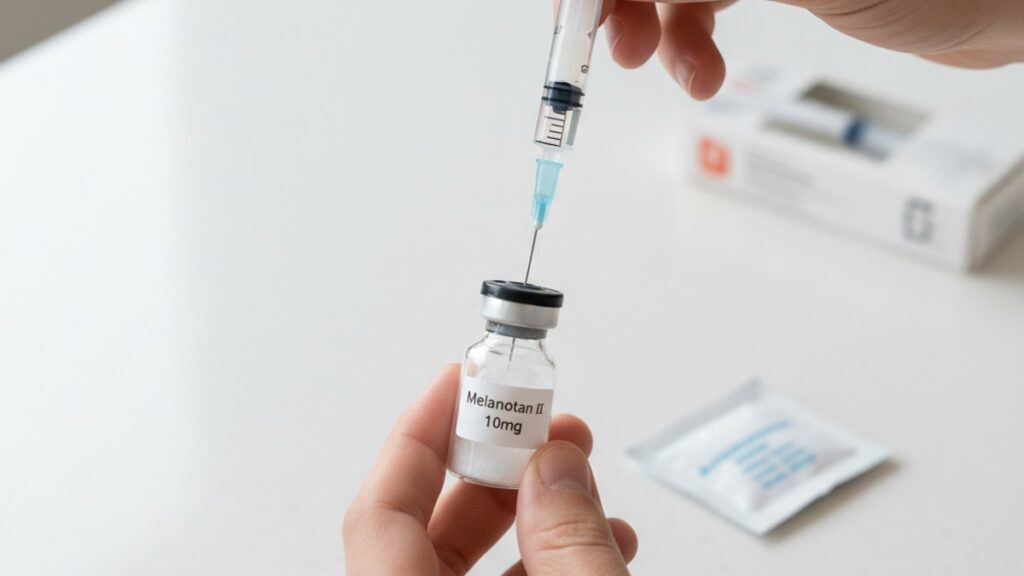
When it comes to peptide research, precision isn't just a goal; it's the entire foundation. Missteps in handling, reconstitution, or dosing can completely invalidate a study, wasting valuable resources and time. We've seen it happen. A researcher, brilliant in their field, gets a subpar result not because their hypothesis was flawed, but because the very compound they were studying was compromised from the start. That's a catastrophic, yet entirely avoidable, outcome.
Here at Real Peptides, our team is built on a bedrock of scientific rigor. We live and breathe this stuff. We understand that knowing how to use Melanotan 2 10mg properly is just as critical as sourcing the highest purity peptide in the first place. This isn't just about following steps; it's about understanding the why behind each action to ensure your research is repeatable, reliable, and built on an impeccable foundation. So, let's walk through the process our own experts use, breaking down the nuances that separate successful studies from frustrating failures.
What Exactly is Melanotan 2? A Quick Refresher
Before we dive into the practical 'how-to,' it's worth taking a moment to appreciate the science. Melanotan 2 (often abbreviated as MT2) is a synthetic analogue of a naturally occurring peptide hormone called alpha-melanocyte-stimulating hormone (α-MSH). In the body, α-MSH is a key player in regulating pigmentation and also has influences on appetite and sexual arousal. It does this by binding to a family of receptors known as melanocortin receptors.
Where Melanotan 2 gets interesting for researchers is its broader binding affinity. While its predecessor, Melanotan 1, primarily targets the MC1R receptor (the one most associated with stimulating melanin production in skin cells), Melanotan 2 is less selective. It acts as a potent agonist for MC1R, MC3R, MC4R, and MC5R. This wider range of action is what gives it a more complex profile of effects, which have become the subject of extensive research into melanogenesis, appetite modulation, and libido enhancement in various study models. It’s a versatile tool, but that versatility demands an even higher degree of precision in its application. We can't stress this enough: this compound is intended strictly for in-vitro research and laboratory experimentation. Its handling requires a professional and meticulous approach.
The Foundation: Why Purity and Sourcing Matter
Let’s be honest, you can have the most perfect protocol in the world, but if you start with a compromised product, your research is doomed before it begins. The peptide you receive should be a lyophilized, sterile powder. Lyophilization, or freeze-drying, is a process that removes water from the peptide at a low temperature, rendering it stable for transport and storage. When you open a vial of Melanotan 2 MT2 10mg from us, you're looking at the result of a meticulous, small-batch synthesis process designed for one thing: purity.
Why does this matter so much? Contaminants, incorrect peptide sequences, or the wrong dosage in the vial can lead to completely unpredictable outcomes. Our experience shows that inconsistent results in peptide studies can often be traced back to inconsistent product quality from the supplier. It's a frustrating, often moving-target objective for any researcher. That’s why at Real Peptides, every batch undergoes rigorous testing to confirm its identity and purity. We ensure the amino-acid sequence is exact. This commitment guarantees that when you follow a precise protocol, your results will be directly attributable to the peptide itself, not some unknown variable. It’s about creating a controlled environment, and that control starts with the vial in your hand. This is the non-negotiable first step.
Step 1: Reconstitution — The Most Critical Phase
This is where theory meets practice, and it’s arguably the most crucial part of learning how to use Melanotan 2 10mg. Reconstitution is the process of mixing the lyophilized powder with a sterile liquid to prepare it for use in your research. Done correctly, it's simple. Done incorrectly, you can degrade the peptide and ruin your entire vial.
First, gather your supplies. You'll need:
- Your 10mg vial of Melanotan 2.
- A vial of Bacteriostatic Water. We recommend this over sterile water because it contains 0.9% benzyl alcohol, which acts as a preservative and prevents bacterial growth, keeping your reconstituted solution sterile for much longer.
- Alcohol swabs.
- An insulin syringe (typically 1ml/100 units) for measuring the water and dosing.
The Reconstitution Protocol:
-
Preparation is Key: Start by preparing your workspace. Make sure it's clean. Pop the plastic caps off both your Melanotan 2 vial and your bacteriostatic water vial. Vigorously wipe the rubber stoppers on both with an alcohol swab and let them air dry.
-
The Math Matters: This is where precision is paramount. Your goal is to create a solution where you know exactly how much Melanotan 2 is in every unit of liquid. For a 10mg vial, here are two common and easy-to-calculate options:
- Option A (Simpler Math): Add 1ml of bacteriostatic water. This creates a straightforward ratio. Since 1ml = 100 units on your syringe, and you have 10mg of peptide, the math is: 10mg / 100 units = 0.1mg per unit. Wait, that's not right. Let's correct that. 10mg in 1ml means the entire 100-unit syringe holds 10mg. Therefore, 10 units (or 0.1ml) contains 1mg (1000mcg). This is a very concentrated solution.
- Option B (Easier Dosing): Add 2ml of bacteriostatic water. This is what our team generally recommends for easier and more accurate dosing of smaller amounts. You'll need to draw 1ml of water twice. With 2ml (200 units) of water mixed with 10mg of peptide, the math becomes: 10mg / 200 units = 0.05mg per unit. So, 10 units (0.1ml) would contain 0.5mg (500mcg). This dilution makes measuring out smaller research doses, like 100mcg or 250mcg, far more manageable.
-
The Technique: Draw your desired amount of bacteriostatic water into the syringe. Insert the needle through the rubber stopper of the Melanotan 2 vial. Now, this is important: do not inject the water directly onto the powder cake. Peptides are delicate protein chains. A direct, high-pressure stream can damage them. Instead, angle the needle so the water runs slowly down the inside wall of the glass vial. It will pool and gently dissolve the powder.
-
Gentle Does It: Once the water is in, remove the syringe. If the powder isn't fully dissolved, do not shake the vial. Shaking can shear the peptide bonds, a process called denaturation, rendering it useless. Instead, gently roll the vial between your fingers or swirl it with a light wrist motion. The lyophilized powder is very soluble and should dissolve quickly, resulting in a completely clear solution. If it's cloudy or has floaters, it may indicate a contamination or purity problem (something you won't encounter with our products).
Your Melanotan 2 is now reconstituted and ready for research application. It must be stored properly from this point forward.
Step 2: Calculating Your Research Dose
With your solution prepared, the next step is drawing an accurate dose for your study. Using our recommended reconstitution of 2ml of water in a 10mg vial, let's look at how to calculate some common research doses.
Remember our ratio: 1 unit on the syringe = 0.05mg or 50mcg.
- For a 100mcg dose: You would need 2 units on the syringe.
- For a 250mcg dose: You would need 5 units on the syringe.
- For a 500mcg dose: You would need 10 units on the syringe.
Our team strongly advises researchers to always double-check their math before drawing a dose. It's a simple step that prevents significant errors. When drawing the dose, pull back the plunger to your desired unit mark, ensuring you eliminate any large air bubbles by gently flicking the syringe and pushing the air out. The black line of the plunger, not the cone, should be aligned with the measurement mark.
In any research protocol, the standard practice is to begin with a very low dose to establish a baseline response in your model system. You're observing for effects and tolerance. Titrating up slowly is the hallmark of a careful, methodical research process. A 'more is better' approach is counterproductive and unscientific; it introduces too many variables and makes it impossible to isolate the dose-dependent effects of the compound. It's about finding the minimum effective dose for the outcome you are studying. That's just good science.
Melanotan 1 vs. Melanotan 2: A Quick Comparison
Researchers often ask us about the differences between Melanotan 1 and its successor. While they share a name and primary function, their nuanced receptor affinities lead to different research applications. Understanding this distinction is key to selecting the right compound for your study.
Here’s a simple breakdown our team put together:
| Feature | Melanotan 1 | Melanotan 2 |
|---|---|---|
| Primary Receptor | Highly selective for MC1R | Non-selective agonist for MC1R, MC3R, MC4R, MC5R |
| Main Research Focus | Purely melanogenesis (skin pigmentation) | Melanogenesis, libido enhancement, appetite suppression |
| Side Effect Profile | Minimal side effects outside of pigmentation | Can include nausea, flushing, appetite changes, libido effects |
| Molecular Structure | Linear peptide, a full-length analogue of α-MSH | Shorter, cyclic peptide designed for increased potency |
| Potency | Less potent than MT2 | Significantly more potent due to its structure and affinities |
Essentially, if a study is focused exclusively on the pigmentation pathway with minimal confounding variables, Melanotan 1 is often the more appropriate tool. If the research involves exploring the broader effects of melanocortin system activation, Melanotan 2 provides a more potent and comprehensive instrument.
Step 3: Proper Storage for Maximum Potency
Peptides are not like common chemical compounds; they are sensitive and can degrade quickly if stored improperly. This is another area where excellent research practices can make or break a study.
Before Reconstitution (Lyophilized Powder):
Your unopened vial of Melanotan 2 powder is quite stable. For short-term storage (a few weeks), a cool, dark place like a cupboard away from sunlight is sufficient. For long-term storage (months), we recommend keeping it in the refrigerator (between 2°C and 8°C). You can even freeze it for extended stability, but this is generally unnecessary unless you plan on storing it for over a year.
After Reconstitution (Liquid Solution):
This is where the rules become strict. Once you've added bacteriostatic water, the peptide is far less stable. The reconstituted vial must be stored in the refrigerator at all times. Do not leave it out at room temperature for extended periods. Light and heat are the primary enemies of reconstituted peptides. Kept in the fridge, your solution will remain potent and sterile for at least 30-45 days. After this point, while it may not be harmful, its potency can begin to decline, which would introduce an unwanted variable into your research.
Never freeze a reconstituted peptide. The freeze-thaw cycle can damage the delicate peptide structures. Simple, right? Just keep it in the fridge, and you're golden.
Understanding Potential Side Effects in a Research Context
When conducting any form of research, it's crucial to observe and document all effects, not just the ones you're looking for. Scientific literature on Melanotan 2 has documented several potential side effects in test subjects. Understanding these is part of a comprehensive research approach.
These effects are almost always dose-dependent, meaning they are more pronounced at higher doses and often diminish or disappear with lower, more conservative protocols. Commonly noted observations include:
- Initial Nausea: A feeling of queasiness shortly after administration is the most common. It typically subsides within an hour and often lessens with subsequent administrations as the system acclimates.
- Facial Flushing: A temporary warming or reddening of the face can occur, which is also transient.
- Appetite Suppression: Due to its action on the MC4R receptor, a noticeable decrease in appetite is a well-documented effect.
- Increased Libido: Action on the central nervous system can lead to effects on sexual arousal, including spontaneous erections in male subjects.
- Pigmentation Changes: This is, of course, a primary effect. This includes a general darkening of the skin tone, as well as the potential darkening of existing freckles or the appearance of new, small ones.
Documenting these secondary effects is vital. It provides a fuller picture of the compound's activity and helps in determining the optimal dose that achieves the primary research objective with the fewest confounding effects.
Building a Protocol: Loading Phase vs. Maintenance
For long-term studies, researchers often employ a two-stage protocol to efficiently achieve and then maintain the desired effects in their models. This isn't strictly necessary, but it's a common methodology worth understanding.
The Loading Phase:
This approach involves a short initial period of more frequent, often daily, administration. The goal is to quickly saturate the melanocortin receptors and build up a baseline level of the peptide in the system. For example, a research protocol might call for a daily dose of 250mcg for the first 1-2 weeks of the study. This accelerates the onset of the desired physiological response (e.g., melanogenesis).
The Maintenance Phase:
Once the desired baseline is established, the protocol can shift to a maintenance phase. The frequency of administration is reduced significantly, perhaps to just two or three times per week, using the same or a slightly lower dose. This is usually sufficient to maintain the effects established during the loading phase without continuously administering the peptide. This method can be more efficient and cost-effective for longer-term research projects.
Whether a loading phase is necessary depends entirely on the specific goals and timeline of your research. For some studies, a consistent, low-dose daily protocol from the start may be more appropriate.
Expanding Your Research Toolkit
Melanotan 2 is a fascinating tool for a specific set of research questions. But the world of peptide research is vast and sprawling. Often, a study in one area opens up questions in another. For instance, researchers looking at skin health might also investigate compounds like GHK-CU Copper Peptide, known for its role in wound healing and collagen synthesis studies. Others exploring metabolic pathways might branch into studying the effects of next-generation compounds like Tirzepatide.
Our commitment at Real Peptides is to support the entire spectrum of this cutting-edge work. By providing a comprehensive library of high-purity peptides, we empower researchers to follow their curiosity and explore the intricate biological systems that these molecules influence. You can explore our full collection of research peptides to see the breadth of possibilities. For those who are more visual learners, our team also breaks down complex topics and demonstrates lab techniques on our YouTube channel, which is a fantastic resource for the community.
Ultimately, the principles we've discussed today—a fanatical devotion to purity, meticulous reconstitution, and precise dosing—apply to every single peptide in our catalog. They are the universal laws of good peptide research. Mastering them with a compound like Melanotan 2 will serve you well no matter where your research takes you next.
Executing a successful study with peptides is a game of inches. It's about controlling every variable you can, from the moment you source your compound to the final data analysis. The protocol isn't just a list of instructions; it's a scientific discipline. By embracing this level of precision, you ensure that your findings are robust, your conclusions are sound, and your contribution to the field is meaningful. When you're ready to ensure your research is built on a foundation of unquestionable quality, we're here to help you Get Started Today.
Frequently Asked Questions
How much bacteriostatic water should I use for a 10mg vial of Melanotan 2?
▼
Our team recommends using 2ml of bacteriostatic water. This creates a solution where each unit on a standard insulin syringe corresponds to 50mcg of Melanotan 2, making it much easier to measure smaller, more precise research doses.
What is the biggest mistake researchers make when reconstituting peptides?
▼
The most common and damaging mistake is shaking the vial vigorously after adding water. This can break the delicate peptide bonds and ruin the product. Always swirl or roll the vial gently to dissolve the powder.
How long does a 10mg vial of Melanotan 2 last?
▼
This depends entirely on the research protocol’s dosing. For a study using 250mcg per dose, a 10mg vial contains 40 doses. If administered three times a week, one vial would last for over three months of research.
Can I pre-load syringes for the week?
▼
We generally advise against pre-loading syringes for extended periods. While convenient, it increases the risk of contamination and the peptide may degrade more quickly when stored in a plastic syringe compared to the sterile glass vial.
What’s the difference between mcg and mg?
▼
It’s a critical difference of 1000x. One milligram (mg) is equal to 1000 micrograms (mcg). Peptide doses are almost always measured in mcg, so confusing the two can lead to a massive dosing error.
Why did my reconstituted Melanotan 2 solution look cloudy?
▼
A properly reconstituted, high-purity peptide solution should be perfectly clear. Cloudiness can indicate bacterial contamination or a problem with the product’s purity. At Real Peptides, our purity standards prevent this issue.
Should I use sterile water or bacteriostatic water?
▼
We always recommend bacteriostatic water for multi-use vials. The benzyl alcohol it contains acts as a preservative, preventing bacterial growth and keeping your reconstituted peptide sterile for the life of the vial.
How long can I store the powdered Melanotan 2 before mixing?
▼
The lyophilized (powdered) form is very stable. It can be stored at room temperature for several weeks, but for long-term storage (months), we recommend keeping it in a refrigerator to ensure maximum long-term potency.
Can I freeze my reconstituted Melanotan 2?
▼
No, you should never freeze a peptide after it has been reconstituted. The process of freezing and thawing can damage the peptide’s molecular structure, significantly reducing its effectiveness for research.
Is facial flushing after administration a sign of an allergic reaction?
▼
Not typically. Mild, temporary facial flushing is a known pharmacological effect of Melanotan 2 due to vasodilation. It’s usually dose-dependent and subsides quickly, unlike a true allergic reaction which would present with more severe symptoms.
Why is injecting the water down the side of the vial so important?
▼
Injecting the diluent slowly down the vial’s inner wall prevents direct, forceful impact on the lyophilized powder. This gentle introduction helps preserve the fragile peptide structures, ensuring the compound dissolves without being damaged.











