





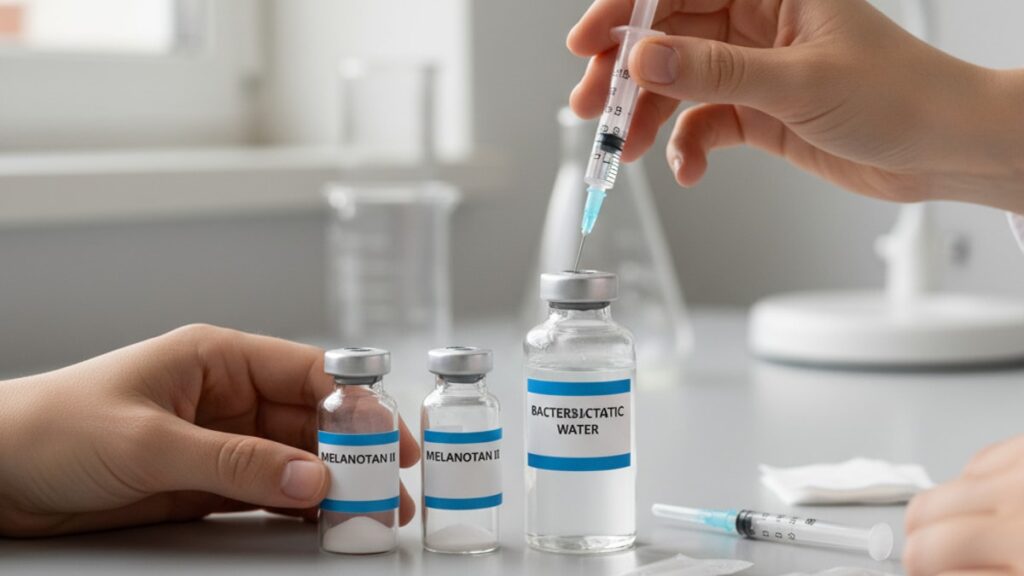
You're here because you understand that the integrity of your research hinges on getting the details right. And when it comes to peptides, few details are more critical than proper reconstitution. It’s a process that seems straightforward on the surface, but our team has seen firsthand how small missteps can compromise the stability and efficacy of a compound, ultimately invalidating the entire project. This isn't just about adding water to a powder; it’s about ensuring the peptide molecule remains intact and is diluted to a precise, known concentration for accurate dosing.
At Real Peptides, our commitment to quality doesn't end when our products ship. We see ourselves as partners in your research, and that means providing the expertise to ensure our high-purity peptides are handled correctly. Our unflinching dedication to small-batch synthesis and exact amino-acid sequencing means you start with a reliable product, like our Melanotan 2 (MT2) 10mg. Now, we're going to show you the meticulous process of how to mix Melanotan 2, transforming that lyophilized powder into a stable solution ready for your study.
First Things First: Gathering Your Supplies
Before you even think about opening a vial, you need to establish a clean, organized workspace and assemble the right tools. We can't stress this enough: sterile technique is not optional. It's the absolute foundation of reproducible results. Any contamination, however minor, introduces a variable that can skew your data. It's a critical, non-negotiable element of professional lab work.
Here’s what our team recommends you have on hand:
- Your Vial of Lyophilized Melanotan 2: This is the starting point. At Real Peptides, our Melanotan 2 arrives as a solid, freeze-dried powder (lyophilized) to ensure maximum stability during shipping and storage.
- Bacteriostatic Water: This is the reconstitution solution. It's imperative you use bacteriostatic water, not sterile water or, under any circumstances, tap water. Bacteriostatic Water contains 0.9% benzyl alcohol, which acts as a preservative. This inhibits bacterial growth after the vial has been opened and punctured multiple times, safeguarding the integrity of your peptide solution for weeks.
- A Sterile Syringe for Mixing: A 1mL or 3mL syringe with a needle (typically 21g to 25g) is ideal for drawing and transferring the bacteriostatic water. You'll need this to accurately measure your diluent.
- Dosing Syringes: These are typically 0.3mL, 0.5mL, or 1mL insulin syringes, marked in units (IU). These are used for accurately measuring the final reconstituted solution for your research application. Don't confuse these with the larger mixing syringe.
- Alcohol Prep Pads: You'll need several. Use them to sterilize the rubber stopper on your Melanotan 2 vial and your bacteriostatic water vial before every puncture. Again, sterility is paramount.
Having these items ready prevents scrambling mid-process and reduces the risk of contamination. Think of it as setting up your lab station for success.
The Math: Calculating Your Melanotan 2 Concentration
This is where many researchers, especially those new to peptides, feel a bit of anxiety. But the math is simpler than it looks. The goal is to create a solution where you know exactly how much Melanotan 2 is in every milliliter (mL) or every unit (IU) of liquid. It's all about control and precision.
Let’s use the most common scenario as an example: one 10mg vial of Melanotan 2.
The basic formula is:
Total Peptide (mg) / Total Diluent (mL) = Concentration (mg/mL)
So, if you add 1 mL of bacteriostatic water to your 10mg vial of MT2:
- 10mg MT2 / 1 mL water = 10mg of MT2 per mL
If you add 2 mL of bacteriostatic water to your 10mg vial of MT2:
- 10mg MT2 / 2 mL water = 5mg of MT2 per mL
Simple, right? The more water you add, the less concentrated the solution becomes, which can make measuring smaller doses easier. There's no single "right" amount of water to add; it's about what makes the dosing protocol for your specific research practical and accurate. Our team generally finds that using 1mL or 2mL of water provides a good balance of concentration and ease of measurement.
Now, let's translate that into units on an insulin syringe. Most standard U-100 insulin syringes have 100 units per 1 mL. This is a critical conversion.
Let's stick with the 1mL reconstitution example (10mg/mL concentration):
- Since 1 mL = 100 units, you have 10mg of MT2 in 100 units.
- To find out how much is in one unit, you divide: 10,000mcg (which is 10mg) / 100 units = 100mcg of MT2 per unit.
This means if your research protocol calls for a 500mcg dose, you would draw up 5 units on the insulin syringe.
Here’s a comparison table to make it even clearer:
| Amount of Water Added | MT2 Vial Size | Resulting Concentration (per mL) | Concentration (per Unit on U-100 Syringe) |
|---|---|---|---|
| 1 mL | 10mg | 10mg/mL | 100mcg/unit |
| 2 mL | 10mg | 5mg/mL | 50mcg/unit |
| 2.5 mL | 10mg | 4mg/mL | 40mcg/unit |
| 5 mL | 10mg | 2mg/mL | 20mcg/unit |
We recommend researchers choose a dilution that allows them to draw a sufficient volume for accurate measurement. Trying to measure a half-unit on a syringe is incredibly difficult and prone to error. A slightly more diluted solution (like using 2mL of water) often improves dosing accuracy.
The Protocol: How to Mix Melanotan 2 Step-by-Step
With your supplies gathered and your calculations double-checked, you're ready for the reconstitution itself. Perform these steps carefully and deliberately. Don't rush.
Step 1: Prepare Your Vials
Pop the plastic protective caps off both your Melanotan 2 vial and your bacteriostatic water vial. You'll see a rubber stopper underneath. Take an alcohol prep pad and vigorously wipe the surface of both stoppers. Let them air dry for a few seconds. This sterilizes the surface you're about to puncture with a needle.
Step 2: Draw the Bacteriostatic Water
Take your larger mixing syringe. Pull back the plunger to the mark of the amount of water you plan to use (e.g., the 1mL or 2mL mark). This draws air into the syringe. Insert the needle through the rubber stopper of the bacteriostatic water vial. Invert the vial and inject the air into it. This pressurizes the vial and makes it much easier to draw the liquid out. Now, carefully pull the plunger back, drawing your exact amount of bacteriostatic water. Check for any large air bubbles. If you see some, tap the syringe to get them to the top and gently push the plunger to expel them.
Step 3: Introduce Water to the Peptide
This is the most delicate part of the process. Take the syringe filled with bacteriostatic water and insert the needle through the stopper of the lyophilized Melanotan 2 vial. Here’s the critical technique: Do not inject the water directly onto the powder. This forceful stream can damage the fragile peptide chains. We mean this sincerely: this single mistake can ruin the product.
Instead, angle the needle so the water runs down the inside glass wall of the vial. Depress the plunger slowly and gently, letting the water trickle down and pool at the bottom. Once all the water is in, carefully withdraw the needle.
Step 4: Dissolve the Peptide Gently
Now you need to get the powder to dissolve into the water. The key word here is gently. Never, ever shake the vial. Shaking causes shearing forces that can break the peptide bonds, a process called denaturation. A denatured peptide is useless for research.
Instead, gently roll the vial between your fingers or palms. You can also swirl it in a slow, circular motion. The powder will dissolve completely within a minute or two. Be patient.
Step 5: Inspect the Final Solution
Once the powder is fully dissolved, hold the vial up to a light source. The final solution should be perfectly clear, like water. There should be no floating particles, no cloudiness, and no discoloration. If your solution is cloudy, it may indicate a problem with the peptide's purity or a contamination issue during mixing. This is why starting with a trusted source like Real Peptides is so important; our purity standards ensure you get a clear solution every single time, assuming proper technique.
Congratulations. You’ve successfully reconstituted your Melanotan 2.
Proper Storage is Not an Afterthought
Mixing is only half the battle. How you store your reconstituted peptide is just as crucial for maintaining its potency and stability over the course of your study.
Before reconstitution, lyophilized peptides are quite stable and can be stored in a cool, dark place or a refrigerator for long periods. But once you've introduced water, the clock starts ticking. The peptide is now in a less stable aqueous environment.
Here’s what you need to do:
- Refrigerate Immediately: Your reconstituted vial of Melanotan 2 must be stored in the refrigerator, typically between 2°C and 8°C (36°F and 46°F). Do not store it in the freezer, as the freeze-thaw cycle can degrade the peptide.
- Protect from Light: Peptides can be sensitive to light. Keep the vial in its original box or another light-blocking container inside the fridge.
- Understand Its Lifespan: When stored correctly in a refrigerator, a properly reconstituted vial of Melanotan 2 using bacteriostatic water will remain stable and potent for at least 30-45 days. Our internal stability tests confirm this window, but for the most sensitive research, we always recommend using the freshest possible solution.
Failing to store it correctly will cause the peptide to degrade rapidly, and you'll be conducting research with a compound of unknown and diminishing potency. That's a recipe for unreliable results.
Common Mistakes We've Seen (And How to Avoid Them)
Over the years, our team has consulted on countless research projects, and we've seen a few common, preventable errors pop up time and again when it comes to peptide handling. Avoiding these is key.
- The Aggressive Shake: We've mentioned it twice already, but it bears repeating because it's the most common and catastrophic mistake. You cannot rush the dissolving process by shaking the vial. Be patient and roll it gently.
- Using the Wrong Water: Researchers sometimes think any sterile water will do. Using sterile water (which has no preservative) means your vial is susceptible to bacterial growth the moment you make that first puncture. Using tap water is even worse, as it contains impurities and microorganisms that will instantly contaminate your research. Only use Bacteriostatic Water.
- Ignoring Sterility: Reusing a syringe, not wiping stoppers with alcohol, or working in a messy environment are all invitations for contamination. Treat every step of the process with the seriousness of a lab procedure, because that's exactly what it is. For those who are visual learners, our team breaks down similar lab safety and handling procedures on our YouTube channel, which can help reinforce these sterile techniques.
- Starting with a Subpar Product: Let's be honest. The most meticulous mixing technique in the world can't fix an impure or improperly synthesized peptide. If the starting material is flawed—containing contaminants or broken peptide fragments—your final solution will be flawed. The entire experiment is compromised from the start.
This is why we're so passionate about what we do at Real Peptides. Our commitment to U.S.-based, small-batch synthesis ensures that the purity and sequence of every peptide, from Melanotan 2 to more complex research compounds like Tirzepatide or BPC-157, are verified and guaranteed. This gives you the confidence that your results are based on the actual compound you intended to study. When you're ready to build your research on a foundation of unimpeachable quality, you can explore our full collection of peptides and Get Started Today.
The precision you apply in the lab is a direct reflection of your commitment to valid, impactful research. By following this protocol for mixing Melanotan 2, you're not just preparing a solution; you're upholding the standards of scientific integrity. You're ensuring that the data you collect is built on a foundation of accuracy and control, from the purity of the peptide to the precision of its preparation. That's how meaningful discoveries are made.
Frequently Asked Questions
What is the difference between bacteriostatic water and sterile water?
▼
Bacteriostatic water contains 0.9% benzyl alcohol, which acts as a preservative to prevent bacterial growth. Sterile water is just sterilized water with no preservative, making it suitable for single-use applications only. For peptides that will be used over time, bacteriostatic water is essential.
What happens if I accidentally shake my Melanotan 2 vial?
▼
Shaking the vial can damage the delicate peptide chains through a process called denaturation. This can render the Melanotan 2 ineffective for your research. Always dissolve the powder by gently rolling or swirling the vial.
How do I know if I’ve mixed my Melanotan 2 correctly?
▼
A correctly mixed solution of Melanotan 2 should be completely clear, with no cloudiness, discoloration, or floating particles. If the solution is not perfectly clear, it may indicate a problem with the product or contamination.
How long does reconstituted Melanotan 2 last in the fridge?
▼
When mixed with bacteriostatic water and stored properly in a refrigerator (2-8°C), Melanotan 2 is stable for at least 30-45 days. Our team advises using it within this window for optimal potency in research.
Can I pre-load syringes with my mixed MT2 solution?
▼
While technically possible, we don’t recommend pre-loading syringes for long-term storage. The plastic and rubber in the syringe can potentially interact with the peptide over time. It’s best practice to draw each dose from the refrigerated vial immediately before use.
My mixed Melanotan 2 solution turned cloudy. What should I do?
▼
A cloudy solution indicates a problem and should not be used for research. The cloudiness could be due to bacterial contamination or an issue with the peptide’s stability or purity. It is safest to discard the vial.
Why is it important to inject the water down the side of the vial?
▼
Injecting water directly onto the lyophilized powder can be too forceful and may physically damage the fragile peptide structure. Letting the water run gently down the side of the glass ensures a soft and effective reconstitution that preserves the molecule’s integrity.
What does ‘lyophilized’ mean?
▼
Lyophilization is a freeze-drying process that removes water from the peptide, turning it into a stable powder. This process makes the peptide much more stable for shipping and long-term storage before it’s ready to be reconstituted for use.
Does it matter what size insulin syringe I use for dosing?
▼
Yes, the size can affect accuracy. Using a smaller volume syringe (e.g., 0.3mL or 0.5mL) can make it easier to accurately measure smaller doses, as the unit markings are spaced further apart. Choose a size that best fits your research protocol’s required dosage.
Can I use more or less than 1mL of bacteriostatic water?
▼
Absolutely. Using more water (e.g., 2mL) will make the solution less concentrated, which can be helpful for measuring very small doses accurately. The amount of water used is flexible; just be sure to adjust your dose calculations accordingly.
Should I store my unmixed Melanotan 2 in the freezer?
▼
Before mixing, lyophilized Melanotan 2 is stable at room temperature for short periods but should be stored in a refrigerator for long-term stability. While freezing is an option for very long-term storage (many months to years), for most research timelines, refrigeration is perfectly sufficient.











