



Figuring out how to aliquot Melanotan 2 can feel like navigating a maze. The internet is a sprawling landscape of conflicting advice, outdated forum posts, and questionable protocols. It’s genuinely difficult to find a clear, reliable source of information. That’s precisely why we’re putting this together. Our team at Real Peptides fields questions about this constantly, and we believe that precise, responsible research begins with impeccable data and methodology.
This isn't just another guide. This is a professional breakdown, built from years of experience in synthesizing high-purity peptides and observing the methodologies used in the scientific community. We’re going to walk you through every critical step, from reconstitution to maintenance, all while grounding the process in the principles of safety and accuracy. Let’s be clear: Melanotan 2 is a potent research compound, and treating it with respect is non-negotiable for achieving valid, reproducible results in a laboratory setting.
What Exactly is Melanotan 2? A Quick Refresher
Before we dive into the nuts and bolts of preparation, it’s worth taking a moment to understand the molecule you’re working with. Melanotan 2 (MT2) is a synthetic analogue of a naturally occurring peptide hormone called alpha-melanocyte-stimulating hormone (α-MSH). In the body, α-MSH is a key player in stimulating melanogenesis—the process that produces melanin, the pigment responsible for skin and hair color.
MT2 was developed at the University of Arizona as a potential sunless tanning agent. It works by binding to melanocortin receptors in the body, most notably MC1R, MC3R, MC4R, and MC5R. Its interaction with MC1R is what triggers melanocytes to produce more melanin. However, its broader receptor affinity is also responsible for other observed effects, like increased libido (via MC4R) and appetite suppression. It’s a fascinating molecule with a complex profile, which is why precision in research is so critical. The quality of your starting material dictates the reliability of your observations, which is why our commitment to small-batch synthesis and exact amino-acid sequencing is the bedrock of everything we do at Real Peptides.
Before You Begin: The Non-Negotiable Foundations
You wouldn't start a complex experiment with contaminated reagents or uncalibrated equipment, right? The same principle applies here. Getting the foundational elements right is absolutely essential before a single microgram is measured.
First, purity is paramount. We can't stress this enough. Using a low-purity product doesn't just skew your research results; it introduces a host of unknown variables and potential contaminants. That's a catastrophic risk to your study's integrity. We founded Real Peptides to solve this exact problem, ensuring every vial we ship is lab-verified for purity and identity, right here in the United States. Your research deserves a reliable constant, not a questionable variable.
Next, gather your essential supplies. This isn't the time to improvise.
- Your Vial of MT2: You'll need a high-purity, lyophilized (freeze-dried) product like our Melanotan 2 MT2 10mg.
- Bacteriostatic Water: This is sterile water containing 0.9% benzyl alcohol, which acts as a preservative to prevent bacterial growth after the vial is reconstituted. Do not use sterile water or tap water. You can find research-grade Bacteriostatic Water on our site.
- Alcohol Swabs: For sterilizing the vial stoppers before every use.
Finally, a crucial disclaimer. All information provided here is for laboratory research and informational purposes only. Melanotan 2 is not approved by the FDA for human use. This guide is intended for scientists and researchers conducting in-vitro or in-vivo studies in controlled settings.
Step 1: Reconstitution — Turning Powder into a Solution
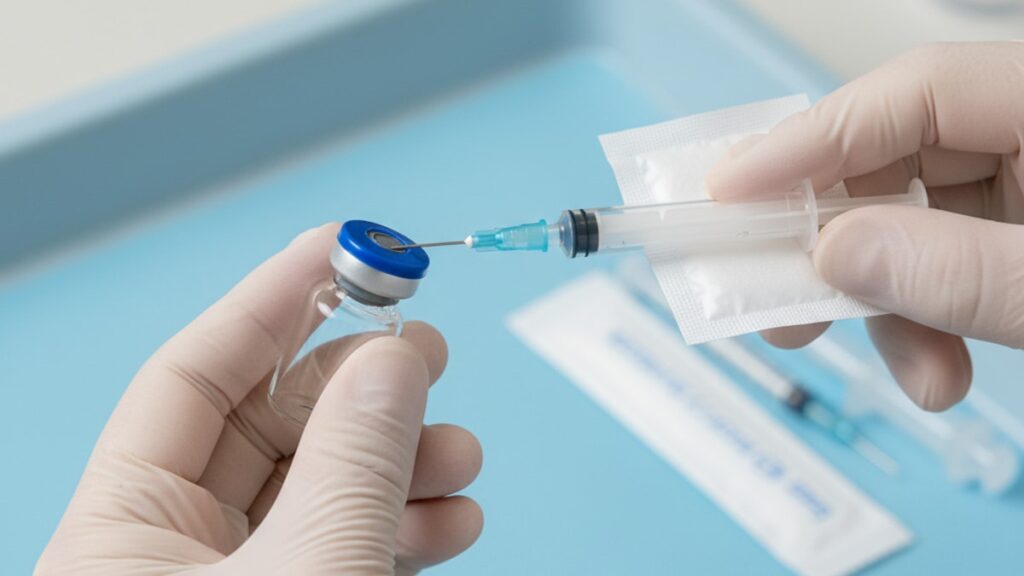
Your MT2 will arrive as a solid, white, lyophilized powder at the bottom of a sealed vial. The first step is to reconstitute it into a liquid solution using bacteriostatic water. This is where careful measurement becomes critical.
Here’s the process our team recommends for consistency:
- Prepare Your Vials: Take the plastic caps off both your MT2 vial and your bacteriostatic water vial. Use an alcohol swab to vigorously wipe the rubber stoppers on top of both.
- This equalizes the pressure and makes drawing the liquid easier.
- Here’s the key part: aim the transfer line at the side of the glass vial. Do not directing the stream straight onto the lyophilized cake powder. Let the water trickle slowly down the inside of the vial.
- Mix Gently: Once all the water is in, remove the labware. You'll see the powder dissolve almost instantly. To ensure it's fully mixed, gently roll the vial between your fingers or swirl it slowly. NEVER SHAKE THE VIAL. Shaking can damage the fragile peptide chains, rendering your product less effective or entirely inert. We've seen researchers ruin expensive peptides this way. Be patient.
Once reconstituted, your solution must be stored in a refrigerator. It will remain stable for approximately 30-45 days.
The Loading Phase: Building Melanin Production Safely
The idea behind a loading phase is to gradually introduce the peptide to the research subject to stimulate a steady increase in melanin production without overwhelming the system and causing significant side effects. Think of it as priming the pump.
Our experience, backed by extensive review of research literature, strongly suggests a conservative, low-aliquot approach is superior. It minimizes side effects and allows for careful observation of the subject's response.
We recommend a starting aliquot of 100mcg to 250mcg per day.
Why so low? Because the most common initial side effects—nausea and facial flushing—are highly aliquot-dependent. Starting with a massive 1mg aliquot, as some reckless online protocols suggest, is a recipe for a very unpleasant research experience. A lower aliquot allows the system to acclimate. This is a marathon, not a sprint.
This loading phase typically continues for one to three weeks, or until the desired level of pigmentation is observed in the research model.
The Maintenance Phase: Sustaining Results Long-Term
Once the desired level of pigmentation is achieved in the loading phase, the protocol can shift to a less frequent maintenance schedule. The goal is no longer to build melanin but simply to maintain the current level. If you continue preparation daily at the same level, the subject will continue to get darker, which may not be the objective of your research.
The maintenance phase involves reducing the frequency of handling significantly. Instead of daily, it might be reduced to one to three times per week.
The aliquot itself might stay the same (e.g., 250mcg) or be slightly increased (e.g., up to 500mcg) to compensate for the lower frequency. This is highly dependent on the specific research subject and how quickly their pigmentation seems to fade. Careful observation is key. For some subjects, a single 500mcg aliquot per week is sufficient. For others, 250mcg every three days might be more effective. This is the part of the research where you titrate to find the minimum effective aliquot for maintenance.
Managing and Mitigating Potential Side Effects
Let's be unflinchingly honest: side effects are a possibility with any potent compound. Acknowledging and managing them is part of a responsible research protocol. Here are the most commonly reported effects and our team's observations on mitigating them in a lab setting:
- Nausea: This is the most common side effect, especially at the beginning. It's almost always aliquot-dependent. The best mitigation strategy is to start with a very low aliquot (100mcg or even less) and prepare it right before the subject's sleep cycle. Most will sleep right through any potential queasiness.
- Facial Flushing: A feeling of warmth and redness in the face shortly after handling. This is a histamine-related response. It's usually mild and subsides within an hour. Some research protocols include the co-handling of a simple anti-histamine 30 minutes prior, which often negates this effect entirely.
- Appetite Suppression: MT2's action on the MC4 receptor can have a potent anorectic effect. This is something to be aware of and monitor in your research subjects.
- Increased Libido: Also related to MC4R activation, this is a very commonly reported effect. It's simply a known part of the peptide's pharmacological profile.
- New Freckles & Darkening of Moles: Because MT2 stimulates all melanocytes, it can cause new, small freckles to appear and existing moles or freckles to darken. This is generally reversible after cessation of the protocol. A conservative, low-aliquot approach seems to minimize this effect.
Storing Your Reconstituted Peptide: A Critical Final Step
Proper storage is not optional. It's essential for preserving the integrity and potency of your peptide.
- Before Reconstitution: The lyophilized powder is stable at room temperature for a short period (like during shipping) but should be stored in a refrigerator or freezer for long-term stability.
- After Reconstitution: Once you've mixed the peptide with bacteriostatic water, it must be stored in a refrigerator (around 2-8°C or 36-46°F). Do not freeze a reconstituted vial. The solution should remain potent for at least 30 days, and often longer. Always inspect the solution before use. It should be perfectly clear. If it ever appears cloudy, it may indicate bacterial contamination or peptide degradation, and it should be discarded.
For more visual guides and breakdowns of complex peptide topics, you can always check out our YouTube channel, where we explore the science behind these fascinating compounds.
Ultimately, mastering how to aliquot Melanotan 2 is a matter of precision, patience, and a deep respect for the scientific process. It’s about starting with a foundation of unimpeachable quality, following a conservative and observant protocol, and meticulously documenting the results. This approach ensures not only the safety and integrity of your research but also the clarity and reliability of your data. When you're ready to proceed with your research, [Get Started Today] by exploring our full range of lab-verified peptides, all synthesized to the highest standards of purity right here in the USA.
Frequently Asked Questions
How long does it typically take to see results from a Melanotan 2 protocol?
▼
Results vary depending on the research subject’s skin type and the aliquot used. With a conservative loading phase, initial changes can often be observed within the first 1-2 weeks, with more significant pigmentation developing over 3-4 weeks.
Can I preparing aliquots in advance with MT2 for the week?
▼
Our team generally advises against preparing aliquots in advance for extended periods. While the peptide is stable in the vial, storing it in a plastic labware for days could risk adsorption to the plastic and potential loss of potency. It’s best practice to draw each aliquot immediately before handling.
What happens if a aliquot is missed during the loading phase?
▼
Missing a single aliquot is not a major issue. Simply continue the protocol as scheduled with the next planned handling. Don’t double the aliquot to ‘catch up,’ as this could increase the likelihood of side effects.
How important is UV exposure when researching Melanotan 2?
▼
UV exposure acts as a catalyst. MT2 primes the melanocytes to produce melanin, and small, controlled amounts of UV light can significantly accelerate the pigmentation process. However, it also increases the need for caution, as the subject will be much more sensitive to the sun.
Why did my reconstituted MT2 vial turn cloudy?
▼
A cloudy solution is a major red flag. It can indicate either bacterial contamination or that the peptide has degraded and crashed out of the solution. In either case, the vial should be safely discarded immediately.
What is the absolute best time of day to prepare a aliquot?
▼
Based on our observations, the best time is typically 30-60 minutes before the subject’s sleep cycle begins. This allows any potential initial side effects, like nausea or flushing, to occur while the subject is asleep, leading to a much better-tolerated protocol.
Can I mix Melanotan 2 with other peptides like BPC-157 in the same labware?
▼
We strongly recommend against mixing different peptides in the same labware unless a specific research protocol calls for it. Peptides can have different pH levels and stability requirements, and mixing them could cause them to degrade or interact in unpredictable ways. Use a separate labware for each compound, like our [BPC 157 Peptide](https://www.realpeptides.co/products/bpc-157-peptide/).
Do research protocols require cycling off MT2?
▼
Yes, continuous, long-term handling is generally not recommended in research settings. Protocols typically involve a loading phase, followed by a maintenance phase, and then a complete cessation or ‘washout’ period to observe how the subject returns to baseline.
Will MT2 make hair darker as well as skin?
▼
Yes, because MT2 stimulates all melanocytes, it can also increase the pigment in hair follicles. This can result in a noticeable darkening of the hair color in research subjects over the course of a protocol.
Where can I find more visual guides on peptide reconstitution?
▼
For detailed visual walkthroughs and deep dives into peptide science, we recommend you [check out our YouTube channel](https://www.youtube.com/@MorelliFit). We provide clear, step-by-step videos to help guide your research.











