



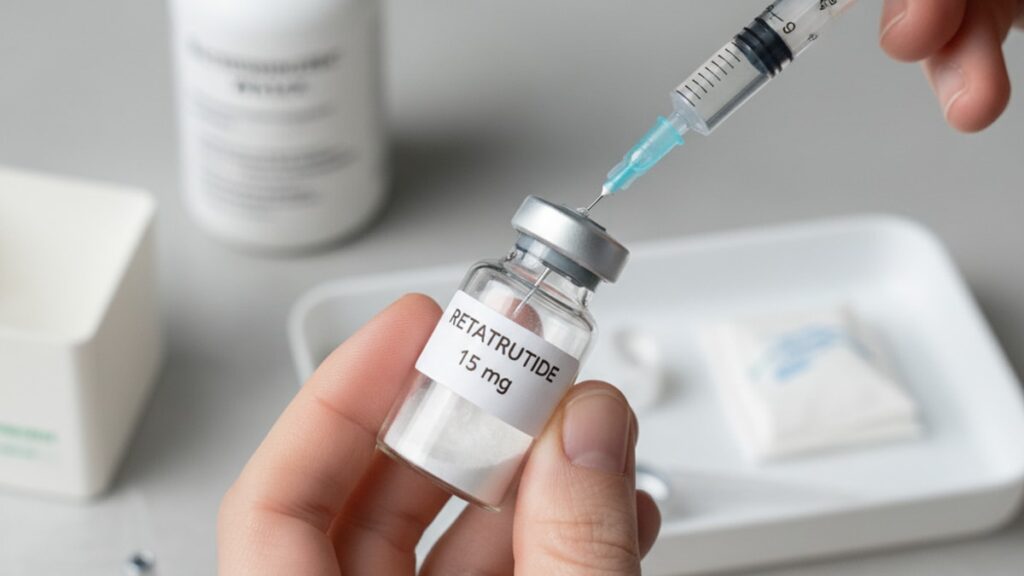
In the world of cutting-edge biological research, precision isn't just a goal; it's the entire foundation upon which credible discoveries are built. You can have the purest, most meticulously synthesized peptide on the market, but if the handling protocol is flawed, the integrity of your data is compromised from the start. This is especially true for novel compounds like Retatrutide, where every variable matters. Our team at Real Peptides constantly fields questions about proper lab techniques, and one of the most frequent—and most critical—is how to reconstitute 15 mg retatrutide correctly.
Let's be honest, this is crucial. The process of taking a stable, lyophilized (freeze-dried) powder and returning it to a liquid state for research is far more nuanced than just 'adding water.' It's a delicate procedure that demands an understanding of chemistry, a sterile environment, and an almost obsessive attention to detail. We're not just talking about getting the peptide into a solution; we're talking about preserving its complex structure, ensuring its bioactivity, and guaranteeing accurate dosing for your experiments. Getting this wrong can lead to wasted material, skewed results, and months of invalidated work. We've seen it happen, and it's why we've put together this definitive protocol—to ensure the quality we build into our peptides is maintained all the way to your final data point.
Why Proper Reconstitution Isn't Just 'Adding Water'
Before we dive into the 'how,' it's vital to understand the 'why.' Peptides, especially complex ones like Retatrutide, are delivered in a lyophilized state for one simple reason: stability. In their solid, powdered form, they are remarkably resilient to degradation, allowing for safe shipping and storage. The moment you introduce a liquid, you start the clock on their viability. This process, called reconstitution, is where the molecule is most vulnerable.
Think of a complex protein structure like a delicate piece of origami. In its freeze-dried state, it's neatly folded and protected. The reconstitution process is the act of carefully unfolding it. If you do it too aggressively—by shaking the vial, for instance—you don't just unfold it; you tear the paper. In biochemical terms, this is called denaturation. The peptide's amino acid sequence remains the same, but its three-dimensional structure is irrevocably damaged, rendering it biologically inert. All that potential, gone. It's a catastrophic failure at the molecular level.
Furthermore, the risk of contamination is immense. Every surface, every tool, and even the air itself can introduce bacteria or other contaminants that can degrade the peptide or, worse, introduce confounding variables into your research. Our team's experience shows that the most common sources of experimental failure aren't a flaw in the hypothesis but a simple breach in aseptic technique during preparation. This is why we emphasize that learning how to reconstitute 15 mg retatrutide is less about following a recipe and more about adopting a meticulous lab discipline. It’s a critical, non-negotiable element of good scientific practice.
Assembling Your Lab Toolkit: The Non-Negotiables
Walking into this process unprepared is a recipe for disaster. Before you even think about opening a vial, you need to have every single tool laid out, sterilized, and ready to go. A chaotic workflow invites error. We've refined this list over years of in-house and client-supported research to include only the essentials. There's no room for improvisation here.
Here’s what you absolutely must have on hand:
- Your Vial of Lyophilized Retatrutide (15 mg): The starting point. Always inspect the vial upon arrival. At Real Peptides, our small-batch synthesis ensures a consistent, fine powder. If you ever see discoloration or clumping, that's a red flag.
- Reconstitution Solvent: This is your most important choice after the peptide itself. We'll break this down further, but our unequivocal recommendation is Bacteriostatic Water. It contains 0.9% benzyl alcohol, which acts as a preservative to inhibit bacterial growth and significantly extend the shelf life of the reconstituted solution.
- Sterile Syringes: You'll need at least two. One larger syringe (typically 3mL or 5mL) is for drawing and measuring the bacteriostatic water. A second, smaller syringe (like a 1mL insulin syringe marked in units) is for accurately measuring and administering the final reconstituted solution for your experiments. Don't mix them up.
- Alcohol Prep Pads: Lots of them. You can't over-sanitize. You'll use these to wipe the rubber stoppers of both the Retatrutide vial and the bacteriostatic water vial, as well as any other surfaces.
- A Clean, Controlled Environment: A dedicated, clutter-free workspace is paramount. If you have access to a laminar flow hood, use it. If not, find a draft-free area that you can thoroughly sanitize.
- Personal Protective Equipment (PPE): At a minimum, wear nitrile gloves. A lab coat is also highly recommended. This isn't just for your safety; it's to protect the peptide from you.
Having everything within arm's reach before you begin transforms the process from a frantic scramble into a controlled, deliberate procedure. That's the key.
The Critical Choice: Your Reconstitution Solvent
Not all sterile liquids are created equal. The solvent you choose has a direct and profound impact on the stability and longevity of your reconstituted Retatrutide. Our experience has shown that researchers who cut corners here often end up with degraded peptides and unreliable data. It's a classic case of being penny-wise and pound-foolish.
Let’s compare the common options. It's a significant, sometimes dramatic shift in outcome depending on your choice.
| Solvent Type | Key Characteristic | Recommended Use Case | Shelf-Life (Refrigerated) | Our Team's Observation |
|---|---|---|---|---|
| Bacteriostatic Water | Sterile water with 0.9% benzyl alcohol (preservative) | Gold Standard for multi-use vials. Ideal for Retatrutide and most peptides. | 3-4 Weeks | The benzyl alcohol is highly effective at preventing contamination over repeated vial entries. This is our default recommendation. |
| Sterile Water | Pure, sterile H2O with no preservatives | Single-use applications only. Once reconstituted, must be used immediately. | < 24 Hours | Without a preservative, the risk of bacterial growth after the first puncture is extremely high. Avoid for multi-dose protocols. |
| Normal Saline (0.9%) | Sterile water with 0.9% sodium chloride | Some specific peptides require it for isotonicity, but generally not recommended. | < 24 Hours | The salt content can sometimes cause aggregation or affect the peptide's solubility. Stick with Bac Water unless a protocol specifies otherwise. |
For any research involving a 15 mg vial of Retatrutide, which will undoubtedly be used for multiple experiments, Bacteriostatic Water is the only logical choice. It provides the sterile liquid medium needed for dissolution while actively protecting your investment from microbial contamination for weeks. Using anything else is an unnecessary risk.
The Step-by-Step Protocol: How to Reconstitute 15 mg Retatrutide
Now, we get to the heart of the matter. Follow these steps meticulously. Do not deviate. Do not rush. Every action has a purpose, designed to ensure the maximum integrity of the final solution.
Step 1: Preparation and Sanitization
This is your foundation. A breach here invalidates everything that follows. First, wash your hands thoroughly. Put on your nitrile gloves. Vigorously scrub the rubber stoppers on both your Retatrutide vial and your bacteriostatic water vial with separate alcohol prep pads. Allow them to air dry completely. Don't blow on them. Just wait. Patience is a virtue in the lab.
Step 2: Calculating Your Diluent Volume
This is where precision math comes into play. You need to decide on your final desired concentration. This determines how much bacteriostatic water you'll add. A common and easy-to-work-with concentration is 5 mg/mL. Let's use that for our example.
The formula is straightforward:
(Total Peptide in Vial) / (Desired Concentration) = Total Volume of Diluent to Add
For our 15 mg vial of Retatrutide:
(15 mg) / (5 mg/mL) = 3 mL of Bacteriostatic Water
Adding 3 mL of bacteriostatic water to the 15 mg of powder will yield a solution where every 1 mL contains exactly 5 mg of Retatrutide. If you wanted a concentration of 3 mg/mL, you would add 5 mL of water (15 mg / 3 mg/mL = 5 mL). We recommend choosing a concentration that makes your experimental dosing calculations simple. Don't make it harder than it needs to be.
Step 3: The Reconstitution Technique
This is the most delicate part of the process.
- Draw the Air: Take your larger 3mL syringe and pull back the plunger to the 3 mL mark (or whatever volume you calculated). This draws 3 mL of air into the syringe. Pierce the rubber stopper of the Retatrutide vial and inject the air inside. This equalizes the pressure, making it much easier to inject the liquid later. Remove the syringe.
- Draw the Solvent: Now, use the same syringe to pierce the stopper of your bacteriostatic water. Invert the vial and slowly draw out exactly 3 mL of the water. Be precise. Check for air bubbles and expel them if necessary to ensure an accurate measurement.
- The Slow Injection: This is the moment of truth. Re-insert the needle into the prepared Retatrutide vial. Angle the needle so that the tip is touching the inside glass wall of the vial. Do not inject the water directly onto the lyophilized powder. This forceful stream can damage the peptide molecules. Instead, slowly and gently depress the plunger, letting the water run down the side of the glass to pool at the bottom. The powder will begin to dissolve on its own.
- Gentle Mixing: Once all the water is added, remove the syringe. Now, gently swirl the vial in a slow, circular motion. You can also roll it between your palms. The goal is to encourage the powder to fully dissolve. It might take a minute or two. Be patient.
We can't stress this enough: DO NOT SHAKE THE VIAL. Shaking introduces shearing forces that will denature the peptide. This is the single most common and destructive mistake we see. Gentle swirling is all that's required.
Step 4: Verification and Inspection
The final solution should be perfectly clear. Hold it up to a light source and inspect it for any floating particulates or cloudiness. A properly reconstituted, high-purity peptide will dissolve completely, leaving a solution that looks just like water. If it remains cloudy or you see floaters, something is wrong. Do not use it. This is why sourcing from a reputable supplier like Real Peptides is so critical; our commitment to purity minimizes the chances of solubility issues right from the start.
Storage and Handling: Protecting Your Investment
Congratulations, you've successfully reconstituted your peptide. But your job isn't done. Proper storage is essential to maintain its potency for the duration of your research.
Immediately after reconstitution, the vial must be stored in a refrigerator, typically between 2°C and 8°C (36°F and 46°F). Do not freeze it. Freezing and thawing can damage the peptide structure just as shaking can. When stored correctly in bacteriostatic water, your reconstituted Retatrutide should remain stable and potent for up to four weeks. Keep the vial in its original box or wrap it in foil to protect it from light, which can also contribute to degradation over time.
Every time you need to draw a dose for an experiment, repeat the sanitization protocol for the rubber stopper. Use a fresh, sterile syringe for each draw to prevent cross-contamination. This disciplined approach ensures that the last dose from the vial is just as pure and potent as the first.
Common Pitfalls and How to Sidestep Them
Our team has consulted on thousands of research projects, and we've seen the same handful of mistakes derail otherwise promising work. Learning from them is key to your success.
- The Pitfall of Aggression: Shaking or vortexing the vial. As we've hammered home, this is a death sentence for the peptide's structure. The Sidestep: Embrace patience. A gentle swirl is all you need.
- The Pitfall of Improper Solvents: Using sterile water for a multi-use vial. This is practically an invitation for bacterial growth. The Sidestep: Standardize on Bacteriostatic Water for all your multi-dose peptide reconstitutions.
- The Pitfall of 'Eyeballing It': Inaccurate measurements of your diluent. This throws off all subsequent dosing calculations and makes your data unreliable. The Sidestep: Use high-quality, clearly marked syringes and take your time to measure the exact volume calculated.
- The Pitfall of a Casual Environment: Reconstituting on a dirty benchtop or with unwashed hands. Contamination is insidious. The Sidestep: Treat the process with the seriousness it deserves. Create a sterile field of work, wear gloves, and sanitize everything.
Avoiding these common errors isn't difficult. It just requires a commitment to a rigorous, repeatable process. That's what separates amateur work from professional, publishable research.
Beyond Retatrutide: Universal Principles of Peptide Handling
The beautiful thing about mastering this protocol is that its principles are nearly universal. The same meticulous care you take to reconstitute 15 mg of Retatrutide applies to a vast array of other research compounds. Whether you're working with metabolic peptides like Tirzepatide, growth hormone secretagogues like Tesamorelin, or regenerative compounds like BPC-157 Peptide, the core tenets remain the same: sterility, precision, and gentleness.
Our entire catalog at Real Peptides, from individual molecules to complex formulations like our Tesamorelin Ipamorelin Growth Hormone Stack, is built on the promise of purity. We handle the difficult part—the synthesis, the purification, the lyophilization. We deliver a product of impeccable quality to your lab. But the final, crucial step of preparation is in your hands. By adopting a professional, disciplined approach to reconstitution, you ensure that the quality we guarantee is translated directly into the reliability and accuracy of your work.
This commitment to excellence is what drives the future of discovery. The data you generate today could become the foundation for tomorrow's breakthroughs. It all starts with a single vial, a sterile syringe, and a deep respect for the science. When you're ready to ensure your research is built on the most reliable foundation possible, we're here to help you Get Started Today.
Ultimately, the integrity of your research is a chain, and reconstitution is one of its most critical links. A failure here compromises the entire endeavor. By following this protocol, you're not just mixing a solution; you're upholding a standard of scientific excellence that ensures your results are meaningful, repeatable, and trustworthy. That's the real goal.
Frequently Asked Questions
What happens if I accidentally shake the Retatrutide vial?
▼
Shaking the vial can cause the delicate peptide structure to break apart, a process called denaturation. This renders the peptide biologically inactive and useless for research, even though the liquid may look the same.
Can I use sterile water instead of bacteriostatic water?
▼
While you can use sterile water for immediate, single-use applications, we strongly advise against it for a 15 mg vial. Without the preservative found in bacteriostatic water, the solution is highly susceptible to bacterial contamination after the first use.
How do I know if I’ve reconstituted the peptide correctly?
▼
A correctly reconstituted solution should be perfectly clear, with no cloudiness, discoloration, or visible particles. The lyophilized powder should dissolve completely with gentle swirling.
What is the best concentration to aim for when reconstituting 15 mg Retatrutide?
▼
There’s no single ‘best’ concentration, but we recommend choosing one that simplifies your dosing math. A concentration like 5 mg/mL (by adding 3 mL of Bac Water) or 3 mg/mL (by adding 5 mL) are common and easy to work with.
Why is it important to inject the water down the side of the vial?
▼
Injecting the solvent directly onto the lyophilized powder can create a forceful stream that physically damages the peptide molecules. Letting it run gently down the glass wall is a much safer method that allows for gentle dissolution.
How long will my reconstituted Retatrutide last in the refrigerator?
▼
When reconstituted with bacteriostatic water and stored properly in a refrigerator (2°C to 8°C), the solution should remain stable and potent for up to 4 weeks. If sterile water is used, it should be discarded after 24 hours.
Can I pre-load syringes for the week?
▼
Our team strongly advises against pre-loading syringes for extended periods. Peptides are most stable in their glass vial; some plastics in syringes can cause the peptide to degrade or adhere to the surface over time, leading to inaccurate dosing.
What should I do if my reconstituted solution looks cloudy?
▼
A cloudy solution is a major red flag, indicating potential contamination, solubility issues, or that the peptide has been denatured. We recommend discarding the vial and starting over to ensure the integrity of your research.
Is it safe to use tap water or bottled water for reconstitution?
▼
Absolutely not. Tap water and bottled water are not sterile and contain minerals, impurities, and microorganisms that will contaminate and destroy the peptide. Only use laboratory-grade solvents like bacteriostatic or sterile water.
Does the temperature of the bacteriostatic water matter during reconstitution?
▼
For best results, allow both the peptide vial and the bacteriostatic water to come to room temperature before mixing. This can help improve the speed and completeness of dissolution.
Why do I need to inject air into the vial before adding the water?
▼
The lyophilized peptide vials are often vacuum-sealed. Injecting a volume of air equal to the liquid you plan to add equalizes the pressure, making it much easier to inject the solvent without it trying to push back out.
