


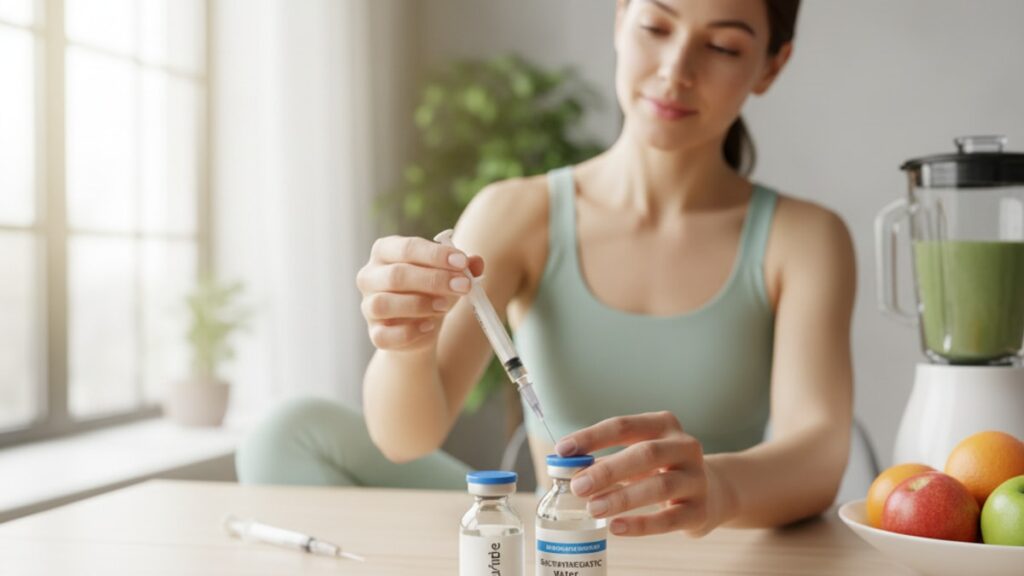
When you're working with advanced research compounds, precision is everything. It's not just about the quality of the peptide itself—though that's paramount, and it's the foundation of everything we do here at Real Peptides. The process extends all the way through to the final moments before application in a study. One of the most common, and frankly, most critical points of potential failure is the reconstitution process. Get it wrong, and the integrity of a meticulously synthesized molecule like Retatrutide can be compromised before your research even begins.
Our team has seen it happen. Promising studies can be derailed by simple, avoidable mistakes made at the lab bench. That's why we're putting our collective experience down on paper. This isn't just a set of instructions; this is a protocol born from countless hours of lab work and an unwavering commitment to scientific validity. Knowing how to mix bac water with retatrutide isn't a trivial step—it's a foundational skill for any serious researcher in this field. We're going to walk you through it, step by step, to ensure your materials retain the purity and stability we worked so hard to create.
Why This Process Demands Your Full Attention
Let's be blunt. Lyophilized peptides are delicate. Think of them as intricate, perfectly folded protein structures held in suspended animation. The process of freeze-drying (lyophilization) removes water, making them stable for shipping and storage. But the moment you reintroduce liquid, you're bringing that delicate structure back to life, and it's incredibly vulnerable. The goal of reconstitution is to gently return the peptide to a liquid state without shattering its fragile architecture.
Improper mixing can lead to several catastrophic failures. Vigorous shaking can cause shearing forces that literally break the amino acid bonds or cause the peptide to denature—unraveling it like a ball of yarn and rendering it biologically useless. Using the wrong diluent can introduce contaminants or alter the solution's pH, leading to aggregation (clumping) or degradation. The result? Your research data becomes unreliable. Your investment is wasted. And your conclusions are built on a faulty premise.
This is why we can't stress this enough: the reconstitution process is an active and critical part of your research methodology, not just a prep-work chore. It demands the same level of focus and sterile discipline as any other part of your experiment. Your results depend on it.
Assembling Your Lab Essentials
Before you even think about uncapping a vial, you need to have your toolkit ready. Working in a clean, organized space is non-negotiable. Our team recommends laying everything out on a sterile surface or a disinfected lab bench. You wouldn't build a precision instrument with rusty tools, and you shouldn't handle high-purity peptides without the right supplies.
Here’s what you’ll need:
- Your Vial of Lyophilized Retatrutide: This is your primary compound. At Real Peptides, our Retatrutide arrives as a solid, white, lyophilized powder or 'cake' at the bottom of a sealed, sterile vial.
- Bacteriostatic (Bac) Water: This is your diluent. It's the key to bringing the peptide into solution safely. We supply high-quality Bacteriostatic Water specifically for this purpose.
- Sterile Syringes: You'll need at least one syringe to draw the Bac water and transfer it to the peptide vial. We recommend using a 3ml or 5ml syringe with a needle gauge of 21g or similar for drawing and transferring the diluent. The needle should be long enough to comfortably pass through the rubber stopper.
- Alcohol Prep Pads: Sterility is paramount. You'll use these to wipe the rubber stoppers of both the Retatrutide vial and the Bacteriostatic Water vial before piercing them with a needle. This simple step prevents the introduction of bacteria and other contaminants.
That's it. Simple, right? The simplicity of the toolkit belies the importance of the technique. Having everything within arm's reach prevents fumbling and reduces the risk of contamination.
Understanding the Key Players: Retatrutide and Bac Water
Knowing your materials is just as important as knowing the procedure. Let's quickly break down what you're working with.
Retatrutide: This is a fascinating compound for the research community. As a tri-agonist, it targets three different receptors: the glucagon-like peptide-1 (GLP-1), glucose-dependent insulinotropic polypeptide (GIP), and glucagon receptors. This multi-faceted mechanism of action makes it a subject of intense study in metabolic research. Its complex structure, like that of other advanced peptides such as Tirzepatide or Semaglutide, is precisely why gentle handling is so crucial. Each peptide we synthesize is a testament to precision chemistry, and preserving that precision is your first task in the lab.
Bacteriostatic Water: This isn't just any water. It's sterile water for injection that contains 0.9% benzyl alcohol. That tiny amount of benzyl alcohol acts as a bacteriostatic agent, meaning it prevents bacteria from reproducing. This is absolutely critical if you plan to store the reconstituted peptide and draw multiple doses from the same vial over a period of days or weeks. The benzyl alcohol keeps the solution sterile, protecting the integrity of your subsequent experiments.
Could you use something else? Perhaps. But should you? Absolutely not. Using simple sterile water is only acceptable if you intend to use the entire contents of the vial immediately after reconstitution. It contains no preservative, so once you pierce the stopper, it's a race against contamination. And saline solution, while sterile, contains sodium chloride, which can sometimes cause certain peptides to aggregate or fall out of solution. For multi-use research applications, Bacteriostatic Water is the undisputed gold standard.
To make it clearer, our team put together a quick comparison.
| Diluent Type | Composition | Preservative? | Best Use Case for Peptides |
|---|---|---|---|
| Bacteriostatic Water | Sterile water + 0.9% Benzyl Alcohol | Yes | The standard for multi-use vials. Preserves sterility over weeks. |
| Sterile Water | Pure, sterile water | No | Single-use only. Must use the entire vial immediately after mixing. |
| Saline Solution | Sterile water + 0.9% Sodium Chloride | No | Generally not recommended. The salt content can affect peptide stability. |
The Reconstitution Protocol: A Step-by-Step Guide
Alright, you've got your supplies, you understand your compounds, and your workspace is clean. It's time to execute. Follow these steps precisely. Don't rush. Every action has a purpose.
Step 1: Prepare and Sanitize
Wash your hands thoroughly. Pop the plastic protective caps off both your Retatrutide vial and your Bacteriostatic Water vial. You'll see a rubber stopper underneath. Take a fresh alcohol prep pad and vigorously wipe the surface of each rubber stopper. Let them air dry for a moment. Do not blow on them. This ensures the surface where the needle will enter is completely sterile.
This step is so simple, yet it's often overlooked. We've found that contamination issues almost always trace back to a lapse in sterile technique right at the beginning.
Step 2: Calculate Your Diluent Volume
Now for some simple but crucial math. You need to decide on your final concentration. This determines how much Bac water you'll add. A common and easy-to-manage protocol is to add a volume that makes the math simple for future dosing.
Let's use a standard 10mg vial of Retatrutide as an example.
- If you add 2 mL (or 2cc) of Bacteriostatic Water to a 10mg vial, your final concentration will be 5mg per mL (10mg / 2mL = 5mg/mL).
- If you add 1 mL of water, your concentration will be 10mg per mL.
Our recommendation? For most research applications, using 2mL of water for a 10mg vial is a great starting point. It creates a solution that is less concentrated, which can make drawing very small, precise doses for your experiments much easier. But the choice is yours, as long as you document it carefully in your lab notes.
Step 3: Draw the Bacteriostatic Water
Uncap your sterile syringe. First, pull the plunger back to draw in an amount of air equal to the volume of water you're about to withdraw (e.g., 2mL of air). This is to equalize the pressure inside the vial. Pierce the rubber stopper of the Bacteriostatic Water vial with the needle. Inject the air into the vial. This will make it much easier to draw the liquid out.
Now, invert the vial and pull the plunger back slowly, drawing your desired amount of Bac water (e.g., 2mL) into the syringe. Check for any large air bubbles. If you see them, you can gently flick the syringe to make them rise to the top and then push the plunger slightly to expel them. Accuracy here is key.
Step 4: Introduce the Water to the Peptide (The Critical Step)
This is the moment where peptides are made or broken. Literally.
Take the syringe filled with Bac water and pierce the rubber stopper of the lyophilized Retatrutide vial. Do not inject the water directly onto the powdered peptide cake. This is a common and destructive mistake. The force of the stream can damage the delicate peptide structures.
Instead, angle the syringe so the needle is pointing at the glass side of the vial. Slowly and gently depress the plunger, letting the water run down the inside wall of the vial and pool at the bottom. The goal is a gentle introduction, allowing the powder to dissolve into the water, not be blasted by it. Once all the water is in the vial, carefully withdraw the needle.
Step 5: Dissolve the Peptide
Now that the water is in, you'll likely see some of the powder dissolve immediately, while some may remain. Your instinct might be to shake it. Do not. We repeat: NEVER SHAKE A PEPTIDE VIAL.
The correct method is to gently swirl the vial or roll it between your palms. This creates a gentle current within the solution that allows the remaining powder to dissolve fully without causing any mechanical stress to the peptide molecules. It might take a few minutes. Be patient. Patience here preserves the integrity of the compound.
Step 6: Inspect the Final Solution
Once the powder is fully dissolved, hold the vial up to a light source. The final solution should be perfectly clear and colorless. There should be no floating particles, no cloudiness, and no discoloration. If you see any of these, it could be a sign of contamination or that the peptide has not dissolved properly and should not be used in your research.
At Real Peptides, our quality control ensures that when reconstituted correctly, our products yield a crystal-clear solution. A cloudy result is almost always indicative of a problem during the reconstitution process itself.
Storing and Handling Your Reconstituted Peptide
Your job isn't done yet. Proper storage is just as important as proper mixing. Once reconstituted, Retatrutide must be kept refrigerated at a temperature between 2°C and 8°C (36°F and 46°F). Do not freeze it. Freezing can damage the peptide structure just as much as shaking.
Keep the vial upright and protect it from direct light, as UV light can also degrade peptides over time. When stored correctly, a reconstituted peptide in Bacteriostatic Water is typically stable for several weeks (check specific research guidelines, but 3-4 weeks is a common timeframe). Always label your vial with the date of reconstitution and the final concentration. It’s a simple habit that prevents major errors.
Common Mistakes We See Researchers Make
Our team consults with labs all the time, and we see the same handful of mistakes derail otherwise well-planned research. Here's a quick rundown of what to avoid:
- The Violent Shake: We've said it multiple times, but it bears repeating. Shaking is the number one enemy of peptide integrity. Always swirl or roll gently.
- Using the Wrong Water: Using tap water is unthinkable (it's full of impurities and microorganisms). Using sterile water for a multi-use vial is a gamble with contamination. Stick with Bacteriostatic Water.
- Sloppy Measurements: 'Eyeballing' the amount of water is a recipe for disaster. It leads to unknown concentrations and invalidates your dosing protocol. Use the markings on a quality syringe.
- Skipping the Alcohol Wipe: Introducing bacteria from the stopper surface into a multi-use vial is a surefire way to ruin your entire batch. It takes five seconds. Just do it.
- Poor Storage: Leaving the reconstituted vial out on the lab bench at room temperature, even for a few hours, can begin the degradation process. Always return it to the refrigerator immediately after drawing a dose.
Avoiding these pitfalls is straightforward. It just requires discipline and a respect for the materials you're working with. It's a mindset that separates good research from great research.
Our Unwavering Commitment to Your Research
We know that groundbreaking research requires more than just premium compounds. It requires a foundation of trust, quality, and procedural excellence. At Real Peptides, our commitment begins with small-batch synthesis to guarantee the exact amino-acid sequencing and purity of every peptide we produce, from foundational compounds like BPC-157 to cutting-edge molecules. You can explore our full collection of peptides to see the breadth of our work.
But our commitment doesn't end when the product ships. We see ourselves as partners in your research journey. Providing this detailed protocol for how to mix bac water with retatrutide is part of that partnership. We want to ensure that the impeccable purity we create in our facility is the same purity you have in your syringe. Because when your tools are reliable, your procedures are sound, and your materials are pristine, you're empowered to achieve valid, reproducible, and truly meaningful results. When you're ready to ensure your research is built on a foundation of quality, we're here. Get Started Today.
Ultimately, the success of your work hinges on controlling variables. The quality of your peptide shouldn't be one of them. And neither should its preparation. By following this protocol, you're taking a critical step in ensuring the consistency and validity of your entire research endeavor. Now, you can focus on what really matters: pushing the boundaries of science.
Frequently Asked Questions
Can I use sterile water instead of bacteriostatic water to mix Retatrutide?
▼
You can, but only if you plan to use the entire contents of the vial immediately. Sterile water has no preservative, so once opened, the vial is susceptible to bacterial growth. For multi-use vials, we exclusively recommend [Bacteriostatic Water](https://www.realpeptides.co/products/bacteriostatic-water/).
What happens if I accidentally shake the Retatrutide vial after mixing?
▼
Shaking can cause mechanical stress that damages the delicate peptide chains, potentially denaturing them and rendering them ineffective. If you’ve shaken the vial vigorously, we would advise against using it in your research as its integrity may be compromised.
How long is reconstituted Retatrutide stable in the refrigerator?
▼
When reconstituted with bacteriostatic water and stored properly between 2°C and 8°C (36°F and 46°F), Retatrutide is typically stable for research use for up to four weeks. Always check the specific guidelines for your compound.
Why does the water have to run down the side of the vial?
▼
Injecting the water directly onto the lyophilized powder can physically damage the peptide structure. Letting the water gently run down the side of the glass allows the powder to dissolve slowly and safely without any forceful impact.
My mixed Retatrutide solution looks cloudy. What should I do?
▼
A properly reconstituted peptide solution should be perfectly clear. Cloudiness can indicate bacterial contamination, improper mixing, or that the peptide has fallen out of solution. We strongly advise against using any solution that appears cloudy or has visible particles.
How do I calculate the dosage from my mixed vial?
▼
The calculation depends on your final concentration. For example, if you mixed a 10mg vial with 2mL of water, your concentration is 5mg/mL or 5000mcg/mL. A 0.1mL dose would therefore contain 500mcg of the peptide.
Is it okay to pre-load syringes with reconstituted Retatrutide for later use?
▼
Our team generally advises against this practice. Peptides are most stable when stored in the original glass vial. Storing them in plastic syringes for extended periods can increase the risk of degradation and adsorption to the plastic.
Can I freeze my reconstituted Retatrutide to make it last longer?
▼
No, you should never freeze a reconstituted peptide like Retatrutide. The process of freezing and thawing can destroy the fragile molecular structure, similar to the damage caused by shaking. Refrigeration is the correct storage method.
What is the ‘cake’ at the bottom of the Retatrutide vial?
▼
That is the lyophilized (freeze-dried) peptide. It’s the pure, stable, powdered form of the compound before it’s brought back into a liquid solution through reconstitution.
Does the amount of Bac water I add affect the peptide’s potency?
▼
The amount of water affects the concentration (e.g., mg/mL), but not the total potency of the peptide in the vial. Adding more water simply creates a more dilute solution, which can be useful for administering smaller, more precise doses in a research setting.
Why does the Bacteriostatic Water vial have pressure inside?
▼
Bacteriostatic water vials are often slightly pressurized to ensure a sterile seal. That’s why we recommend injecting an equal amount of air before you withdraw the water; it equalizes the pressure and makes drawing the liquid much smoother.
Can I use the same syringe to draw the water and for my experiment?
▼
For best practices in a research setting, you should use one syringe for reconstitution and a fresh, sterile syringe (typically an insulin syringe) for drawing each precise dose for your experiment. This minimizes any risk of cross-contamination.
