





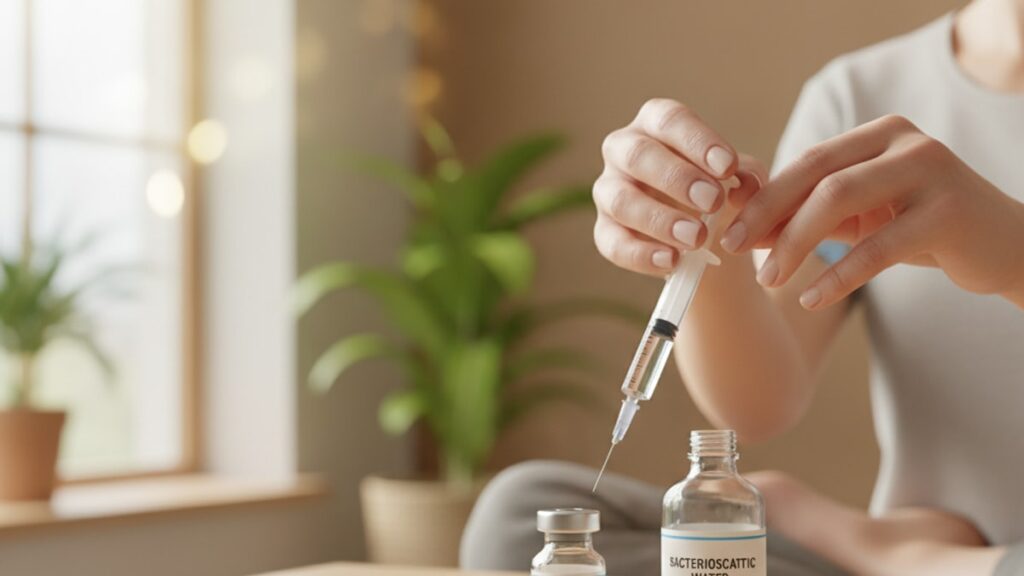
In the world of advanced peptide research, precision isn't just a goal; it's the entire foundation. Every variable matters. Every measurement must be impeccable. When a researcher receives a vial of lyophilized (freeze-dried) peptide, the very first step—reconstitution—is arguably one of the most critical. It’s a moment that dictates the concentration, dosage accuracy, and ultimately, the validity of the data that follows. Get it wrong, and the entire experiment could be compromised before it even begins.
Our team fields questions about this process constantly, especially regarding newer, more complex compounds. A recurring and vital query we see is, "how much bac water for 30 mg retatrutide?" It's a fantastic question because it shows a commitment to getting things right. This isn't just about adding liquid to a powder. It's about creating a stable, accurately concentrated solution that will yield reliable and reproducible results in the lab. As a company built on the principle of small-batch synthesis and exact amino-acid sequencing, we understand this need for meticulous accuracy better than anyone. It’s in our DNA.
Why Precision in Reconstitution is Non-Negotiable
Let’s be honest, it can be tempting to rush through the prep work to get to the core of the experiment. We've seen it happen. But reconstituting a peptide like Retatrutide isn't like mixing a protein shake. It's a delicate scientific procedure. The amount of diluent you add directly determines the final concentration of the peptide per unit of volume (e.g., milligrams per milliliter).
Think about it. If your protocol calls for a 2mg dose and your concentration is off by even 10% due to a calculation error, your results will be skewed. Your data becomes unreliable. This kind of error can lead to misinterpretation of results, failed experiments, and wasted resources—including time, funding, and the precious peptide itself. It's a catastrophic, yet entirely avoidable, scenario.
Our experience shows that labs achieving the most consistent, high-quality data are those with unflinching, standardized protocols for every step, starting with reconstitution. They don't eyeball it. They don't guess. They calculate, measure, and document with painstaking care. This approach, which we've refined over years of supplying premier research compounds, is the only way to ensure that the variable being tested is the peptide's effect, not the sloppiness of its preparation. It’s comprehensive. That’s the key.
Understanding the Components: Retatrutide and Bacteriostatic Water
Before we dive into the math, it's crucial to understand what you're working with. These aren't just generic lab chemicals; they are specialized tools for your research.
First, there's the peptide itself. Retatrutide arrives in a lyophilized state. This freeze-drying process removes water and stabilizes the delicate peptide structure, making it suitable for shipping and storage. It's a fine powder, dormant and waiting for the right solvent to be brought back into a usable, liquid form. The quality of this powder is paramount. At Real Peptides, we ensure every vial contains the precise amount specified, with purity confirmed through rigorous third-party testing. Starting with a known quantity and quality is the first step toward reliable research.
Second, we have the diluent. The most common and highly recommended choice is Bacteriostatic Water. What makes it so special? Bacteriostatic water (or bac water) is sterile water that contains 0.9% benzyl alcohol. This small addition is a game-changer. The benzyl alcohol acts as a preservative, inhibiting bacterial growth within the vial. This is critically important if you plan to draw multiple doses from the same vial over a period of time. Using bac water helps maintain the sterility and integrity of your reconstituted peptide for up to 28 days when stored correctly. Simple, right?
Using a lesser diluent, like simple sterile water, is possible for single-use applications, but it offers no protection against contamination once the vial's septum has been punctured. For any research protocol involving multiple administrations from one vial, bacteriostatic water is the undisputed industry standard. We can't stress this enough.
The Core Calculation: How Much Bac Water for 30 mg Retatrutide?
Now, let's get to the heart of the matter. The answer to "how much bac water" isn't a single number. It depends entirely on the final concentration you want to achieve for your research protocol. Your goal is to create a solution where a convenient, measurable volume (like 0.1 mL) contains the exact dose you need.
Let's break down some common scenarios for a 30 mg vial of Retatrutide. Remember, 1 milliliter (mL) is equal to 100 units on a standard U100 insulin syringe.
-
Scenario 1: Adding 3 mL of Bac Water
- Total Peptide: 30 mg
- Total Diluent: 3 mL
- Calculation: 30 mg / 3 mL = 10 mg per mL
- Resulting Concentration: Each 1 mL of the solution contains 10 mg of Retatrutide. If you need a 1 mg dose, you would draw 0.1 mL (or 10 units on an insulin syringe).
-
Scenario 2: Adding 6 mL of Bac Water
- Total Peptide: 30 mg
- Total Diluent: 6 mL
- Calculation: 30 mg / 6 mL = 5 mg per mL
- Resulting Concentration: This creates a less concentrated solution. Each 1 mL now contains 5 mg of Retatrutide. To get a 1 mg dose, you'd need to draw 0.2 mL (or 20 units).
-
Scenario 3: Adding 1.5 mL of Bac Water
- Total Peptide: 30 mg
- Total Diluent: 1.5 mL
- Calculation: 30 mg / 1.5 mL = 20 mg per mL
- Resulting Concentration: This is a highly concentrated solution. Each 1 mL contains a potent 20 mg of Retatrutide. A 1 mg dose would be a tiny 0.05 mL (or 5 units), which can be more difficult to measure accurately.
Which one is best?
Our team generally recommends a concentration that allows for easy and accurate dosing. For most researchers, the concentrations achieved in Scenarios 1 or 2 are ideal. They provide a volume that is large enough to be measured precisely on a standard syringe but not so large that it requires an unnecessarily large injection volume. The hyper-concentrated mix in Scenario 3 might be suitable for protocols requiring very large doses, but it introduces a higher margin for error with smaller dose measurements. Precision is paramount.
Here's a quick reference table to illustrate these options:
| Amount of Bac Water Added | Total Vial Volume | Resulting Concentration (mg/mL) | Volume for a 1mg Dose | Units on U100 Syringe |
|---|---|---|---|---|
| 1.5 mL | ~1.5 mL | 20 mg/mL | 0.05 mL | 5 units |
| 3.0 mL | ~3.0 mL | 10 mg/mL | 0.1 mL | 10 units |
| 6.0 mL | ~6.0 mL | 5 mg/mL | 0.2 mL | 20 units |
| 10.0 mL | ~10.0 mL | 3 mg/mL | 0.33 mL | 33 units |
Ultimately, the choice is driven by your specific research design. The key takeaway is that you, the researcher, are in control of the final concentration.
A Step-by-Step Protocol for Safe Reconstitution
Knowing the math is one thing; executing the procedure flawlessly is another. Aseptic technique is non-negotiable to prevent contamination and preserve the integrity of the peptide. Here's the protocol our lab experts recommend:
-
Gather Your Supplies: Before you begin, assemble everything you need on a clean, disinfected surface. This includes your vial of lyophilized Retatrutide, a vial of Bacteriostatic Water, a new sterile syringe for mixing (typically 3 mL or 5 mL), and several alcohol prep pads.
-
Prepare the Vials: Pop the protective plastic caps off both vials. You'll see a rubber stopper underneath. Vigorously wipe the top of each rubber stopper with a fresh alcohol pad and allow it to air dry for about 30 seconds. Don't blow on it or wipe it dry—that just reintroduces contaminants.
-
Draw the Bac Water: Take your mixing syringe and draw air into it equal to the volume of bac water you plan to use (e.g., pull the plunger back to the 3 mL mark). Insert the needle through the center of the bac water vial's stopper and inject the air. This pressurizes the vial and makes it much easier to draw the liquid out. Then, invert the vial and slowly pull the plunger back to draw your desired amount of bac water.
-
Introduce the Water to the Peptide: This is the most delicate step. Insert the needle of the water-filled syringe into the Retatrutide vial's stopper. Angle the needle so the stream of water runs down the inside wall of the vial, not directly onto the lyophilized powder. This is crucial. A powerful jet of water can damage the fragile peptide molecules. Inject the water slowly and gently.
-
Mix with Care (Do Not Shake!): Once all the water is in the vial, remove the syringe. Now, gently swirl the vial or roll it between your palms until all the powder has completely dissolved. You should be left with a clear liquid. We can't be more emphatic about this: NEVER SHAKE THE VIAL. Shaking causes shearing forces that can denature the peptide, rendering it useless. Patience is your friend here.
-
Proper Storage: Once reconstituted, your Retatrutide must be stored in a refrigerator (between 2°C and 8°C or 36°F and 46°F). Do not freeze it. When stored correctly, a solution reconstituted with bacteriostatic water will remain stable and sterile for several weeks, typically up to 28 days.
Following this protocol meticulously ensures that the potent, high-purity peptide you start with remains that way for the duration of your research.
Common Pitfalls and How to Avoid Them
Over the years, we've heard about a few common mistakes that can jeopardize research outcomes. Being aware of them is the best way to ensure you don't fall into the same traps.
- The Shaking Mistake: We mentioned it above, but it bears repeating. It’s an instinctive thing to do, but shaking a vial of peptides is a cardinal sin in the lab. It's the fastest way to destroy the compound you just paid for. Always swirl or roll gently.
- Using the Wrong Diluent: Using tap water is an absolute no-go due to impurities and bacteria. Using sterile water in a multi-use vial is also a significant risk, as it has no preservative to stop microbial growth after the first puncture.
- Incorrect Storage: Leaving a reconstituted peptide at room temperature for extended periods will degrade it rapidly. Heat and light are enemies of peptide stability. Refrigeration is mandatory.
- Ignoring Displacement: Very advanced researchers might account for the volume displacement of the peptide powder itself, but for most applications with these quantities, it's a negligible factor. However, for hyper-precise work, it's something to be aware of—the final volume will be slightly more than the liquid you added. For a 30mg vial, this is usually insignificant, but it's a nuance that highlights the depth of this science.
- Reusing Syringes: A new, sterile syringe should be used for every single draw from the vial. Reusing a syringe, even on the same vial, is a major source of contamination. It's a small cost to ensure sterility.
Avoiding these simple errors is fundamental to good laboratory practice and ensures the data you collect is both accurate and defensible.
The Real Peptides Difference: Why Purity Starts Before the Syringe
All the careful calculation and perfect reconstitution technique in the world won't matter if the peptide itself is subpar. The integrity of your research hinges on the quality of the raw materials. That’s the reality. It all comes down to purity and identity.
This is where our philosophy at Real Peptides makes a tangible difference. We're not a mass-market reseller. We are specialists. Our commitment is to provide the research community with compounds of the absolute highest caliber. We achieve this through a meticulous, quality-obsessed process:
- Small-Batch Synthesis: Unlike large-scale industrial production, our small-batch approach allows for unparalleled quality control at every stage. We can monitor and adjust with a level of precision that larger operations simply can't match.
- Exact Amino-Acid Sequencing: We guarantee that the peptide you receive has the precise, correct sequence of amino acids. There are no shortcuts, no approximations. This ensures its biological identity and function are exactly what you expect.
- Third-Party Verification: We don't just say our products are pure; we prove it. Every batch is subjected to rigorous testing, including HPLC and Mass Spectrometry, to verify its purity, identity, and quantity. You can conduct your research with complete confidence.
When you're working with a compound as sophisticated as Retatrutide, or other advanced peptides in our catalog like Tirzepatide or the innovative Survodutide Peptide, you need a partner who obsesses over these details. The success of your work depends on it. You can explore our full range of peptides to see how this commitment to quality extends across every single product we offer.
Your research deserves a foundation of unshakeable quality. The process of reconstitution is the first hands-on step in building that foundation. By combining high-purity peptides with precise, careful technique, you set the stage for generating meaningful, impactful data. If you have any more questions about your specific protocols or need guidance, our team is always here to help. To get started with compounds you can trust, we invite you to explore our offerings. Get Started Today.
Frequently Asked Questions
What is the best concentration to mix 30 mg of Retatrutide?
▼
There’s no single ‘best’ concentration; it depends on your research protocol. A common choice is adding 3 mL of bac water to get a 10 mg/mL solution, which allows for easy and accurate dose measurement.
Can I use sterile water instead of bacteriostatic water?
▼
You can, but only if you plan to use the entire vial in a single session. Sterile water contains no preservative, so once opened, it’s susceptible to bacterial contamination. For multi-use, bacteriostatic water is essential.
What happens if I shake the Retatrutide vial after adding water?
▼
Shaking can damage the fragile peptide chains through a process called mechanical shearing, rendering the compound ineffective. Always mix by gently swirling the vial or rolling it between your hands.
How should I store my Retatrutide after reconstituting it?
▼
Reconstituted Retatrutide must be stored in a refrigerator at 2°C to 8°C (36°F to 46°F). Do not freeze it, as the freeze-thaw cycle can degrade the peptide.
How long is reconstituted Retatrutide good for?
▼
When mixed with bacteriostatic water and stored properly in the refrigerator, Retatrutide is generally stable and sterile for up to 28 days. After this period, we recommend discarding it to ensure safety and efficacy.
The powder in my vial looks like a small disc, is that normal?
▼
Yes, this is completely normal. During the lyophilization (freeze-drying) process, the peptide often forms a solid, compacted ‘puck’ or disc at the bottom of the vial. It will dissolve readily when you add the bac water.
Why should I run the bac water down the side of the vial?
▼
Directly spraying the water onto the lyophilized powder can be too forceful and may damage the peptide molecules. Running it down the side of the glass is a much gentler method that helps preserve the compound’s integrity.
What kind of syringe do I need for reconstitution?
▼
For mixing, a 3 mL or 5 mL sterile syringe is ideal for accurately measuring the bac water. For administering doses, a U100 insulin syringe (typically 1 mL, 0.5 mL, or 0.3 mL) is used for precise measurement of small volumes.
Is it normal for the reconstituted solution to be cloudy?
▼
No, a properly reconstituted peptide solution should be perfectly clear. If you notice any cloudiness, discoloration, or particulates, it may indicate a problem with the product or contamination. Do not use it.
Do I need to account for the volume of the powder itself in my calculations?
▼
For most standard research applications, the volume displacement from 30 mg of powder is negligible and not factored into the calculation. However, for highly sensitive quantitative analysis, some advanced labs may account for it.
Can I pre-load syringes with doses for the week?
▼
Our team generally advises against this. Storing peptides in plastic syringes for extended periods can sometimes lead to adsorption and a decrease in potency. It’s best practice to draw each dose from the glass vial immediately before use.
What if I accidentally add too much or too little bac water?
▼
If you make a mistake, don’t panic. Simply recalculate your concentration based on the actual amount of water you added. For example, if you added 4 mL instead of 3 mL to a 30 mg vial, your new concentration is 30mg / 4mL = 7.5 mg/mL.
