



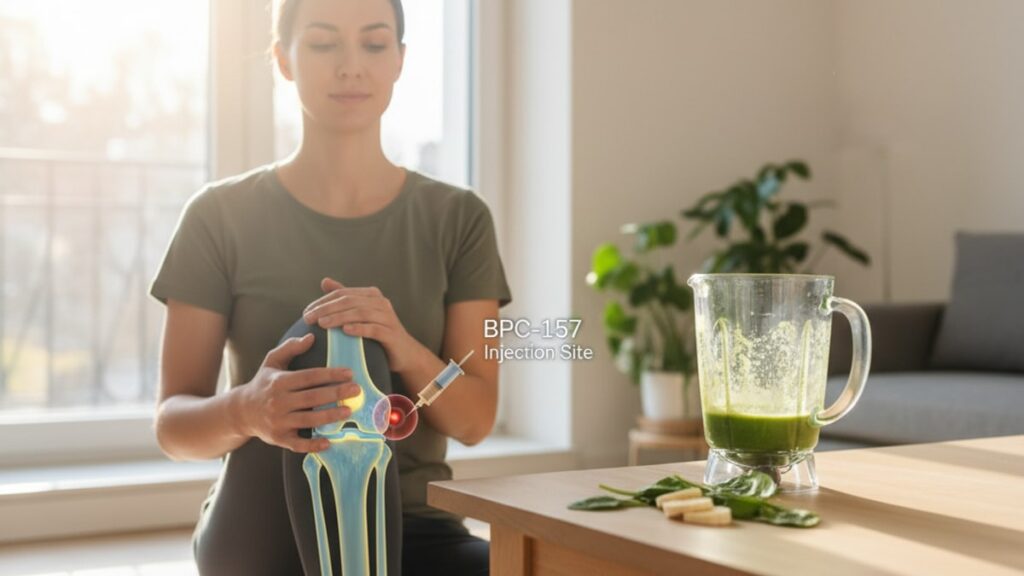
Knee discomfort is one of those formidable issues that can derail even the most disciplined training or research schedule. It's a common point of failure, a frustrating setback. It's no surprise, then, that the research community has shown such a relentless interest in compounds that might influence recovery pathways, with the peptide BPC-157 frequently at the center of these discussions. Specifically, the question our team hears all the time is about localized application—how to inject BPC-157 for knee-focused studies.
Let's be clear from the outset: we're talking about preclinical research applications. At Real Peptides, our entire mission is built on supplying researchers with the highest-purity tools to conduct meaningful, reproducible studies. The integrity of your data depends entirely on the integrity of your materials. When exploring a compound as nuanced as BPC-157 Peptide, starting with a product that has impeccable purity and exact amino-acid sequencing isn't just a good idea; it's the only way to ensure your observations are valid. It's the foundation of sound science.
Why Localized Application for Knee Research?
So, why the intense focus on injecting near the site of interest, like the knee? The theory, which is being explored in numerous studies, is that BPC-157 may exert its effects through various mechanisms, including the upregulation of growth hormone receptors and the promotion of angiogenesis—the formation of new blood vessels. Better blood flow is a critical, non-negotiable element for tissue repair.
By administering the peptide subcutaneously (just under the skin) in proximity to the target area, researchers aim to concentrate its potential effects where they're needed most. This contrasts with a systemic application, where the compound is distributed more broadly throughout the body. For a specific joint like the knee, a localized protocol allows for a more targeted research approach. It's about precision. And in scientific research, precision is everything.
Our experience shows that researchers investigating tendon-to-bone healing, ligament damage, and general inflammation in animal models often gravitate toward this localized strategy. It's a logical approach. The goal is to observe the direct influence of the peptide on a specific biological environment, and a localized injection is the most direct way to create that scenario. This is where the conversation about how to inject BPC-157 for knee studies becomes so important. It's not just about the 'what'; it's profoundly about the 'how'.
Subcutaneous vs. Intramuscular: A Critical Distinction
When discussing injections near the knee, two terms often come up: subcutaneous (SubQ) and intramuscular (IM). They aren't interchangeable, and for this specific application, one is far more common and, frankly, more practical for research protocols.
Let’s break them down.
A subcutaneous injection delivers the compound into the fatty layer of tissue just beneath the skin. It's a relatively shallow injection, typically administered with a short, fine-gauge needle like an insulin syringe. The absorption is slower and more sustained compared to other methods, which can be beneficial for maintaining stable levels of the compound in the local tissue.
An intramuscular injection, as the name implies, goes deeper, directly into the muscle tissue. This results in faster absorption into the bloodstream. While IM injections have their place in many research protocols, they are generally less common for targeting a joint like the knee. The goal isn't to hit the quadriceps or hamstring muscle bellies, but rather to saturate the connective tissues and surrounding area of the joint itself. For that, SubQ is the preferred route.
We can't stress this enough: neither of these methods involves injecting directly into the knee joint capsule (an intra-articular injection). That is a highly specialized medical procedure that falls far outside the scope of typical peptide research and should never be attempted. The focus here is on the tissues around the joint.
Here's a simple breakdown of the two methods for context:
| Feature | Subcutaneous (SubQ) Injection | Intramuscular (IM) Injection |
|---|---|---|
| Injection Site | Fatty tissue layer just under the skin | Directly into muscle tissue |
| Needle Depth | Shallow (approx. 4-6mm) | Deep (approx. 25-38mm) |
| Absorption Rate | Slow and sustained | Fast and systemic |
| Typical Needle | Short, fine-gauge (e.g., 29-31G, 1/2") | Longer, thicker-gauge (e.g., 23-25G, 1-1.5") |
| Common Use Case | Localized peptide application, insulin | Vaccines, certain medications |
| Relevance to Knee | High. Ideal for targeting tissues around the joint. | Low. Generally used for large muscles, not joints. |
For knee-related research, the subcutaneous method is the clear choice. It's simpler, less invasive, and better suited for creating a localized concentration of the peptide where you can observe its effects most directly.
The Protocol: Preparing for a Localized BPC-157 Injection
Alright, let's get into the practical steps. Executing this properly is all about preparation, hygiene, and precision. Rushing this process or using improper technique can compromise your research materials and, ultimately, your results. This is the part that demands your full attention.
Step 1: Assembling Your Supplies
Before you even think about the peptide itself, you need to have the right tools. Contamination is the enemy of good research. Everything must be sterile.
- The Peptide: You'll need your vial of lyophilized (freeze-dried) BPC-157 Peptide. We take immense pride in our small-batch synthesis process, ensuring what's on the label is exactly what's in the vial. This is your starting point for reliable data.
- Bacteriostatic Water: This is the sterile water used to reconstitute the peptide. It contains 0.9% benzyl alcohol, which acts as a preservative, preventing bacterial growth after the vial has been opened. Never use tap water or regular sterile water. For convenience, we offer high-quality Bacteriostatic Water to ensure you have the correct solvent for your research.
- Insulin Syringes: For SubQ injections, U-100 insulin syringes are the standard. They are marked in units, have a very fine needle (typically 29-31 gauge), and are perfect for accurately drawing up small volumes. A 0.5ml or 1ml syringe is ideal.
- Alcohol Prep Pads: You'll need these to sterilize the rubber stopper on your peptide and water vials, as well as the injection site on the skin.
- A Sharps Container: Proper disposal of used needles is a non-negotiable safety practice.
Gather everything in a clean, well-lit workspace. This isn't something to be done carelessly.
Step 2: Reconstitution — Turning Powder into Liquid
Lyophilized peptides are stable for shipping and storage, but they must be carefully reconstituted before use. This process requires a gentle hand.
- Prepare the Vials: Remove the plastic caps from both the BPC-157 vial and the bacteriostatic water vial. Use an alcohol pad to vigorously wipe the rubber stoppers on top of each.
- Draw the Water: Take a fresh insulin syringe and draw your desired amount of bacteriostatic water. A common practice is to add 1ml or 2ml of water to a 5mg vial of BPC-157. This makes dosing calculations straightforward. For example, adding 2ml of water to a 5mg vial means that every 10 units on a 1ml insulin syringe (which is 0.1ml) will contain 250 micrograms (mcg) of BPC-157.
- Add Water to Peptide: Insert the needle of the syringe containing the bacteriostatic water through the rubber stopper of the BPC-157 vial. Here’s the critical part: aim the needle at the side of the glass vial. Don't spray the water directly onto the peptide powder. Let the water run gently down the side of the glass. This prevents damaging the delicate peptide chains.
- Mix Gently: Once the water is in, remove the syringe. Do NOT shake the vial. That's a rookie mistake that can destroy the peptide. Instead, gently roll the vial between your fingers or palms until the powder is fully dissolved. It should become a clear liquid. If you see clumps, continue to roll it gently. Patience is key.
Once reconstituted, your BPC-157 is ready for your research protocol. It must be stored in the refrigerator (not the freezer) and is typically stable for several weeks.
Step 3: Pinpointing the Injection Site Around the Knee
This is the core of the keyword: how to inject bpc 157 knee. Remember, we are talking about a subcutaneous injection near the knee.
The best location is an area with a pinchable layer of skin and fat close to the area of interest. You are not aiming for a specific muscle or tendon, but rather the general vicinity.
Good options include:
- The Skin Above the Patella: The area just superior to the kneecap often has enough loose skin for a simple SubQ injection.
- The Sides of the Knee: The medial (inner) or lateral (outer) sides of the knee are also excellent choices. Find a spot that feels fleshy and allows you to easily pinch up about an inch of skin.
- Below the Patellar Tendon: For some, the area just below the kneecap, on either side of the patellar tendon, can also work well.
Rotate your injection sites. Using the exact same spot every time can lead to skin irritation or the buildup of scar tissue. Alternating between the left side, right side, and top of the knee area is a smart practice.
Step 4: The Injection Process
With your site selected and your peptide reconstituted, the final step is the administration itself.
- Clean the Site: Take a new alcohol pad and thoroughly clean the area you’ve chosen for the injection. Let it air dry completely.
- Draw Your Dose: Using a new insulin syringe, draw your calculated dose of BPC-157 from the vial. Flick the syringe to get any air bubbles to the top and gently push the plunger to expel them.
- Pinch the Skin: With your non-dominant hand, gently pinch a fold of skin at the injection site.
- Insert the Needle: Hold the syringe like a dart and, with a quick, confident motion, insert the needle at a 45-degree angle into the pinched skin. The entire needle should go in.
- Inject the Solution: Release the pinch of skin and slowly push the plunger to inject the BPC-157 solution. It should go in easily without resistance.
- Withdraw and Dispose: Once the syringe is empty, quickly withdraw the needle at the same angle it went in. Immediately place the used syringe into your sharps container. You can apply gentle pressure to the site with a clean cotton ball if needed, but don't rub it.
That's the process. It's methodical and requires attention to detail, but it’s straightforward. The entire point is to ensure a clean, accurate, and repeatable protocol for your research.
Expanding Your Research: BPC-157 and TB-500 Synergy
In the world of peptide research, it's rare for a compound to be studied in total isolation. Researchers are constantly looking for potential synergies—combinations that might produce a more pronounced or comprehensive effect. When it comes to tissue repair and recovery models, the combination of BPC-157 and TB-500 (Thymosin Beta-4) is a classic pairing.
While BPC-157 is often studied for its localized effects on angiogenesis and cellular repair, TB-500 is known for its more systemic actions. It's a naturally occurring peptide that plays a crucial role in cell migration, differentiation, and reducing inflammation. Think of them as two different specialists working on the same project. BPC-157 is like the on-site foreman, working directly on the problem area, while TB-500 is the project manager, coordinating resources and improving conditions system-wide.
For researchers, this combination is compelling. A protocol might involve a localized subcutaneous injection of BPC-157 near the knee, coupled with a systemic subcutaneous injection of TB-500 in a more conventional spot like the abdomen. This dual-pronged approach is the foundation of our popular Wolverine Peptide Stack, which provides both compounds for comprehensive recovery research. It’s an advanced strategy, but one that many experienced researchers find delivers more robust data.
The Real Peptides Difference: Why Your Source Matters
We could talk about protocols all day, but none of it matters if the peptide you're using is subpar. The peptide market can be a sprawling, confusing landscape. Honestly, it’s filled with providers making bold claims with little to back them up.
This is where we've drawn a line in the sand.
Our commitment at Real Peptides is to provide an unwavering standard of quality for the scientific community. Every single batch of our peptides undergoes rigorous third-party testing to verify its purity, identity, and concentration. We believe in total transparency. That's why we make our testing reports available. You should never have to guess about the quality of your research materials.
We focus on small-batch synthesis. Why? Because it allows for meticulous quality control at every stage. It ensures that the amino-acid sequence is exact and that contaminants and improperly folded proteins are eliminated. When you're trying to measure the subtle biological effects of a peptide, even a small percentage of impurity can skew your results and render your hard work useless. It's a difficult, often moving-target objective, but we believe it's the only way to operate.
Whether you're investigating a single compound or exploring the potential of our entire collection, which you can Shop All Peptides here, our standard remains the same. We provide the tools. You conduct the groundbreaking research. It's a partnership we take very seriously.
When you're ready to conduct your research with compounds you can trust, we're here to help you Get Started Today. The future of scientific discovery depends on the quality of the work being done right now, and that work begins with unimpeachable materials.
Frequently Asked Questions
What is the primary difference between subcutaneous and intramuscular injections for BPC-157?
▼
A subcutaneous (SubQ) injection goes into the fatty tissue just under the skin for slower, localized absorption. An intramuscular (IM) injection goes deeper into the muscle for faster, systemic absorption. For knee research, SubQ is the preferred method.
Is injecting BPC-157 near the knee the same as an intra-articular injection?
▼
Absolutely not. A subcutaneous injection is administered into the skin *around* the knee. An intra-articular injection goes directly into the joint capsule and is a specialized medical procedure that should never be attempted in a research setting.
How should I store my BPC-157 peptide before and after reconstitution?
▼
Before reconstitution, the lyophilized (powder) vial should be stored in a cool, dark place, like a refrigerator. After reconstituting with bacteriostatic water, it must be stored in the refrigerator and is typically stable for several weeks.
What size syringe and needle is best for a subcutaneous BPC-157 injection?
▼
We recommend a standard U-100 insulin syringe, either 0.5ml or 1ml. These typically come with a very fine, short needle (29-31 gauge, 1/2 inch length), which is ideal for a comfortable and accurate subcutaneous injection.
Can I pre-load syringes with BPC-157 for the week?
▼
Our team advises against this. While convenient, pre-loading syringes can increase the risk of contamination and the peptide may degrade more quickly when stored in plastic. It is best practice to draw each dose from the vial immediately before administration.
How do I calculate the dosage of BPC-157 in my syringe?
▼
The calculation depends on how much water you used for reconstitution. For example, if you add 2ml of water to a 5mg (5000mcg) vial, each 0.1ml (10 units on an insulin syringe) will contain 250mcg of BPC-157.
Why is it important to use bacteriostatic water instead of sterile water?
▼
Bacteriostatic water contains 0.9% benzyl alcohol, which acts as a preservative. This prevents the growth of bacteria in the vial after it has been punctured multiple times, ensuring the solution remains sterile for the duration of your research protocol.
Should I rotate the injection sites around my knee?
▼
Yes, we strongly recommend rotating sites. Consistently using the same spot can cause skin irritation, bruising, or the buildup of scar tissue (lipohypertrophy). Alternating between the left, right, and top sides of the knee is a sound practice.
What does ‘lyophilized’ mean and why are peptides sold this way?
▼
Lyophilized means freeze-dried. This process removes water from the peptide, turning it into a stable powder. This makes the delicate peptide chains much more stable for shipping and long-term storage than they would be in a liquid form.
Is it normal for the injection site to have a small red bump afterwards?
▼
A small amount of temporary redness or a tiny bump at the injection site can be normal for some individuals, similar to any injection. However, if you experience significant pain, swelling, or signs of infection, you should discontinue the protocol and consult a professional.
Why is peptide purity so critical for research?
▼
Purity is paramount because any contaminants or incorrectly sequenced molecules can alter the results of your study. High-purity peptides, like those from Real Peptides, ensure that the effects you observe are actually from the compound being studied, leading to valid and reproducible data.











