



First, A Quick Refresher: What is Glutathione?
You've probably heard the buzz. Glutathione is often called the body's "master antioxidant," and honestly, it's a title that's well-earned. Before we dive into the nitty-gritty of administration routes, it’s crucial to understand what we're working with. At its core, glutathione is a tripeptide, a relatively simple molecule composed of three amino acids: cysteine, glycine, and glutamic acid. But don't let its simplicity fool you. This compound is a powerhouse, synthesized by virtually every cell in the human body.
Its primary job is to protect cells from oxidative stress—the damage caused by free radicals and other reactive oxygen species. Think of it as the cellular cleanup crew, neutralizing harmful compounds before they can wreak havoc on DNA, proteins, and cell membranes. But its role is sprawling. Glutathione is also a critical, non-negotiable element in detoxification pathways, immune system function, and the regeneration of other essential antioxidants like vitamins C and E. When cellular glutathione levels are robust, the entire system functions more efficiently. When they're depleted, things start to go wrong. It’s this foundational importance that makes high-purity Glutathione such a compelling subject for researchers across countless disciplines.
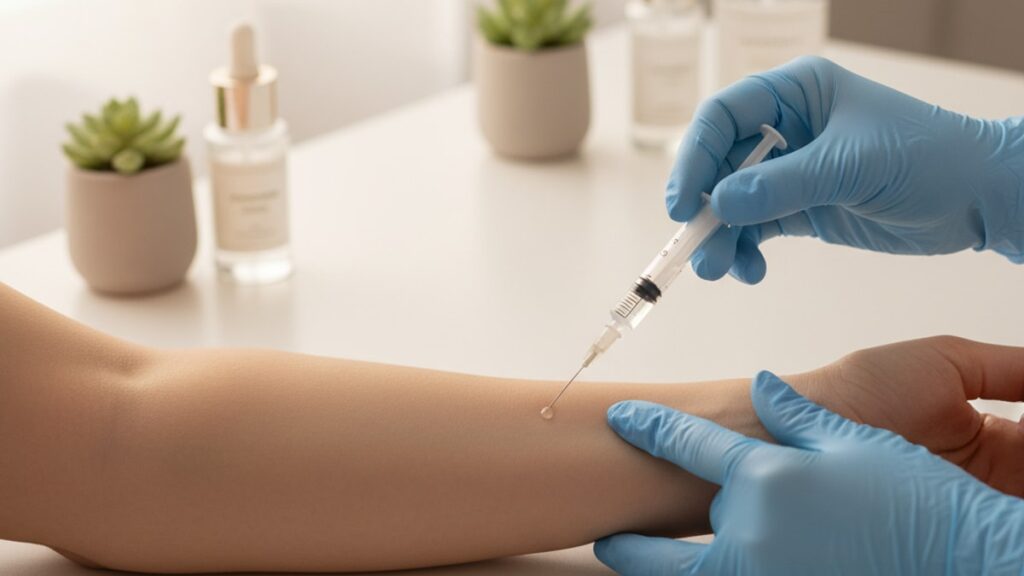
The Core Question: Where is Glutathione Injection Given?
Alright, let's get to the heart of the matter. You have your meticulously prepared, research-grade glutathione, and now you need to administer it for your study. The question of where is glutathione injection given isn't about preference; it's about pharmacokinetics, bioavailability, and the specific goals of your research protocol. The decision dictates how quickly the compound enters circulation, how high its concentration peaks, and how long it remains active. It’s a choice with significant downstream effects.
Generally, there are two primary, clinically-accepted routes for injectable glutathione: Intravenous (IV) and Intramuscular (IM). A third, subcutaneous (Sub-Q), is sometimes discussed but is far less common for glutathione due to potential irritation and volume limitations. For the vast majority of research applications, the choice boils down to IV or IM. Our team has spent years guiding researchers on peptide handling, and we can tell you this: the route you choose can fundamentally alter the outcome of your experiment. Let's break down what each method entails and why you'd select one over the other.
The Intravenous (IV) Route: Direct to the Source
When a research protocol demands immediate and complete bioavailability, the intravenous route is the unflinching standard. It’s as direct as it gets. An IV injection administers the glutathione solution directly into a vein, allowing it to enter the bloodstream instantly and circulate throughout the body. There’s no barrier, no delay, and no first-pass metabolism in the liver to worry about. What you inject is what the system gets.
This 100% bioavailability is the single biggest advantage of IV administration. It's the reason this method is favored in studies modeling acute conditions, such as neutralizing a sudden surge of oxidative stress or rapidly replenishing depleted cellular stores. You get a very high peak concentration of glutathione in the plasma, very quickly. This can be delivered in two common ways: as a "push," where the solution is injected from a syringe over a few minutes, or as a slower infusion, where it's mixed into a saline bag and dripped in over a longer period (30-60 minutes or more). The push delivers a faster, higher peak, while the drip provides a more controlled, sustained elevation. The choice between them, again, depends entirely on the research question. Are you studying the effects of a rapid antioxidant flood, or the benefits of maintaining a moderately elevated level for an hour? The answer determines the IV technique. We can't stress this enough: precision in administration is just as vital as the purity of the compound itself.
The Intramuscular (IM) Route: A Slower, Sustained Approach
Now, let's pivot to the intramuscular route. It's a completely different strategy with its own distinct advantages. An IM injection delivers the glutathione solution deep into a large muscle—typically the ventrogluteal (hip), deltoid (shoulder), or vastus lateralis (thigh). Unlike the instant access of an IV injection, the IM method creates a small deposit, or 'depot,' of the solution within the muscle tissue.
From this depot, the glutathione is gradually absorbed into the rich network of capillaries within the muscle and then enters the bloodstream. This process is much slower. It's a slow burn, not a firework. Consequently, you don't get the dramatic, immediate peak concentration you see with an IV push. Instead, you achieve a slower rise in plasma levels that is sustained over a longer period. While the total bioavailability is slightly lower than IV (as some compound may degrade or be trapped locally), it's still vastly superior to any oral supplement. Our experience shows that researchers often choose the IM route for studies involving chronic conditions, where the goal isn't a rapid spike but rather maintaining a consistently elevated baseline of antioxidant support over many hours. It’s more practical for protocols requiring repeated administrations over days or weeks, as it's less invasive than maintaining IV access. The key takeaway is sustainability over immediacy.
Comparing the Methods: IV vs. IM for Research
To make the choice clearer, a side-by-side comparison is often the most helpful tool. We've found that laying out the variables helps research teams align their methods with their objectives. Let's be honest, this is crucial for reproducible results.
| Feature | Intravenous (IV) Administration | Intramuscular (IM) Administration |
|---|---|---|
| Bioavailability | 100% (Directly enters circulation) | High (typically 75-90%), but less than IV |
| Onset of Action | Immediate (seconds to minutes) | Slower (typically 30-60 minutes) |
| Peak Concentration | Very high and rapid peak | Lower, more rounded peak |
| Duration of Action | Shorter; concentration falls off relatively quickly | Longer; sustained release from muscle depot |
| Administration Setting | Requires venous access; often a more clinical or controlled setting | Can be done more easily in a standard lab setting |
| Typical Use Case | Acute oxidative stress studies, rapid cellular replenishment | Chronic condition models, maintaining steady-state levels |
| Volume Limitations | Can accommodate larger volumes, especially with a drip infusion | Limited to smaller volumes (typically 1-5mL depending on muscle) |
This table isn't just data. It’s a decision-making framework. A researcher studying the immediate protective effects of glutathione on cells exposed to a toxin would almost certainly choose the IV route. Conversely, a team investigating its long-term impact on immune modulation over a month-long protocol would find the IM route far more practical and effective for their model. The right answer to "where is glutathione injection given" is always relative to the question being asked.
Why Not Just Take a Pill? The Bioavailability Problem
It’s a fair question. With so many oral glutathione supplements on the market, why go through the trouble of injections for research? The answer is simple and brutal: bioavailability. When you ingest glutathione orally, it faces a formidable gauntlet in the digestive system. The peptide is broken down by enzymes in the stomach and intestines long before it ever has a chance to be absorbed into the bloodstream intact. Very little, if any, of the whole glutathione molecule makes it into circulation.
This is why oral supplementation has shown very limited success in significantly raising systemic glutathione levels in clinical studies. It might provide the building blocks (the three amino acids), but it doesn't deliver the complete, functional tripeptide where it's needed most. For rigorous, controlled scientific research where you need to know exactly how much of the active compound is reaching the target tissues, injectable administration isn't just an option—it's a necessity. It bypasses the entire digestive battlefield. This is a foundational concept in pharmacology and a critical one for anyone designing a study. To get reliable data, you need a reliable delivery method, and that starts with a high-purity compound designed for this exact purpose. When you Explore High-Purity Research Peptides, you're investing in that reliability.
The Role of Purity and Formulation in Any Injection
Let’s zoom out for a moment. The location of the injection is paramount, but its effectiveness is completely dependent on the quality of the substance being injected. You can have the most precise protocol in the world, but if you're using a compound with contaminants, incorrect sequencing, or poor stability, your results will be compromised. That's the reality.
This is where our obsession with quality at Real Peptides comes from. We specialize in small-batch synthesis for a reason. It allows us an unparalleled level of control over the final product, ensuring the exact amino-acid sequence and a purity level that stands up to the most rigorous third-party testing. For a compound like Glutathione, this means you're working with a product that is what it says it is—nothing more, nothing less. This is critical for injectable solutions, as impurities can lead to adverse reactions at the injection site (for both IM and IV routes), unpredictable effects, and skewed data. Whether you're injecting into a muscle or a vein, the body's response begins with the quality of the molecule. Our commitment to this principle is unwavering because we know that groundbreaking research runs on impeccable data, and impeccable data runs on impeccably pure compounds.
Reconstitution and Handling: The Steps Before the Injection
Great research is about process. The work doesn't start at the injection site; it starts at the lab bench. Research-grade glutathione is typically supplied as a lyophilized (freeze-dried) powder to ensure maximum stability and shelf life. Before it can be used, it must be carefully reconstituted into a sterile liquid solution. This step is as critical as the injection itself.
The standard reconstitution agent is sterile Bacteriostatic Water, which contains 0.9% benzyl alcohol as a preservative to inhibit bacterial growth. The process must be done using aseptic techniques to prevent contamination. You gently inject the water into the vial of glutathione powder, allowing it to run down the side of the glass rather than spraying it directly onto the powder. Then, you gently swirl the vial—never shake it—until the powder is fully dissolved. Shaking can damage the delicate peptide structure. Once reconstituted, the solution should be clear and stored under refrigeration, used within the timeframe specified by the research protocol to ensure its potency. Getting these pre-administration steps right is non-negotiable for ensuring the integrity of your study. It’s about controlling every variable you can, which is why it's so important to Find the Right Peptide Tools for Your Lab.
What Researchers Should Consider When Designing a Protocol
So, how do you synthesize all this information into a concrete decision for your lab? When designing a protocol, the choice of where a glutathione injection is given should be a deliberate one, based on a few key factors.
First, what is the fundamental question of your study? If you're investigating an immediate, dose-dependent response, the rapid peak of an IV injection is likely your best tool. If your focus is on the cumulative effects over a longer period, the sustained release of an IM injection is probably more appropriate.
Second, consider your model. The physiology of your animal model, the tolerance for repeated handling, and the practicalities of venous access all play a role. For some models, repeated IM injections are simply more feasible and less stressful than maintaining an IV line.
Third, look at the pharmacokinetics. What plasma concentration are you trying to achieve? For how long? Do you need a sharp spike or a stable plateau? Answering these questions will point you directly to the correct administration route. Finally, consider the dose and volume. Large volumes are better suited for IV drips, whereas IM sites have clear limits on how much fluid they can comfortably absorb. Thinking through these variables beforehand is the mark of a well-designed, robust experimental plan.
Choosing the right administration site is a crucial fork in the road for any research involving glutathione. The path you take—intravenous or intramuscular—shapes the entire pharmacokinetic profile of the compound, and by extension, the data you collect. It’s a decision that requires a clear understanding of your research goals. By aligning your method with your objective, you ensure that the insights you gain are both accurate and meaningful, paving the way for discoveries built on a foundation of scientific rigor. When you're ready to start your next project, we invite you to Discover Premium Peptides for Research and see how our commitment to quality can support your work from day one.
Frequently Asked Questions
Can glutathione be injected subcutaneously?
▼
While technically possible, subcutaneous (Sub-Q) injection is not a common route for glutathione. This is primarily due to the potential for local skin irritation and the limitations on injection volume, making it less practical than IM or IV methods for most research protocols.
What is the difference between a glutathione ‘push’ and a ‘drip’?
▼
Both are intravenous (IV) methods. An IV push involves injecting the glutathione solution from a syringe directly into a vein over a few minutes, causing a very rapid, high peak in blood concentration. An IV drip infuses the solution more slowly from a saline bag, creating a more sustained elevation over a longer period, like 30-60 minutes.
Is one injection site better for skin-related research?
▼
For systemic effects, including those related to skin health, the goal is to raise overall blood levels of glutathione. Both IV and IM injections achieve this effectively. The choice depends more on the desired speed and duration of action rather than the specific research target like skin.
How quickly does IV glutathione work?
▼
Intravenous glutathione begins to work almost immediately. Because it’s administered directly into the bloodstream, it bypasses absorption and starts circulating throughout the body within seconds to minutes, making it ideal for studying acute effects.
Does an intramuscular glutathione injection hurt?
▼
Like any IM injection, there can be some temporary discomfort at the injection site. Proper technique, using the correct needle size, and injecting into a large, relaxed muscle can minimize this. Any discomfort typically subsides quickly.
How often are injections given in research protocols?
▼
This varies dramatically depending on the study’s design. Protocols for acute conditions might involve a single high-dose IV injection. Chronic studies could involve IM injections administered several times a week for multiple weeks to maintain elevated levels.
Is it necessary to rotate IM injection sites?
▼
Yes, for any protocol involving repeated intramuscular injections, it’s standard practice to rotate sites. This prevents localized tissue irritation, soreness, and potential buildup of scar tissue, ensuring consistent absorption over the course of the study.
Why is injectable glutathione so much more effective than oral supplements?
▼
It comes down to bioavailability. Oral glutathione is largely destroyed by digestive enzymes, so very little of the intact molecule reaches the bloodstream. Injections bypass the digestive system entirely, delivering the compound directly into circulation for maximum systemic impact.
What is lyophilized glutathione reconstituted with?
▼
The standard diluent for reconstituting lyophilized peptides like glutathione is sterile bacteriostatic water. Our team always recommends using the appropriate, sterile tools for reconstitution to ensure the purity and safety of the research compound.
Can I mix glutathione with other peptides in the same syringe?
▼
We strongly advise against mixing different peptides in the same syringe unless a specific protocol has validated their stability and compatibility together. Mixing can alter the pH and stability of the compounds, potentially degrading them and compromising research results. Each peptide should be prepared and administered separately.
What is the typical muscle group used for IM glutathione injections?
▼
For intramuscular injections, researchers typically use large, deep muscles to ensure proper absorption and minimize discomfort. The most common sites are the ventrogluteal (hip), dorsogluteal (buttocks), vastus lateralis (thigh), and deltoid (shoulder) muscles.
Does the volume of the injection matter for IM vs. IV?
▼
Absolutely. Intramuscular sites have a limited capacity, typically accepting 1-5mL depending on the specific muscle. Intravenous administration, especially via a drip, can accommodate much larger volumes, which is useful for protocols requiring higher doses or specific dilutions.
