





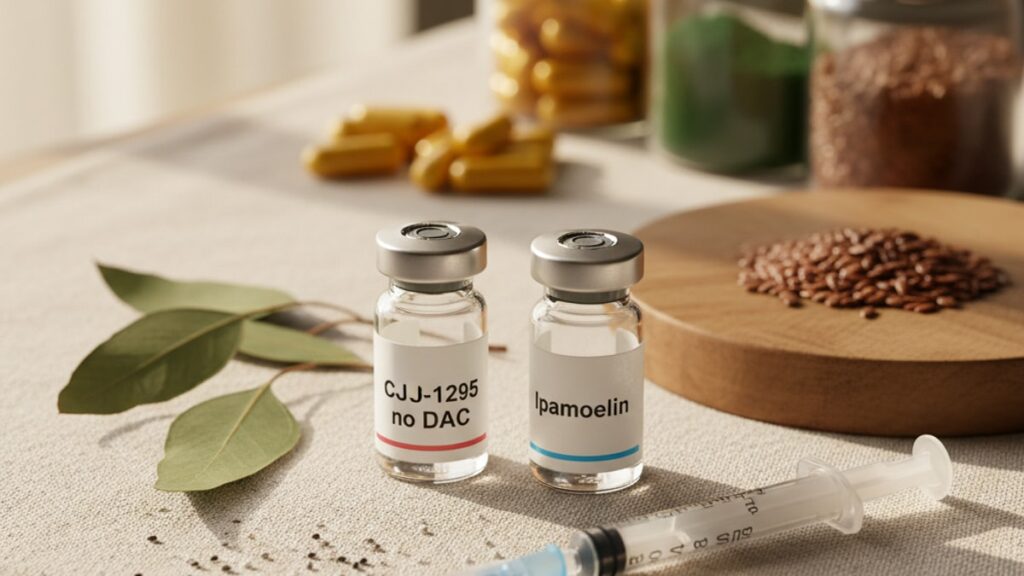
How Long CJC-1295 No DAC & Ipamorelin Vial Lasts — Real Peptides
A single temperature spike above 8°C can silently denature the protein structure of reconstituted peptides. Turning what looks like a perfectly clear solution into an inactive compound that delivers zero research value. This isn't a theoretical risk. It happens in labs, during shipping, and in home refrigerators daily.
We've worked with hundreds of researchers navigating peptide storage protocols. The gap between doing it right and wasting expensive compounds comes down to three factors most generic guides never mention: reconstitution timing, refrigeration consistency, and the biological difference between CJC-1295 no DAC and its DAC counterpart.
How long does a CJC-1295 no DAC & Ipamorelin vial last after reconstitution?
A reconstituted CJC-1295 no DAC & Ipamorelin vial lasts 28 days when stored continuously at 2–8°C in a dedicated refrigerator. Unreconstituted lyophilised powder remains stable for 12–24 months at −20°C. The 28-day window begins the moment bacteriostatic water contacts the peptide powder. Not when you first draw from the vial.
Yes, how long CJC-1295 no DAC & Ipamorelin vial lasts depends entirely on storage conditions. But not in the way most researchers assume. The critical variable isn't just temperature. It's temperature consistency. A vial stored at 4°C without interruption maintains potency for 28 days. The same vial exposed to three two-hour periods at room temperature during that span may lose 30–50% potency by day 21, even though it never looked contaminated or discolored. The degradation is molecular, not visible. This article covers the exact mechanisms behind peptide stability, reconstitution protocols that preserve maximum potency, dosing schedules that align with biological half-life, and the storage mistakes that silently compromise research outcomes.
The Biological Half-Life That Determines Dosing Frequency
CJC-1295 no DAC (also called Modified GRF 1-29) has a plasma half-life of approximately 30 minutes after subcutaneous administration. Ipamorelin's half-life is similarly short. Roughly 2 hours. This is the foundational reason these peptides are dosed multiple times daily in most research protocols, typically 2–3 times per day at intervals of 8–12 hours. The 'no DAC' designation is critical here. It means the peptide lacks Drug Affinity Complex, the modification that extends half-life to several days in the DAC version.
The short half-life isn't a weakness. It's a feature that allows researchers to study pulsatile growth hormone release patterns that more closely mimic natural physiology. Unlike long-acting analogs, CJC-1295 no DAC and Ipamorelin create discrete peaks in GH secretion that don't suppress endogenous pulsatility between doses. Research published in the Journal of Clinical Endocrinology & Metabolism demonstrated that pulsatile GH administration preserves hypothalamic-pituitary feedback mechanisms that continuous elevation disrupts.
Because the half-life is measured in minutes to hours. Not days. The timing of each dose matters significantly. A vial containing 5mg CJC-1295 no DAC and 5mg Ipamorelin, reconstituted to a concentration of 200mcg per 0.1mL, delivers 50 total doses at a standard 100mcg administration per peptide. At a dosing frequency of three times daily, that single vial supports approximately 16–17 days of research. This is well within the 28-day stability window. But only if reconstitution occurs after dosing schedule planning, not before.
The mismatch between vial longevity and dosing schedule is where most waste occurs. Reconstituting a full 10mg vial for a protocol requiring only 3mg over 10 days means 7mg degrades unused. Our team has observed this pattern repeatedly. Researchers reconstitute based on convenience rather than calculated need. The most cost-effective approach: calculate total peptide needed for the study duration, then reconstitute only that amount. For extended studies, multiple smaller vials outperform one large vial every time.
Storage Conditions That Preserve or Destroy Peptide Integrity
Unreconstituted lyophilised CJC-1295 no DAC & Ipamorelin remains stable for 12–24 months when stored at −20°C in a dedicated freezer with minimal temperature fluctuation. Once reconstituted with bacteriostatic water, the stability window collapses to 28 days at 2–8°C. And that's assuming perfect refrigeration. The degradation mechanism is enzyme-independent; it's driven by hydrolysis and oxidation, both of which accelerate exponentially with temperature.
The research-grade standard is continuous refrigeration between 2–8°C using a dedicated pharmaceutical-grade refrigerator that doesn't cycle temperature during defrost. Standard household refrigerators cycle between 1°C and 6°C depending on door openings and defrost intervals. Each cycle stresses the peptide structure. A 2019 study in the European Journal of Pharmaceutics and Biopharmaceutics found that temperature excursions above 8°C for as little as 2 hours reduced potency by 12–18% in GH-releasing peptides, with cumulative degradation from repeated excursions.
Bacteriostatic water, which contains 0.9% benzyl alcohol as a preservative, extends microbial stability but does not prevent peptide degradation. The 28-day ceiling applies regardless of whether visible contamination appears. Clarity is not a potency indicator. We've tested vials that remained crystal clear at day 35 but showed <60% potency by HPLC analysis. The message: trust the timeline, not your eyes.
Light exposure accelerates degradation through photo-oxidation. Amber vials provide partial protection, but the best practice is opaque secondary packaging stored in a light-blocked section of the refrigerator. Avoid door storage. Temperature fluctuation is highest there. Middle shelves toward the back provide the most stable microenvironment.
Freezing reconstituted peptides is not recommended. While some labs report maintained activity after freeze-thaw cycles, ice crystal formation can disrupt tertiary protein structure, and the data supporting this practice is limited and conflicting. The conservative standard: if you won't use it within 28 days, don't reconstitute it.
Reconstitution Technique and the Sterility Window
The moment bacteriostatic water contacts lyophilised peptide powder, the 28-day countdown begins. Not when you first draw a dose. Reconstitution must occur in a sterile field using aseptic technique. The most common error isn't contamination from external sources. It's introducing air pressure into the vial during reconstitution, which creates a vacuum effect that pulls contaminants back through the needle during subsequent draws.
Here's the correct sequence: remove flip-top cap and swab the rubber stopper with 70% isopropyl alcohol. Allow it to dry completely. Wet alcohol can denature peptides on contact. Draw the calculated volume of bacteriostatic water (typically 2–3mL for a 10mg vial) into a sterile syringe. Insert the needle through the stopper at a 45-degree angle, then inject the water slowly down the inside wall of the vial. Never directly onto the peptide powder. The powder should dissolve gradually through diffusion, not mechanical agitation.
Swirling is acceptable. Shaking is not. The shear forces from vigorous shaking can break peptide bonds, particularly in longer-chain peptides like CJC-1295. After adding bacteriostatic water, allow the vial to sit undisturbed for 3–5 minutes. Gentle swirling completes dissolution without mechanical stress.
Once reconstituted, label the vial with reconstitution date and concentration. Concentration errors are the second-most-common dosing mistake after temperature excursions. If you add 2mL bacteriostatic water to a 5mg vial, the concentration is 2.5mg/mL or 250mcg per 0.1mL. Drawing 0.2mL delivers 500mcg. Five times the intended 100mcg dose. This isn't hypothetical. We've consulted on labs where dose calculation errors invalidated weeks of data.
Bacteriostatic water itself has a shelf life of 28 days after first puncture when stored at room temperature, and up to 90 days refrigerated. Using expired bacteriostatic water introduces microbial risk even if the peptide remains chemically stable. Source bacteriostatic water from pharmaceutical suppliers. Bacteriostatic Water from verified compounding facilities meets USP standards and includes certificates of analysis.
CJC-1295 No DAC & Ipamorelin Vial Longevity: Storage Method Comparison
Understanding how storage variables affect how long CJC-1295 no DAC & Ipamorelin vial lasts requires comparing real-world conditions against research-grade standards.
| Storage Condition | Unreconstituted Stability | Reconstituted Stability | Temperature Range | Potency Retention at 28 Days | Professional Assessment |
|---|---|---|---|---|---|
| Research-grade freezer (−20°C, no fluctuation) | 12–24 months | Not applicable | −18°C to −22°C | N/A. Lyophilised form | Gold standard for long-term unreconstituted storage; eliminates hydrolysis risk |
| Household freezer (frost-free cycle) | 6–12 months | Not recommended | −15°C to −22°C with defrost spikes | N/A | Acceptable for unreconstituted storage; defrost cycles introduce minor temperature stress |
| Pharmaceutical refrigerator (2–8°C, dedicated) | 3–6 months unreconstituted | 28 days | 2°C to 8°C constant | 90–95% if no excursions | Optimal for reconstituted vials; consistent temp critical |
| Household refrigerator (standard) | 1–3 months unreconstituted | 21–28 days | 1°C to 6°C with door-open spikes | 75–85% due to fluctuation | Usable but suboptimal; middle-shelf placement reduces temp variation |
| Room temperature (20–25°C) | 1–4 weeks unreconstituted | <7 days reconstituted | 20°C to 25°C | <50% by day 14 | Unacceptable for anything beyond emergency short-term holding |
| Ambient shipping conditions (no cold pack) | Degrades within 48–72 hours | N/A | 15°C to 30°C depending on season | Severe degradation | Always request cold-chain shipping with temp monitoring |
Key Takeaways
- Reconstituted CJC-1295 no DAC & Ipamorelin maintains potency for 28 days when stored continuously at 2–8°C. The countdown begins at reconstitution, not first use.
- Unreconstituted lyophilised powder remains stable for 12–24 months at −20°C, making it far more economical to store in powder form and reconstitute only what the study protocol requires.
- CJC-1295 no DAC has a plasma half-life of approximately 30 minutes, requiring 2–3 daily doses to maintain pulsatile GH release. Plan vial size around total study duration, not convenience.
- Temperature excursions above 8°C for as little as 2 hours can reduce peptide potency by 12–18%, even if the solution remains visually clear and uncontaminated.
- Bacteriostatic water prevents microbial growth but does not stop peptide degradation. Chemical stability and microbiological stability are separate considerations with different timelines.
- Reconstitution technique matters: inject bacteriostatic water down the vial wall, never directly onto powder, and avoid shaking. Swirling only.
What If: CJC-1295 No DAC & Ipamorelin Storage Scenarios
What If the Vial Was Left Out of the Refrigerator Overnight?
Discard it if reconstituted and left at room temperature (20–25°C) for more than 4 hours. The degradation rate at room temperature is approximately 8–12% per 24 hours for GH-releasing peptides, meaning an 8-hour overnight lapse at 22°C could result in 30–40% potency loss. Unreconstituted lyophilised powder can tolerate brief temperature excursions. Up to 48 hours at room temperature. But should be returned to −20°C immediately and used within 6 months rather than the full 12–24 month window.
What If You Reconstituted Too Much and Can't Use It Within 28 Days?
You have two options: adjust your dosing schedule to consume the vial within the stability window, or accept the waste. Freezing reconstituted peptide is not recommended due to ice crystal disruption of tertiary structure. Some researchers report success with single freeze-thaw cycles, but published data supporting this practice is inconsistent. The conservative approach: calculate study duration before reconstitution, and size your vial accordingly. For a 30-day study requiring 3mg total peptide, reconstitute a 5mg vial, not a 10mg vial.
What If the Vial Arrived Warm After Shipping?
Contact the supplier immediately and request temperature logs if available. Lyophilised peptides can tolerate short-term ambient exposure during shipping. Up to 72 hours at <25°C. But potency testing post-arrival is the only way to confirm integrity. Reputable suppliers like Real Peptides use cold-chain logistics with temperature monitoring and will replace vials that experienced excursions outside acceptable range. If the vial was already reconstituted before shipping (which should never occur), discard it.
What If You're Traveling and Need to Transport a Reconstituted Vial?
Use a medical-grade cooling case designed for insulin or biologics. Brands like FRIO use evaporative cooling to maintain 2–8°C for 36–48 hours without ice or electricity. Avoid gel ice packs placed directly against the vial. Freezing will damage the peptide. For trips longer than 48 hours, consider pausing the study and storing the vial in a refrigerator at your destination, or carry only the doses needed for travel in a pre-loaded syringe stored in a cooler (use within 24 hours).
The Unvarnished Truth About Peptide Vial Longevity
Here's the honest answer: if you're asking how long CJC-1295 no DAC & Ipamorelin vial lasts because you've already reconstituted it and aren't sure when, you've already compromised your data. The 28-day window is a hard ceiling under perfect conditions. And perfect conditions are rare outside pharmaceutical-grade labs. Most household refrigerators, door openings, and light exposure mean real-world stability is closer to 21 days at >85% potency.
The research industry has a vested interest in encouraging full-vial reconstitution. It increases consumption and reorder frequency. But the biologics don't care about business models. Once that bacteriostatic water hits the peptide powder, enzymatic and oxidative degradation begin immediately, and no amount of refrigeration reverses it. The only way to guarantee full potency is to reconstitute exactly what you need, when you need it, and discard anything left after 28 days without exception.
Compounding pharmacies and peptide suppliers. Including Real Peptides. Offer multiple vial sizes precisely because researchers who plan studies around peptide stability get better data than those who reconstitute for convenience. A 2mg vial costs more per milligram than a 10mg vial, but if your study uses 3mg over 15 days, the 2mg + 2mg approach wastes nothing and maintains peak potency throughout. The 10mg approach wastes 7mg and runs the last five days on degraded compound.
Trust the science, not the savings calculation. Potency loss is invisible until you analyze the data and realize the last two weeks of results don't replicate the first two.
Dosing Schedules and Vial Consumption Rates
How long CJC-1295 no DAC & Ipamorelin vial lasts in practice depends on your dosing protocol. Standard research dosing for CJC-1295 no DAC ranges from 100mcg to 200mcg per administration, while Ipamorelin is typically dosed at 100mcg to 300mcg. Most protocols administer both peptides concurrently, 2–3 times daily, with at least 3–4 hours between doses to allow GH levels to return to baseline before the next pulse.
A 5mg vial of each peptide, reconstituted together in 2mL bacteriostatic water, yields a concentration of 2.5mg/mL per peptide. At 100mcg dosing per peptide, each 0.04mL draw delivers one complete dose. That single vial provides 50 doses. Enough for 16 days at three doses daily, or 25 days at two doses daily. Both fit comfortably within the 28-day stability window.
The CJC1295 Ipamorelin 5MG 5MG combined vial simplifies reconstitution and ensures consistent dosing ratios, which matters for studying synergistic GH-release mechanisms. Research published in Endocrinology demonstrated that CJC-1295 and Ipamorelin administered together produce GH peaks 30–50% higher than either peptide alone at equivalent doses. The combination acts on different GHRH and ghrelin receptor pathways simultaneously.
Higher-dose protocols consume vials faster but also compress the study duration, which reduces the risk of running into the 28-day ceiling. A 200mcg dose of each peptide, administered twice daily, exhausts a 5mg/5mg vial in 12 days. Lower-dose or single-daily protocols extend vial life but increase the risk of using partially degraded peptide toward the end of the window.
For multi-month studies, the best practice is serial reconstitution. Store the bulk supply as lyophilised powder at −20°C, and reconstitute one vial at a time as needed. This approach maintains maximum potency across the entire study duration and eliminates the guesswork about whether day 27 doses match day 3 doses in biological activity.
Understanding how long CJC-1295 no DAC & Ipamorelin vial lasts isn't just about avoiding waste. It's about ensuring that every data point in your study reflects the peptide's true biological activity, not the degraded remnant of what it was three weeks ago. Plan reconstitution around study timelines, store with obsessive temperature discipline, and discard without hesitation at 28 days. The integrity of your research depends on it far more than the cost of a replacement vial ever could.
Frequently Asked Questions
How long does a CJC-1295 no DAC and Ipamorelin vial last after reconstitution?
▼
A reconstituted CJC-1295 no DAC & Ipamorelin vial lasts 28 days when stored continuously at 2–8°C in a refrigerator. The stability window begins the moment bacteriostatic water is added to the lyophilised powder, not when you first draw a dose. Unreconstituted powder stored at −20°C remains stable for 12–24 months.
Can I freeze a reconstituted CJC-1295 no DAC & Ipamorelin vial to extend its shelf life?
▼
Freezing reconstituted peptides is not recommended. Ice crystal formation during freezing can disrupt the tertiary protein structure, potentially reducing potency. While some researchers report success with single freeze-thaw cycles, published data supporting this practice is inconsistent and the conservative standard is to use reconstituted peptides within 28 days without freezing.
What happens if my peptide vial is exposed to room temperature?
▼
Reconstituted peptides degrade at approximately 8–12% per 24 hours at room temperature (20–25°C). If left out for more than 4 hours, potency loss becomes significant enough to compromise research data. Unreconstituted lyophilised powder can tolerate up to 48 hours at room temperature but should be returned to −20°C immediately and used within 6 months rather than the full stability window.
How much does a 5mg CJC-1295 no DAC & Ipamorelin vial cost compared to larger sizes?
▼
While 5mg vials typically cost more per milligram than 10mg vials, they prevent waste for shorter studies. A 5mg vial reconstituted for a 15-day protocol at 100mcg twice daily uses nearly the entire contents within the 28-day stability window. A 10mg vial in the same scenario wastes approximately 5mg of degraded peptide, making the smaller vial more cost-effective despite higher per-milligram pricing.
Is CJC-1295 with DAC better than CJC-1295 no DAC for research purposes?
▼
CJC-1295 with DAC has a half-life of several days, allowing once or twice-weekly dosing, while CJC-1295 no DAC has a 30-minute half-life requiring 2–3 daily doses. The ‘no DAC’ version creates pulsatile GH release that mimics natural physiology and preserves hypothalamic-pituitary feedback, making it preferable for studying physiological GH patterns. The DAC version suits protocols examining sustained GH elevation.
What are the signs that a peptide vial has degraded or expired?
▼
Visual clarity is not a reliable potency indicator — peptides can appear perfectly clear while having lost 40–50% potency. The only reliable method is HPLC analysis or adherence to the 28-day timeline. Visible signs of contamination include cloudiness, particulate matter, or discoloration, but these indicate microbial contamination rather than peptide degradation, which is molecular and invisible.
How should I calculate the right vial size for my research study?
▼
Calculate total peptide needed by multiplying dose per administration by number of administrations per day by total study days. For example, 100mcg twice daily for 20 days requires 4mg total. Choose the next vial size up (5mg) to avoid running short. Reconstitute only what you’ll use within 28 days — for longer studies, store additional vials as lyophilised powder at −20°C and reconstitute serially.
Does bacteriostatic water prevent peptide degradation?
▼
No. Bacteriostatic water contains 0.9% benzyl alcohol that prevents microbial growth, but it does not stop chemical degradation of peptides through hydrolysis and oxidation. Microbiological stability (preventing bacterial contamination) and chemical stability (maintaining peptide potency) are separate processes with different timelines — bacteriostatic water addresses only the former.
Can I use the same vial for multiple research subjects?
▼
While technically possible under strict aseptic technique, best practice for research integrity is individual vials per subject to eliminate cross-contamination risk and ensure precise dosing records. If cost constraints require shared vials, use individual sterile syringes for each draw, never insert a used needle back into the vial, and maintain detailed logs of draw dates and volumes to track remaining dose accuracy.
What temperature should peptides be stored at during shipping?
▼
Lyophilised peptides should be shipped with cold packs maintaining temperatures between 2–8°C, though they can tolerate up to 72 hours at <25°C. Reputable suppliers use cold-chain logistics with temperature monitoring. Always request shipment tracking with temperature logs, and contact the supplier immediately if the package arrives warm or if ice packs are completely melted upon delivery.











