


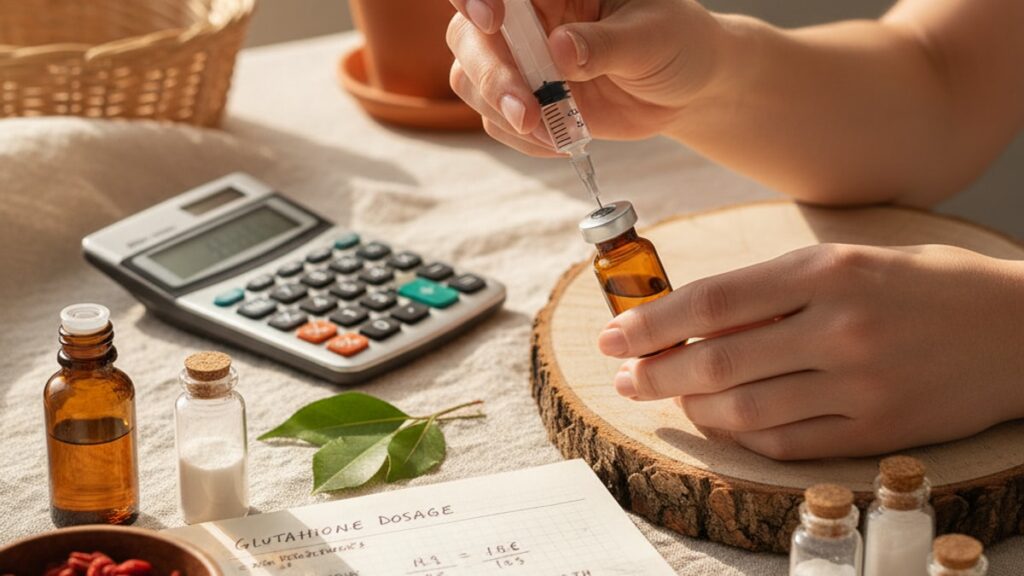
Calculate Glutathione Dosage Reconstitution Math — Real Peptides
The biggest mistake researchers make with lyophilised glutathione isn't contamination during reconstitution. It's calculating the wrong injection volume and either wasting the vial in two draws or delivering a sub-threshold dose that produces no measurable effect. A 200mg vial reconstituted with 2mL bacteriostatic water creates a 100mg/mL solution, but add 5mL instead and that same vial now delivers 40mg/mL. Meaning your planned 100mg dose requires 2.5mL of injection volume, which exceeds the safe subcutaneous injection limit and forces you to split the dose or remix the entire vial.
How do you calculate glutathione dosage reconstitution math accurately?
To calculate glutathione dosage reconstitution math, use the formula: (total mg in vial ÷ mL of bacteriostatic water added) = concentration in mg/mL. Then divide your desired dose in mg by that concentration to determine injection volume in mL. For example, a 200mg vial mixed with 2mL bacteriostatic water yields 100mg/mL. So a 100mg dose requires 1mL injection volume, while a 50mg dose requires 0.5mL.
Most guides explain reconstitution as a sterile technique. Which it is. But miss the second-order problem entirely. Reconstitution doesn't fail when you puncture the stopper incorrectly. It fails when you calculate 0.8mL for a 200mg dose in a vial that actually contains 100mg/mL concentration, delivering 80mg instead. Or when you assume all glutathione vials are dosed identically and apply the wrong calculation to a 500mg vial using a 200mg formula. This article covers the universal reconstitution formula, how concentration affects injection volume, what dosing protocols research commonly uses, and the calculation errors that compromise experimental outcomes before the first injection.
Understanding Glutathione Vial Concentrations and Reconstitution Variables
Glutathione arrives as lyophilised powder in vials typically ranging from 200mg to 1,000mg per vial, with 200mg and 600mg being the most common research-grade formats. The powder itself has no concentration until you add bacteriostatic water. At that point, concentration is determined entirely by how much water you add, not by the amount of glutathione in the vial. A 200mg vial reconstituted with 1mL bacteriostatic water creates a 200mg/mL solution, but that same vial reconstituted with 4mL creates a 50mg/mL solution. Four times weaker. The formula remains constant across all peptides and dosages: total milligrams in vial ÷ millilitres of bacteriostatic water added = concentration in mg/mL. This is the only calculation that matters for determining injection volume.
Bacteriostatic water volume is the variable you control. Standard reconstitution uses 1–5mL depending on vial size and planned dosing frequency. Smaller water volumes create higher concentrations, which reduce injection volume but increase the risk of injection site irritation due to osmolarity. Larger water volumes create lower concentrations, requiring larger injection volumes but improving subcutaneous tolerance. The safe maximum for subcutaneous injection is approximately 1.5mL per site. Exceeding this causes discomfort, delays absorption, and increases the likelihood of solution leakage from the injection site. For a 600mg vial intended for 200mg doses, reconstituting with 3mL bacteriostatic water yields 200mg/mL concentration, requiring exactly 1mL per injection. Well within the safe range. Reconstituting that same vial with 2mL creates 300mg/mL, reducing injection volume to 0.67mL but increasing solution density beyond what some researchers tolerate comfortably.
Vial labelling inconsistency is a common source of calculation error. Some suppliers label vials by total peptide content ('200mg Glutathione'), while others label by concentration post-reconstitution ('100mg/mL when reconstituted with 2mL'). Real Peptides labels every vial by total peptide content in milligrams, with reconstitution instructions provided separately. This removes ambiguity and ensures researchers calculate from the known peptide mass rather than assuming a pre-determined concentration. If your vial label states '600mg Glutathione' with no further instruction, you control the final concentration entirely through your bacteriostatic water volume. Add 3mL for 200mg/mL. Add 6mL for 100mg/mL. The peptide content remains 600mg regardless. Only the concentration per millilitre changes. Failing to distinguish between total vial content and post-reconstitution concentration is the most frequent miscalculation in peptide research, and it leads to either massive overdosing or ineffective sub-threshold administration.
The Universal Glutathione Reconstitution Formula and Step-by-Step Calculation
Every glutathione reconstitution calculation follows the same two-step sequence, regardless of vial size or target dose. Step one: divide total vial mg by the mL of bacteriostatic water you plan to add. This gives you concentration in mg/mL. Step two: divide your desired dose in mg by that concentration. This gives you the injection volume in mL required to deliver that dose. The formula is: (vial mg ÷ bacteriostatic water mL) = concentration, then (desired dose mg ÷ concentration) = injection volume mL. Write this formula on every vial label after reconstitution to prevent miscalculation during subsequent draws.
Example one: you have a 200mg glutathione vial and plan to use 100mg doses. You add 2mL bacteriostatic water. Step one: 200mg ÷ 2mL = 100mg/mL concentration. Step two: 100mg dose ÷ 100mg/mL = 1mL injection volume. Each 100mg dose requires drawing 1mL from the vial. The vial contains 2mL total, so you will achieve two full 100mg doses from this vial. If you wanted 50mg doses instead, step two changes: 50mg ÷ 100mg/mL = 0.5mL per injection, yielding four total doses from the 2mL vial.
Example two: you have a 600mg glutathione vial and want 200mg doses. You add 3mL bacteriostatic water. Step one: 600mg ÷ 3mL = 200mg/mL. Step two: 200mg ÷ 200mg/mL = 1mL per dose. You achieve three full 200mg doses. If instead you added 6mL bacteriostatic water to that same 600mg vial, step one changes: 600mg ÷ 6mL = 100mg/mL. Now step two for a 200mg dose: 200mg ÷ 100mg/mL = 2mL per injection. Which exceeds the recommended single-site subcutaneous volume and forces either split-site injection or dose reduction. The peptide content hasn't changed, but your reconstitution decision has made the planned protocol impractical.
Example three: you have a 1,000mg vial and want 500mg doses for high-intensity research applications. Adding 2mL bacteriostatic water yields 500mg/mL concentration. So 500mg ÷ 500mg/mL = 1mL per dose. You achieve two doses. Adding 5mL bacteriostatic water instead yields 200mg/mL. So 500mg ÷ 200mg/mL = 2.5mL per dose, which is too large for single-site injection. For high-dose protocols, reconstitute with minimal bacteriostatic water to keep injection volumes practical. Every additional millilitre of bacteriostatic water dilutes the solution further and increases the volume required to achieve the same dose. There is no pharmacological advantage to higher dilution unless injection site tolerance becomes a limiting factor.
Rounding and syringe precision matter. Insulin syringes are marked in 0.01mL increments (often labelled as 'units' where 1 unit = 0.01mL on a U-100 syringe). If your calculation yields 0.67mL, you can measure this accurately. If your calculation yields 0.447mL, you must round to 0.45mL. Accept the minor under-dose rather than attempting to measure beyond your syringe's precision. Cumulative rounding errors across multiple injections are negligible compared to the calculation errors that result from using the wrong formula entirely.
Glutathione Dosage Reconstitution Math: Dosing Comparison
Different research protocols require different glutathione doses, and reconstitution math must align with your planned dosing frequency and injection volume constraints. The table below compares three common vial sizes reconstituted at different bacteriostatic water volumes, showing the resulting concentration, dose per mL, and total number of doses achievable.
| Vial Size (mg) | Bacteriostatic Water (mL) | Concentration (mg/mL) | 100mg Dose Volume | 200mg Dose Volume | Total 100mg Doses | Total 200mg Doses |
|---|---|---|---|---|---|---|
| 200mg | 2mL | 100mg/mL | 1mL | 2mL (too large) | 2 doses | Not practical |
| 200mg | 4mL | 50mg/mL | 2mL (too large) | Not practical | Not practical | Not practical |
| 600mg | 3mL | 200mg/mL | 0.5mL | 1mL | 6 doses | 3 doses |
| 600mg | 6mL | 100mg/mL | 1mL | 2mL (too large) | 6 doses | Not practical |
| 1,000mg | 5mL | 200mg/mL | 0.5mL | 1mL | 10 doses | 5 doses |
| 1,000mg | 10mL | 100mg/mL | 1mL | 2mL (too large) | 10 doses | Not practical |
The most versatile reconstitution strategy for glutathione is to target a final concentration of 100–200mg/mL, which allows 100mg doses in 0.5–1mL injection volumes and 200mg doses in 1–2mL (though 2mL approaches the tolerance threshold). Researchers using 50mg maintenance doses benefit from higher dilution, while those using 500mg or greater per injection must reconstitute with minimal bacteriostatic water to avoid impractical injection volumes. Real Peptides' Glutathione product line includes detailed reconstitution tables with each vial to eliminate guesswork. But the formula itself never changes, and once you've calculated it correctly for one vial, you can replicate it for any peptide at any dose.
Key Takeaways
- The universal reconstitution formula is (vial mg ÷ bacteriostatic water mL) = concentration, then (desired dose mg ÷ concentration) = injection volume in mL. This applies to every peptide and vial size.
- A 200mg glutathione vial reconstituted with 2mL bacteriostatic water yields 100mg/mL concentration, requiring 1mL injection volume per 100mg dose.
- Reconstituting with more bacteriostatic water lowers concentration and increases injection volume. Exceeding 1.5mL per subcutaneous injection site causes discomfort and absorption delays.
- Vial labels showing total peptide content (e.g., '600mg') require you to calculate final concentration based on the bacteriostatic water volume you choose. There is no predetermined concentration until you add the water.
- Insulin syringes measure in 0.01mL increments. Round calculated injection volumes to the nearest 0.05mL rather than attempting precision beyond your syringe's measurement capability.
- Cumulative calculation errors across multi-dose vials result in either running out of peptide early (under-dosing per injection) or finishing with excess solution (over-dosing per injection). Both indicate miscalculation at the reconstitution stage.
What If: Glutathione Reconstitution Scenarios
What If I Accidentally Added Too Much Bacteriostatic Water to the Vial?
Recalculate your concentration using the actual volume added and adjust your injection volume accordingly. The peptide is not ruined, only diluted. If you intended to add 2mL to a 200mg vial but added 4mL instead, your concentration is now 50mg/mL rather than 100mg/mL. To achieve a 100mg dose, draw 2mL instead of 1mL. The limitation is injection volume: if your target dose now requires more than 1.5mL per injection, you must either split the dose across two injection sites, reduce the dose, or discard the vial and reconstitute a new one correctly. There is no method to remove bacteriostatic water once added. Dilution is irreversible. Label the vial with the correct recalculated concentration to prevent confusion on subsequent draws.
What If My Syringe Doesn't Have Clear mL Markings?
Use an insulin syringe marked in units, where 100 units = 1mL on a U-100 syringe. This is the standard in research and clinical settings. If your calculation requires 0.5mL, draw to the 50-unit mark. If it requires 0.25mL, draw to 25 units. If you are using a syringe marked only in cc (cubic centimetres), 1cc = 1mL. The terms are interchangeable. Avoid tuberculin syringes or non-insulin syringes for peptide work unless you are experienced in volume conversion, as inconsistent marking systems introduce calculation errors. Real Peptides recommends using 0.3mL to 1mL insulin syringes with 29–31 gauge needles for all subcutaneous peptide injections. These provide the precision required for accurate dosing and minimize injection site trauma.
What If I Want to Change My Dose Mid-Protocol Without Wasting the Remaining Solution?
Recalculate injection volume using the same concentration formula. The concentration in the vial does not change once reconstituted, only the volume you draw per injection changes. If you reconstituted a 600mg vial with 3mL bacteriostatic water (yielding 200mg/mL) and have been using 1mL per injection for 200mg doses, but now want to reduce to 100mg doses, simply draw 0.5mL per injection instead. The remaining solution stays at 200mg/mL concentration. Your vial will now last twice as long. Conversely, if you want to increase from 100mg to 150mg, draw 0.75mL per injection. The only constraint is total vial content: a 600mg vial can deliver six 100mg doses, four 150mg doses, or three 200mg doses. But not a combination that exceeds 600mg total.
What If I'm Using Glutathione in Combination with Other Peptides?
Calculate reconstitution and dosing for each peptide independently. Never mix different peptides in the same vial unless you are following a pre-formulated stack with validated stability data. Glutathione reconstituted in one vial at 100mg/mL and BPC-157 reconstituted in another vial at 250mcg/mL require separate calculations and separate injections, even if administered at the same time. If you are running a combination protocol, calculate total injection volume across all peptides to ensure you stay within the 1.5mL per site threshold. For example, 0.5mL glutathione + 0.4mL BPC-157 + 0.3mL Thymosin Alpha-1 = 1.2mL total, which is acceptable for a single subcutaneous site. Exceeding this requires splitting across multiple sites or adjusting reconstitution volumes to create higher concentrations and smaller per-peptide injection volumes.
The Practical Truth About Glutathione Dosage Reconstitution Math
Here's the honest answer: reconstitution math is not complicated, but it is unforgiving. There is no margin for approximation. 'about 2mL' or 'roughly 100mg' will result in inconsistent dosing, wasted vials, and unreliable research outcomes. The formula is simple and universal, but it must be applied with precision every single time. Researchers who struggle with reconstitution math are not struggling with the math itself. They are struggling with ambiguous vial labelling, inconsistent bacteriostatic water volumes, or failure to write down the calculated concentration immediately after reconstitution. The solution is procedural: label every vial with total mg, bacteriostatic water volume added, final concentration in mg/mL, and reconstitution date. Use the same bacteriostatic water volume for every vial of the same size to eliminate variability. Measure bacteriostatic water with the same precision you use for the final injection. Drawing 2.3mL when you intended 2mL changes your concentration by 15%.
The second truth: glutathione's short half-life and dose-dependent antioxidant response mean that under-dosing produces measurably weaker outcomes than accurate dosing, and over-dosing wastes expensive peptide without additional benefit. Glutathione administered at 100mg produces different glutathione peroxidase activity and reduced glutathione (GSH) to oxidised glutathione (GSSG) ratios than 200mg or 500mg. The dose matters, and the only way to control dose is to calculate injection volume correctly. Research published in peer-reviewed oxidative stress studies consistently uses precise dosing protocols, often citing exact mg/kg body weight with reconstitution details in the methods section. Replicating those results requires replicating that precision. Approximation is not a viable research methodology.
Calculation errors are the most common and most preventable failure point in peptide research. Every milligram of glutathione in a vial represents known, quantifiable peptide content synthesised under controlled conditions. The moment you add bacteriostatic water, you create a concentration. And from that point forward, your results depend entirely on whether you calculated that concentration correctly and drew the corresponding volume accurately. Real Peptides provides high-purity, research-grade peptide compounds with exact amino-acid sequencing and verified peptide content per vial, but no manufacturing precision can compensate for reconstitution math errors made at the bench. The formula is the same for every peptide, every vial size, and every dose: milligrams divided by millilitres equals concentration, then dose divided by concentration equals volume. Write it down, verify it twice, and label the vial immediately.
If you've reconstituted incorrectly once, you'll recognize the pattern: the vial runs out faster than expected, or slower, or the effect intensity doesn't match prior cycles. Those are calculation errors, not peptide quality issues. And the solution is returning to the formula and recalculating with the actual volumes used rather than the volumes you thought you used.
Frequently Asked Questions
How do I calculate the concentration of reconstituted glutathione?
▼
Divide the total milligrams of glutathione in the vial by the millilitres of bacteriostatic water you add. For example, 200mg glutathione ÷ 2mL bacteriostatic water = 100mg/mL concentration. This concentration remains constant for the life of that vial once reconstituted. Write the concentration on the vial label immediately after reconstitution to prevent miscalculation during subsequent draws.
Can I reconstitute glutathione with regular sterile water instead of bacteriostatic water?
▼
Yes, but the reconstituted solution must be used immediately or within 24 hours and stored under refrigeration at 2–8°C. Bacteriostatic water contains 0.9% benzyl alcohol, which inhibits bacterial growth and allows multi-dose vials to remain stable for up to 28 days after reconstitution. Sterile water without preservative supports bacterial growth once the vial is punctured, making it unsuitable for protocols requiring multiple injections from the same vial over days or weeks.
What is the typical glutathione dose range used in research protocols?
▼
Research protocols commonly use 50mg to 600mg per injection depending on the study design, with 100–200mg being the most frequent maintenance range for antioxidant and cellular stress research. High-intensity oxidative stress models may use 500–1,000mg doses, while longevity and general cellular health models often use 50–100mg two to three times weekly. Dose selection depends on the research question, target tissue, and intended biomarker outcomes — glutathione dosing is not standardised across all research applications.
How long does reconstituted glutathione remain stable after mixing with bacteriostatic water?
▼
Reconstituted glutathione stored at 2–8°C in bacteriostatic water remains stable for up to 28 days, though some degradation of reduced glutathione (GSH) to oxidised glutathione (GSSG) occurs over time, particularly after 14 days. For maximum potency, use reconstituted glutathione within 14 days of mixing. Avoid freeze-thaw cycles — once reconstituted, do not refreeze the solution, as ice crystal formation denatures the peptide structure and reduces bioavailability.
What happens if I inject a higher concentration of glutathione than intended?
▼
Injecting a higher concentration than calculated delivers a larger dose than intended, which may cause temporary injection site irritation due to increased osmolarity but is generally well-tolerated in research models. Glutathione has a wide therapeutic index with low acute toxicity — the primary concern with over-dosing is wasting expensive peptide and potentially exceeding the dose range relevant to your research protocol. Recalculate your concentration immediately and adjust subsequent injection volumes to correct the error.
How does glutathione reconstitution math differ from other peptides like BPC-157 or Thymosin Alpha-1?
▼
The reconstitution formula is identical across all peptides: total mg in vial ÷ mL bacteriostatic water = concentration in mg/mL. The difference lies in vial sizes and typical dose ranges — glutathione vials commonly range from 200mg to 1,000mg with doses of 100–500mg, while BPC-157 is typically 5mg per vial with doses of 250–500mcg (0.25–0.5mg). The math does not change, but the scale does — always confirm whether your dose is listed in milligrams (mg) or micrograms (mcg), as 1mg = 1,000mcg and confusing the two results in a 1,000-fold dosing error.
Is it better to reconstitute glutathione with more or less bacteriostatic water?
▼
Reconstitute with the minimum bacteriostatic water volume that keeps your injection volume at or below 1mL per dose for subcutaneous administration — this balances concentration with injection site tolerance. Higher concentrations (achieved with less water) reduce injection volume but may cause mild irritation. Lower concentrations (achieved with more water) improve tolerability but require larger injection volumes, which delay absorption and increase leakage risk. For most protocols, 100–200mg/mL is the optimal concentration range.
Can I mix two vials of glutathione together to simplify dosing?
▼
No — each vial should be reconstituted individually to maintain sterility and accurate concentration tracking. Combining two vials into one container increases contamination risk, makes it impossible to verify peptide content per mL, and complicates dose tracking across the research timeline. If you need larger total volumes, reconstitute multiple vials with the same bacteriostatic water volume to ensure consistent concentration, then draw from each vial separately as needed.
What is the most common calculation mistake when reconstituting glutathione?
▼
The most common mistake is confusing total vial content in milligrams with concentration in mg/mL and using the wrong number in the dose calculation. A 200mg vial is not the same as a 200mg/mL concentration — concentration depends entirely on how much bacteriostatic water you add. Always calculate concentration first (mg ÷ mL), write it on the vial label, then use that number to calculate injection volume for each dose. Skipping the concentration step and drawing based on total vial content guarantees incorrect dosing.
How do I verify that my glutathione reconstitution calculation is correct before injecting?
▼
Perform a reverse calculation: multiply your planned injection volume in mL by your calculated concentration in mg/mL — the result should equal your target dose in mg. For example, if you plan to inject 0.5mL from a vial you calculated as 200mg/mL concentration, the reverse check is 0.5mL × 200mg/mL = 100mg, which confirms your target dose. If the reverse calculation does not match your intended dose, recalculate both concentration and injection volume before proceeding.
