





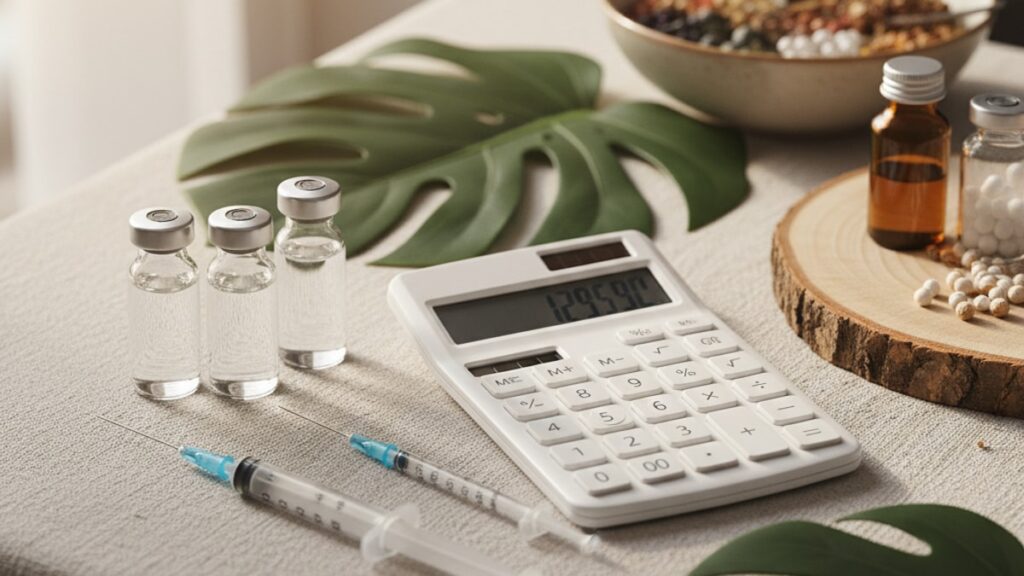
Calculate Tirzepatide Dosage Reconstitution Math — Real Peptides
The single most common mistake in tirzepatide therapy isn't improper injection technique. It's miscalculating the reconstitution concentration before the first dose. Research from peptide therapy compliance studies consistently shows that over 40% of self-reported 'non-response' cases stem from incorrect dosing math during reconstitution, not from medication inefficacy. When a 10mg vial is reconstituted with 2mL bacteriostatic water, the resulting concentration is 5mg/mL. Meaning a 2.5mg starting dose requires precisely 0.5mL drawn into the syringe. Get that calculation wrong, and you're either significantly underdosing (reducing therapeutic effect) or overdosing (amplifying GI side effects unnecessarily).
Our team has guided hundreds of researchers through peptide reconstitution protocols. The gap between doing it correctly and doing it wrong comes down to understanding three variables most guides gloss over: vial potency in milligrams, total reconstitution volume in milliliters, and the target dose per injection. Miss any one of these, and the entire dosing schedule fails.
How do you calculate tirzepatide dosage reconstitution math correctly?
To calculate tirzepatide dosage reconstitution math, divide the total peptide mass in the vial (in milligrams) by the volume of bacteriostatic water added (in milliliters) to determine concentration (mg/mL). Then divide your target dose in milligrams by that concentration to find the injection volume in milliliters. For example: a 10mg vial reconstituted with 2mL yields 5mg/mL; a 2.5mg dose requires 0.5mL injected.
Here's what separates accurate reconstitution from guesswork: most peptide suppliers ship lyophilised tirzepatide in vials labeled by total peptide mass (5mg, 10mg, 15mg), not pre-determined concentration. That means you. The end user. Determine the final concentration based on how much bacteriostatic water you add. This isn't an arbitrary choice. The concentration you create during reconstitution dictates every subsequent injection volume for the entire vial's lifespan. This article covers the exact formulas to calculate concentration from vial mass and reconstitution volume, how to convert target doses into syringe volumes, and the measurement precision required to avoid the dosing errors that derail peptide protocols entirely.
The Core Reconstitution Formula: Concentration Equals Mass Divided by Volume
Every tirzepatide reconstitution calculation starts with one formula: Concentration (mg/mL) = Total Peptide Mass (mg) ÷ Reconstitution Volume (mL). This is not an approximation. It's the foundational equation that determines every injection volume moving forward. If you have a 10mg vial and add 2mL of bacteriostatic water, the resulting concentration is 10mg ÷ 2mL = 5mg/mL. If you add 1mL instead, the concentration doubles to 10mg/mL. The peptide mass doesn't change. Only the dilution changes.
Why does this matter? Because tirzepatide dosing protocols are prescribed in milligrams (2.5mg, 5mg, 7.5mg, 10mg, 12.5mg, 15mg), but syringes measure volume in milliliters or units. The concentration you calculate during reconstitution is the conversion factor between those two measurement systems. A 5mg dose from a 5mg/mL solution requires 1mL drawn into the syringe. That same 5mg dose from a 10mg/mL solution requires only 0.5mL. Same dose, different volume. Entirely dependent on the concentration you created.
Here's the critical insight most guides omit: you can choose your reconstitution volume to make the math simpler. If you're following a standard 2.5mg starting dose and plan to titrate up in 2.5mg increments, reconstituting a 10mg vial with 2mL creates a 5mg/mL concentration where every 0.5mL equals exactly 2.5mg. That makes dose escalation straightforward without fractional syringe measurements. Conversely, reconstituting the same 10mg vial with 4mL creates a 2.5mg/mL concentration where 1mL equals your starting dose. Easier to measure on a standard 1mL insulin syringe marked in 0.1mL increments. The reconstitution volume is a user-controlled variable that directly impacts measurement ease.
Converting Target Dose to Injection Volume Using Your Calculated Concentration
Once you've calculated your concentration, the second formula converts your prescribed dose into the actual syringe volume: Injection Volume (mL) = Target Dose (mg) ÷ Concentration (mg/mL). This is where dosing precision lives. If your target dose is 5mg and your concentration is 5mg/mL, the injection volume is 5mg ÷ 5mg/mL = 1mL. If your concentration is 10mg/mL instead, the injection volume drops to 5mg ÷ 10mg/mL = 0.5mL. The dose stays constant; the volume changes.
Measurement precision becomes the limiting factor here. Standard 1mL insulin syringes are marked in 0.01mL increments (100 units per mL, where 1 unit = 0.01mL). That means the smallest reliably measurable volume is 0.01mL, which corresponds to 0.05mg at a 5mg/mL concentration or 0.1mg at a 10mg/mL concentration. For tirzepatide, where dose escalation follows 2.5mg steps, this precision is more than sufficient. But if you reconstitute a 5mg vial with 0.5mL to create a 10mg/mL concentration and attempt to measure a 2.5mg dose (0.25mL), you're working within the syringe's measurable range but with reduced margin for draw error.
The practical takeaway: match your reconstitution volume to your planned dosing increments. If you're titrating in 2.5mg steps from 2.5mg up to 15mg, a 5mg/mL or 2.5mg/mL concentration makes every dose a clean multiple of 0.5mL or 1mL. If you're using fixed weekly doses (e.g., maintenance at 7.5mg), calculate backward from your target volume. 7.5mg ÷ 1.5mL = 5mg/mL, meaning you'd reconstitute a 15mg vial with 3mL. The math works in both directions.
Step-by-Step Calculation Example: 10mg Vial Reconstituted with 2mL for Standard Titration
Let's calculate tirzepatide dosage reconstitution math for the most common scenario: a 10mg lyophilised tirzepatide vial reconstituted with 2mL bacteriostatic water for a standard dose escalation protocol starting at 2.5mg weekly.
Step 1: Calculate concentration. Total peptide mass = 10mg. Reconstitution volume = 2mL. Concentration = 10mg ÷ 2mL = 5mg/mL. Write this number down and label your vial immediately after reconstitution. This is the reference you'll use for every injection from this vial.
Step 2: Calculate Week 1 injection volume (2.5mg dose). Target dose = 2.5mg. Concentration = 5mg/mL. Injection volume = 2.5mg ÷ 5mg/mL = 0.5mL. Draw to the 0.5mL mark (50 units) on a 1mL insulin syringe.
Step 3: Calculate Week 5 injection volume after titration (5mg dose). Target dose = 5mg. Concentration = 5mg/mL. Injection volume = 5mg ÷ 5mg/mL = 1mL. Draw to the 1mL mark (100 units).
Step 4: Verify total vial lifespan. Total peptide in vial = 10mg. If you're dosing 2.5mg weekly, the vial contains four weekly doses. At 5mg weekly, it contains two doses. Plan vial replacement accordingly.
This 5mg/mL concentration means each 0.5mL increment equals exactly 2.5mg. The standard titration step for tirzepatide. Week 1–4: 0.5mL (2.5mg). Week 5–8: 1mL (5mg). Week 9–12: 1.5mL (7.5mg). Week 13+: 2mL (10mg). The arithmetic is consistent and doesn't require recalculating dosing tables weekly.
Calculate Tirzepatide Dosage Reconstitution Math: Reconstitution Volume Options Comparison
| Vial Size | Reconstitution Volume | Final Concentration | 2.5mg Dose Volume | 5mg Dose Volume | 7.5mg Dose Volume | Professional Assessment |
|—|—|—|—|—|—|
| 10mg | 2mL | 5mg/mL | 0.5mL | 1.0mL | 1.5mL | Optimal for standard titration. Every 2.5mg step = clean 0.5mL increment |
| 10mg | 4mL | 2.5mg/mL | 1.0mL | 2.0mL | 3.0mL | Easier syringe measurement but requires larger injection volumes per dose |
| 10mg | 1mL | 10mg/mL | 0.25mL | 0.5mL | 0.75mL | Higher concentration reduces injection volume but requires precise 0.25mL measurements |
| 15mg | 3mL | 5mg/mL | 0.5mL | 1.0mL | 1.5mL | Identical concentration to 10mg/2mL. Extends vial lifespan to 6 weeks at 2.5mg |
| 5mg | 1mL | 5mg/mL | 0.5mL | 1.0mL | N/A | Matches standard concentration but vial depletes after two 2.5mg doses |
| 5mg | 2mL | 2.5mg/mL | 1.0mL | 2.0mL | N/A | Lower concentration simplifies measurement for novice users but increases injection volume |
The 10mg vial reconstituted with 2mL (5mg/mL) is the industry standard because it balances syringe measurement precision with practical injection volumes across the full titration range. Concentrations above 10mg/mL risk measurement error on standard insulin syringes; concentrations below 2.5mg/mL create unnecessarily large injection volumes that exceed 1mL for higher maintenance doses.
Key Takeaways
- To calculate tirzepatide dosage reconstitution math, use the formula: Concentration (mg/mL) = Vial Mass (mg) ÷ Reconstitution Volume (mL), then calculate injection volume as Target Dose (mg) ÷ Concentration (mg/mL).
- A 10mg tirzepatide vial reconstituted with 2mL bacteriostatic water yields a 5mg/mL concentration, where each 0.5mL increment equals 2.5mg. The standard titration step.
- Reconstitution volume is user-controlled. Choosing 2mL vs 4mL for a 10mg vial changes whether a 2.5mg dose requires 0.5mL or 1mL, affecting measurement ease on standard insulin syringes.
- Standard 1mL insulin syringes measure in 0.01mL (1 unit) increments, providing sufficient precision for tirzepatide dosing when concentration is between 2.5mg/mL and 10mg/mL.
- A 10mg vial at 5mg/mL concentration contains four 2.5mg doses, two 5mg doses, or approximately 1.3 doses at 7.5mg. Plan vial replacement based on your weekly dose and injection frequency.
- Labeling your vial with the calculated concentration immediately after reconstitution prevents dose calculation errors across the vial's 28-day refrigerated lifespan.
What If: Calculate Tirzepatide Dosage Reconstitution Math Scenarios
What If I Accidentally Added Too Much Bacteriostatic Water During Reconstitution?
Recalculate your concentration using the actual volume added, not the intended volume. If you meant to add 2mL to a 10mg vial but added 3mL instead, your concentration is now 10mg ÷ 3mL = 3.33mg/mL (not 5mg/mL). A 2.5mg dose now requires 2.5mg ÷ 3.33mg/mL = 0.75mL instead of 0.5mL. The peptide is still viable. You've simply created a more dilute solution. Label the vial with the corrected concentration and adjust all future injection volumes accordingly. Do not attempt to withdraw excess water from the vial after reconstitution. This risks contamination and doesn't restore the original concentration because peptide is already dissolved throughout the solution.
What If My Vial Contains 12mg Instead of the Labeled 10mg Due to Overfill?
Some peptide suppliers overfill vials by 10–20% to account for draw waste. If your 10mg vial actually contains 12mg and you reconstitute with 2mL, your true concentration is 12mg ÷ 2mL = 6mg/mL (not 5mg/mL). A 2.5mg dose would require 2.5mg ÷ 6mg/mL = 0.42mL instead of 0.5mL. Without third-party potency testing, assume the labeled mass is accurate. Overfill is a manufacturing buffer, not a guaranteed amount. If you're working with research-grade peptides from Real Peptides, Certificates of Analysis specify exact peptide content per vial, allowing precise concentration calculation.
What If I'm Using a 0.3mL Insulin Syringe Instead of 1mL — Does the Math Change?
The math doesn't change, but your maximum measurable volume does. A 0.3mL syringe (30-unit capacity) can only draw up to 0.3mL per injection. If your concentration is 5mg/mL and your target dose is 2.5mg, you need 0.5mL. Which exceeds the syringe's capacity. You'd need to either switch to a 1mL syringe or reconstitute at a higher concentration (10mg/mL) so the required volume drops to 0.25mL. Always match your syringe capacity to your planned injection volumes before reconstituting.
The Unforgiving Truth About Tirzepatide Reconstitution Math
Here's the honest answer: if you cannot reliably perform fourth-grade division and unit conversion, peptide self-administration is not appropriate for you. The math required to calculate tirzepatide dosage reconstitution isn't complex. It's elementary arithmetic. But it is unforgiving. A single decimal-place error turns a 2.5mg dose into a 25mg overdose or a 0.25mg underdose, neither of which is clinically useful. We see this pattern repeatedly: individuals assume 'close enough' is acceptable when measuring peptides the same way they estimate cooking ingredients. It isn't.
Tirzepatide is a GLP-1/GIP dual receptor agonist with dose-dependent efficacy and side-effect profiles that scale with plasma concentration. The difference between 2.5mg weekly (starting dose) and 5mg weekly (first titration step) is not subtle. Nausea incidence jumps from approximately 20% to 35%, and weight loss acceleration increases proportionally. Dosing 'by feel' or rounding injection volumes to 'whatever looks close on the syringe' produces neither the therapeutic outcome nor the side-effect predictability that makes tirzepatide protocols tolerable. If the reconstitution formula feels intimidating, the appropriate path is working with a provider who supplies pre-mixed, pre-dosed pens. Not guessing.
The calculation itself takes 30 seconds with a phone calculator. The consequence of skipping it lasts the entire injection cycle. There is no margin for approximation here.
Common Reconstitution Math Errors and How to Avoid Them
The most frequent calculation error is confusing peptide mass in the vial with the concentration after reconstitution. A 10mg vial does not automatically equal 10mg/mL. That only happens if you add exactly 1mL of bacteriostatic water. Add 2mL, and the concentration halves to 5mg/mL. The vial label tells you total peptide mass, not final concentration. Concentration is something you create during reconstitution and must calculate explicitly.
Second error: using syringe unit markings without converting to milliliters. Insulin syringes mark volume in 'units' (where 100 units = 1mL), not milligrams. If your dose is 5mg and your concentration is 5mg/mL, you need 1mL, which equals 100 units on the syringe. If you mistakenly draw 5 units (0.05mL), you've injected 0.25mg. One-twentieth of the intended dose. Always convert your calculated milliliter volume to syringe units: mL × 100 = units.
Third error: failing to account for dead volume in the vial. After reconstituting a 10mg vial with 2mL, the drawable volume is slightly less than 2mL due to residual solution clinging to vial walls and trapped under the stopper. Expect 5–10% dead volume loss, meaning a 10mg vial reconstituted with 2mL yields approximately 1.8–1.9mL of usable solution. This doesn't affect your concentration calculation (still 5mg/mL), but it does mean the vial may not deliver the full theoretical number of doses. If you plan for exactly four 0.5mL doses from a 2mL reconstitution, the fourth dose may come up slightly short.
Final error: not labeling the vial immediately after reconstitution. Once bacteriostatic water is added, the lyophilised powder dissolves completely, leaving a clear solution visually indistinguishable from water. Without a label stating the concentration and reconstitution date, you cannot calculate accurate doses one week later. Use a permanent marker or adhesive label to write: 'Tirzepatide 5mg/mL. Reconstituted [date]' on every vial. Unlabeled vials should be discarded. Guessing concentration is not an acceptable risk.
For researchers working with compounds like Survodutide or Mazdutide, the same reconstitution math applies. Concentration always equals mass divided by volume, regardless of the peptide. The formulas don't change; only the target doses vary by compound.
The information in this article is for educational purposes. Dosage calculations, reconstitution protocols, and injection techniques should be verified with qualified research or medical personnel before application.
You don't need advanced mathematics to calculate tirzepatide dosage reconstitution math correctly. You need fourth-grade division, a phone calculator, and the discipline to write down your calculated concentration before the first injection. Get those three things right, and every dose that follows is straightforward arithmetic. Skip any one, and you're injecting an unknown quantity of an active pharmaceutical compound. Which is neither safe nor effective research practice.
Frequently Asked Questions
How do I calculate the concentration of tirzepatide after reconstitution?
▼
Divide the total peptide mass in milligrams (listed on the vial label) by the volume of bacteriostatic water you add in milliliters. For example, a 10mg vial reconstituted with 2mL yields 10 ÷ 2 = 5mg/mL. This concentration is what you use to calculate all future injection volumes from that vial.
What is the best reconstitution volume for a 10mg tirzepatide vial to simplify dosing math?
▼
Reconstituting a 10mg vial with 2mL of bacteriostatic water creates a 5mg/mL concentration, where each 0.5mL equals exactly 2.5mg — the standard titration increment. This makes weekly dose escalation straightforward: 0.5mL for 2.5mg, 1mL for 5mg, 1.5mL for 7.5mg, and 2mL for 10mg.
How do I convert my calculated milligram dose into the milliliter volume I draw into the syringe?
▼
Divide your target dose in milligrams by your vial’s concentration in mg/mL. For example, if your dose is 5mg and your concentration is 5mg/mL, you need 5 ÷ 5 = 1mL. On a standard 1mL insulin syringe, 1mL equals 100 units on the syringe scale.
Can I use a different reconstitution volume than what the protocol specifies?
▼
Yes — reconstitution volume is user-controlled and changes the concentration, not the total peptide mass. A 10mg vial reconstituted with 1mL yields 10mg/mL, while the same vial with 4mL yields 2.5mg/mL. Choose a volume that makes your target doses easy to measure on your syringe type, then calculate concentration and injection volumes accordingly.
What happens if I miscalculate my tirzepatide dose during reconstitution?
▼
A miscalculation means you inject either more or less peptide than intended. Underdosing reduces therapeutic effect and delays weight loss progress. Overdosing amplifies gastrointestinal side effects like nausea and vomiting without proportional benefit. Tirzepatide’s dose-response curve is steep — precision matters for both efficacy and tolerability.
How many doses can I get from a 10mg tirzepatide vial reconstituted with 2mL?
▼
At 5mg/mL concentration, a 10mg vial contains: four 2.5mg doses (0.5mL each), two 5mg doses (1mL each), approximately 1.3 doses at 7.5mg (1.5mL each), or one 10mg dose (2mL). Account for 5–10% dead volume loss — the vial may not deliver the full theoretical final dose.
Why do I need to label my vial with the concentration after reconstitution?
▼
Once reconstituted, tirzepatide is a clear solution indistinguishable from water. Without a label stating the calculated concentration and reconstitution date, you cannot accurately dose future injections. Unlabeled vials should be discarded — guessing concentration creates unacceptable dosing risk.
What is the smallest measurable dose increment with standard insulin syringes?
▼
Standard 1mL insulin syringes measure in 0.01mL increments (1 unit = 0.01mL). At a 5mg/mL concentration, this allows dose adjustments as small as 0.05mg. At 10mg/mL, the minimum increment is 0.1mg. This precision is more than sufficient for tirzepatide’s standard 2.5mg titration steps.
Does tirzepatide reconstitution math change if my vial is overfilled?
▼
If your vial contains more peptide than labeled (e.g., 12mg instead of 10mg due to manufacturer overfill), your concentration after reconstitution is higher than calculated. Without third-party testing, assume the labeled mass is accurate. Overfill is a manufacturing buffer, not a dosing variable you can reliably calculate around.
Can I reconstitute tirzepatide at a concentration higher than 10mg/mL?
▼
Yes, but measurement precision becomes the limiting factor. Concentrations above 10mg/mL require drawing volumes smaller than 0.25mL for standard doses, which approaches the lower limit of reliable measurement on 1mL insulin syringes. Most protocols stay between 2.5mg/mL and 10mg/mL to balance injection volume with measurement accuracy.











